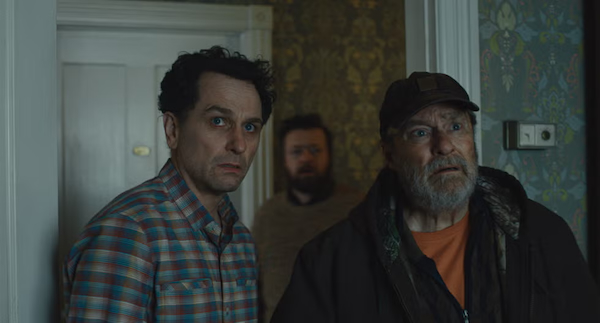
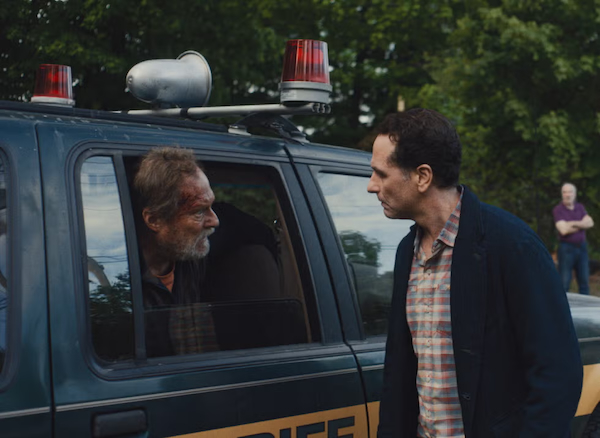
Sometimes you just can’t get a song out of your head. You hear it everywhere you go, like a haunt. For Stephen Root, it’s the sea-hag song from episode 3 of Widow’s Bay. The 74-year-old actor stars on the Apple TV horror-comedy series about a cursed New England town as the island’s crazed believer, a fisherman named Wyck. Opposite him is the sceptic town mayor (played by Matthew Rhys), who tries his best to ignore Wyck’s warnings until he comes face-to-face with one of the island’s wacky monsters: a sea hag. She’s one of Root’s favourites.
“The first scene Matthew and I did was that scene in episode 3, me telling him about the hag,” Root tells me. The gag was always that she kills you by crawling onto your bed and sitting on your face (“I laughed so hard when I read that,” the actor says), but the shanty song didn’t include Root’s raspy refrain until he gave it a try on set. “Every sailor knows the story of the hag,” he begins, then he takes a beat and whisper-sings, “Aawoo... Aawoo.”
Root’s performance captures everything about Widow’s Bay that makes the show such a delight, including his ability to turn every scary scene into a funny one, or vice versa. As we talk over coffee and tea at Gabriel’s Bar & Restaurant near Central Park in New York City, I swear I could hear one of the busboys “Aawoo” as he walked by.
Root is something of a Hollywood earworm himself. Just look at his lengthy résumé and you’ll realise that you’ve seen this character actor everywhere. His IMDb page lists more than 300 roles—most famous among them are his stapler-obsessed Office Space character, his voice-acting roles on King of the Hill, and his many cameos in Coen brothers films. But to list all the critically acclaimed projects he’s lent his talents to would take another 2,000 words. He’s built a reputation as your favourite character actor’s favourite character actor, and he takes pride in the fact that he’s recognised from so many different projects.
“A character actor is the muscle of a show,” Root tells me. “I’m not just playing myself. A character actor really builds the world that you’re playing in, and that makes me feel good whenever I get stopped on the street for different stuff. I’m not just that guy from that show.”
Root came very close to being “that guy from that show” in 2019, when he was nominated for his first Emmy for his role as Monroe Fuches on HBO’s Barry. Fuches was originally a much smaller role before Root turned Barry’s (Bill Hader) pseudo father figure into one of the most dynamic characters on the show. And although Root would have happily accepted the award had he won, I believe it when he says that it means more that he was simply given the chance to prove himself.
“Barry was a big breakthrough for me because I could do some meat—really heavy stuff,” he says. “It morphed from a comedy to a drama in later seasons, and I loved that. I got to show that I could do it for the first time since my West Wing days. Every once in a while, you want to remind people that, yeah, I don’t just do weird guys. I can really do something.”
Even so, it’s not as if Root’s weird guys don’t live in the pantheon of weird guys. He played a sinister blind art dealer in Get Out, an oblivious average joe who couldn’t tell that his wife was cheating on him in Dodgeball: A True Underdog Story, and a nearly unintelligible southern radio-station owner in O Brother, Where Art Thou? who keeps his eyes open so wide that it looks as if they might just fall out.
So when Barry director Hiro Murai told Root that a new Apple TV series he was executive-producing was in need of someone to play an old fisherman with knowledge of all the island’s cursed history, Root knew that Widow’s Bay was another chance to show what he’s capable of.
“I read the first script, and it just sealed it,” Root says. “It was Twin Peak–ish, like watching a night gallery from the ’70s. I didn’t know [showrunner] Katie Dippold, but the combo [on Widow’s Bay] was completely original. It was like, Oh, this will be fun to walk that line.”
Below, Root shares more about blending comedy and horror in Widow’s Bay, Matthew Rhys’s crazy antics on set, and why he’s still chasing a lead acting role.
ESQUIRE: What sold you on Widow’s Bay?
STEPHEN ROOT: I had a talk with Katie, and it was like with Bill and Barry. Bill directed the entire fourth season, and that’s what he’d been wanting to do. He came in, and everybody knew he was a brilliant comedian, but that’s not what he came into town to do. He came in to direct, and he got to do it and to show how good he was. His tone sets Barry up just like how Katie’s tone sets Widow’s Bay up. It’s the creators.
Plus, they told me that Matthew was in it, and it was already like 80 per cent I was doing it. I have to tell you how much I admire Matthew, because he had to keep the emotional tone of the show for the first three episodes pretty much by himself. I mean, we all reacted to him. But we were block shooting—meaning that we shot the series out of order based on location. So, at different points, he would need to go back and be the character from before again, and he worked really hard to do it.
I heard a story about Matthew, while you were both on Perry Mason together, that he would steal the Hollywood carts and drive around the set as fast as possible. Is that true?
He would fight off anybody who wanted to drive the cart and go, “No, no, no, I’m driving.” We’d get as many people as we could in there, maybe four or five and three in the backseats, and he’d say, “Here we go!” He’d go zipping as fast as he could down in between the studios, and if any tourist bus came by, he would stop it, go in front of it, and go, “Matthew Rhys, The Americans, remember? Matthew Rhys!” And we would die, he was so funny.
It’s insane that your acting résumé is long enough that this isn’t even the first time you’ve worked with Matthew. Are there any roles that you’re turning down, or does it just feel like you’re saying yes to everything?
I probably say yes too much. Last year, I was pretty wiped out. I’m glad I did all those shows. I’m lucky enough that I have enough of a name that I can get offers, mostly. But yeah, I need a little break. I’ve decided right now that I’m going to wait for a really juicy thing next.
What does it take to act in that many projects?
You have to be completely down-to-earth and be grateful for the work. When I came out of college and started to work, my goal was not anything, but to be a working actor. I came to New York, did National Shakespeare Company, and that level of work was what I considered to be my career path—not as a TV star or a movie guy or anything else. If you ask 99 per cent of actors, they’re just happy to work.
Was there a time in your career where you felt like you weren’t necessarily going out for the role but that they were explicitly coming to you and asking for a “Stephen Root type” character?
That happened more because I was playing offbeat characters. I’d done a few in my early TV and film days, like the principal in the Buffy movie, or the guy in Stephen King’s Golden Years that complained about eating week-old beef. That kind of guy. So once I established that as what I could do, that’s when I started seeing a “Stephen Root type” in a breakdown. The more offbeat things I did, the roles just kept coming.
What went into forming Wyck?
To me, shoes are really important for a character. That’s how he walks. Wyck walks in boots, but if they were sandals, that’s something else. And we knew this guy—old fisherman with the hat and the vest. I had a beard, but not heavy, and they said, “Please don’t shave for the next two months.” We let it grow from there. So, that’s also helpful. But sometimes you have to go outside-in to a character, and this was that. Clothes help the man.
Wyck has a great monologue in episode 7, when he explains how he accidentally killed his childhood friend after they were attacked by a sea monster. It felt like one of those meaty scenes that you said you loved so much about your time on Barry.
She wrote me a great monologue. I very much had my Jaws moment in that. It was a difficult shoot because we were doing a lot of wrestling and fighting on a boat in a studio that was 20 feet high, with people rocking it. So, I guess we were lucky that we weren’t on the water for the most part. But it was a hard shoot—it was almost like an action movie.
Are you a superstitious guy? Do you believe in curses?
Do I believe that there is something beyond the pale of life? Yeah, I think so. There are too many people having the same stories for there not to be anything. The older I get, the more I believe everything is kind of connected. It seemed like a very strange concept when I was younger that the rock over there and that tree are all connected to the world. So, I feel later in my life not to cuckoo anything and just to let it show you.
Is there anything left about Wyck’s character that you’d love to see explored in a potential second season?
If we have another season, we’ve gotten no clues from Katie as to where the through line is going to be, and that’s fine for now. I’m interested in seeing more about the island, because the island itself is a character. But the reason you watch a show is if you’re investing in the character, and I’m hoping that we’ve connected enough that they want to keep coming to see what happens to us.
I heard you say in an older interview that your goal was still to land a lead role in a film or TV show. Is that still the case?
Yeah, it would be really nice. I haven’t had the experience of being a number one on a call sheet. I’ve been two and I’ve been three and four, but number one is a heavy-duty thing. I haven’t found that yet, and maybe I won’t. For me, it depends on the writing and who would shepherd it.
Is it something that you want to prove to yourself, that you can do it, or something that you want to show everyone that you can do?
I’m kind of beyond showing people what I can do, but I know what you mean in terms of being able to be the lead in a thing. But at this point, if you don’t like what I do, I’d tell you you can turn it off. [Laughs.] And that’s okay.