
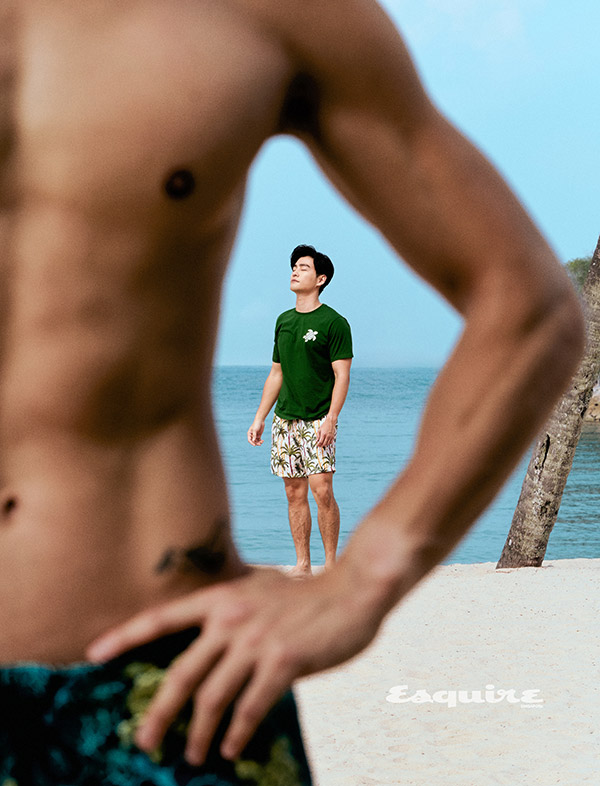
Ask two men who have just spent a day splashing around in Sentosa together how well they know each other, and you expect a certain amount of bluster. Instead, singer-songwriter, and former Singapore national swimmer Benjamin Kheng, 36, gives it to you straight. “Honestly? On a scale of one to 10, maybe two.”
He pauses, recalculating. “Maybe after today, after all that splashing around…”
It is a fair assessment. For years, Benjamin and Malaysian actor and singer Alvin Chong, 35, aka ALVN, orbited each other in the way people in their line of work tend to: at fashion activations in Bangkok, at brand events in Kuala Lumpur, on a group trip to Jeju where, as ALVN recalls, there were “cameras everywhere, in your face all the time.” They follow each other online. They have watched each other’s stories. ALVN once went to see Benjamin’s band play in KL. But a proper trip, just the two of them, without a production crew deciding when to laugh? “This,” Kheng says, “is our first trip together.”
So consider what follows a kind of accelerated friendship: two men from either side of the Causeway, both famous enough to be recognised in a mall, both at their fittest, both quietly admitting that the hardest work they are doing right now has nothing to do with their bodies at all.
In their business, Kheng concedes, it is hard not to think about aesthetics. That’s usually why people start working out. But this year brought challenges at work and at home, and he started running. A lot. What began as a thinly veiled metaphor for escaping the trivialities of life became something else.
“It went from ‘oh, it lowers my cholesterol’ to ‘I need this for my mental clarity,’” Kheng says. “It became very meditative.” (At the moment, Kheng has put a pause on running due to an injury. He longs to run again.)
The larger lesson, though, has been about speed, or rather the lack of it. “As a Singaporean, sorry, we don’t know how to slow down,” Kheng says. “We’re constantly competing, if not with other people, then with ourselves.” Wellness, as he now defines it, is the slow realisation that almost nothing on his calendar is brain surgery. “Unless it is,” he adds. “But nothing is an emergency.”

ALVN’s problem is the opposite of rushing. It is thinking. “It’s just work and home,” he says of his life. “And when there’s no problem, I’ll [conjure up] a scenario.” He is, by his own diagnosis, an overthinker, and for a long time it cost him his sleep. Training became an off-switch; it tires him out and empties his head.
Just don’t ask him to run a marathon. “So boring,” ALVN says, with the conviction of a man who has considered it and has long since moved on. Kheng tries to sugarcoat running in a marathon. ALVN declines.
Instead, for the past two years, ALVN trained for HYROX, the fitness race that involves running with stations of sled pushes, wall balls, and other forms of organised suffering. The appeal is the absence of decisions. “I don’t have to think. I just have to focus,” he says. “I don’t have to go to the gym and plan my workout.” He didn’t want to race at first; he does not like competing. Then a friend needed a partner, and he agreed to do it “just one time.” Now he is lining up for the KL edition again, this time as a friend of PUMA.
He has noticed the culture shift around him, too. “Malaysians are the laziest people ever,” he says, laughing. “We don’t walk. Our pavements aren’t made for walking. We want to drive right up to the porch.” And yet, in the last couple of years, the run clubs have arrived. “It’s a good sign.”
He also has a bigger idea brewing. In a few years, he would like to take his followers on trips with no phones and no signal, just days of actual company. As AI makes it ever easier to never leave the house, he suspects real-world presence will become a luxury item. “In the future,” he says, “people will appreciate this more.”
Ask what part of his well-being he is neglecting, and Kheng groans.
He credits his wife, Naomi Yeo, with an intuition about the body he is still learning about. Her feelings, he says, show up physically; she listens to them. Meanwhile, he is “a millennial Singaporean trying to constantly prove himself”; a man who believes he has earned his rest if he has ticked off X, Y and Z. What gets sacrificed is what he calls “watering my own little corner of the universe”: friends, personal connection, time alone. “You get so caught up in the rat race,” he says, “you don’t realise you’re squandering a lot of future time by chasing stuff right now.”
ALVN’s answer comes slower, and lands harder. “My relationship with my family,” he says.
His family is in Penang, but he hasn’t been home in three years. His mother visits him; he does not go back, partly because of work and partly because every homecoming leaves him feeling “very heavy on [his] shoulders.” He has three brothers. “Honestly, we don’t know much about each other’s lives,” he says. “I don’t know who their best friend is. I don’t know what they do. They don’t know about me.”
Last year he tried to fix it the way a successful son might: he took the whole family to Taipei, the first trip they had ever made together. It was a struggle. “Maybe because I’ve been away for too long, I don’t know how to communicate with them,” he says. When they returned home, nothing changed.
“But I still hope I have time to fix it while my parents are still alive,” he says, misty-eyed. “I’m trying. Sometimes it’s just too much.”
Around the table, nobody could offer a neat solution, because anyone raised in an Asian household knows there isn’t one. You can try to talk. You can raise your voice; ALVN has, and it changed nothing.
Kheng then reaches for the old proverb about leading a horse to water. It is, everyone agrees, a tricky relationship, and it gets trickier the older everyone gets.
Composing himself, ALVN continues: “During media interviews, it’s like, oh, how’s Chinese New Year? What’s your plan with the family?” His standard answer is that he’s working. The odd thing, he notes, is that his best friends’ parents adore him. “I just don’t know why I couldn’t fix [my own family].”
Maybe time will tell.

Kheng has been a band member, a solo artist, an actor and a host. When asked which of those selves feels most like home, he picks none of them. Instead, he opted for a free community choir he started with friends.
The format is simple. There is no agenda. Strangers turn up, learn their part, and by the evening’s end, the room sings together. “For so long, music has become my identity, and my calling card,” he says. “It was very self-serving. No matter how you slice it, there is a level of narcissism.” Choir broke that spell. “Today I’m not an artist. Today I’m simply a teacher, a sharer of the energy. It was completely transformative for me, and really healing.” Kheng wants to carry it into everything he does: less about him, more about the people in the room. “Yes, we need to build our own identity. That’s our rice bowl. But that project sent me back to the reason I started in the first place.”
ALVN’s own journey brings him towards music, and for a different reason. He wrote songs as a form of journaling. While modest about the output, his music carried him through breakups and family trouble as a kid. ALVN began to see songwriting as the one place the public might meet him rather than his public persona.
“As an actor and content creator, people don’t really know you for you,” he says. “They remember the role. But what does he like? What does he do when he’s sad?” ALVN wrote his first song in 2019 and sat on it for years before releasing it. He used to be signed; now he funds his own music, which means he no longer has to answer to anyone about whether a song will make money. Another single is planned for next year.
“We need more musicians who aren’t AI prompts,” Kheng says, delighted.
Kheng’s education in masculinity came from Singapore Sports School, which he describes as what happens when the top athletes from every school are sequestered into one building. It was a place full of ego, full of the alpha boys of their year. Kheng was the shortest kid in his cohort, and he also loved Disney, anime, storytelling and music. “I was the loser of the school,” he says. For years, he tried not to be that boy.
Strength, he says, is an admirable trait in a man. But so is being moved by things. What matters most to Kheng now is access: men being able to talk about how they feel. “I’ve seen too many of my guy friends not deal with depression, and instead do stupid things and hurt themselves, just because they don’t know how to ask for help,” he says. His own close circle is a band of geeks, academics and “weird people” who will text, without irony, dude, I love you, let’s hang. “There’s no agenda,” he says. “I’m very grateful I’ve made positive male friendships in my 30s.”

ALVN’s definition, however, is more practical. Some people online still insist a man must be the sole breadwinner. “But in this economy, how many families can do that?” Everyone has to pull their own weight. For ALVN, manhood boils down to one rule: walk the talk. If you promise it, deliver it.
Masculinity follows him to work, too. ALVN spent most of his career in Malay-language romance and melodrama, a genre he says hasn’t moved much in a decade. Action roles, in his experience, go to actors who are darker, rougher, more conventionally masculine. Army roles are out. His face, the table agrees, is too pretty for the jungle. Next year he plans to cut his hair short and try to change the casting conversation.
Then, last month, something different came along: eight days playing a young autistic man. ALVN prepared by watching videos from autism advocates and parents on TikTok, learning how widely the condition varies. On set, ALVN worked on shifting his eye line and adjusting small physical gestures. What stayed with him were the families. ALVN admits that he used to find a public tantrum annoying. “Now, after getting to know more about these families, I feel for them,” he says. “They are trying their very best.”
What were they taught about being a man that they have since unlearned?
Kheng answers with grief. He lost his mother at a young age, and later, friends. As a boy, he was told to stop crying and move on. “Obviously later in life I realised that’s nonsense,” he says. “Grief isn’t something you close a chapter on and throw away. It stays in you forever. And it isn’t the enemy you think it is.” He reaches for an image he loves: grief as glitter, the kind you keep finding in the corners long after the party. “You learn to grow around it, and carry it.”
ALVN agrees, with an amendment. Men are allowed to cry, he says. Although it depends on where and when. Tearing up in public is fine; breaking down is another matter. ALVN has found a place where he can be himself.
“I cry in the car,” ALVN says. After a rough day, he drives home, parks the car and waits. He’d switched off the engine, rolled the window down a little. Then he screams and cries. He takes his time. Sometimes it takes half an hour. Then, when he is spent, ALVN is ready to go upstairs.
He picked up this old habit as a kid in Penang. He was raised in a home where there was constant fighting. Things are thrown; there’s no one to talk to. At school, the other kids’ lives sounded like fiction. “They’d say, ' Oh, we have a family day. What the hell is ‘family day’?” His parents were rarely home. His brothers attended different school sessions, so ALVN’s meals were eaten alone. His grandmother raised him. After his grandparents died, the wider family stopped gathering. “Everyone has their own family now,” he says. “It’s kind of sad.”
He knows what he would do differently if he ever had children, but he is not sure he ever will. “The burden and the responsibility are so huge.”
The darker admission comes almost as an aside. Lately, he says, when a character on screen loses a parent, he feels nothing, whereas a kid he would have wept. Some nights he wonders whether he would be happy if his parents were gone tomorrow, and he honestly doesn’t know. “That makes me feel inhuman,” he says.
Everyone at the table pauses, a little shakily. “It got heavy real quick,” Kheng says.

Are men becoming more honest about their bodies, or just better at hiding the flaws?
“We’re getting better,” Kheng says. “I don’t think we’re completely there yet.” Social media keeps serving up an ideal, and Southeast Asian beauty standards can be strikingly monocultural. “As a 30-something man, I deal with hair problems all the time. It’s a huge insecurity.” Men rarely say it, he notes, but watch a guy’s hairline retreat and you can watch his confidence go with it. “Even if you don’t do anything about it, as long as you can talk about it, that’s a better start.”
ALVN is a step ahead on candour. He has done Botox and admits it readily to anyone who asks. His friends want to know his secret, and he hands over the name of his clinic. He has had two hair transplants. “I tell people, I’m a man, I lost my hair,” he says. “There’s nothing to hide.”
His one lingering insecurity is his fitness. “I don’t look fit anymore,” he says, glancing sideways. “Especially when I stand next to Benjamin.”
Strip away the mirror, though, and both men operate for reasons that have little to do with how they look. ALVN has the most quietly ambitious retirement plan you will ever hear. He wants to spend old age living a month at a time in different countries, Australia, Northern Ireland, wherever, and he wants to do it with a backpack on. “In order to do that, I need a healthy body. I need to be able to move my joints,” he says. “That’s what I’m working towards.”
For Kheng, it is a finer line. Having dealt with depression in the past, he once used exercise as an escape hatch. He came up as a competitive swimmer, which at that level means staring at the black line on the pool floor for hours on end. But now, running gives him the same meditative hum.
His run club is a group of 30-somethings in Singapore, working professionals, some married with kids, all figuring it out. Once a week they suffer together. “That physical release, when you’re with people, is so real,” he says. Afterwards they talk about their lives, and now they hang out outside of runs, too. “Exercise really brings people together. That’s the best part of it.”

Malaysia and Singapore share a very particular idea of success, and a very particular habit: the countries will ignore you until you make it abroad, then they will claim you back. Henry Golding’s name comes up. Both countries, it is noted with some amusement, consider him theirs. “We can share Henry,” Kheng offers.
Then he answers with a line he keeps returning to: “If you want butterflies, don’t chase them. Build a beautiful garden, and the butterflies will come. And if they don’t, you still have a beautiful garden.”
“All we can do in life, when you zoom out, is make beautiful our own corner of the universe,” Kheng continues. The alternative is a treadmill with no off button. “No matter how much success we get, we go, man, I’m not Henry Golding. I’m not Tom Holland. Comparisons never stop.” He has done this for more than a decade, and if he lets his mind wander, he still feels as insecure as he did on day one.
Kheng rewrote the scorecard: Can you sleep well at night? Do you have five people you can call at a moment’s notice? Can you eat well and go to bed smiling? Did you make someone else’s life better? “That,” he says, “is the true metric of success.”
ALVN’s answer comes from a self-described pessimist who has made peace with odds. Nobody, he points out, can guarantee a million streams or a blockbuster, not unless they have the money to make it happen. ALVN measures the process instead. “If I want to do something, I just make sure it’s my best. If it’s a success, it’s a bonus.” What counts is whether he and the people around him were happy making it.
That is why he has stopped working with producers who tell him to sit down and trust them. “I’m the singer. I have to sing it,” he says. Now he only works with people willing to listen, and for people like that he will happily take the last meeting of a brutal shoot day.
Midway through his answer, he loses the thread entirely, laughs, and apologises. Then he finds it again, and it turns out to be the simplest thing anyone has said all day.
“As long as I don’t have any regrets,” ALVN says. “I think that’s it.”
On a scale of one to 10, it is hard to say exactly how well Kheng and ALVN know each other, but it’s considerably higher than it was before they met. They have, after all, spent an afternoon telling each other the things men usually save for in a bar, a boxed confession reserved for this Brotherhood of Men.
Photography and Videography: Shawn Paul Tan
Creative Direction and Styling: Asri Jasman
Hair for ALVN: Nicole Ang at SUBURBS STUDIO
Makeup for ALVN: Kenneth Chia using SHISEIDO
Hair for Benjamin Kheng: Christvian Wu using GOLDWELL
Makeup for Benjamin Kheng: Sha Shamsi using DIOR BEAUTY
Photography and Camera Assistants: Chay Wei Kang and Sean Lim
Styling Assistants: Ashley Guan and Erica Zheng
Location: Siloso Beach, Sentosa