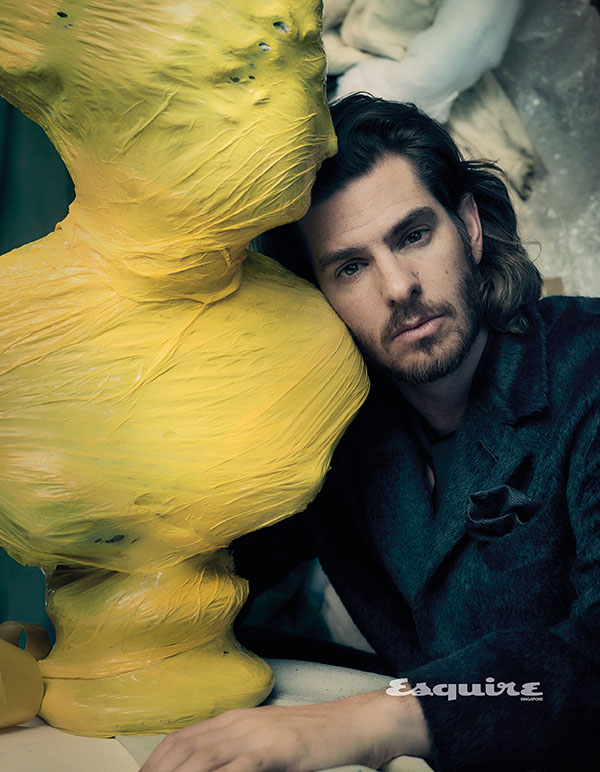
If you’ve ever read a celebrity profile in a magazine, particularly a men’s magazine like this one, you’ll know there are rules. It starts with a headline: something punchy and direct; maybe, at a push, a little cheesy; that gives you a sense that the guy you’re profiling—and right now, for a variety of reasons, it’s usually a guy—is someone who matters.
This particular profile is of Andrew Garfield, the 43-year-old British-American actor known for being a sensitive, committed type, with an unerring talent for eliciting from an audience both empathy and fondness for the characters he has portrayed. These have included Eduardo Saverin, Mark Zuckerberg’s screwed-over Facebook co-founder in David Fincher’s The Social Network in 2010; Desmond Doss, the conscientious-objector medic in Mel Gibson’s grisly World War II drama Hacksaw Ridge from 2016; and, between Tobey Maguire and Tom Holland, the middle of our three most recent Spider-Men.
So, in an ever-paler approximation of Gay Talese’s 1966 Esquire profile “Frank Sinatra Has a Cold”, you might opt for something warm and inviting, along the lines of: “Andrew Garfield Feels all the Feels” or “Andrew Garfield is Here for You”. But that’s if you were writing a profile about the old Andrew Garfield and obviously you’re writing a profile about the current Andrew Garfield, so you’ve got to move the story on. You need his personal path to have taken a turn, for his career trajectory to be entering some nascent phase and, if it hasn’t, you’ve got to dream one up.
So you comb through his recent and upcoming projects—playing OpenAI CEO Sam Altman in a new Luca Guadagnino movie; starring in Paul Greengrass’s gritty drama about the Peasants’ Revolt—in search of a thematic thread that will give you something new. Maybe you’ll imbue him with a darker, more twisted edge, something that might give you a headline like: “Andrew Garfield is Done Being Nice” or “Andrew Garfield is all the Rage”. Well, it’s a start.
Andrew Garfield knows all this, about the mechanics of interviews, because he’s done a fair few of them in his two decades of professional fame. In fact, he’s the one who brings the topic up—breaks the fourth wall, puts me on the spot—within minutes of meeting him at the café at the British Film Institute (his idea, and the equivalent, it seems to me, of a lion suggesting a rendezvous at London Zoo; or, to nod to another imminent project, a tiger).
I find him at a low table in the corner, in a baseball cap from the Japanese brand Freshservice; a T-shirt that says “Zephyr Competition Team”, as in the 1970s skateboarders; and trousers in a stripey, Casey-Jones-train-driver fabric. He’s winningly hospitable: he pays for our drinks (which are only bottles of water, but even so) and he plumps up my sofa cushion. He’s just back from Berlin where he’s wrapped on Wild Things, a mini-series about the German magician-and-animal-tamer duo Siegfried and Roy. “So I’m a little wonky,” he says. Garfield is playing Roy, the big-cat guy, for whom his hair has grown to shoulder-length and—no tiger analogies this time—is indisputably leonine.
We make small talk about the weather: the odd, looming grey that’s been sitting over London recently—it’s early June—and messed up last night’s sleep (well, small-ish talk: “It was a strange pressure on your chest,” he says. “I was like, am I having a heart attack?!”).
Then, all of a sudden, he wants to know: what’s my angle for the piece? What’s my plan?
No one I’ve interviewed, I tell him truthfully, has ever asked me that before.
“But it’s fun, it’s a nice game to play!” he says. “That’s the universal language—finding narrative, finding story. That’s why I can still do these things and not completely run away and hide from them.”
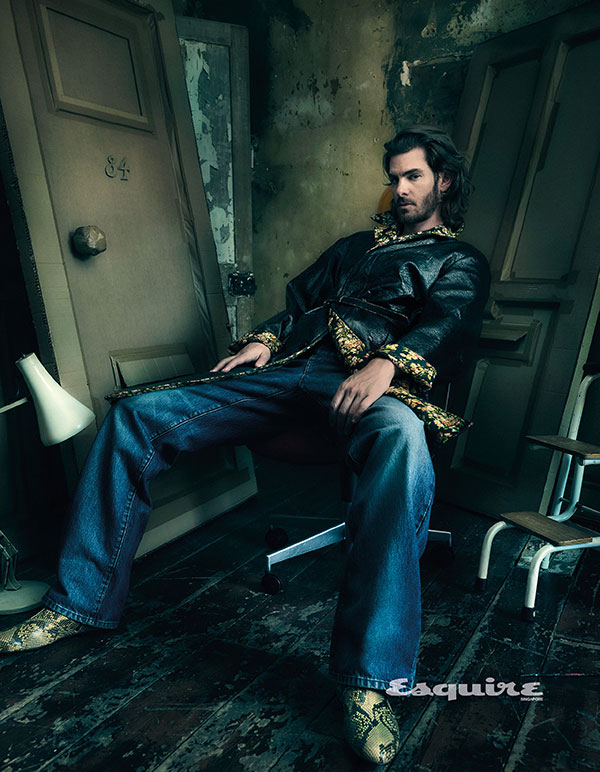
I had assumed he was contractually obliged to do them, I say; that interviews like this are written into film contracts. It’s part of his job just as it’s part of mine.
“Not that I’m aware of, though that might be some real ignorance on my part,” he says, seeming genuinely to ponder it, before he shifts tack. “George Monbiot has this concept called The Celebrity Profile Index, which is that you can tell the sickness of a culture by how much column space celebrities are given.”
I counter limply that actor profiles could seem, in this current age of celebrity-fuelled Insta-slop, comparatively edifying.
“It’s the proportions, it’s the ratio,” he says, already animated and quite literally, as his quasi-Facebook-colleague Sheryl Sandberg once had it, leaning in. “What are we, as a culture, focused on? Is it matters of import or is it matters of distraction? I’m OK being part of distraction, but I’d much rather be part of something that speaks to hungry souls.”
So it looks like “Andrew Garfield Keeps it Light” is definitely out. “Andrew Garfield Speaks to Hungry Souls”? We’re getting somewhere.
The first project we’re unofficially assigned to talk about—the one that most closely coincides with the publication of this story—is The Uprising, a new movie directed by Paul Greengrass, the British director of, among other things, United 93 and three of the Bourne films.
In The Uprising, Garfield plays Ploughman, a fictional everyman farmer whose wife and children have died in the Black Death and, when the King’s men come looking for even more tax money to fund foreign wars, has nothing to lose by taking a stand. Ploughman’s actions—it turns out he’s handy with a scythe in more ways than one—turn him into a talismanic figure in what would boil over into the Peasants’ Revolt of 1381, in which John Ball preached rebellion and Wat Tyler lost his head. It’s a story about abuses of power, the mutability of populism and the shifting of paradigms, and one that seems to have resonated with Garfield deeply.
“The truth of that period of time,” he says, “was that there were brutal conditions for working-class people, brutal taxation post-plague, incompetence in government, abusive practices, with the underclass being seen as sub-human creatures from the perspective of those in power.”
Not phenomena confined to the Middle Ages then? It all sounds quite... now.
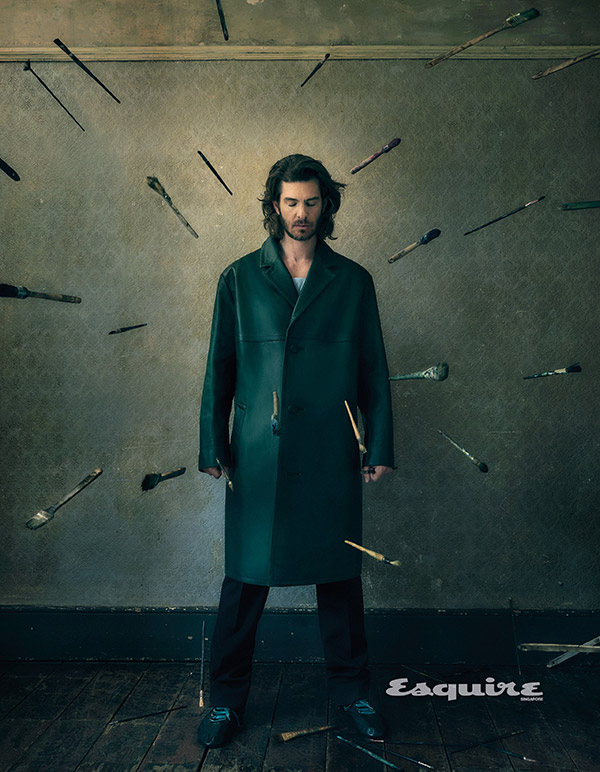
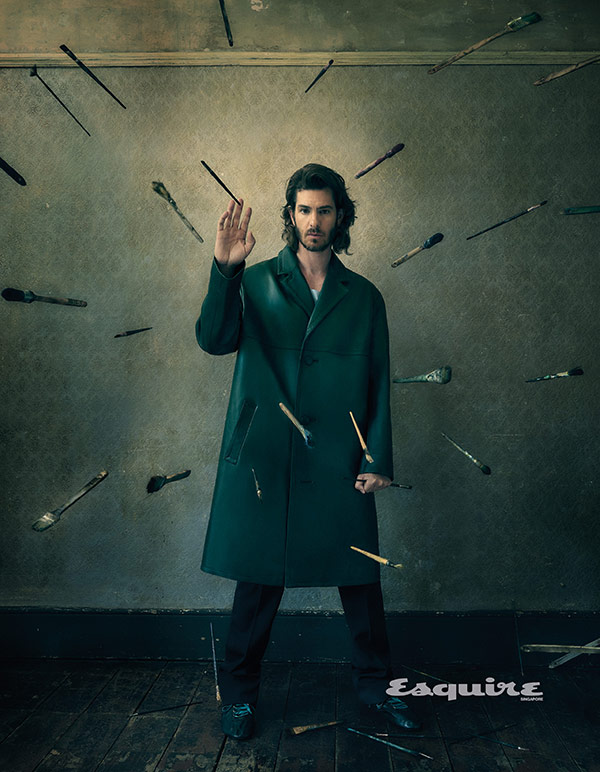
“Yeah, here and in the United States, and all around the world,” Garfield agrees. “One of the things that’s cool about this film is that it’s a bit of a Rorschach Test. A lot of differently politically aligned people will go, ‘Oh, it’s me!’ We get into really dicey territory—and to not see the [British far-right activist] Tommy Robinson stuff as anything but despicable is just ignorant—but I’m sure a bunch of people will look at this film and go, ‘England first! What about us?’ It’ll be very interesting in that regard.
“If there is a pure spine, a pure strand at the centre of the piece,” he continues, “it is a group of people looking around going, ‘Something’s rotten in the state of Denmark, and it’s been rotten, and we were told that this was just the way it was.’ There’s a kind of genuine awakening happening, an awakening to one’s own dignity, to the dignity of every living thing, and with that a quest to put the world right. What was inspiring and exciting in the making of [the film] was this possibility of justice, this possibility of healing.”
If you’ve read one of these sorts of profiles before, you’ll know it’s customary to canvas opinion about your subject from those who’ve had professional dealings with him. So, I spoke to Greengrass about The Uprising, and about why he wanted Garfield for Ploughman. Over a video call, the director praised Garfield’s “high intelligence, passion, trust, good humour, sheer grit and determination”; in Greengrass’s eyes, he is right up there in the Great Actor firmament.
“I’ve been blessed to work with some really, really great ones,” he said. “Matt Damon back in the day, Tom Hanks and Matthew McConaughey more recently, and now Andrew. They’ve all got a very strong mixture of strength and vulnerability, and Andrew has that very, very much. When Andrew gets into a fight, you believe he can do it, but he’s got gentleness too, which is in his soul, in his emotional make-up. The rub of those two things makes him a great leading actor. Does that answer your question?”
Thank you, Paul, it does.
One project down, it is time, I tell Garfield, to cover some biographical stuff.
“MotherwasEnglishdadwasAmericanborninAmericaraisedinEngland,” he rattles off, as frenetically as that reads. “Every single profile is like, ‘Born to an English mother and an American father...’”
True, I say, but you can’t assume...
“...everyone has read the previous ones.”
Exactly!
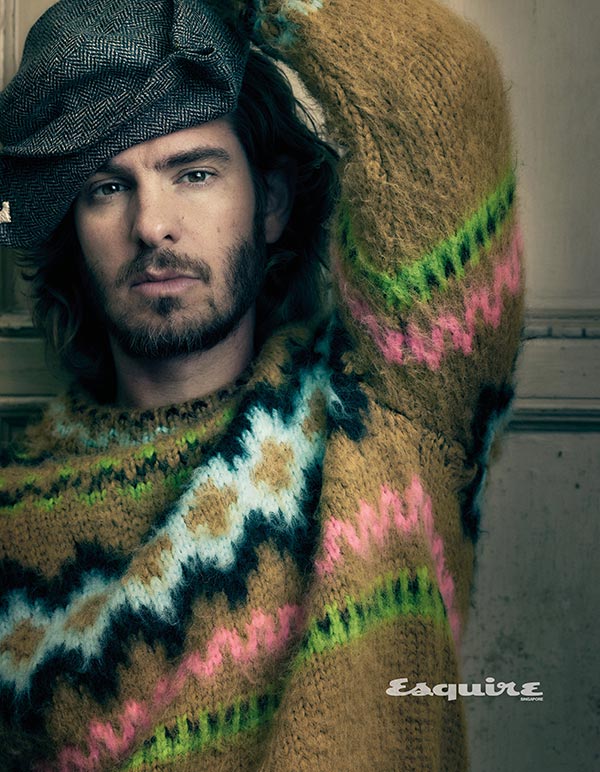
Born to an English mother and an American father, Garfield and his parents and older brother Ben lived in California for his early years, a period he recalls in snatches: “I remember being in Marina del Rey with my mum; I remember a billowing curtain; and hanging out with my brother at the beach.” At the age of three, the family moved to Banstead in Surrey, England, to the house in which his father Richard, a swimming coach, still lives.
Garfield describes himself as “a very physical, rough-and-tumble kid” with a “monkey physicality”, who spent as much of his time as possible “rolling around and swinging”. His parents sent him to swimming and gymnastics classes, in which he competed at a high level. His specialism was the floor routine, and he estimates he can still do “a back handspring, round-off, back somersault—and then an ice pack for three weeks”. He quit both at 13, but by then he’d diverted his energies into a new kind of floor work: acting.
At 17, he went to study acting at the Central School of Speech and Drama in Swiss Cottage, forging a long-standing allegiance to north London, where he still lives. He was one of the younger students at Central, which he admits he enjoyed. “I loved being the baby,” he says. Then, more wistfully: “I’m not the baby anymore. That ship has sailed.” At his final-year showcase, he was signed by the agent Kate Bryden, who remains his agent to this day: “I’m a creature of habit,” he says, “and I like long, intimate relationships with people.”
He came to many viewers’ attention for the first time in the 2007 Channel 4 film Boy A, about a young man trying to reintegrate into society 14 years after having murdered a child when he was one, too. He gained yet more for playing a tragic human clone, Tommy, in Mark Romanek’s adaptation of the Kazuo Ishiguro novel Never Let Me Go, after which Romanek recommended him to David Fincher, who was casting an upcoming film about the creation of Facebook.
Garfield was originally in discussion for the role of Mark Zuckerberg in The Social Network who, in Fincher’s version, is part visionary tech prophet, part socially disastrous nerd. In a 2010 interview with the Los Angeles Times, Fincher explained why he chose, instead, to cast Garfield as the empathetic Eduardo Saverin: “He has such incredible access to his kind of core humanity that I was like, ‘Why would we waste an actor like this on the part of the guy [who seems like he has] Asperger’s?’”
Garfield has certainly been drawn to—and had success with—characters who feel more than most, such as the pacifist Desmond Doss, for which he received his first Academy Award nomination; or Rent composer and über-thesp Jonathan Larson in the 2021 film adaptation of Larson’s semi-autobiographical musical Tick, Tick... Boom!, for which Garfield received his second Academy Award nomination and an actual Golden Globe; or Aids victim Prior Walter in Tony Kushner’s play Angels in America, performed first in London and then in New York, for which he won a Tony Award.
“They’re just my kind of dudes,” he says now. “They’re in the service of something greater. They’re putting all of their passion, all of their heart, every fibre of their being into service and, ultimately, they’re on the side of the angels.”
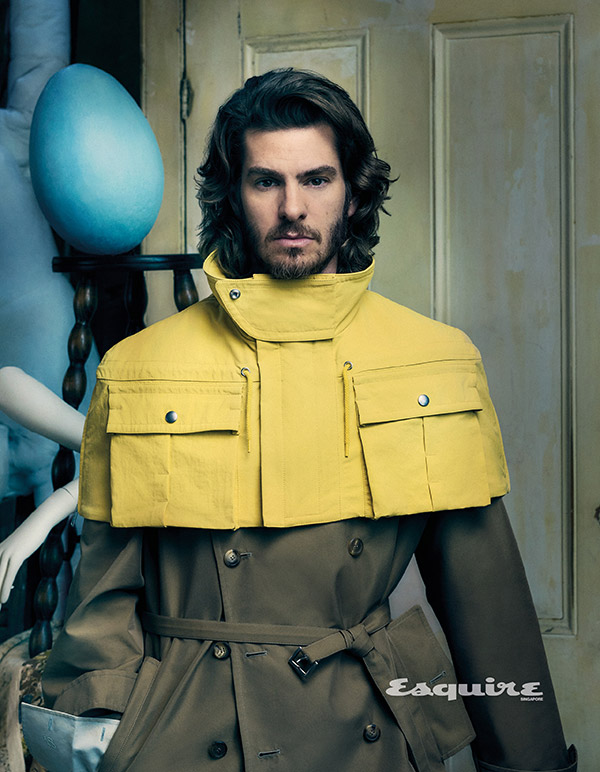
As for where this instinct in him comes from, there does seem to be a source.
Garfield’s mother Lynn, a nursery teacher, died of pancreatic cancer in 2019. “I hope I have my mother’s capacity for empathy and compassion and care and nurturing and love,” he says. “She was a very purely unconditionally loving person, wanting to help everybody all the time—anyone she could get her hands on, anyone that came into her orbit. It was a very beautiful and exhausting quality for her. She was never pushy, but she could read people, and she could feel who needed a little extra kiss. Yeah, she was one of those.”
From his father Richard, with whom he is close, he inherited something a little different. “I’m very aware of my dad in me: of his and my ambition, competitiveness, but also a kind of tenderness. He’s very decent, staunchly ethical. He has a real moral rectitude. I also know I have the capacity for anger that he has. I labelled anger as a negative emotion for a long time, but I don’t think it is. I think it’s boundary-setting. So I’m down with anger.”
He doesn’t give that impression, I say. (Well, there’s maybe a micro-hint of competitiveness, just once, when I tell him later that the actor Nicolas Cage has named Garfield as his favourite Spider-Man: “That’s the best news I’ve had all day.”)
He laughs. “It’s a very managed kind of public image I’m trying to create! I was raised as an athlete, so I’m very driven. But there’s also a longing for meaning, a spiritual connection, a flow state. Sometimes they can be very, very at odds. Sometimes I have to leave the competitive animal at home, so that I can [be free to] get it wrong.”
Ah, animals! Thanks, Andrew. Just the segue I need.
The second project to discuss, though less pressingly, as it’s not out until next year, is Wild Things, a seven-part limited series on Apple TV based on a podcast about the lives and misadventures of Las Vegas’ most outrageously coiffed Teutonic double act. Garfield’s half, Roy Horn, was famously mauled by one of his favourite big cats, a white tiger called Mantecore, while performing on stage at The Mirage casino in 2003. His partner Siegfried Fischbacher, with whom Roy and a menagerie of exotic animals shared a Vegas home known as the Jungle Palace, is being portrayed, in another inspired bit of a casting, by Jude Law.
“They’re a handsome couple,” agrees Joe Wright, the director of film adaptations of Atonement and Pride & Prejudice, who directed episodes five and six of Wild Things. “But they’re also very different, and I really enjoyed getting into that difference, as well as finding the love and appreciation of each other.” (Wait, are we talking about Andrew and Jude or Siegfried and Roy? “Both, actually.”)
Garfield and Law clearly embraced the assignment. Wright describes one episode, which takes place during Siegfried’s 59th birthday celebrations, and might just be the most actor-y thing I’ve ever heard. “We hired 360 Berlin clubbers to come and party with us. We played music and danced for five days solid and allowed the party to happen, with Andrew and Jude in the middle of it. It had this wonderful, crazy atmosphere of sex and hedonism and loss of self and beauty and rave.
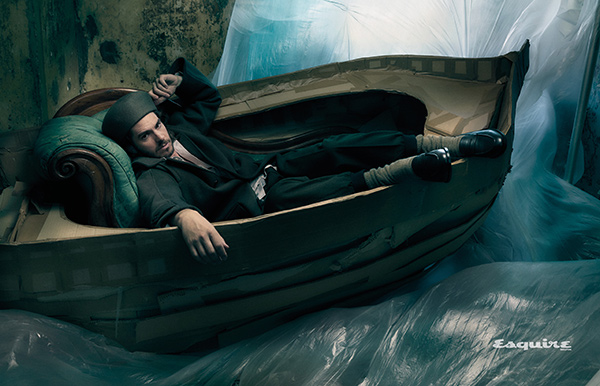
“Andrew is an incredibly beautiful actor,” Wright goes on. “It was a real privilege to create space for him to fly. If you allow Andrew the space, he’s like a shaman. He’ll channel something totally unexpected—for both of you. You’ll find yourself on set on the edge of your seat thinking, ‘My God, where is he going to go next?’”
Garfield had his own unusual way into the character. His regular driver when he’s working in London is a man called _____. (“Take his name out, actually, because I’m about to say something revealing.”) When Garfield told him he was making a drama about Siegfried and Roy, _____ informed him that, when he and his wife had been to see their show in Vegas in 1994, it had had a peculiarly rousing effect.
“‘We both came out so fucking charged up, I was hard as a rock!’” says Garfield, in a gruff Cockney accent, speaking as _____. “‘I think I got my wife pregnant that night.’” He’s Andrew again now: “This was before I started [the project]. I was like, guys! They were doing alchemical work!”
Actually, that wasn’t his only route to Roy; though much like a cheesed-off white tiger, the other one crept up on him.
“We were doing one sequence, and I was getting really hot between takes,” he begins.
Were you wearing a lot of lamé? I ask. (Which looks facetious written down, but I was genuinely not sure.)
“No, no, it was more like psychological heat. Like, why am I so uncomfortable? Why am I so worried about whether people hate me right now? I realised, and I said to Joe, that where he led me subconsciously is to me as a seven-year-old with my older brother and his friends. I just happened to be a 50-year-old German tiger magician in these scenes, but that was the part of me that was starting to get brought up. I was obsessed with my older brother. All I wanted was his approval, his friendship, and that was a big part of the dynamic between me and Siegfried.”
I ask Garfield’s brother Ben, now a doctor specialising in respiratory conditions, if Andrew has finally won his approval. Via e-mail, he replies:
“I think we’ve both been working on gaining each other’s approval at various stages. What I do know is that I’m incredibly proud of him. Everyone sees how talented he is, but what people don’t always see is just how hard he works. He’s one of the most dedicated people I know, he’s a wonderful uncle, and he’s been there for me through some of the toughest moments of my life. So if he ever doubted it, he can stop now; he has my approval. I hope I have his, too.”
Over the years, Andrew and Ben have had “our moments, as brothers do”, Garfield says, but “for a long time now we’ve been really, really good”. He also has close friends from school and Central—to whom he is “Garf” or “Garfy”—who keep him grounded and obligingly take the piss out of him if required (“That’s the love language we all have,” he says). He’s also picked up “a few great industry friends that aren’t terrible, that are brilliant, that are just people”.
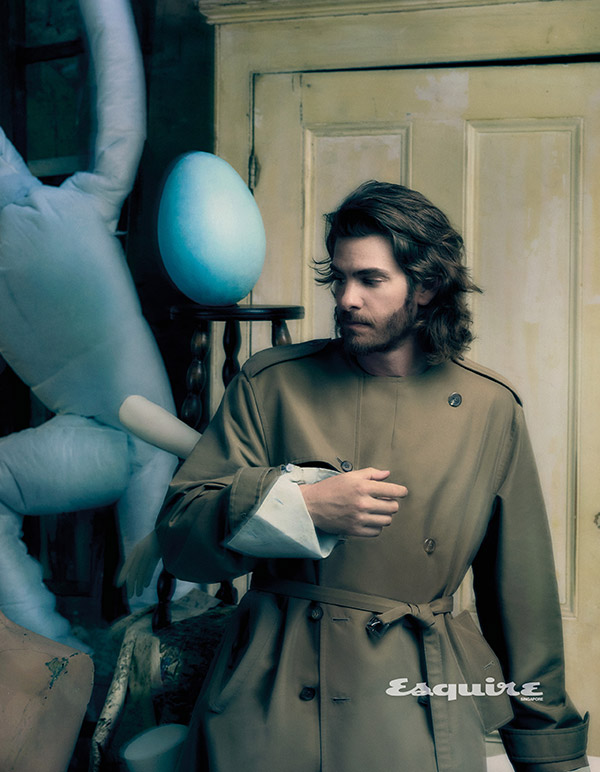
All in all, he seems to have navigated fame pretty well, though his notion that meeting in the BFI café would be “hiding in plain sight” doesn’t quite come off. The first stranger to approach is a young man who’s made a short film and wants Garfield to sign its programme (“Andrew Garfield,” Andrew Garfield writes, and then in capitals underneath: “NOT IN THE FILM”); the second man says he wouldn’t have come up, only—what are the chances!—Garfield just so happens to be his favourite actor. Garfield is gracious to both. Does this sort of weirdness mess with his head? “It does, it’s tricky,” he concedes. “But you know, there are worse experiences to have.”
He is also at a funny age: in his early 40s, but with a certain boyishness about him. Though he came up with the likes of Jamie Dornan and Eddie Redmayne, with whom he hung out when they were all baby actors in LA, his youthful looks have given him a longer acting adolescence than most; no one’s casting him as Lear yet. “I do like hanging out with younger actors,” he says, name-checking the 30-year-old British actor and director Harris Dickinson as an example. “I never want to lose an ability to play, and hanging out with Harris, you feel like you stay in contact with that within you.”
Were you to ask him about life plans—romantic ones, for example—you’d be met with what has become his standard response. “I’ll say it on the record: it’s not something I will ever talk about. Maybe if I’m married with kids and 10 years into the relationship I might feel comfortable saying ‘my wife and my kids’. Maybe. But maybe fucking not!” (Having said that, he knows, and I know, and he knows I know, that at the time of our interview, his girlfriend, the American actress Monica Barbaro, is about to perform in Les Liaisons Dangereuses at the National Theatre, approximately 40 feet away from where we’re sitting.)
But isn’t this all sounding like the sweet, emotionally available Garfield as we feel like we knew him already? Where’s the darkening twist?
Don’t worry, it’s been brewing.
Last year, Garfield appeared in After the Hunt, a film from the Italian director Luca Guadagnino about a young Black college student, Maggie (The Bear’s Ayo Edebiri), who accuses an older white professor, Hank, played by Garfield, of sexual assault. Garfield’s Hank is a different beast from those we’ve seen: he’s swaggering, he’s virile, he’s dangerous. He is not, by any stretch of the imagination, nice. In terms of the masculine archetypes Garfield has played before, Hank seems, in a way...
“A departure, yeah,” Garfield anticipates. “I think Luca is one of those directors who likes subverting expectations around an actor.”
Guadagnino, over e-mail, describes seeing Garfield in his first-ever film role, playing a disaffected student in Robert Redford’s Lions for Lambs. “Since then, I was constantly looking for an opportunity to work with him,” he said. When it came to casting Hank, Guadagnino wrote that he “needed an actor who could be able to encompass all the fraught morality at play with him, yet trick you into empathy”. Garfield, all open shirt buttons and roving hands, absolutely delivered.
“I feel grateful to those experiences of playing bad people. But I prefer at least trying to be a good friend”
Guadagnino came back for more. Before After the Hunt had even been released, the director got in touch to discuss Garfield playing Sam Altman in Artificial, a film drama about the five days during which the controversial OpenAI CEO was ousted—and then re-hired—by the company he co-founded. “I was like, ‘This feels a bit quick’,” Garfield remembers. “But Luca was like [adopts lisping Italian accent], ‘Darling, trust me. We do it, it’s gonna be incredible. It’s gonna be a masterpiece.’ I do trust him, so I said yes, and then it was: here we fucking go!”
Mark Zuckerberg and Sam Altman are obviously not one and the same, but they are both—let’s make no bones about it—ruthless technocrats at the top of our currently upended world order. Does the fact that Garfield was once deemed unsuited to the role of Zuckerberg but is now able to play Altman suggest that a change in him has taken place? Guadagnino may not think so (“Andrew can play any role he wants. He is sublime,” he wrote), but Garfield agrees there’s something to it.
“Yeah, I think I’ve been fascinated since I missed that opportunity—though I got given the most amazing opportunity [of playing Eduardo Saverin] and wouldn’t have it any other way—but I definitely feel I’m closer to understanding the drives, the psychology. With Sam, everything’s a game. It’s a game, and everything gets very, very simple. It’s, ‘I know I have to win this game, because I am the most ‘good’ person, and if I don’t win this game, Elon Musk wins this game.’”
“I don’t know this person, to be clear,” he continues. “I don’t know Sam Altman. I’ve never met him. I was going off of the script and court transcripts and interviews and research, and we were telling a story, but I think anyone who takes on that level of responsibility for a company or a technology that you know is going to do a hell of a lot of damage to the soul of humanity [must have] a certain ability to dissociate.”
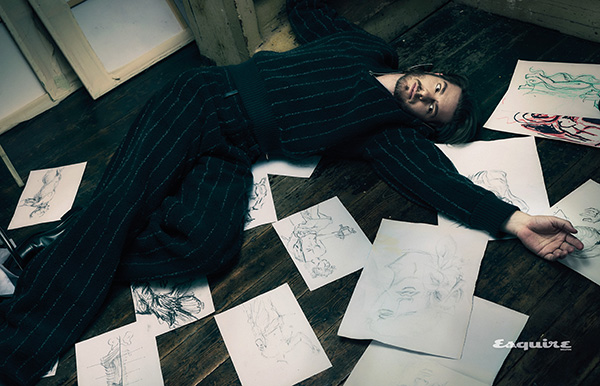
Garfield admits he’s not always drawn to characters like Altman, partly because his “from the inside out” process as an actor, of having to find the essence of that character somewhere inside himself, means accessing deeper parts of his psyche that he might not like. “What Jung would call ‘the shadow self’,” he explains. “The aspects of ourselves that we disown. There’s something there for me to integrate, because I’m so afraid of being it.”
“But then the argument is,” he goes on, growing more animated, contorting his body towards me on the banquette, “that if we weren’t all less rejecting in the first place, less ‘that’s not us’, then Donald Trump wouldn’t have been voted in twice, and Nigel Farage wouldn’t be anywhere near a position of power. Whereas if we go, ‘OK, interesting—where am I [in a] wannabe fascist, grifter, opportunist, power-hungry, ethic-less, spineless fucking pig?’ We can identify that this is the bad part of us. We know this in ourselves.”
He takes a breath. Relaxes. “And then it’s, ‘Ah, sweet Nigel. Guys, let’s just not let him get anywhere near this.’”
Roles like Altman take their toll. Garfield says he “couldn’t wait” to stop playing Jim Bakker, the embezzling preacher husband in Michael Showalter’s 2021 biopic The Eyes of Tammy Faye. “I feel grateful to those experiences of playing those people,” he says. “But I don’t love it. Ultimately I’m like, ‘Thank God that’s over.’ I felt that way with Sam and with Hank [from After the Hunt]. Because I much prefer at least trying to be community-minded, a good friend. I love being a cosy guy.”
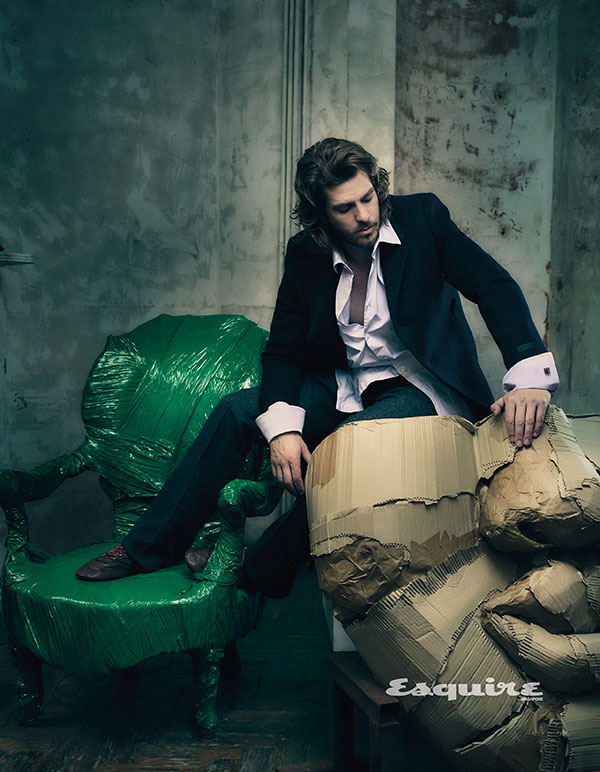
Soon after our interview, Luca Guadagnino’s Artificial is in the news. The distributor that was supposed to be releasing it, Amazon MGM Studios, announces in June that it will no longer be doing so. No reason is given, but the fact that Amazon and OpenAI have recently confirmed a USD50bn deal does not go unnoticed. (At the time of going to press, the rights to Artificial seem to have been picked up by the American film company Neon, which has stated an intent to release it, with a view to awards contention, as early as this autumn.)
This kerfuffle—perhaps purely coincidentally—only strengthens an idea that we had spoken about when we met: that societal power is very different now. Certainly, we’re living through a time when the people who wield it seem not obviously to be motivated by humanity’s best interests. You could say it’s a little like the gross imbalances that brought about the Peasants’ Revolt, and that maybe Garfield is drawn to explorations of these big global moments...
“Now we’re finding the narrative!” he says. “I say ‘we’; I mean you.”
But maybe it’s not really a narrative, it’s more of an impulse in him: an urge to probe and to question, a propensity to take a macro view of things, to scrutinise received ideas and structures and turn them over and over, whether they come from a president or a technocrat or a film director or a king.
Or a lowly men’s magazine profile writer. But, if I am permitted to cleave to convention for another paragraph or two, pieces like this often end with a little summary of what the interviewee has got coming up: future plans, projects, hopes and dreams. As does this one.
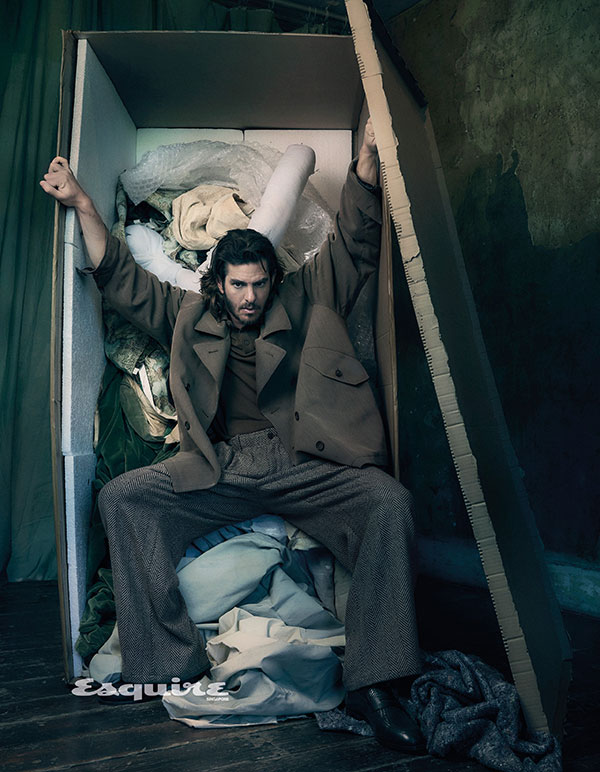
“You know, I learnt a lot over the course of this past year,” Garfield says. “I did three things back-to-back—I’ve never done that before. I’m knackered. But it happened to be three things I really wanted to do, and they were all happening at the same time. I was like, ‘Fuck, I don’t want to miss these.’ But I’m definitely going to have a holiday and a rest. I’m going to be normal. I’m going to be ordinary. I’m going take a walk and I’m going to read a book, and I’m going to be with my people, and I’m going to go to Disneyland with my nephews.”
Is he actually?
“Maybe? None of your business! But maybe!”
He brought it up!
“Yeah, I know,” he concedes. “I’m going to play basketball, and I’m going to go swimming, and I’m going to be. Just be. And I’m going to remember that I don’t always have to be ‘on’, performing. And I’m going to think about how to live. That’s the thread now; that feels like the narrative. How do we not only survive in this very polarised, financially differentiated, resource-scarce time, when an empire is at its hilt, maybe pre-falling? How do we free ourselves from the shackles?
“That’s what The Uprising’s about,” he circles back, deftly. “How do we free ourselves from an oppressive society and a set of systems and structures that doesn’t want us free? So, yeah. I’ll have a swim, and I’ll think about that. That sounds like heaven to me. And then I’ll take action.
There’s one thing we haven’t settled on. The headline. We were always going to struggle to come up with one in the moment (by the end of the interview, as we leave the BFI café and say our goodbyes in the lobby, it feels like it has become something of a joint endeavour). So, as I write the penultimate paragraph of the profile—this one, in fact—I ask Garfield’s publicist if she can run a few options past him, some of the ones I spouted at the beginning. Andrew Garfield Feels all the Feels? Andrew Garfield is Here for You? Andrew Garfield is all the Rage?
She gets back to me. “For the title he says his preference is ‘Andrew Garfield is Here for You’,” she writes. Ah, OK. I’ll admit it isn’t the one I’d hoped he’d pick, which was hiding in plain sight in the list, and is now at the start of this piece (“He’s fine with this article title,” his publicist confirms later. “It was his second choice”). “Andrew Garfield is Here for You” may not have been the narrative conceit I went with in the end, but it’s a nice one. And, having got a little bit of a sense of the guy now, I can believe that it’s true.
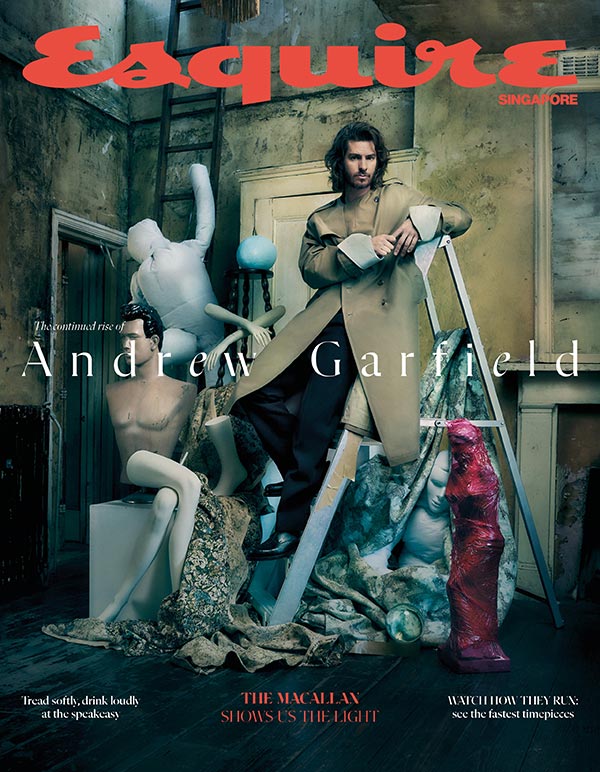
Photography: Rob Rusling
Styling: Julian Ganio
Grooming: Lucy Halperin at THE WALL GROUP
Set Design: Scarlet Winter at LALALAND ARTISTS
Styling Assistant: Louis Williams