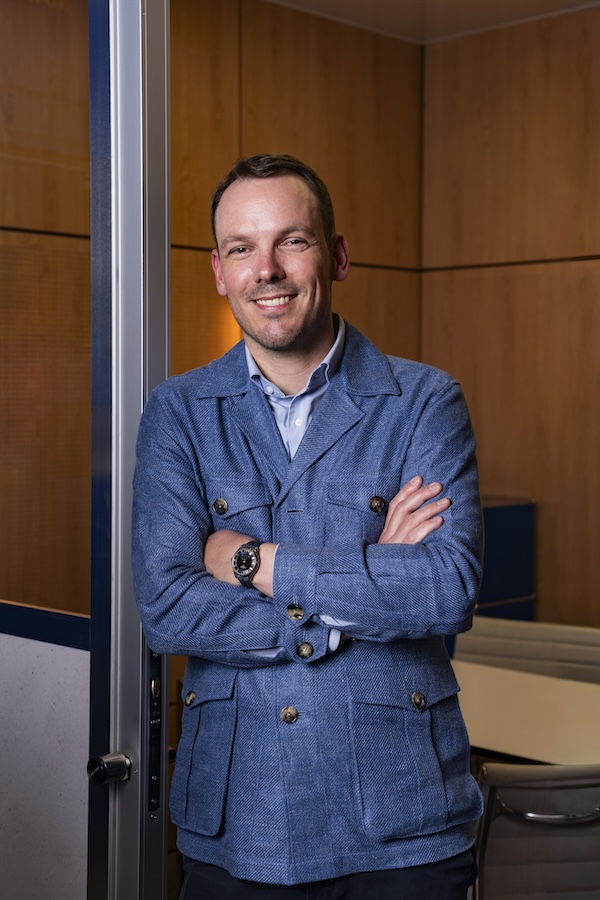
There is the idea of a shark swimming, that if it ever stops moving, it dies. That notion has been applied to life, where stagnancy can be the deathknell of innovation. Not so for Romain Marietta, who joined ZENITH in 2006 as a fresh business and communications grad, and has been with the company ever since.
Now, his title is chief product officer, where he oversees the concept-to-market watch creation, and the company’s heritage. Go ahead. Ask him about ZENITH’s history and Marietta will answer it with the passion of an evangelist. Marietta’s insight has also shaped some of ZENITH’s significant recent releases, including the DEFY and CHRONOMASTER lines. As an ardent advocate for the company, we wagered that a conversation with Marietta during this year’s Watches and Wonders in Geneva would not leave us wanting. We were right.
ESQUIRE SINGAPORE: It’s day three. How has the reaction been to ZENITH’s novelties?
ROMAIN MARIETTA: Very good, overall feelings are very happy. We have a new clasp (the ZENCLASP) and a select number of novelties to showcase, so the sessions are very focused. So far, people are happy with all of it.
ESQ: Last year was the brand’s anniversary.
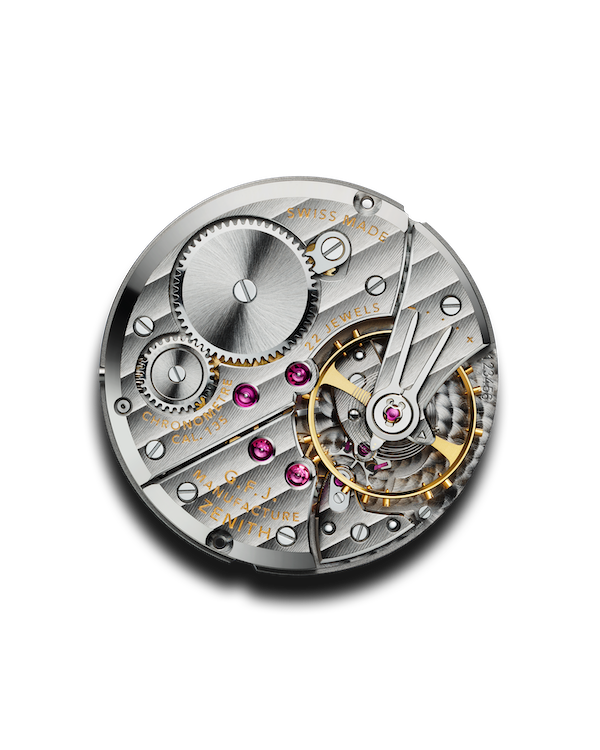
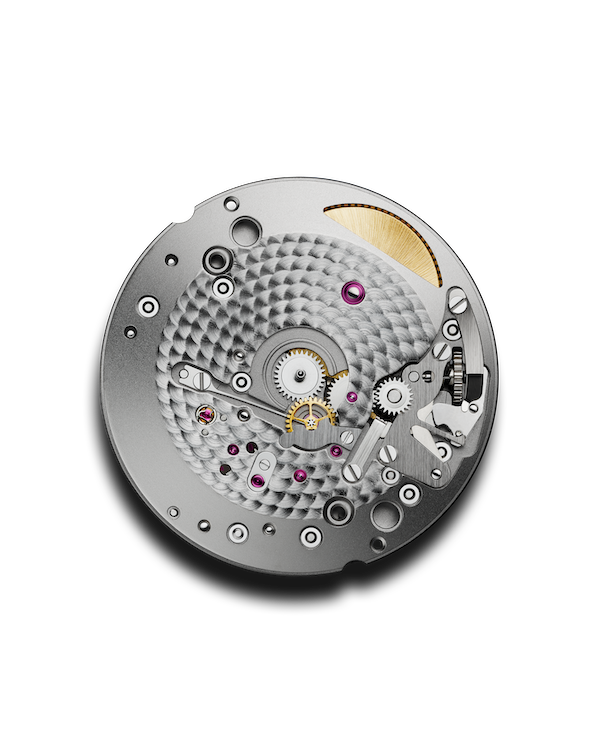
RM: It was 160 years of ZENITH’s history, and some of the products were [ahead of their time]. We continue the story with the G.F.J., and the Calibre 135, which has been a success. The watch from last year was sold out and the new model is almost gone. Economically speaking, even with what is going on worldwide, so far, everything is good.
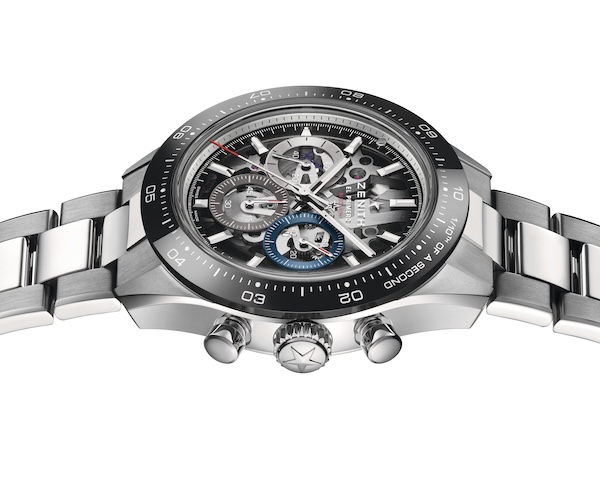
ESQ: Tell us more about the ZENCLASP. How long did the R&D for that take?
RM: Rolex has a lot of patents on its own clasps, as do the other brands with their own. A lot of development [on the clasps] has been made in the last 20 years, all of which are protected and patented. So, if you want to implement a certain clasp to the watches, you will either get something that already exists and put a ZENITH logo on it, or we make our own clasp. We took that second approach.
We knew the challenges going into this. The development process was time-consuming, but we wanted to have something very refined and technically on point. We worked on it for two years, and it took six months to check that we did not infringe on any existing patents to be able to come up with, not only a new clasp system, but also something that’s also retrofittable on [previous models]. It really is a state-of-the-art micro-adjustable buckle.
ESQ: Why was it important to have your own clasp?
RM: I mean, we have our own design, our own movements. Why not our own clasp? It’s also a message to our consumers. The CHRONOMASTER Sport is our iconic model. It’s a best seller, and it’s a real contender against the other chronographs on the market, like the [OMEGA] Speedy, [Rolex’s] Daytona, the [Breitling] Navitimer. If you want people to take you seriously, your chronograph needs to be state-of-the-art. We already have the movement and design, and the pain points were the bracelet and the buckle.
ESQ: What’s your favourite novelty from this year?
RM: That would be the G.F.J in tantalum. That’s why I have it on my wrist. It’s an understated piece, and I love the material.
ESQ: We understand that you are a big fan of Swiss manufacturing.
RM: We have been based in Switzerland since 1865, and never moved. We are Swiss, and watchmaking is part of our DNA. From the manufacture to our workers, everything takes place in Switzerland. Of course, it is important to us, this identity. As ZENITH, we represent the best of Swiss watchmaking.
As a producer of mid- to high-segment products, our watches are... kind of expensive. That is related to our production, where we are making fewer than 20,000 watches a year. We are not mass market, therefore we add a lot of value on our timepieces.
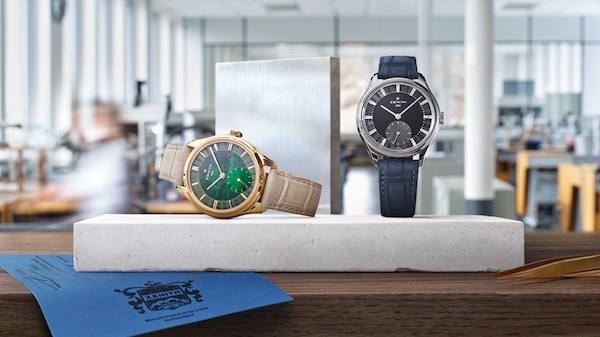
ESQ: This isn’t the first time that you have stone dials for your watches. I think you used lapis lazuli for the CHRONOMASTER last year. Stone dials aren’t the easiest to work with, no?
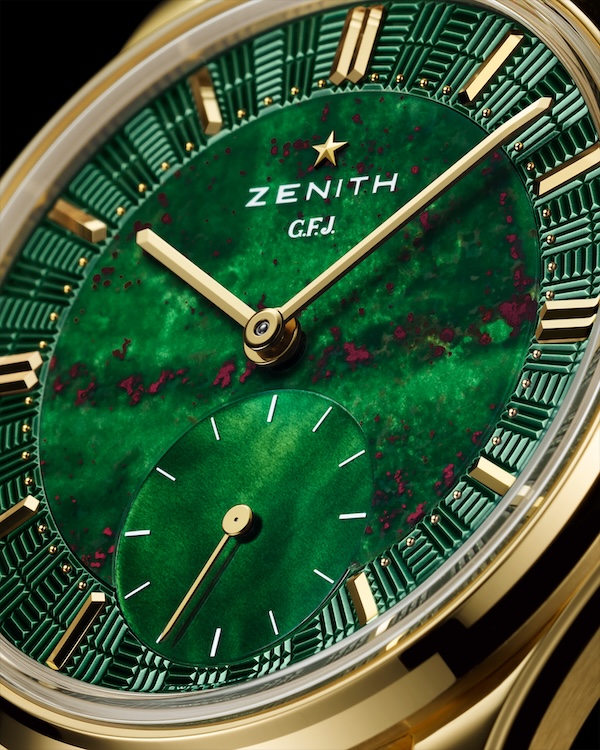
RM: Yeah. It’s true that stone dials are not our signature, but they look beautiful. Last year, we used lapis lazuli; this year, we work with jasper bloodstone for the G.F.J. We wanted to have a three-part dial design, where we executed three different finishings. You have your subdial made from tinted green MOP (mother-of-pearl), the centre made of bloodstone, and the “brick” guilloché pattern on the outer [chapter] ring.
ESQ: You also work with tantalum.
RM: It’s the first time we are using the material for G.F.J. The G.F.J. model uses only precious materials, like gold, rose gold, white gold, platinum... Tantalum is one of those rare, exclusive metals.
Honestly, the bluish tint of tantalum is amazing. It goes very well with the dial (black onyx, grey mother-of-pearl) with baguette-cut diamonds. Tantalum isn’t as common as gold, but we saw other independent brands use it, and we wanted to challenge ourselves in incorporating it.
We wanted to bring something new to the table for the collectors, and having a timepiece made with a new material is appealing for collectors.
ESQ: What is something that the average consumer will not immediately notice from this year’s novelties?
RM: A small detail that I like personally is found in the CHRONOMASTER Sport Skeleton. You can see these two screws (one at 4:30 and the other at 10:30) that hold the dial. Usually, you’d hide them but they add to the technical look of the piece.
For the G.F.J., obviously, there’s the Côtes de Genève finishing, which is darker against the ruthenium. But how about this: if you look at the G.F.J. model in tantalum, you’d notice that “G.F.J.” isn’t stamped. Instead, it was engraved by hand because stamping is almost impossible to do on tantalum.
ESQ: You’ve been with ZENITH for 20 years.
RM: Half of my life. [laughs]
ESQ: That’s a long time.
RM: I started as a trainee, yeah. It was an internship that was supposed to last for six months, but after four months, they hired me. I started in the product marketing department, and made user manuals for the watches. I did not know anything about watches at the time because I wasn’t an engineer, and the first task was to write the manual of the most complicated watch ever created by ZENITH.
ESQ: What watch was it?
RM: This watch never came out on the market, but I had to explain about the world timer, minute repeater, big date, chronograph, flyback, and a split-second. This required talking to the designers and watchmakers, and that made me fall in love with watches.
After that, I joined the commercial team, then product development. I saw many CEOs come in and out, each with their own strategies. A lot of things occur at ZENITH, and it keeps you on your toes. You have to think quickly; you have to be curious; you have to bring something new to the table.
That is why I’ve worked with ZENITH for so long. I still enjoy what I do and I am passionate about the brand.
ESQ: Does your longevity with ZENITH affect how you work?
RM: The more embedded you are with the brand, the more you understand it. You can go deeper, and discover a lot of things about the company’s history. I’m still learning. My journey continues.
ESQ: You witnessed many changes with the brand.
RM: Of course. There were changes in terms of communication. The message is clearer, but the soul of the brand is still there. That was the case when I first joined. When I first joined ZENITH, it was different. The CEO then [Thierry Nataf] had a lot of crazy ideas. Now we are more focused on the watches.
ESQ: Given your tenure with the company, are you protective of it?
RM: I see myself as a bit of the guardian of the temple, y’know. Sometimes, when a watch is suggested, I’d say, Oh we’ve done that or That wouldn’t work. Let’s try this instead.
ESQ: When it comes to, like, marketing and technicality, were there any butting of heads on how to portray the watches to the public?
RM: No, no. The ultimate goal is for product development and the marketing team to be on the same page. We are a small brand in Le Locle, and it’s important to be aligned. The marketing guys are not engineers, so we have to explain the elements of inspiration that led us to the final design, because that is our role.
So, for the last three, four years, we have had our own creative studio. I co-lead the creative studio with Sébastien [Gobert, creative director of ZENITH]. Everything passes through us, and since we are the centre of everything, we try to make all messages consistent, to be able to have the same vision.
ESQ: Do you wish for a bigger team?
RM: We are a big brand, but with about 300 people worldwide. That’s small if you compare with some of the other companies like [Audemars Piguet] with 3,000 people or Rolex with 15,000. The more people you have, the more layers of discussion you have to get through. At ZENITH, we have meetings within a small group of people, and that helps a lot.
ESQ: Is there anything that would make you want to leave ZENITH?
RM: Let me answer this differently. I know which brand I would not like to work for. Even if they paid me 10 times my salary, I cannot work for them if they don’t give me the same sort of emotions I get with ZENITH. If I need to work for someone, I need to love what they do; I need to believe in what they do.
I have been approached by some brands to join them, and sure, they have more resources, but at some point, it boils down to what they have, what I can get, and if there is the freedom to create with the brand. At ZENITH, there may be six people doing product development, but we have a room to create, and that’s why I’m still here.
ESQ: It seems like you truly value your freedom to innovate.
RM: It’s super important. With a lot of brands, you feel that they don’t have the freedom to create, because what they release is boring. At ZENITH, we have the flexibility to do many things. Can you imagine when I asked Julien [Tornare, previous CEO of ZENITH] if we could bring back the Calibre 135 movement, and he was incredulous. The movement from 1949? What do you want with it? Do you really believe it’s gonna put us on the map? The cost of reviving this movement was huge, but at ZENITH, we did it.
You know what? If I were to leave one day, maybe I would join an independent watchmaker. Maybe after 20 years, I’ll have to ask myself this question. My wife, who used to work with ZENITH for 12 years, said that if you’re feeling comfortable, maybe it is time to challenge yourself.
But I don’t think I’m comfortable. It’s still exciting to me. To work our asses off, to make the watches, to communicate to the public about them. I’m 43 now, and I still have a lot to do. I don’t know what will make me change my position, but for the time being, I don’t want to change.