On February 1, 2026, the day before Groundhog Day, in Lenhartsville, Pennsylvania, a driveway glazed with ice leads to an open garage door that glows against the snow. Winter, the kind that freezes the ground solid and makes the idea of early spring feel like polite fiction, has settled in hard.
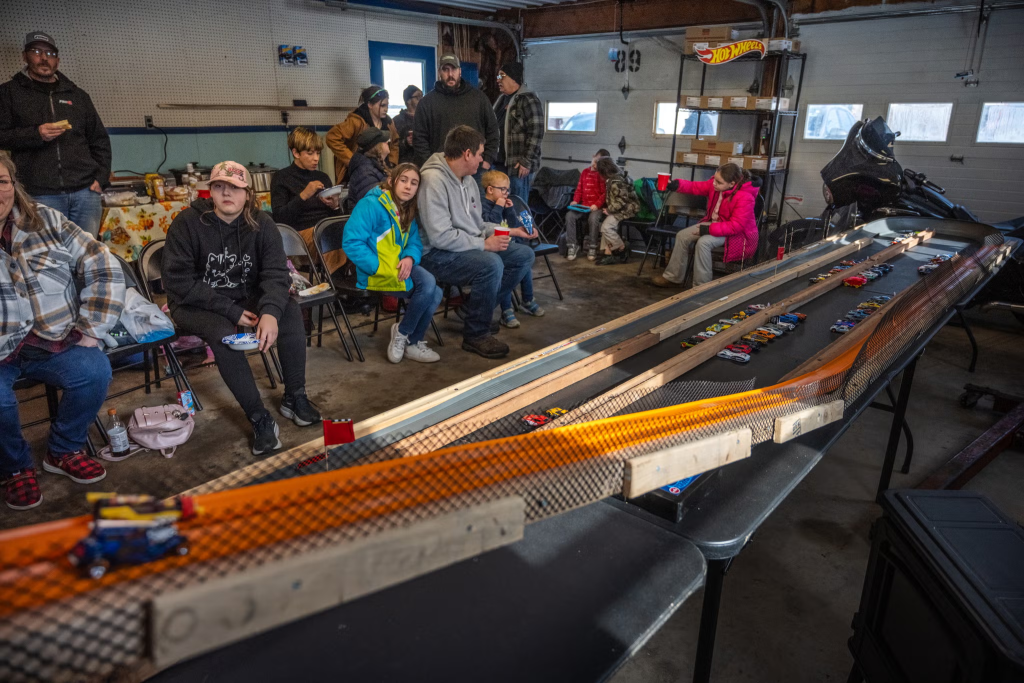
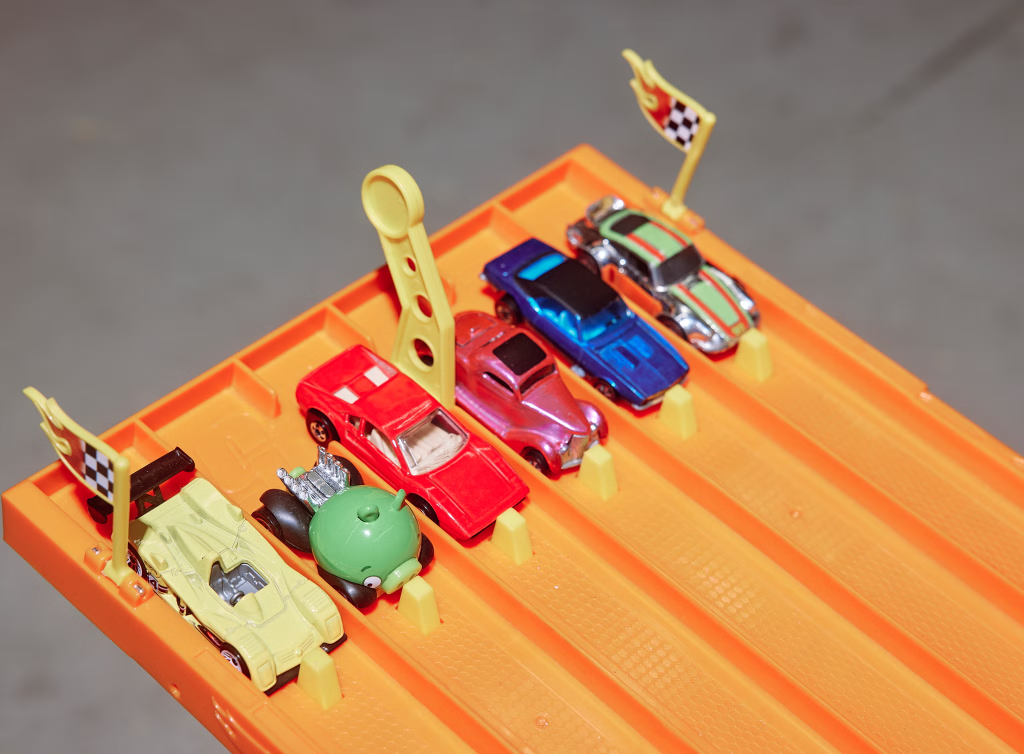
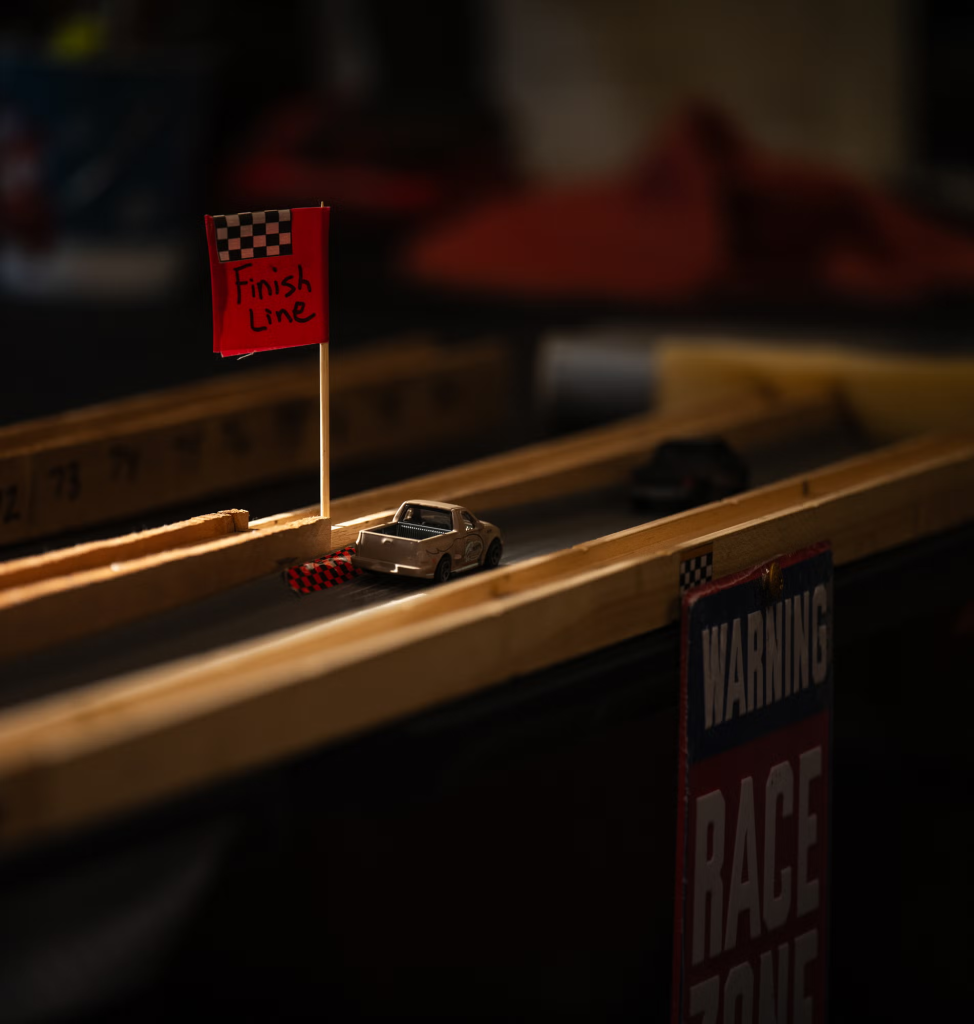
Inside, the garage is warm and bright. Fluorescent lights hum overhead. Sunlight slips through a single window and lands on the curve of a long grey-and-orange racetrack. The thirty-three feet of plastic run nearly the length of the space, perched on folding tables and reinforced with wooden rails and black mesh safety netting. The start gate rises sharply at twenty-two inches and drops fast into a banked U-turn, then levels into a final straight where miniature flags mark a checkpoint and a finish line.
The little cars are lined up in neat rows according to their heats, waiting. There’s a He-Man themed Hot Wheels car with an oversize cartoon rider at the wheel; a classic chrome-and-red Bone Shaker rat rod; a humble Honda Civic; a few Ford pickup trucks to keep things grounded; and a scattering of low, wide fantasy castings built for speed. Some look carefully prepared, while others look like childhood favourites pulled straight from a shelf or toy box.
Invitations and connections weren’t necessary. I opened Facebook, searched “Hot Wheels gravity race,” and found a handful of listings within driving distance. This was simply the closest to my home in Philadelphia. The host of this particular event, Edwin Herman, is a fifty-three-year-old Army veteran.
In his earliest memories, he remembers racing the cars with his brother over a track that ran from the living room, off the sofa, and into the hallway. Later, when his own two boys came along, he did the same with them. Their bedroom walls were filled with rows of Hot Wheels and Matchbox cars.
His garage is one node in a much larger network. Across the country, in basements, church halls, hotel conference rooms, and TikTok live streams, men are connecting through metal chassis and plastic wheels. The cars are toys, technically, but they’re also replicas of objects that, in real life, signal independence, power, and control.
They ask to be handled, raced, and worn down. Or, just as insistently, to be preserved. Sealed in plastic and cardboard. Untouched and motion deferred. From the outside, it might read like arrested development or simple nostalgia. But to the men who collect, race, and play with them, it’s much, much more than that.
Die-cast toys emerged in Europe in the first half of the twentieth century, made possible by new zinc-alloy casting techniques that allowed small objects to be produced cheaply and consistently. Before plastic took over childhoods, metal—heavy, durable, meant to last—was the default.
Matchbox cars were first introduced in 1953 by the British company Lesney Products, and in postwar Britain, the company built its identity around realism and scale and named its cars for the kind of cardboard container they fit inside. These were miniature working vehicles for a rebuilding world: delivery trucks, fire engines, family sedans, and other everyday silhouettes.
When die-cast cars crossed the Atlantic in the 1950s and ’60s, they entered a different cultural moment. The American car became more than just a mode of transportation; it became a form of aspiration. Suburbs were spreading, and highways were new. Speed, customisation, and spectacle mattered.
In 1968, Hot Wheels arrived with something Matchbox didn’t offer: fantasy calibrated for motion, with thicker axles, low-friction wheels, and brighter paint. Proportions bent toward speed rather than accuracy. These weren’t models of cars so much as arguments about what cars could be.
Most die-cast-car brands settled into a shared 1:64 scale, small enough to disappear into a pocket but heavy enough to feel real. Die-cast metal bodies, plastic bases, and free-rolling wheels were a common language that allowed thousands of vehicles, across decades and brands, to exist in quiet relation to one another. By offering an infinitely expandable personal fleet, die-cast-car brands made kids—and, later, men—feel as though nothing had to be chosen or given up.
By the late twentieth century, the balance of power had shifted. Matchbox passed through multiple owners as sales softened, and in 1997, Mattel—the California toy giant behind Barbie and the already dominant Hot Wheels brand—acquired Tyco Toys, which owned Matchbox at the time.
Though the two brands were under the same corporate roof, the rivalry didn’t disappear. Rather, it was consolidated. Realism and fantasy were now managed inside the same portfolio. As other brands have faded in and out of relevance, Matchbox and Hot Wheels have survived the test of time.
For most people, the entry point to die-cast cars is unceremonious. A car is a car. It rolls. It crashes. It vanishes into a pocket and resurfaces days later under a couch or at the bottom of a backpack. So the base-level cars are almost improbably affordable. A basic Hot Wheels or Matchbox model retails for around one to two dollars at big-box stores and grocery checkouts, a price point that has fuelled impulse buys for decades.
But the ecosystem rises from there with Premium lines featuring heavier castings, more detailed finishes, and rubber tyres. Limited releases are sold in smaller runs, often online, and Mattel’s limited-edition Red Line Club cars—marketed to adult collectors—generally retail in the twenty-to-thirty-dollar range and can trade for more on the secondary market. The same silhouette can be disposable or archival, toy or artifact, depending on who is holding it.
Like a picture that arrives intact, Cory Joy can see the colour and the shape of the car, even feel the weight of it in his palm. He remembers how the wheels rolled, how the metal body warmed if he held it too long. The memory isn’t abstract; it’s more physical.
Joy grew up with a single mother and not much money in a time when boredom was something kids learnt to manage. “When we got one or two cars,” he says, “that was a big deal. That was it.”
He would kneel in the dirt behind the house, shape a track with his hands and a stick—banking turns and carving grooves—and let gravity do the rest. “Everywhere we went, we took cars with us,” he says. “You’d throw a couple in your pocket and go.”
The toy car that keeps resurfacing in his memory comes from a James Bond movie: the white Lotus Esprit. In his mind, it could slide into the water and become something else entirely—a submarine, just like in the film. It was solid and small, heavier than it looked, and he remembers the flash of white in the sun, the scrape of metal against dirt, the dust it kicked up as it shot downhill.
Nothing about the car felt precious. It was meant to be used. Until the toy disappeared, as things tend to do over the years. Joy, now fifty-six, is a Christian pastor in Nashville, Indiana, a picturesque town that looks like a postcard. It’s small enough that news still moves through schools, churches, and word of mouth—and small enough, Joy says, that people cling to the Norman Rockwell version of things, even when everyone knows it isn’t the whole story.
Die-cast cars have been part of his work there for years. He brings them into schools and youth groups, sets up long plastic tracks on cafeteria tables and gym floors, and lets kids race. What he notices isn’t just the winner. Kids start negotiating. Two for one. Fast car for a cool-looking one. A trade now, a promise later.
No one teaches them how to assign worth; they decide it themselves. They work it out on their own through scarcity, preference, and pride. Joy recognises the instinct immediately. He grew up with it. A die-cast car wasn’t disposable; it was something you traded, raced, broke, fixed, and carried with you.
That sense of structure, informal but binding, shaped Joy’s adult life. He became a pastor, drawn to work that emphasised showing up over showing off. His days settled into a routine of sermons, school visits, and community events.
In 2017, that order collapsed when his oldest son, Caleb, died of a fentanyl overdose at age twenty-eight. The loss was a private devastation but also part of a broader crisis that had been tightening its grip on rural Indiana for years. Brown County, like many small midwestern communities, had not been immune to the rise in opioid and heroin overdoses, even if the problem often remained quietly contained within families.
People knew addiction was present; it just wasn’t something the town liked to name publicly. What stayed with Joy wasn’t a single moment so much as the feeling that everything familiar—faith, authority, safety—had lost its insulation. “It thrust us into a world where there was a lot of lack of hope,” he says. “Trauma, disappointment, and people without good coping mechanisms.”
After that, the objects he’d once treated as incidental began to matter differently. Die-cast racing became a way to stay grounded with structure and rhythm. “Hot Wheels has been a healthy coping mechanism,” he says plainly.
Then the Covid-19 pandemic hit. Churches closed, schools went remote. Routine evaporated. Joy found himself spending more time in virtual spaces talking, listening, and showing up, so he took die-cast-car racing to TikTok.
Now, on most Friday nights, he runs live races for grown men scattered across the country, many of whom he knows only by their usernames. In the chat, profile photos of chrome-heavy trucks, airbrushed logos, cartoon flames, and the occasional Bible verse blur together. Some accounts document nothing but carefully photographed customs; others alternate between Scripture slides and race clips without explanation.
The races are cheap to enter—five or ten “tacos,” the casual slang for dollars—and loosely structured, just enough to feel fair. Joy lines up brand-new, unmodified cars, spins a digital wheel, and sends them down an almost-twenty-one-foot track calibrated to quarter-mile scale. Winners advance. Losers laugh it off and buy back in.
“I’ve seen grown men cry,” Joy says, “and then ten minutes later, we’re trash-talking each other over a race.” Tears rarely have anything to do with winning or losing. They come after someone shares a story about a marriage, a diagnosis, or just a bad week.
Between heats, there are raffles and side deals. The bigger nights are when the races double as fundraisers. The chat never really stops with jokes, prayers, and congratulations drifting past in real time as people come and go. “It’s like the plaza of any town or city,” Joy says. “You go there because you know somebody’s going to be there.”
Edwin Herman’s garage functions mainly as a working room. Tools hang from pegboards, and all sorts of containers and spare parts lie on surfaces. Along one side, a chrome-wire shelving unit holds boxes of already opened die-cast cars, hundreds of them, stacked neatly between sheets of thin foam.
Against another wall, two folding tables hold Crock-Pots and snacks, pressed up beside pens, scissors, red-dot stickers, a plastic bin for entry money, and a pair of reading glasses set carefully off to the side. Two tidy rows of folding chairs face the track like bleachers with a strip of red tape across the concrete floor, marking a boundary meant to keep spectators from leaning too far forward.
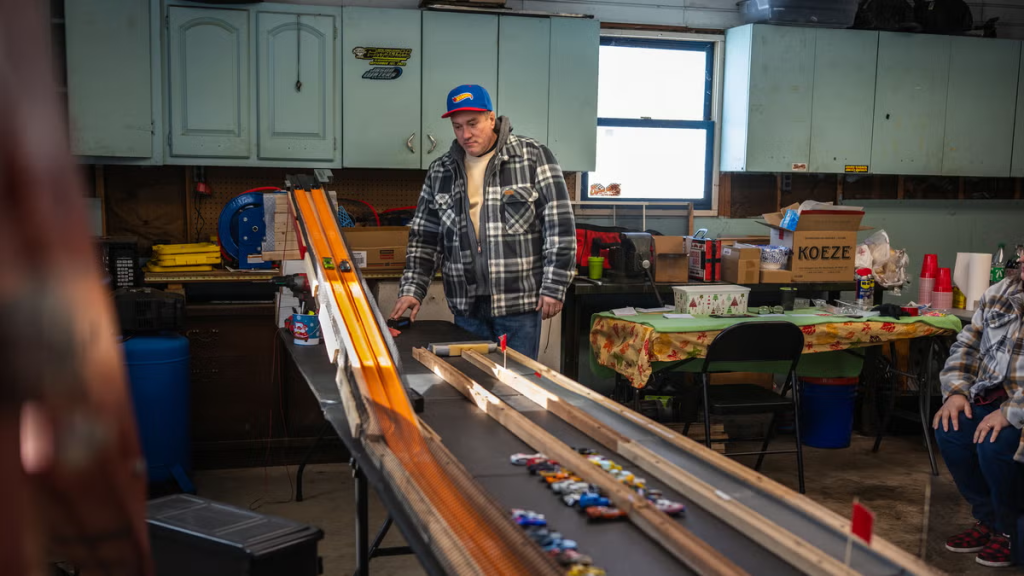
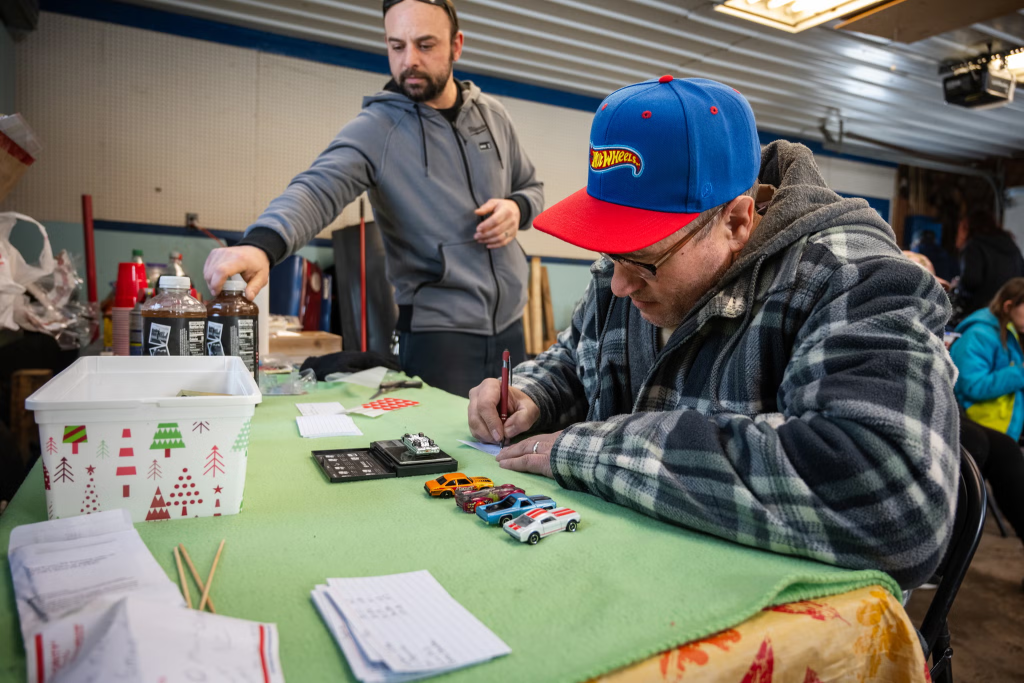
The rules exist mostly by consensus, this being only the third race he’s held. Registration opens at noon, and racing begins around one. Any 1:64-size die-cast car is fair game, stock or custom, as long as it fits the starting gate, keeps its wheelbase under two and a half inches, and weighs no more than fifty-seven grams. Each person can enter up to five cars.
Herman weighs them one by one on a small digital scale and logs each number by hand on an index card. From there, cars are sorted into heats by weight and by his best guess at their ability to go fast. He takes timing, fairness, and repeatability just as seriously as in life-size-car racing, in which he participates through enduro, the kind of automobile racing in which drivers rip inexpensive stock cars around an oval track for hundreds of laps.
By the time racing begins, about twenty-eight people are gathered. Mostly adults. Women too. Herman’s sister stops by with her chili. His niece hovers near the chairs for a while before drifting off. A brother-in-law comes through briefly. Old friends from school lean against the workbench and talk trash. Gosia, Herman’s wife, moves easily through the space, checking on food, teasing her husband, keeping one eye on the kids and another on the track where she also has cars lined up.
A few children thread through the folding chairs, holding gaming devices or clutching die-cast cars of their own, sometimes both. One racer wasn’t there at all, at least not physically. He mailed his cars from North Carolina to compete.
I enter five cars at a dollar apiece, assuming I’ll stay for an hour or two. I stay for four. When I finally depart, I leave behind my two cars that have advanced—an El Segundo Coupe and a supercharged Twin Mill, both red, both part of a five-car set purchased from a pharmacy for seven bucks—trusting them to finish what they started.
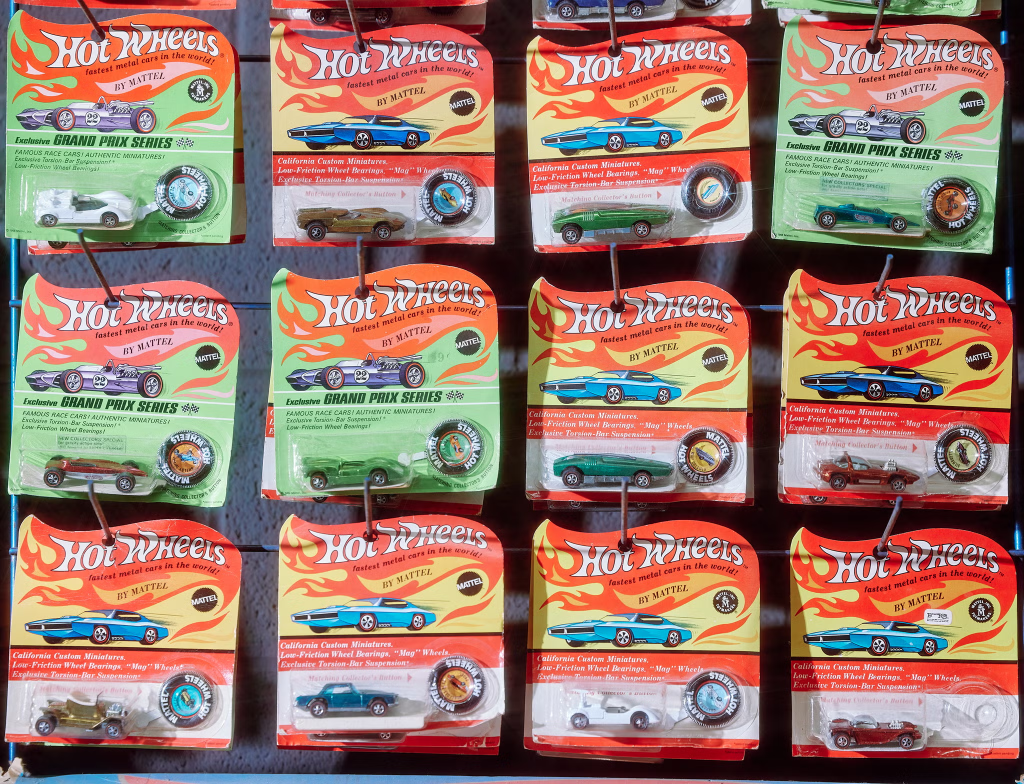
Ted Wu, Senior Vice President at Hot Wheels and Global Head of Vehicles and Building Sets at Mattel, talks about toy cars the way some people talk about family heirlooms, with affection, responsibility, and a clear sense that none of it really belongs to him. “Whether you’re three or 103,” he says, “we have something for you.”
Wu oversees Hot Wheels and Matchbox as part of a broader portfolio at Mattel, but his relationship to the cars predates the job. He grew up in a house with a father who loved cars. One of the first model cars Wu remembers owning as a kid was a Hot Wheels Porsche 964. Drawing them came next. Then he studied them, first through illustration and design, then through business economics and visual art.
At Mattel, that dual fluency is the job. Hot Wheels has posted eight consecutive years of record growth. The one-dollar singles, the cars you find at grocery stores and in big-box aisles, remain the number-one toy in the world by volume. More than twenty-five Hot Wheels cars are produced every second.
Each year, roughly 130 new models enter the lineup. None are straight repeats. Every car is new in some way. A new casting. A new livery. A recolour that makes an old shape feel different. “We don’t think we’re just making toy cars,” Wu says. “We’re representing car culture.”
That philosophy allows the same object to land differently depending on who’s holding it. A Nissan Skyline might matter to a gearhead because the headlight tampo is historically correct. Or a kid might just like it because it’s a cool purple car. Ideally, it’s both.
Wu won’t share the exact buyer percentages, but kids still outnumber adults. The number of older consumers, though, is growing and increasingly visible. “It’s not like we saw adults coming in and said, ‘Oh, we’ve got to jump on that,’ ” he says. “The brands have always appealed that way. We’ve always been focused on authenticity.”
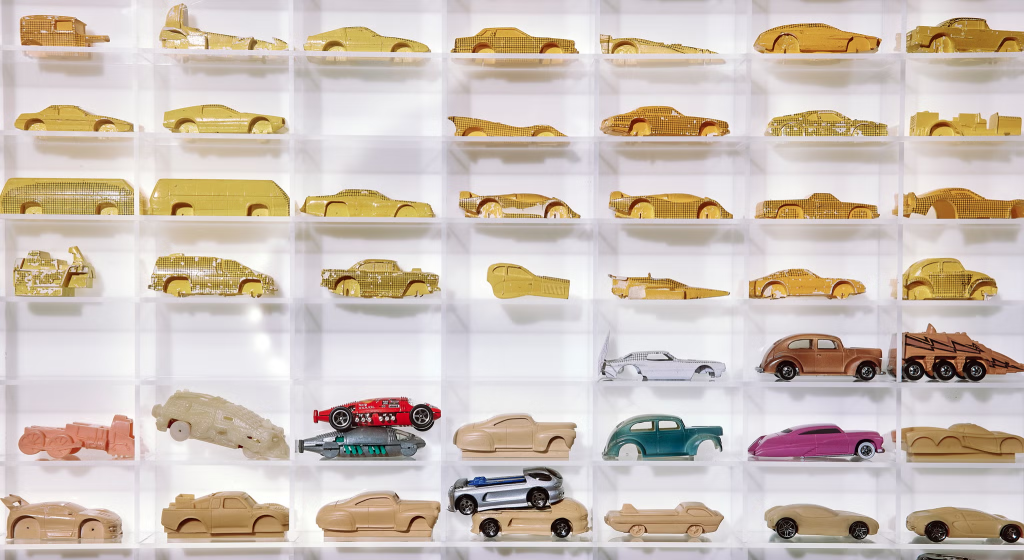
Many of Hot Wheels’ designers are classically trained transportation artists who designed full-scale cars, recruited directly from the automotive industry. The annual planning process is equal parts art and logistics: Hundreds of cars are laid out on boards, balanced by silhouette, colour, price point, and subculture. Japanese domestic market. American muscle. Exotics. Everyday commuters. “We measure twice and cut once,” Wu says. “Then we go.”
What Wu doesn’t try to regulate is what happens after the cars leave the store. Unopened blisters don’t bother him. Neither do stripped paint jobs, replated bodies, or engraved customs. “That’s a collector call,” he says. And customisation? He lights up. “It’s more expression of your individual self, which is what Hot Wheels is all about,” he says.
On camera, Julio “Kandyman” Perez’s hands move deliberately. He lifts the bare, paint-stripped body of a toy car onto a turntable, rotates it under the light, and decides where colour should live. He uses real automotive paints, real airbrush methods. Candy colours build slowly, one layer over another, until the surface looks wet, then deep, then almost unreal. If something goes wrong late in the process, there’s no shortcut; he has to strip it and start again.
Perez spent more than thirty years working on full-scale cars—fabrication, bodywork, paint—long days on concrete floors, hands permanently marked by solvents and pigment. That life narrowed abruptly. Years of diabetes had already taken a toll, but the turning point came in a series of cascading crises: recurring infections in his feet, hospital stays, a heart attack that required stents, and ultimately partial amputations on his left foot. The long days on concrete shop floors—fifteen, sometimes eighteen hours—were no longer sustainable. Neuropathy and foot drop made standing painful; healing grew slower and riskier each time.
“When you’re used to working a hundred miles an hour and suddenly you stop,” he says, “it affects you physically and mentally.” What he lost wasn’t only income but identity. Die-cast cars entered his life not for nostalgia but for proximity. “This is the closest I can be to a car,” Perez says. It’s the closest he can still get to the version of himself who knew what to do with his hands.
At 1:64 scale, there’s no margin. Tape placement, order, and patience matter. A single car can take weeks of daily work. Perez favours larger castings—delivery vans, long roofs, custom bodies—anything that gives him room to think. He strips factory paint, erases mould lines Mattel never intended anyone to see, rebuilds wheels, repaints tyres, cuts and splices bodies into vehicles that never existed.
What surprises newcomers isn’t just the finish but how little of the process he guards. Perez teaches airbrush classes. He answers questions live and explains what he’s doing as he’s doing it. If someone asks how he gets a result, he shows them—careful to note that it’s his way, not the way. That openness has shaped the community around him, and Perez has become a mentor almost by default.
Chris Lang first encountered Perez on TikTok, watching his live customisation sessions and studying the discipline in his paintwork: the restraint, the patience, the respect for surface. He began showing up regularly in Perez’s live streams, asking questions, paying attention. Over time, the interaction moved from casual chat to something closer to an apprenticeship. “He helped me tremendously,” Lang says. “He’s been doing this a long time.”
Lang is fifty-eight and based in Katy, Texas. He trained in a family engraving business, Max Lang Belts & Buckles, and worked for decades on silver, gold, and leather. He knows how metal behaves under pressure, how much it will take before it resists.
When he turned to die-cast cars, he didn’t treat the objects as toys or replicas but as raw material, a blank canvas. He joined a Facebook collector group and watched the numbers tick upward. Nearly half a million members. “I remember thinking, What can I sell to 498,000 people?” Lang says. “I’m a retail guy. That’s how my brain works.”
Lang sources his castings himself, usually at Walmart, gravitating toward bodies with uninterrupted surfaces—’55 Chevys, gassers, older muscle cars—metal that will take a pattern without fighting back. Factory paint is removed with Orange Stripper until the bare body, which was cast from a zinc-based alloy called Zamac, is exposed.
“They look beautiful at first,” Lang says, “but almost like sterling silver, they start to tarnish.” After engraving, the bodies are electroplated in silver or gold, sealing the surface and giving the work permanence without softening the lines.
The first time he shared a finished car publicly, the response surprised him. People he considered untouchable—established customisers, collectors with reputations—reacted immediately. The validation mattered more than the sale.
One buyer in particular stayed with him: someone from Hot Wheels magazine. For a man whose engraving portfolio includes a sterling-silver belt-buckle set made for President George W. Bush, that approval landed differently. Recognition from inside the die-cast-car world meant more than the prestige of any high-profile commission.
At the time I spoke with him, Lang had been doing this for just eleven months. What began as a way to stay busy after he and his wife separated—something precise when the rest of his life felt unmoored—quickly became structured. Orders stacked up. Turnaround times mattered. He began tracking materials, shipments, and hours. The cars didn’t fix anything, but they gave him a rhythm and a reason to show up.
Most pieces sell for USD150 to USD300, more if there’s gold plating or a labour-intensive pattern. The goal isn’t exclusivity. He respects the work and the people who want to own his work. “This is a middle-class hobby,” he says. “I don’t want to be the guy who turns a one-dollar car into something nobody can afford.” Lang and Perez also regularly give cars away as donations to fundraisers, races, and people who show up consistently and help keep the ecosystem running.
But Lang is clear about what he and Perez make. “People ask if it’s a toy or if it’s art,” he says. “It’s art.”
Nelson Luz, fifty-three, has been collecting for most of his life. As a kid in Europe, it was bottle caps—raced along classroom railings, bumped off ledges, traded between classes. Then coins. Then comic books, which eventually took over his house: boxes stacked, values logged, rare issues sealed away. Each phase followed the same logic. “It always goes back to the hunt,” he says. “Finding variations. Finding something unique.”
Hot Wheels came later, almost by accident. One Christmas when he was in his forties, his niece gave him a small die-cast version of a car he actually owned—a Mazda RX-7. It went on a shelf. Then a second followed. Then another. Cars he’d driven, or cars his brother loved. Cars he recognised. “You start with what you know,” he says. “And then it just opens up.”
Today, Luz talks about Hot Wheels the way businessmen talk about supply chains. There are mainlines and premiums. Treasure hunts in box stores at odd hours, super treasure hunts at conventions, and toys. Cars meant to be raced, cars meant to stay sealed, and cars that exist mostly as leverage—objects whose value depends on timing, scarcity, and who wants what this week. He tracks it all in a database he built himself, logging releases, variants, and storage locations.
“Nobody wants to overpay,” Luz says. “But everybody wants to feel like they got it right.”
Collecting culture isn’t all about money. One collector on TikTok chases a single casting across every colourway, forming a sort of rainbow effect when they are displayed. Another sticks to Japanese domestic-market cars, or American muscle, or trucks built to be customised. Some won’t rip open the packaging if it’s intact. Others open everything immediately. “Eventually,” Luz says, “you figure out who you are in it.”
Bruce Pascal, sixty-four, has turned his obsession into a private archive. His Hot Wheels museum in Maryland houses prototypes, unreleased designs, and one-offs that were never meant to survive beyond conference rooms or factory floors.
Pascal grew up in a car family with a 1929 Buick in the driveway. He moved from toy cars as a boy to real ones as an adult: a 1940 Buick Special, a 1960 Chrysler Imperial, a 1970 Dodge Charger. He put himself through college by serving legal papers, a job that, without the Internet, required him to knock on doors and ask neighbours or follow forwarding addresses and paper trails.
When his mother returned his childhood Hot Wheels to him in a cigar box in the late 1990s, a friend looked at the cars and offered him USD200. “And all of a sudden, something went off in my head,” he says. A real car took up a garage. It needed insurance. Oil changes. This, he thought, looked easier.
Within weeks, Pascal was running classified ads in The Washington Post: Were you born in the 1960s? Do you still have your Hot Wheels? He didn’t know what to offer. He guessed. Two hundred dollars. Three hundred. Sold. Within six months, he had hundreds of original late-1960s Hot Wheels models nicknamed Red Line–era cars for the thin red stripe on their wheels.
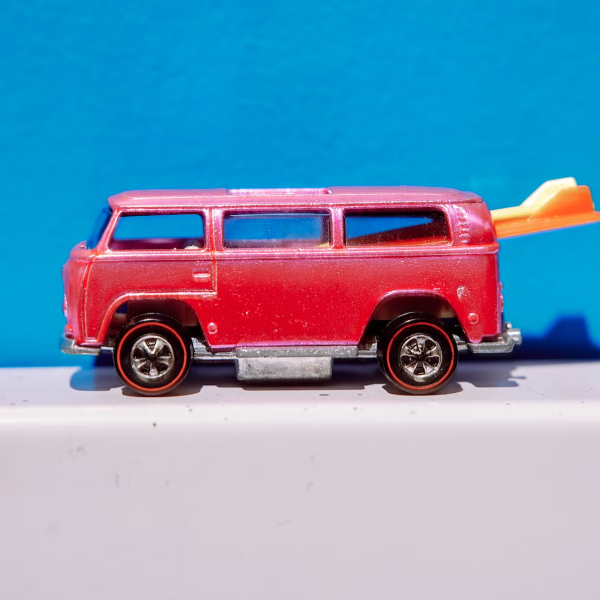
Then he read about the world’s rarest Hot Wheels item—the shiny pink “Beach Bomb” Volkswagen van prototype—selling for USD72,000.
“That’s a great deal,” he told his wife with regret in his voice. “I could’ve bought that.”
A few months later, he noticed the deal hadn’t closed. Pascal tracked down the seller. Then the original Mattel employee who had taken the prototype home decades earlier. When rival collectors questioned its authenticity, Pascal did what he’d always done. He gathered affidavits, internal Mattel magazines, business cards, and photographs. The car was real. And so was the implication: If one former employee had brought a holy grail home, others might have done the same.
Night after night, he combed through old Mattel house magazines, copying names from anniversary announcements and retirement blurbs. He built spreadsheets and cold-called, sometimes ringing thirty people before landing on the correct former employee. He didn’t ask for cars; he asked for stories.
“I needed a reason to call,” he says. “You can’t just say, ‘Hi, you worked at Mattel—do you have anything for sale?’ ”
Sometimes he was offered patents or wooden hand-carved models. Sometimes blueprints and prototypes that were never released. Over time, Pascal interviewed more than four hundred former Mattel employees, acquiring thousands of artifacts: internal documents, store displays, race suits, gas-station banners, and design concepts for cars that never made it to shelves.
He talks about production errors and wheel variations with the same precision he uses when discussing what will happen to the collection after he’s gone. Pascal knows that the hardest items in his collection aren’t the ones you can price by auction results but the things that exist once or twice, with no public record attached.
To prepare for that, he’s built a private database: what he paid, what he believes each item is worth, and instructions for how his wife and daughters should sell them if he dies. “I don’t expect them to run a museum,” he says. “I’m not trying to win an award for dying with the most Hot Wheels.”
Despite the size of the brand, the ecosystem is small. Pascal knows Ted Wu, for instance, who doesn’t see Pascal as an abstract “collector” but as a person—one of a tight orbit of designers, historians, and obsessives who have circled around Hot Wheels for decades.
In Edwin Herman’s garage, the cars drop. Gravity does what it always does. A blue Mercedes-Benz 190 slams the wall before the checkpoint and is out on the spot. A purple Porsche 935 flips in the hot-dog turn and skids across the line backward but still takes the heat. A red ’70 Dodge Charger dives into the banked curve alongside a blue flame-licked ’62 Chevy pickup, the upset unfolding in real time.
Along the rail, my El Segundo Coupe and Twin Mill look almost modest beside a white-and-blue-striped Porsche 944 Turbo and a low-slung fantasy racer with a lime canopy. Some cars are picked for pedigree, others for paint, but I chose mine by instinct, the way kids do. The Coupe’s retro-futuristic lines and clean red finish simply felt right in my hand.
Herman tells me later, via Facebook message, that my cars made the final round. I finish twelfth out of twenty-eight in the overall standings. Although I never touched the podium, I find myself proud of smaller victories, like “choosing well” and advancing further than I expected in my first race. Each outcome delivered the same small shock—a jolt in the body, a quick smile—proof that some part of my innocence is still intact.
Herman wants to host more of these events each month, refining his system. Soon he will register his track on a public locator used by gravity-race organisers nationwide. Lang and Perez, meanwhile, plan to attend the sixteenth annual Hot Wheels collectors national convention in April in Indianapolis, along with others who have spent years trading jokes, cars, and stories without ever shaking hands.
Mattel will likely send designers, maybe even Wu, who will answer questions and sign cards like a rock star after a concert. Joy is thinking about attending too, hoping to meet many of the people he knows only by screen name. But even in a convention centre full of Hot Wheels, Matchbox, and brands long forgotten, Joy still finds the meaning of it all in a single, white toy car.
After his son died, Joy needed time before he could face the boxes of belongings left behind. Grief moved slowly. But when he finally opened one, tucked inside was the car Joy had carried in his mind’s eye for years, the Lotus Esprit he assumed he traded, sold, or lost.
Did his son know how much the toy mattered? Is that why he kept it, through addiction, instability, homelessness? In Joy’s hand, the car is what it has always been: metal, paint, wheels. It rolls. Fits perfectly in his palm. Built for motion. Small enough to carry. Sturdy enough to last.