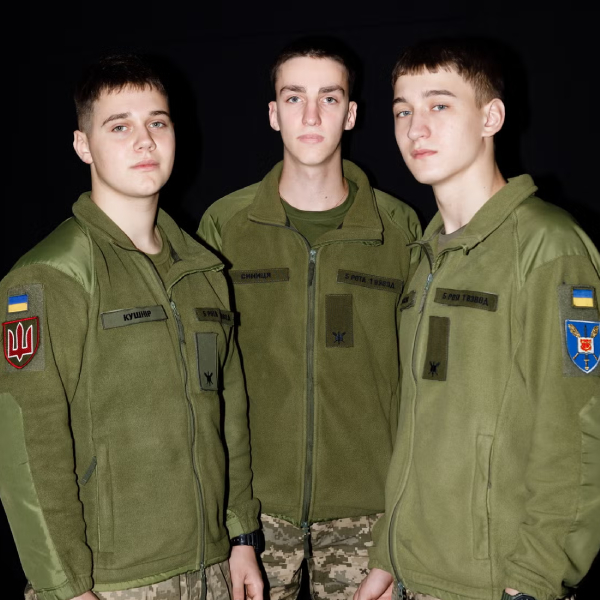
At 6:30am, the school day at Ivan Bohun High School in Kyiv begins. Students at the boarding school for boys and girls aged 15 to 17 wake up, make their beds, brush their teeth. At 7am, they go for a 20-minute run, followed by their first breakfast; they pour into a large cafeteria and eat eggs and toast quietly.
At 8:20am, they stand in a line for roll-call, ready for their first lessons of the day. Ivan Bohun is a regular high school in some ways, with regular subjects, but the children are also here to learn something else: to defend their country—if need be, with their lives.
Built as a school for imperialist soldiers in 1915, two years before the Russian Revolution, it is named after Ivan Bohun, a Cossack colonel and a symbol of Ukrainian independence. It has been used by the tsarist army, the revolutionary Bolsheviks, Nazi soldiers, the Soviet Army and, finally, Ukraine’s military. The halls are covered with paintings of Cossack fighters and Ukraine’s beloved poet Taras Shevchenko, photographs of military jets flying through the air and portraits of alumni who have died more recently while in combat on the country’s front lines.
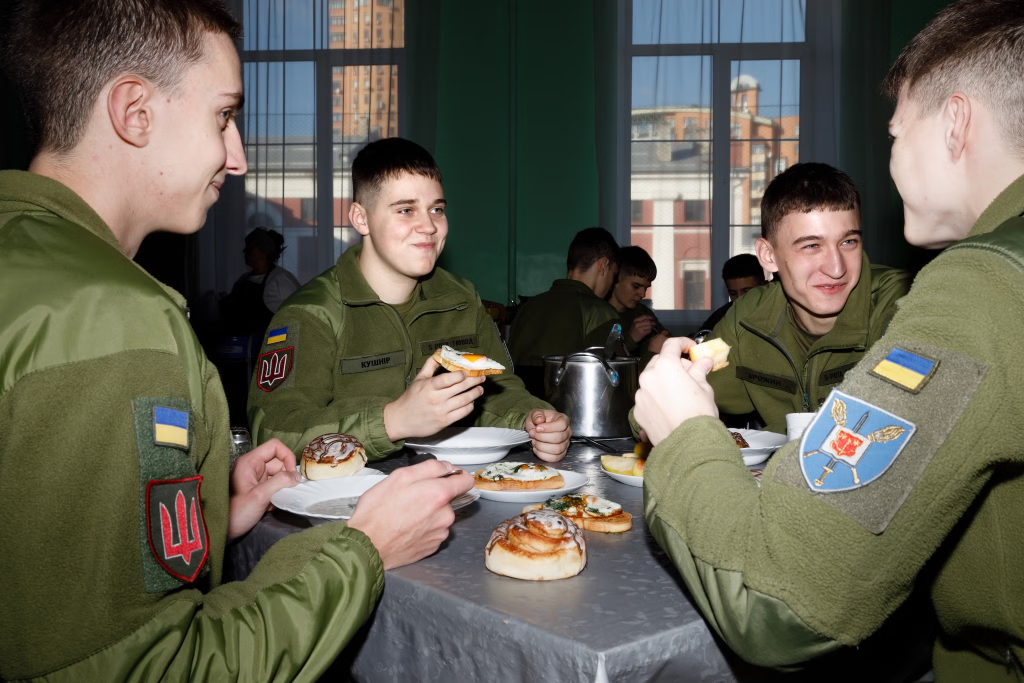
Unlike teenagers at other high schools, where students might wear whatever they want and classrooms echo with loud voices, the children at Ivan Bohun are different. They wear long-sleeved, olive-green button-downs, camouflage trousers and brown military boots. The boys have buzzcuts and the girls wear their hair pulled back in tight buns without a strand out of place. Students are divided into classes of 20, which they call “platoons”.
In the heart of Ukraine’s capital city, the 600 boys and girls at the Ivan Bohun school are cadets at the country’s largest military academy. Five days a week, the cadets study the usual topics—maths, science, history—but also Nato classes, military intelligence, how to shoot a rifle and the components of various types of drones. After graduating, students can advance to military universities and later rise through the ranks of Ukraine’s army to become sergeants, lieutenants and colonels, or staffers in the Ministry of Defence.
The root of the pupils’ patriotism is not hard to trace. On 24 February 2022, Russia’s full-scale war in Ukraine began. Moscow’s troops attacked the neighbouring country from all sides in an attempt to seize Ukraine, which Russia has sought to achieve since the initial phase of the war began in 2014. Russian President Vladimir Putin justified the invasion by calling for the demilitarisation of Ukraine, with the intention of stopping the expansion of Nato and Western influence, which he considers major threats to Russia.
Putin has yet to call the invasion of Ukraine a “war”, preferring “special military operation”. Over most of the course of the students’ lifetimes, the war has sought to strip away Ukrainian culture, which Putin has claimed never existed. It has tried to terrorise civilians and exhaust Ukraine’s military.
Over the past four years, countless families have been torn apart, millions have been internally displaced or become refugees in foreign countries; according to the United Nations, more than 10 million Ukrainians have been forced to flee their homes, including more than 1.76 million children. And no one knows when any of it will come to an end.
Each cadet is motivated to join Ukraine’s military for reasons that are inescapably personal. Some of them have come from the occupied territories. Some have parents who are serving in the military or have died during the war. Other cadets fled Russian-occupied regions or came from heavily attacked towns and cities.
Every student has grown up with Russian aggression and known little else; when Putin launched the first phase of the war in 2014—annexing Crimea, a peninsula in Ukraine, and pushing for control of Donetsk and Luhansk, which collectively make up the Donbas region—some of these children were as young as four years old.
The trauma of surviving occupation—of being trapped with few resources, witnessing the violence and devastation of war and the constant fear that, at any moment, Russian soldiers can inflict havoc on civilian life—is enough to have a lasting impact on even the most composed of adults. But at the academy, the cadets’ experiences of occupation have sparked something different: a desire to devote their lives, which have only just begun, to the defence of their country.
The deputy headmaster of Ivan Bohun is Colonel Dmytro Yermolenko. He has worked at the school since 2002 and plays a pivotal role in day-to-day life. He walks through the halls with force; cadets stand to attention and salute him as he passes. He’s no-nonsense, and he speaks about the history of the institution with passion.
“This room was used as a hospital for Nazi soldiers during World War II,” he tells me as we stand at the back of a chemistry class. “Over here, you can see our museum dedicated to Ukraine’s military,” he says as we enter a room filled with Ukrainian uniforms, badges and pictures. He walks to a tall glass case to point out photographs of the cadets walking in Ukraine’s Independence Day parade. In a faculty office room, Yermolenko offers me tea and says, with evident pride: “You can see that our cadets are very disciplined.”
One of the internally displaced is Yehor, 17, a vice sergeant of the 1st Platoon. He is lanky, with freshly buzzed brown hair, and speaks with composure and care. He is from Tokmak, a small city in the south-central Zaporizhia region, which became a vicious front line in the early days of the war.
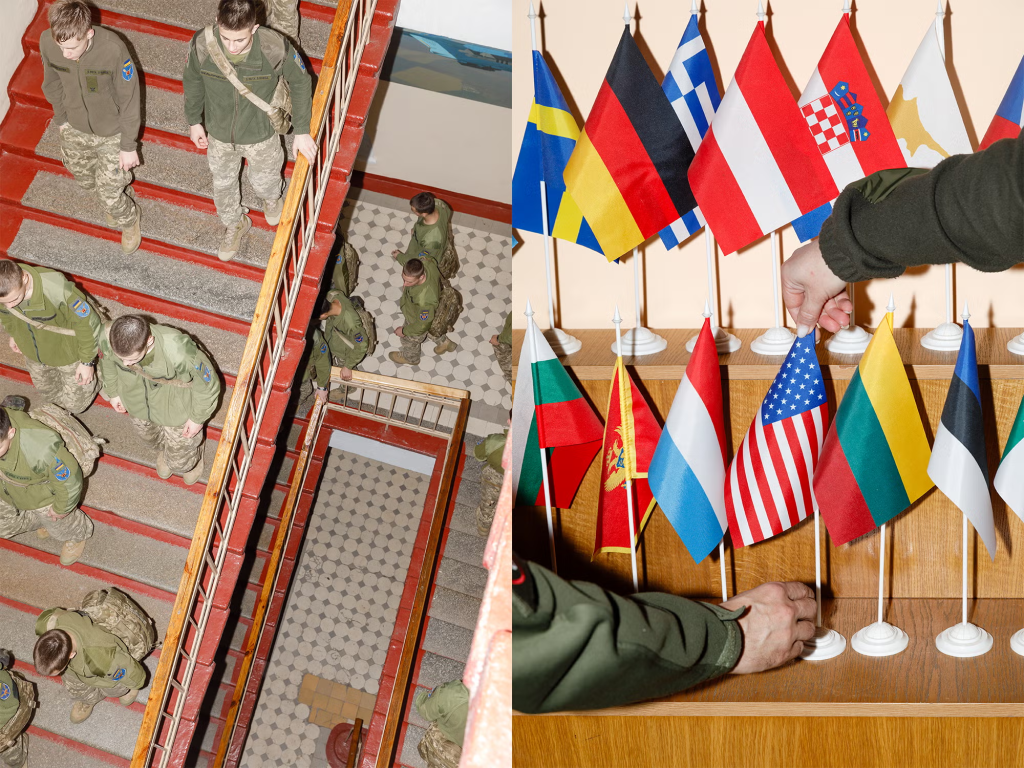
In one of the academy’s offices, a Nato-themed room with a vast wooden table around which the staff sometimes hold interviews with foreign diplomats, Yehor tells me about his life in Tokmak in the before-times: he was a normal kid, helping his parents do chores around the house, hanging out with friends and focused on boxing lessons and school. “Life was good,” he says.
Everything changed on the day the war began. Yehor’s mother woke him early, not for school, but because something was wrong. “I didn’t understand what was happening,” he remembers. “I was confused; it was scary.” With his parents, he stood in front of their television, watching Russia attacking cities throughout Ukraine. When they saw footage of an attack on Kharkiv, Ukraine’s second-largest city in the country’s northeast, they realised that a full-scale invasion had begun.
That same day, Yehor’s father, a soldier, was deployed; he has been serving in the military since. At the same time, Yehor, his mother Olena and his five-year-old sister fled to a small village outside of the city, where they lived with his grandparents. They hoped the village would be safer than Tokmak but, soon after, that too fell under occupation.
For a month and a half, they lived in a town trapped under Russian control, where Russian soldiers were searching for all military families, including Yehor’s. Because of roadblocks set up by Russian troops, it took a day and a half to flee to Zaporizhia city, a drive that had taken just an hour only days before. At every checkpoint, they feared they might be injured or even killed.
Zaporizhia should have been a place where the family could finally rest—it was still under Ukrainian control—but the city was also close enough to the front lines that there were constant air-raid alerts, frequent shelling and endless ballistic attacks. Once, a missile passed their apartment and landed nearby, the blast nearly shattering their windows. Yehor and his family moved to Poland in May 2022, where he felt like a refugee and nothing else. He didn’t like it. For the next six months, Yehor would tell his friends that he would return to Ukraine soon, where his future was.
Life began to fall back into a familiar rhythm when the family moved to Poltava, a city in central Ukraine, in November of that year. There was a veneer of normality—school, sport, new friends—but Yehor says that his time living under occupation “left a lasting impact”. His father is still serving in the military. Frankly, he says: “I still don’t want to remember all of that.”
Two years later, Yehor decided to enrol at Ivan Bohun. “If we want to make a difference in our country, we need to take action instead of simply complaining about the shelling,” he says. Yehor looks up to his parents as role models of what “true patriotism” looks like: his mother, who cooks breakfast for her children every morning, even after the family has spent the night in a bomb shelter, and his dad, who is risking his life for Ukraine. He hopes to follow in their footsteps.
Yehor secured his position as a vice sergeant because of his discipline and determination. He monitors the 1st Platoon’s daily schedule and makes sure his classmates follow it thoroughly, including dressing for the weather: right now, in the Kyiv winter, that means wearing a fleece and thermals under their shirt and trousers to stay warm. But he also checks that the heaters are turned off before Russian shellings and during air-raid alerts, and that none of his platoon stays behind as they move underground.
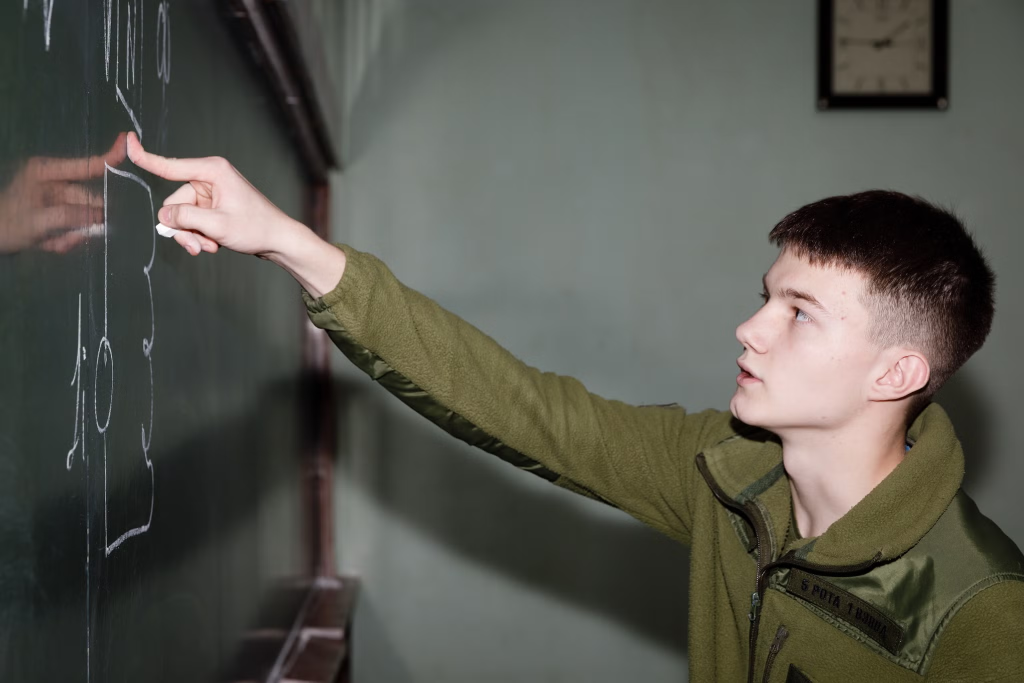
The first class of the day is The Defence of Ukraine, a favourite at Ivan Bohun because students learn about drones, weapons, war tactics and front-line activities. Today’s topic is bluntly straightforward: What are anti-tank mines?
Like Yehor, many of the students at Ivan Bohun have parents who are serving in the military. Sitting next to Yehor is Illia, 17, tall with a brown buzzcut, slim face and thick eyebrows. Illia has a sense of confidence about him: his Ukrainian teacher says he can recite poetry by heart and is proactive in class. He calls Illia “cool”.
At the academy, 26 per cent of students are the children of active-duty military personnel, according to Yermolenko. Illia’s father is a military pilot and his biggest inspiration; one day, he hopes to become a pilot too. “From childhood, my father would take me to the airfield. We would talk and watch the pilots, and I fell in love with it,” he says. “I enjoy the smell of aviation kerosene. When my father returns from the airfield, his jacket smells like that.”
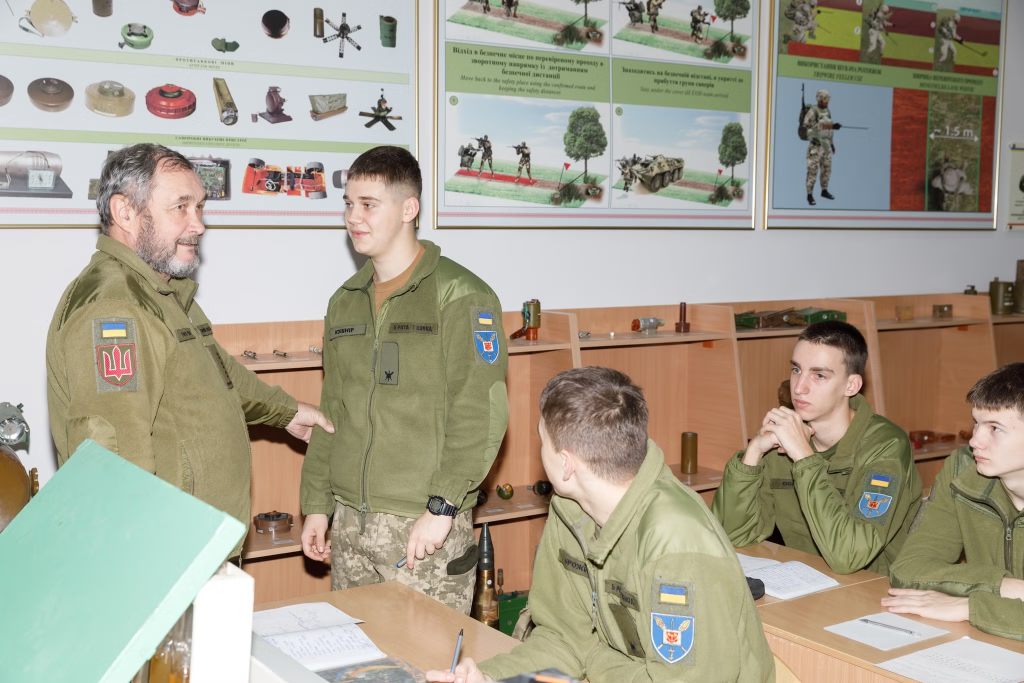
At 9am, just before class begins, all cadets stand for the nation-wide moment of silence, during which the country honours the soldiers who have given their lives to protect their country. The children stand at their desks, heads bowed. It is broken finally by the teacher bellowing, “Слава Україні!” (“Glory to Ukraine!”), to which the cadets reply, “Героям слава!” (“Glory to the heroes!”).
The boys sit in the first three rows of desks, divided into two sections by a large table covered with a map of Mariupol, the city in southern Ukraine where a battle raged for the first 80 days of the war. Ukrainian officials have estimated that at least 25,000 people died during the siege there, though the Associated Press has said the death toll could be three times as high. The map of Mariupol serves as a constant reminder to them of what Russia is capable of.
Illia is from Kyiv. At the beginning of the war, Russian troops had managed to make their way into the Kyiv region, and Putin said that the capital city would fall in a matter of days. One of the first towns on the outskirts of Kyiv to be occupied was Bucha, which became the site of some of Russia’s first alleged war crimes in Ukraine. Bucha was under Moscow’s control for just under one month at the beginning of March 2022, but in that time at least 450 civilians were killed, many of whose bodies were dumped in two mass graves in the town.
Seeing the footage from Bucha was one of the main reasons behind Illia's decision to pursue a career in the military. Four months after Bucha was liberated, he enrolled in the Boyarka military academy, which takes 13- to 15-year-olds. In 2024, he moved to Ivan Bohun. Illia likes his school because it is filled with people who care deeply about Ukraine. “When I see videos like [Bucha], looking at their [Russia’s] actions, I feel more motivated to protect civilians, to protect my country,” he says.
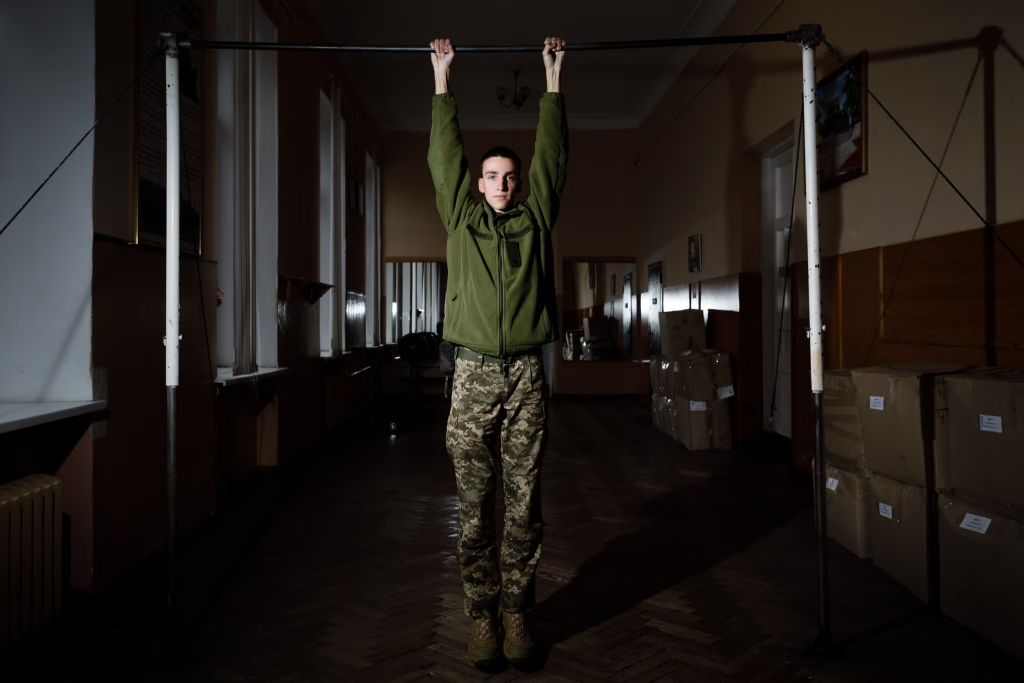
While teenagers elsewhere might spend extensive time online, the cadets can only use their phones at the end of the day and on weekends. The boys I meet speak formally, with few “likes,” “you know,” or “rights”; they sit in their chairs, never fidgeting. They call their peers who are not at the academy “civilian children”, whereas they view themselves as already part of the military. I asked each boy if they knew they could be severely injured or killed while in service; all replied that it is a risk they are willing to take.
For the first three and a half years of the war, men between the ages of 18 and 60 were forbidden to leave Ukraine—part of the enforced martial law—in case they were needed for military mobilisation. But at the end of August 2025, Ukrainian President Volodymyr Zelensky loosened the rules for men who are not yet eligible for military service, which begins at 25.
The new law created a mass exodus of men aged 18 to 22 and, one month later, the European Union granted temporary protection to 79,205 Ukrainians, the largest monthly rise since August 2023. The boys at Ivan Bohun are all under 18 and, under the new legislation, they can leave the country at any time within the next four years. But as scores of young men depart, the boys remain.
The school day rolls on. First period runs into fourth; then the second breakfast of the day at 12:10: cinnamon rolls and porridge. Fifth period through seventh; then a lunch of soup and various kinds of meat. At 3:25pm there are biology, history and Ukrainian lessons; the 1st platoon conducts electromagnetic experiments in their science class. For a brief moment, they can see snow falling through their classroom windows.
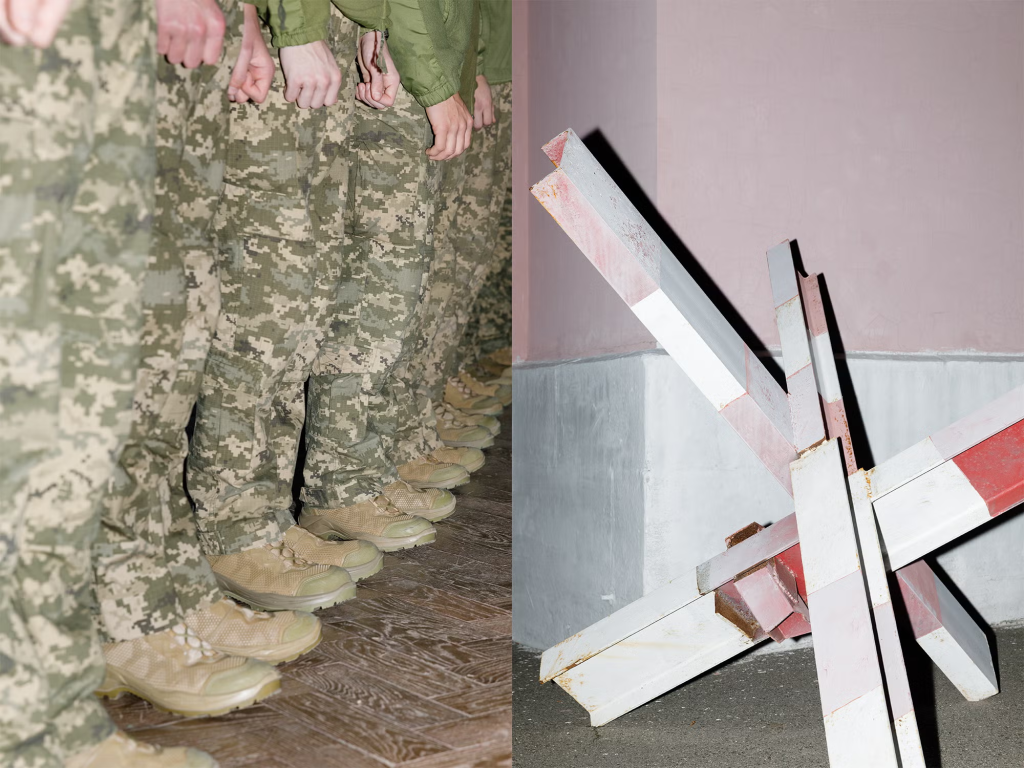
Oleksii, a 17-year-old cadet, tells me he had hoped, in the early days of the war, that Ukraine’s military would liberate his town in the Kherson region. It still has not. Oleksii is the tallest of the five boys; he asks not to be photographed because he still knows people living under occupation.
Before the war, Oleksii was active, curious and cheerful. He liked cars and Lego. He had friends and was sociable. But during the occupation, Oleksii found that Russian troops “annoyed” him. When he tried to play with his friends, he was told not to go too far, to be quiet and not to be seized by Russian soldiers; it is estimated that as many as 20,000 children have been abducted from occupied areas and forcibly taken to Russia.
His family tried to escape from their town in Kherson. The first time, in April, Russian troops forced them to turn back. In August, though it took them five days, they succeeded in leaving. They moved to Vinnytsia, a city in central Ukraine, and began rebuilding their lives. But in Vinnytsia, Oleksii became depressed and had a hard time adjusting to a new city, a new school and being far from his friends.
He became quieter, more reserved—traits that haven’t left him. Oleksii’s mother considered moving the family abroad, but her son insisted on staying in Ukraine. Oleksii had always thought about becoming a soldier, but after fleeing the occupation, the irritation he felt towards the Russians hardened and his decision to join the military became final. In 2023, Oleksii began the process of joining Ivan Bohun. He told his mother: “Who else will liberate our land if not us? Our generation has to do it.”
Oleksii was scared at the beginning of the war, though he is not any more, and believes the academy helped him overcome that fear. There is discipline at the academy, and his platoon is friendly. Like each boy I spoke with, Oleksii would still want to join the military even if the war ends soon. “I believe the youth are the most capable of serving in the modern army,” he says. “The younger generation should do it. There will be no one else to do it.”
There have been efforts at peace negotiations between Russia and Ukraine for more than a year now, spearheaded by the Trump administration. This January, US-mediated talks took place in Abu Dhabi, with further sessions planned, but no resolution has been reached at the time of writing. Few could predict that the war would reach its fourth anniversary this month and, at present, Ukraine’s military is struggling to find recruits. Enthusiasm to enlist was high at the beginning, but it has dwindled since.
Russia is making advances in the Donetsk region, of which it currently controls 80 per cent; two months ago, it claimed to have taken control of the logistical hub city of Pokrovsk. Putin has long said that for there to be any peace deal or end to the war, Moscow must control the entire Donbas region.
Commanders stationed in Donetsk told the Financial Times in 2024 that 50-70 per cent of new recruits are injured or killed within days of starting their first rotation. According to a report from The Centre For Strategic and International Studies, more than 400,000 Ukrainian soldiers have been killed or injured since the war began.
The servicemen and -women who have died often leave behind children who will now grow up without a parent. The charity Unicef estimates that one in five children in Ukraine has lost a relative or friend since the full-scale war began. At Ivan Bohun, nearly four per cent of cadets have lost a parent on the front lines, according to deputy head Yermolenko. Many feel that joining the military is one way they can honour those they have lost.
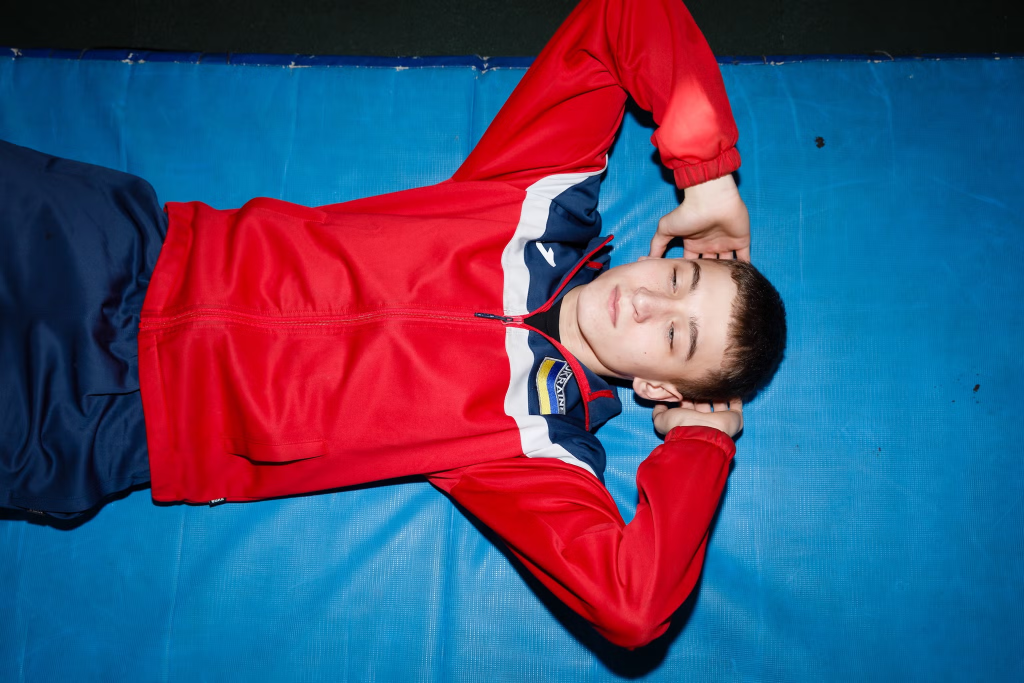
Danylo was 13 when he received the news that his father Ihor had been killed. Although he has the face of a child still growing into his features, his mother Valentyna says he grew up fast. My translator asks Danylo if he is OK with speaking about his father and he replies calmly, “It’s fine.”
Ihor had joined the Marine Corps at the start of the war and told his family that he was not fighting on the front lines, despite having been at the so-called “zero position” of the war for months; many of Ukraine’s battles are fought in trenches a few kilometres from enemy forces, using drones and artillery, but the zero positions are the most dangerous parts of the battlefield, where Russians and Ukrainians meet.
Ihor died on 9 November 2022, killed alongside other soldiers by a Russian cluster bomb in Vodyane, a village in the eastern Donetsk region. A soldier who survived the attack later recounted how Ihor had died in his arms. When Danylo learnt about his father’s death, he shouted: “Everyone can die, but not my father!”
Danylo’s father was his friend—someone he could trust. Ihor was a patriot even before the war; he hated Russian culture and the language, and raised his children to speak Ukrainian at a time when the country still grappled with moving away from Russian. Soldiers from Ihor’s brigade visited the family after his death and told Danylo: “You have to be strong. You are a man; help your mother.”
After Ihor’s death, Danylo frequently ran to his father’s grave in the Vinnytsia region, carrying flowers, but at the same time, he told his mother: “If I were in my dad’s place, I wouldn’t think twice; I would go to war to protect my family the same way as he did.”
Losing his father solidified Danylo’s dream to become a soldier, and he has lost none of his determination. “My father died for our motherland, which gave me even more motivation to pursue this path,” he says. “After his death, I was no longer uncertain. I was 100 per cent determined to become a soldier. A hundred per cent.”
As Danylo is talking, an air-raid siren sounds: a loud and daunting electronic wail warning of the possibility of a Russian attack. The cadets know the drill and walk in a hurry to the basement of the school, which acts as a bomb shelter. It is lined with rows of bunk beds, in case Russia should launch an overnight attack on Kyiv; Moscow has increased its nightly attacks on the capital throughout the past year. As Iranian-designed Shahed drones and missiles pummel the city, its residents move underground.
The air-raid alarm lifts, and Danylo and the 1st platoon move on to physical education. Dressed in their gym clothes—blue, white and red zip-up jackets, blue sweatpants and trainers—the boys begin their CrossFit exercises in the academy’s gymnasium, which has Ukraine’s national colours, blue and yellow, painted on the walls. In pairs, the boys move through intervals of burpees, sandbag squats, kettlebell bicep curls, push-ups and dumbbell power-snatches. A buzzcutted coach in a blue-and-yellow tracksuit looks on, blowing his whistle every 30 seconds.
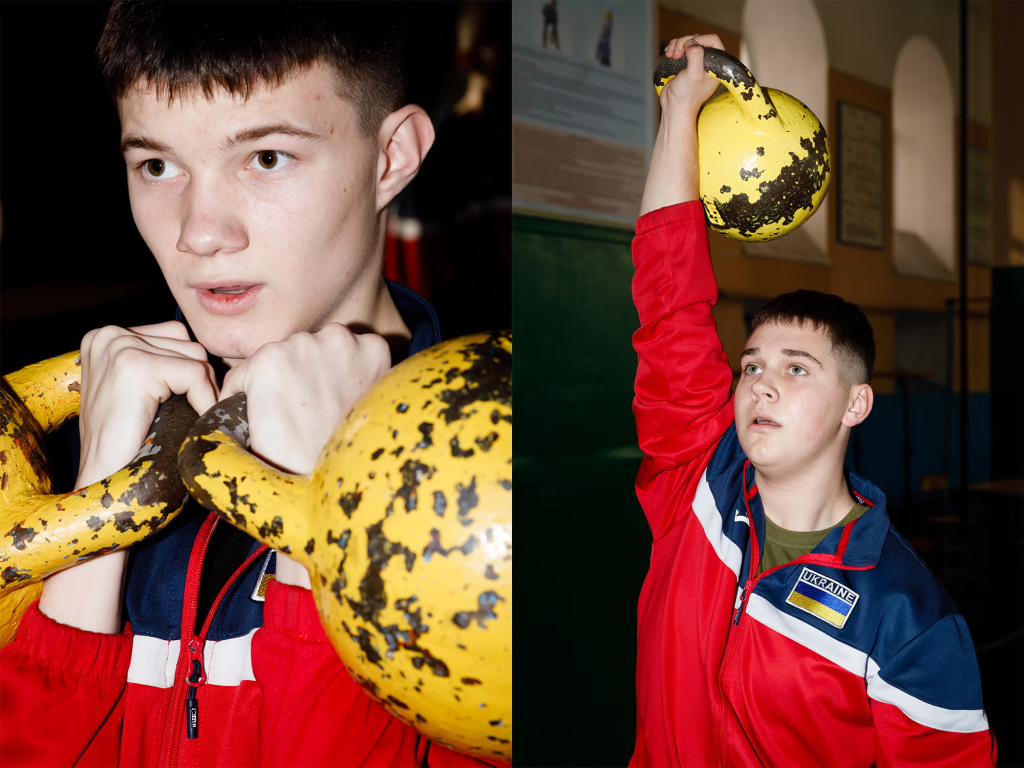
Exercising next to Danylo is 17-year-old Dmytro from Snovsk, a city in the northern Chernihiv region. Both of Dmytro’s parents are members of Ukraine’s military. When the war began, they immediately went to work on the unfolding front lines, where the city was besieged for the first two months of the war. Dmytro has the youngest face of any of the boys I meet, but he speaks about the war like someone much older.
“The academy taught me that Ukraine is our choice. We are not just defending borders, we are defending the right to be who we are,” says Dmytro. “The most inspiring thing is to be around people who are not afraid of responsibility and discipline. When you see someone trying hard, not giving up, and helping others, it helps you become better and continue on this path.”
Four years of war have changed Dmytro, as they’ve changed all the children at Ivan Bohun. He does not define himself as a child suffering the effects of war, but as one who has evolved, despite his circumstances. “The war strengthened me as a person; it strengthened my understanding that Ukraine is not just a place where you were born,” he says.
His words are at odds with his young face, but his determination is clear. “The state and the people who have stayed here have shown everyone that our country is not just a piece of land on a map.”
Additional reporting and translation by Olena Lysenko