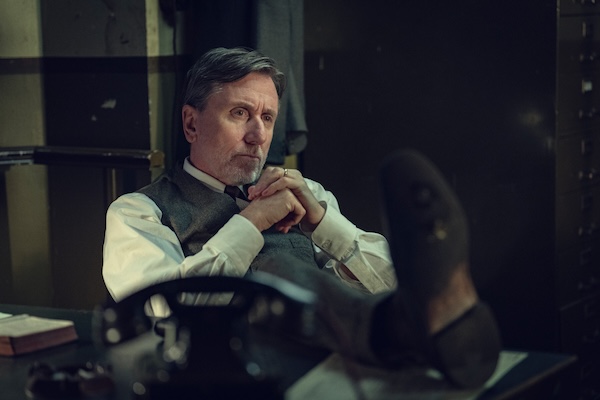
He’s the Machiavellian fifth columnist under orders to crash Britain’s wartime economy from the inside. He’s a cockney Nazi who mysteriously speaks fluent German. But how real is John Beckett in Peaky Blinders: The Immortal Man? Is he based on a real person, or is he merely an imagined villain dreamt up to drag Tommy Shelby back into the fray? Here's everything you need to know.
In the 1940s, the Nazis did forge British currency, thanks to their knack for bureaucracy and the expertise and slave labour of imprisoned Jewish craftsmen. The plan was first to airdrop the cash over Britain, flood the currency and crash the economy. It was called Operation Bernhard and you can read the full account of it all in our dedicated article.
Steven Knight originally wrote Beckett as a Nazi-sympathising aristocrat, but Roth has revealed that he persuaded Knight to make him working-class. Cutting Beckett from similar cloth as the Peaky Blinders, Roth argued, made him more likely to be taken seriously in Birmingham.
It should be said that there was a British politician called John Beckett who left the Labour party and joined the British Union of Fascists in 1934. He was interned during the war after being implicated in a fascist plot, but there is no indication he had anything to do with the Nazi's counterfeit cash scam. Still, there were certainly people on the ground doing a similar job by 1943.
The most notable was a man called Friedrich Schwend, a high-ranking German SS officer who joined Operation Bernhard in 1943 as “Head of Sales”.
A seasoned money-launderer and former arms dealer, Schwend played a critical role in distributing forged currency during the war. His job was to circulate the counterfeit cash through a network of roughly 50 agents—whom he called his “salesmen”—scattered across occupied and neutral territories across Europe.
Some of these operatives were Jewish, chosen deliberately because they were less likely to arouse suspicion when handling foreign currency. They were paid a share of whatever money they managed to launder by whatever means they could devise. Schwend himself, however, ensured that a sizeable portion of the profits found its way into his own pockets.
In Counterfeiter: How a Norwegian Jew Survived the Holocaust, Moritz Nachtstern and Ragnar Arntzen describe him as a man who built an entire business empire out of the operation:
"Schwend [was] a businessman who built a financial empire on his commission: one third of the face-value of the counterfeits plus whatever he could steal. The pounds that passed through his network were used to purchase raw materials from neutral countries, small arms from Yugoslav partisans and paintings by lesser Dutch masters."
The historian Lawrence Malkin paints an even more colourful picture of him in the book Kreuger’s Men: The Secret Nazi Counterfeit Plot and the Prisoners of Block 19. In Malkin's words, Schwend was “one of history’s great confidence men”—a man “strongly motivated by adventure and risk”:
"Schwend could have been the model for the cliched agent straight out of a spy novel, that suavely dressed man at the table in the rear under the slowly rotating ceiling fan, with a huge role of bills in his pocket and stream of supplicants, some swaggering, others unctuous, all eager to sell him something for hard cash."
According to Malkin, Schwend was a silver-tongued manipulator who thrived in the shadows—“nowhere as much at ease as in disputed territory, trading with rival warlords and trying to come away the winner in any deal.”
One episode illustrates the kind of world he operated in. As Italy’s war effort collapsed in 1943, Schwend reportedly moved quickly to buy weapons from soldiers fleeing communist partisan groups hunting them down. During one such deal he was caught in a gunfight and shot in the leg and stomach. Somehow he managed to crawl to safety and escape—an episode that later earned him the Iron Cross for bravery.
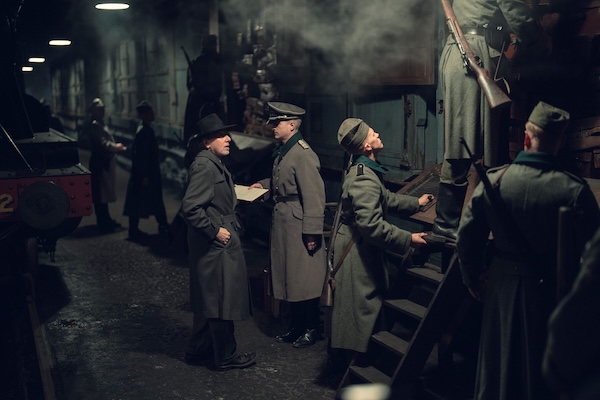
Schwend conducted shadowy deals all over Europe, many so clandestine that the details have vanished from the historical record. Could he have visited Britain, like Beckett in The Immortal Man? It seems unlikely—his chief area of operations were Yugoslavia and northern Italy, buying and selling guns and gold with counterfeit cash that he hoped would find its way back to Britain. If he did do dirty work in the UK, it is more likely he sent someone else.
What is known is that he skimmed money wherever he could, gradually amassing a substantial fortune. Per Malkin:
[Schwend] succeeded in a confidence game of magisterial proportions, passing more counterfeit money than anyone in history.
And by 1944, as the tide of the war clearly began to turn in favour of the Allies, Schwend quietly started to distance himself from the collapsing Reich—concentrating less on ideology than on a single, selfish goal: surviving the war with his loot intact.
Friedrich Schwend survived the war and surrendered to American forces in northern Italy. Soon after, he became an informant for United States intelligence, helping track down fleeing Nazis across postwar Europe. His codename was “Flush” for his talent for “flushing out” fugitives.
The arrangement did not last. In 1946, Schwend himself slipped away to Peru via one of the so-called Nazi “ratlines” that ferried former regime figures out of Europe. There he opened a restaurant—locals reportedly nicknamed him “our Nazi”—while continuing, on the side, with the sort of activities he’d grown so good at during the war: trafficking weapons and counterfeit currency.
American intelligence kept a close eye on him. At one stage the CIA suspected Schwend of forging US dollars for Fidel Castro, though he was never caught red-handed. He was not a good guy—he was even found to have sheltered Klaus Barbie, the Butcher of Lyon, at his home in Peru.
His later years were less glamorous. In Peru he was convicted of smuggling and jailed for two years before being deported to West Germany in 1976. By then he had sunk so low that he was briefly imprisoned again—this time for failing to pay a USD21 hotel bill.
Eventually, however, his wartime past caught up with him. German authorities revived an outstanding warrant connected to the murder of one of his agents in Italy during the war. For that, Schwend received a 21-year suspended sentence and died in 1980.