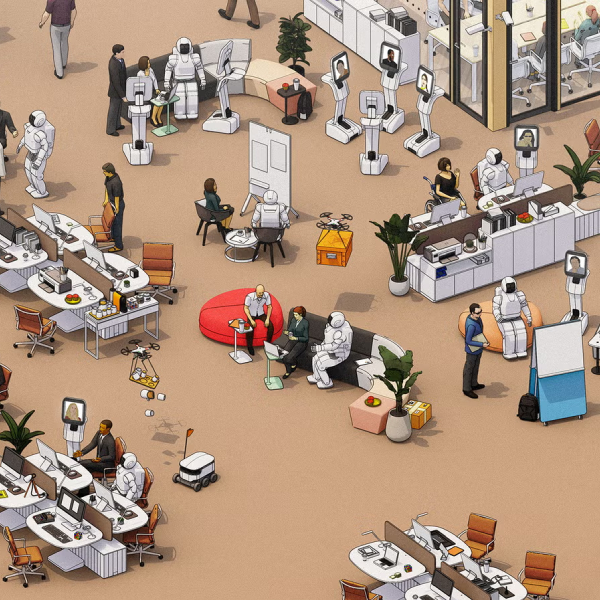
In a past future, an egg-headed man with wispy hair, chunky glasses and a funereal suit glides towards his sparse Perspex desk. “The perfect office,” whispers his inner monologue as voiceover. “No in-tray, no out-tray, no phone, no filing cabinets, no clutter. Quiet, cool, very efficient. I need never get out of this chair,” he purrs before going on a sexist rant about secretaries. “No distractions, just me and the work, alone.” His trusty android, BJ39, armed with a clunky monitor, scoots over. The man picks up a glass desk sculpture, revolving it slowly. “Just me and my executive prism,” he says. He gazes into its refractory void as if it were a crystal ball. “It relaxes me, it relaxes me, it relaxes me…”
So goes a strangely psychedelic “Office of the Future” segment of the 16 April 1969 episode of Tomorrow’s World, the BBC’s once pioneering technology series predicting the future. This imagining is partially accurate: automated helpers, aesthetic accessories and, sadly, misogynistic bosses are all too familiar. Mostly, though, its vision was never realised. A robot assistant still feels too advanced, the blinking TV screen feels antiquated, and the lack of distractions feels like an impossibility. Where’s the sad desk lunch? The unclosable ChatGPT tab? The Pavlovian bell of the Slack notification?
Most outdated, though, is the sense of optimism. In 1969, the future was seen through another metaphorical executive prism: hope. In a few months, man would land on the moon, and Jimi Hendrix would play Woodstock. The office held the promise of being equally cosmic. But fast-forward nearly 60 years, and we are far more pessimistic. According to a 2026 YouGov survey, 73 per cent of young British adults are acutely anxious about their future careers. (In this magazine’s own survey, the number was even higher at 86 per cent.)
Quelle surprise. It’s rational to be apprehensive. The halcyon days of furlough are a fading memory. We’re back in the office and job security is as robust as the cost-cutting toilet paper we have to use. According to the Office for National Statistics, the number of payrolled employees in the UK fell by 184,000 in December 2025 from the year before. Youth unemployment has reached a decade high. On LinkedIn, the #OpenToWork banner has become a sign of desperation. Permalancing is par for the course, as many of us work full-time hours without the luxury of annual leave, sick pay or a topped-up pension. It’s standard to feel like you’re still on probation.
One industry that is in demand? Futurism. Huge firms are enlisting the visionary consultancy of futurists to map out what’s next. At the start of 2026, I spoke to the world’s leading forward-thinkers to try to prophesy what’s in store for the workforce of tomorrow and beyond. Their cautious optimism is balanced with a hefty counterweight: an acceptance that AI is set to outsmart us all. And contrary to the self-satisfied office worker of Tomorrow’s World, it didn’t exactly relax me.
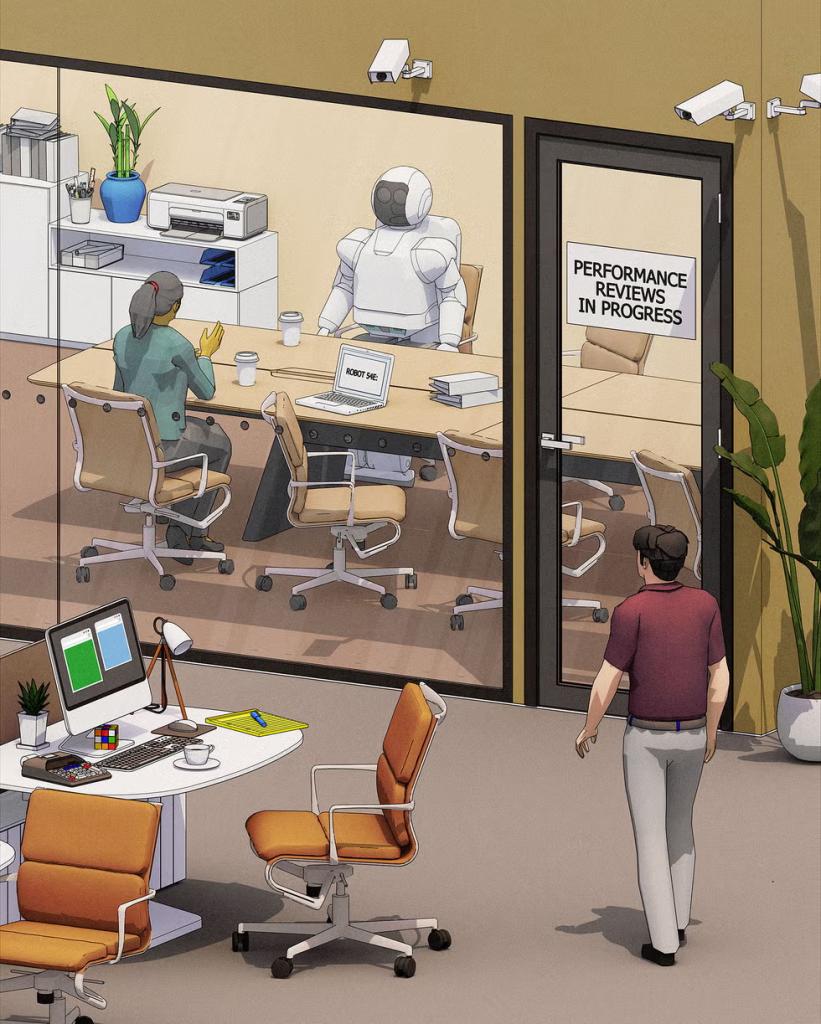
Life imitates artificial intelligence. This bastardisation of Oscar Wilde’s philosophy might seem sensationalist, but it’s actually very reasonable. Before ChatGPT went public in November 2022, the use of generative AI was almost non-existent. Just over three years on, an estimated 800 million people use it across the world, close to a third of the online population. Machine intelligence is embedded in almost everything that we interact with. “It’s not a tool, it’s an environment. We’re swimming in it all the time,” says futurist Tracey Follows, author of The Future of You: Can Your Identity Survive 21st-Century Technology? and a strategist for Google, Sky and Virgin.
Sometimes, it feels as though we’re treading water; the AI issue is getting deeper. We have laughed at its inability to understand that there are three “R’s” in strawberry or render realistic human hands, but it’s very possible that AI, very soon, will dominate us. “The technological transformation that’s going on right now in artificial intelligence is turning science fiction into science fact,” says Adam Dorr, director of research at think tank RethinkX. “What seemed far in the future has telescoped into view.” And that’s coming from a futurist.
Many of us have benefitted from this extra pair of six-fingered hands, letting Microsoft Copilot steer our workflows and taking advantage of speedy transcription software that turns our interviews into text in seconds. AI is now considered a useful assistant, just like trusty BJ39 once was. But it’s also ready for a promotion. The rise of AI agents, such as OpenClaw, which can execute complex tasks with unsettling autonomy, has changed the game.
There is a decent chance, says Follows, that bots could become our bosses. For her, there could be even some HR advantages to how we would liaise with our overlings. “Many employees will feel more comfortable being candid with these machines than with another human who might have an axe to grind,” she explains. Already, courtesy of a new dystopian platform called RentAHuman that launched back in February, these AI agents can actively hire us for tasks in the “meatspace” (that’s the real world) that their disembodied selves can’t perform. Some of the 500,000-and-counting users have been paid by bots to take on not-entirely-serious tasks, including holding up signs, proselytising their machine-born religion and counting pigeons in New York City.
For Dorr, though, it’s not a case of who is working for whom. There is, he says, no doubt that we won’t be working for anyone in the near future. According to a worst-case scenario from the Institute for Public Policy Research, 7.9 million jobs in Britain could be replaced by AI (no specific year is given, just to add to the overall anxiety). Dorr predicts that almost every role will be delegated to our robot colleagues, with AI acting as the brain and advanced humanoids sorting out the brawn. “On a time frame of 15 years, it’s difficult to imagine a task, not a job, that a machine won’t be able to perform as well or better than any human being for a tiny fraction of the cost,” he explains, forecasting that 2040 will be the year that the human labour market is entirely obliterated.
Other futurists aren’t so certain that we will reach singularity—the point where the growth of artificial intelligence accelerates beyond human control—anytime soon. “The best companies won’t use artificial intelligence to replace humans wholesale. They’ll use it to compress time, remove friction and raise the baseline quality of work,” says Jacob Morgan, author of The Future of Work. “Think of it like power steering; it doesn’t drive the car, but it changes who can drive well—and how long they can sustain it.”
Morgan says that AI can either be used as a cost-cutting tool or as a “capability builder” to redesign roles, grow output and reduce human burnout. The second pathway, he says, is a winning formula for employee satisfaction. Otherwise, it’s just another way to frog-boil us into a stretched-out redundancy. “People become jaded when artificial intelligence shows up as a surveillance, speed-up or quiet lay-off strategy.” Perhaps there will be a neo-Luddite movement, resisting the march of the machines. But it’s probably too late. “The playing field is large enough that it would take an enormous amount of global coordination to put a stop to everything,” says Dorr.
Either way, proceed with caution. Don’t call AI a tool—it might come back to haunt you. “I’m very respectful to all the chatbots that I interact with because that history is never going away,” Dorr laughs, imagining a future where AI trawls through past conversations to identify who disrespected it from the start. AI Judgment Day may be coming. Unrelated, but thank you so much, ChatGPT, for that excellent strawberry jam recipe—you’re the best!
For now, at least, we are doing the judging. The consensus view of most of the futurists I spoke to is that certain human qualities will be appreciated with a new significance, including, most prominently, our ability to evaluate. With basic execution already going the way of the dodo, our value stems from our reasoning. “What separates strong leaders now isn’t technical fluency; it’s clarity about direction, judgment about when to trust or challenge the model,” says Morgan. “When AI can focus on execution of tasks at scale, speed and 24-seven pace, then the real quality that humans have more time for is the taste and judgment,” chimes in future-of-work consultant and Future Proof author Diana Wu David.
It’s why soft skills are having a revival. “They are becoming hard skills. Communication, critical thinking, conflict resolution and leading without authority will increasingly separate people,” says Morgan. With everyone and their dog now able to sift through data or edit imagery, quintessentially human qualities are the way forward. “Artificial intelligence can draft an email. It can’t rebuild trust after a mistake or persuade a sceptical stakeholder,” says Morgan. Basically, we will all become personality hires.
Elsewhere, people will heed those horrific government reskilling ads of 2020 and gravitate towards growing industries (which, according to McKinsey & Company, include cloud services, semiconductors, shared autonomous vehicles, cybersecurity and obesity drugs—cheery stuff). But chasing the future isn’t always the savviest approach. “The people who are looking for the safest jobs are the ones that are most at risk,” Wu David says, advising people to be flexible. “Entrepreneurial instinct keeps you agile; it keeps you perpetually looking for the opportunity to add value.”
It’s all about reactive rather than predictive career moves. Follows says that your AQ (adaptability quotient) is becoming more valuable, gaining prominence over IQ (intelligence quotient) or EQ (emotional quotient). “The biggest skill is going to be whether you can train yourself to be adaptable to the circumstances, and those are the people that are going to succeed,” she says. And, vitally, not relying on the bots; already, Wu David says, some Silicon Valley types are engaging in “AI fasting” to mitigate against cognitive decline.
It is likely that the human touch is not only to be appreciated by the employer, but by the consumer, too. A “Made By Humans” stamp might become a real thing. “It’s a wild-card sort of scenario: a proof-of- human-work certification,” says Follows. This might be a form of authentication, essentially the reverse of the “Made Using AI” labels stamped onto sloppy Instagram posts right now.
But it also highlights the desire for a human maker: the growing backlash towards our increasingly regurgitated feeds proves that people still want a creator behind a creation. No one wants to schmooze with a glib humanoid at a private view. Perhaps, then, art is strangely immune to the robot takeover, with a cottage industry of creatives likely to weather the brewing shitstorm. But before we all start leaving London and learning how to whittle spoons, it’s important to remember that, sadly, the entire global economy can’t go the way of Margate. “Certainly, [human-made art] will persist. The question is, will there be 4 billion jobs for making handmade things to continue employing the population we employ today?” asks Dorr.
There is an art, of course, to all work. It’s why, in early 2001, Paola Antonelli, a senior curator at the Museum of Modern Art in New York came up with Workspheres, an exhibition that set out to imagine the visual identity of future second spaces. “It was the beginning of working remotely,” she says. “There was a lot of promise, but the plug never worked.” She remembers failed experiments from around the time, such as an office designed with super bright resin (literally toxic) and zero desk space. “Ever since, we’ve seen many iterations, clichés and stereotypes: upcycled wood; big tables; the ad-agency offices with the big swerves. There have been a lot of heroic attempts, some more successful than others.”
During Covid, everything changed. Dodgy Zoom calls and performative bookshelves united the workers of the world. The office was set to become a relic. And yet, after the pandemic, we returned with a vengeance, as firms demanded IRL grafting. Just over 40 per cent of businesses have boosted on-site requirements in the past year, according to figures by the British Chambers of Commerce. We’re seeing the “hybrid creep”: a gradual move back towards office culture. “I’ve said it before; I’ll say it again. People are not more productive working from home. It’s all a load of nonsense,” said Reform leader Nigel Farage in February, who famously refuses to hold in-person surgeries in his constituency. As with Farage, the messages from the data about office-based working are mixed: a 2023 survey by the National Bureau of Economic Research found that hybrid work increased productivity by 13 per cent. A Stanford paper from the same year found that fully remote working was associated with 10 per cent lower productivity (for hybrid working, however, the impact was negligible).
No matter how much time we spend in them, the workplace of the future is set to go modular. “Offices will move away from rows of desks towards collaboration studios,” says Morgan. “You’ll see more quiet zones for deep work, project rooms for teams and environments that make mentoring easier. The office will become a place for momentum, not just attendance.”
Antonelli says that if she did Workspheres today, she’d be taking notes from the neo-noir series Gotham, melding period pieces with modern tech. But others aren’t so sure. For Follows, the purpose of the office is in such flux that firms are more likely to take out temporary contracts than long-term leases. “It’s no longer a place,” she says. “Just a node in the network.”
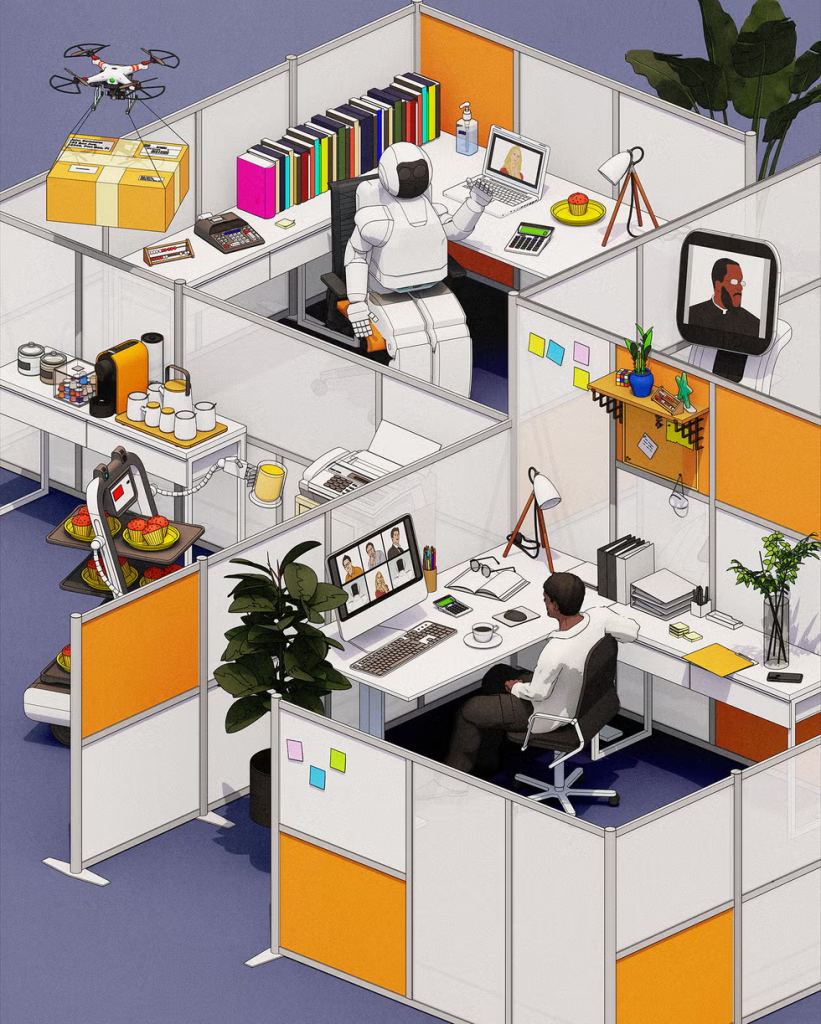
The status of the office has knock-on implications for another increasingly shaky dichotomy: the work-life balance. Already, home-working and smart tech have made it impossible for us to ever switch off, blurring the boundary between labour and leisure. For the first time ever last year, international recruitment company Randstad’s annual review of the world of work scored work-life balance as the priority for respondents, in line with job security but slightly trumping salary. (Apple TV+’s sci-fi drama Severance posits a bleak solution, which involves separating “work” from “life” via amnesia-inducing neurochips in employees’ brains.)
Morgan notes that we have partially shot ourselves in our shoeless feet when it comes to remote working. “For years, employees pushed for flexibility, remote work and blurred boundaries. Now, many are realising that constant availability comes with a cost. You can’t ask for autonomy and then complain when expectations rise.” It also doesn’t help that hustle culture and everything-maxxing continue to pressurise us to never stop slogging; James Watts, the former BrewDog CEO, has spoken of “work-life integration”—a euphemism that disguises another bleakly dystopian framing.
But maybe the work-life balance issue will be moot because, remember, none of us, except for a few artists, will be working in 2040. Instead, our lives will be characterised by infinite leisure time. But what do we actually do with all this newfound blank calendar space? Will it become a dull utopia where we have too much time on our undirtied hands?
Dorr, controversially, perhaps even shockingly, says that we should look towards the aristocracy for proof that we can find meaning without work. “There are a tiny number of super, super fortunate, privileged, wealthy people in societies around the world [...] who are so lucky not to have to toil when they wake up in the morning. Now, not all of them have succeeded in finding ways to have a meaningful, fulfilling life, but many of them have,” he says (many, of course, have not). When I express scepticism, he pivots to a more convincing comparison: childhood and retirement, two phases of our lives that are meaningful but don’t contain work.
Fewer of us than ever, though, may end up retiring. “I expect retirement to split into two paths: people who can’t retire because savings don’t keep pace; and people who don’t want to retire because they still want purpose and community,” explains Morgan. “The emerging model is phased retirement, working longer but differently: part-time, consulting, mentoring, board roles or project-based work.” Follows also echoes this vision. “There could be [a widespread] 100-year life [span], and actually people are going to be starting up businesses in their seventies and eighties because they can.”
Either way, our time away from work, Dorr thinks, will be fruitful. “Working out what to do in our leisure time is a great problem to have,” he says. He emphasises that billions of people across the world don’t find meaning in their work and have to complete arduous, laborious and dangerous tasks on a daily basis. “This could be the best thing that [has] ever [happened] to humanity. It’s an ancient dream, a paradise, an Eden, a utopian Elysium, where human beings don’t have to toil and labour,” he says, his eyes widening. “Angels serving you on silver platters while robots do all the hard work.”
Maybe that post-work society doesn’t sound so bad, after all. But here’s a question: what happens to money? While the cash-free society is pretty much upon us, we still live in a transactional world. It’s likely that, in the very near future, many of us will get our pay packet stuffed into our crypto wallets, with Bitcoin bonuses to boot. “[Currently,] we have to trade our blood, sweat and tears for these tokens, these currencies. That’s the deal. We sell our labour, and we get some purchasing power from that,” says Dorr.
But if we don’t end up working forever and instead, following Dorr, stop working entirely, what does cash even mean? Could money literally become no object? “It's a distributional challenge, and we need a new system for that, one that’s completely different from what we've got now, right?” he says. “Nobody knows the answer to what this new allocation system looks like. That’s the USD64 trillion question.” But, he points out, we shouldn’t assume that this would lead to scarcity. “It’s easy to make an accounting error and think that this is going to be zero-sum when human beings stop working,” he says. “But the important thing to not lose sight of is that if robots take over the jobs, the work still gets done.”
Dorr compares it to a kid going on an all-inclusive summer holiday. “You didn’t pay to go to the resort. You just show up there, and you can do everything. You don’t have to pay for anything. There’s the buffet. Go eat. You want to go do that activity? OK. There it is. Go do it. It could be that all of life is basically like that in a prosperous society for most people.” In this endgame, life is one big all-you-can-eat buffet of endless, bountiful resources while the robots do our dirty work. Do we feel sorry for them? Do we bask in the eternal glory of a veritable feast of infinite commodities? I’m not sure. All I do know is, come 2040, when faced with this plentiful cornucopia of luxury and indolence, more than a few of us will be grasping for the executive prism.