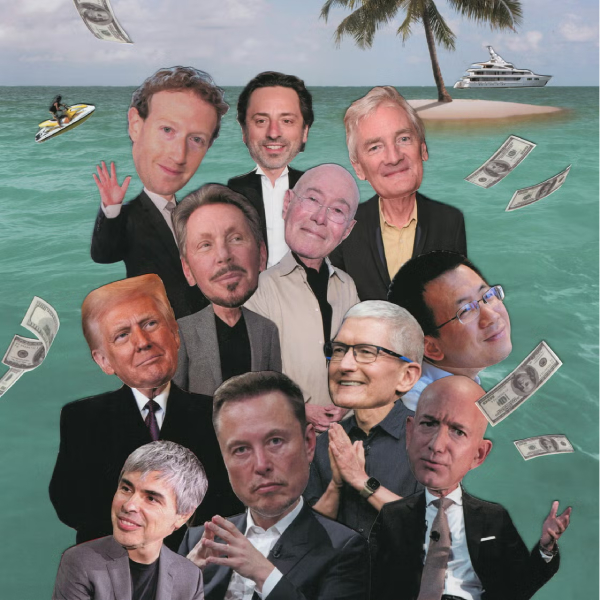
There is a company based in the US called Berkeley Rand, which provides “off-grid superyacht experiences” to its discerning clientele. Its specialisms include re-enacting scale versions of the Battle of Midway for its customers to take part in—complete with “the smell of cordite and cannon fire onboard”—and 3D-printing a free-standing, fully operational restaurant onto a sand shelf in the Maldives that will disappear into the ocean eight hours later. The company’s sole target market? The “bored billionaires”, according to founder Andrew Grant Super in an interview with Evan Osnos of The New Yorker.
Well, could it be anything else? If there is a single winning image to encapsulate the sheer, unlikely, incomprehensible, faintly magical, thoroughly unnatural, sometimes beguiling, often infuriating wealth and worldview of the super-rich in the modern age, surely it is just that. We are living in a time of both remarkable wealth and remarkable wealth inequality; a moment of both huge aspiration and stifled social mobility; an era in which a few thousand people might well hold the keys to the future of humanity.
“It’s a great time to be a billionaire,” says Oliver Bullough, author of several books on the dubious world of global wealth, including his excellent new Everybody Loves Our Dollars, about money laundering. “The super-rich are finding it easier to make money than ever before. And for the first time, no one is making them feel guilty about it whatsoever.”
The age of the billionaire. Billionaire, billionaire, billionaire. Say it aloud. The word itself rolls off the tongue with a pleasing trill, a little jingle, like dollar signs popping up on a fruit machine. Its first recorded usage was in 1841, in the British literary magazine The Athenaeum, which posited the potential for an individual to exist with a fortune of more than a thousand million units of a single currency.
It took precisely 75 years for such a thought experiment to become a reality, when oil magnate John D Rockefeller was confirmed in 1916 as the first dollar billionaire. Then and now, the word — just one letter different from its humdrum associate, the millionaire — encapsulates a mind-boggling sum. The most eye-opening way I have heard to illustrate the number is this: a million seconds is 11 and a half days; a billion seconds is 31.7 years.
At the time of writing [April 2026], there are 3,428 billionaires in the world, according to Forbes, which compiles its ranking of the world’s richest people every year. When the magazine first started publishing its wealth list in 1987, there were 140 billionaires. Thirty years later, in 2017, the number passed 2,000. Eight years after this, it crossed the 3,000 threshold. Four hundred billionaires were added in the past year alone.
The list’s inhabitants are a shifting reflection of the formative industries of the world economy. Seven of the top 10 figures made their fortunes in technology. Bernard Arnault and his family are perhaps the most notable outliers—scions of a fashion fortune built on the boom in luxury in the past half-decade, itself a symptom of a wider explosion in wealth.
Many of the top 10 are near-mononymous household names—Musk, Bezos, Zuckerberg—whose status reveals a late-capitalist obsession with the outrageously rich, and who often now live and operate like movie icons and rockstars once did. (Observe the multi-day Bezos-Sanchez wedding in Venice last year, which was estimated to have taken place at a cost of perhaps USD50m, and featured a flotilla of black-tied stars whizzing in on vaporettos, from Oprah Winfrey to Leonardo DiCaprio to Tom Brady to the Kardashians.)
But for all their public prominence, the billionaire class remains almost entirely unreachable. In an earlier version of this story, my editor Miranda and I contacted over 40 billionaires, in an attempt to take a survey of their lives, successes and lifestyles. We heard back from just one, and even that was non-committal. (The fact that we made the bulk of our approaches during the World Economic Forum at Davos may have complicated things, which tells a story in itself.)
Admitting to the label of billionaire in 2026 is not a straightforward act: an appellation that’s less a mere measure of wealth, perhaps, and more a moral and aesthetic albatross. The widening inequality that has made the billionaire quite so rich is the same one that makes him (and it is almost exclusively a “him”) quite so distasteful and distrusted in certain quarters. The industry of advisors and enablers that surrounds the billionaire has a phrase advising for useful discretion in this regard: “A submerged whale does not get harpooned.”
An image that may come to most clearly define the age of the billionaire was conjured on 20 January 2025, as Donald Trump took his oath of office for his second term. On the stage surrounding him were Zuckerberg, Bezos and Musk, as well as Tim Cook, CEO of Apple, and Sergey Brin, the co-founder of Google.
Evan Osnos, in the introduction to his excellent book about the lives of the ultra-rich, The Haves and Have-Yachts, notes how Trump appointed “thirteen billionaires to the top ranks of his administration”. (Unlucky for some.) It was the moment, Osnos writes, at which “American politics embraced plutocracy without shame or pretence”. For a nation facing spiralling inequality, this was like putting the foxes in charge of the henhouse. Only the foxes also have superyachts. And own the henhouse.
“At the very top level, the wealth is more disturbing to me even than in a kleptocracy,” Bullough says. “For the biggest players, the gravitational power of their wealth is so colossal, they can simply distort what is and isn’t legal. The centi-billionaires make the Russian oligarchs look like pensioners.” As the LSE Review of Books put it: “We have a billionaire problem.”
And yet billionaires do not particularly have an “us” problem. “That was the thing that I think surprised me the most,” says Professor Carl Rhodes of the University of Technology Sydney, who has just written an eye-opening book, Stinking Rich, on the economic conditions around the age of the billionaire. “I was surprised there hadn’t been a wider contestation of this state of affairs. That no one had drawn their pitchforks.”
Wider culture, it seems, is remarkably billionaire-friendly: the hens adore the foxes. This is largely aspirational, or at least paradoxically self-interested. The American public has frequently been described as a collection of “temporarily embarrassed millionaires”—a tag that, in the digital monoculture, might as well apply to the entire Western world. We are, many of us, operating under the shared delusion that we too will one day ascend to the ranks of the billionaire (and thus that we should not tax them too stringently, for one thing): a sentiment reinforced by the modern obsession with entrepreneurship, with start-ups and hustle culture, with crypto-fortunes, and with a certain bro-coded destiny of self-actualisation.
“There’s both a worship of billionaires, and also a recognition that there’s no reasonable way of ever obtaining that status,” says Bullough. “And together, I think that explains this modern obsession with the hustle.”
Jesse Armstrong’s HBO series Succession, though Shakespearean in its themes, is given most of its timely heft by the billionaire status of its fictional patriarch Logan Roy. Billions puts the word front-and-centre in its title, as if to remind us constantly what’s at stake and thus what really matters.
When disgraced influencer Andrew Tate claimed to be “the world’s first trillionaire”, he wasn’t simply engaging in Trumpian hyperbole and ridiculous self-delusion—he was borrowing the buzzword that would give him the most cut-through with his target market of vulnerable, uncertain young men. A billionaire may be a superhero or a supervillain (often with the lair, the look and the zingy name to match—“Elon Musk” seems straight from a comic book). But they’re at least super.
In a drab, stifled economy, the ultra-rich have been lent a certain gung-ho, outsider swagger entirely at odds with their often establishment, institutional, largely corporate entities: modern Wild West frontiersmen, breaking new boundaries; Goodfellasian operators, smashing the rules and gaining the spoils in a way that regular schmucks simply don’t have the guts to.
It is striking how many billionaires now cast themselves as rank outsiders in this way—tech financier Peter Thiel (net worth USD13.9bn) is the paradigm here—decrying, increasingly, the overreaching powers of some nebulous “elite” that is pulling the strings, often while they continue to pull the strings themselves. Thiel has close ties to President Trump, and is the longtime mentor and advisor to JD Vance, Trump’s mooted successor.
Rhodes points out that many of the world’s richest figures insist on casting themselves as largely self-made, despite overwhelming evidence to the contrary. Central to this is President Trump, who long insisted his career fortune (such as it was) came from a measly “USD1m loan” from his multi-millionaire slumlord father.
Forbes was derided in 2019 when it named Kylie Jenner as the world’s youngest “self-made” billionaire at the age of 21, conveniently ignoring the astonishing platform and cultural wealth of her family. This is simpler, perhaps, than admitting we might now live in an inheritocracy; a nepopoly. As our birth is literally the one thing that is out of our personal control, it is perhaps entirely necessary for the culture to perpetuate the narrative of self-achievement instead.
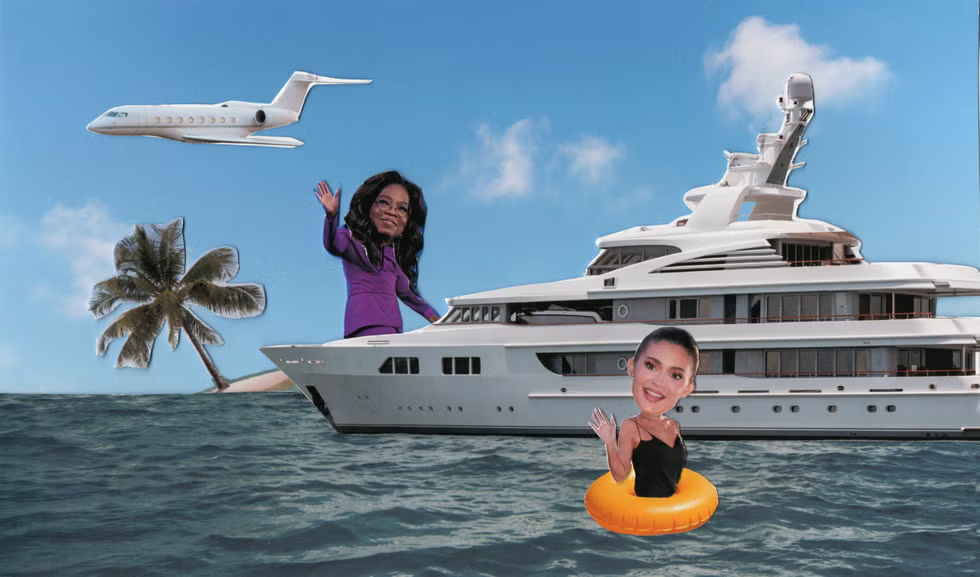
This mythic storytelling helps soothe the cognitive dissonance of what must be, on the day-to-day level, a profoundly unusual existence. (It’s often been pointed out that someone like Bezos could effectively end homelessness and poverty in America overnight. True or not, what must that unrealised opportunity feel like to a single human?) One struggles to invoke Biggie Smalls’ old refrain of “more money, more problems” with a straight face here. But extreme wealth—membership of the notorious “three comma club”, as some call it—does come with psychological side-effects.
“I have met a surprising amount of very unhappy rich people,” James Reginato, the author of the brilliant Growing Up Getty, about the prototypical billionaire family, tells me. “It seems to bring a lot of new neuroses, and amplify the existing ones.” And so the fictional trope of the tortured rich man (Charles Foster Kane, Jay Gatsby) endures in its accuracy. It might also, according to J Paul Getty himself, enact a useful social balm: “The idea that people who are reputedly wealthy must be miserable seems to gladden countless hearts,” he wrote.
The symptoms of this “affluenza” are numerous, such as the knack of the ultra-rich to develop markedly less empathy than their hoi polloi counterparts, according to research published in the journal Psychological Science in 2010. (Another social study, from 2012, found that drivers of luxury sports cars were three times less likely to give pedestrians the right-of-way compared to those driving less expensive vehicles—a neat enough metaphor.)
Or the way that the ultra-rich indulge in a form of the well-established “just world” delusion—the useful idea that the world is essentially fair, and an individual’s personal successes are down almost entirely to their own behaviour and actions, not simply quirks of luck or privilege or birth.
This means one’s own wealth can be internalised as a personal victory, and other peoples’ evident misfortune need not trouble the conscience. The natural result of this delusion is a sort of manic individualism. The New York Times wrote in mid-March how the avuncular era of Bill Gates and Warren Buffett’s philanthropy is effectively over.
“Now, it’s stylish, in a Silicon Valley contrarian sort of way, to bash the Giving Pledge,” wrote Theodore Schleifer, referencing the charity that encourages billionaires to give away at least 50 per cent of their wealth to philanthropic causes. “That was the kind of Obama-y, Blair-ish concept of the super-rich—that they’re really nice guys and they’ll give all their money away,” says Bullough. “Which recently appears to have been replaced by: it’s OK to be super rich and just to keep it all yourself—and then spend it on fascism and going to space.”
“The zeitgeist has changed very fast,” confirms Schleifer in his piece. And the billionaires are changing with it. A large part of the super-rich psyche might be explained by the concept of the “hedonic treadmill”, a mental mechanism whereby the baseline for personal happiness gets drawn higher and higher as wealth and achievements keep rising.
Put simply: the baubles and privileges that would make you and me giddily excited if they were plopped randomly into our lives tomorrow will no longer elicit joy from the ultra-rich. And so the billionaire is often on a junkie’s search for ever greater or more novel highs.
In the pecking order of boating footage, the hierarchy runs thus, according to Osnos’s landmark essay on the phenomenon. If a boat has an onboard crew, it’s a yacht. If the yacht is more than 98ft, it’s a superyacht. If it gets to more than 230ft, it’s a megayacht. And once it stretches to more than 295ft, it’s a gigayacht. In the past 20 years, the size of the average yacht has grown by a third, and now sits at 160ft.
This arms race stems not simply from a nigh-on-phallic one-upmanship (though that is at play, and stories abound of superyacht owners pulling merrily into a harbour on the Côte d’Azur, only to be immediately outsized by a bigger neighbour and slipping into a depression), but also from the sheer nihilistic wastefulness of the expense. These floating palaces are, as Osnos puts it, “the most expensive items that our species has ever figured out how to own”.
A good number of boats are currently being built for north of USD250m, and cost around 10 per cent of that per year to run. They are astoundingly poor invest-ments. As the Financial Times puts it: “Owning a superyacht is like owning a stack of 10 Van Goghs—only you are holding them over your head as you tread water, trying to keep them dry.”
Thorstein Veblen, the economist who coined the term “conspicuous consumption” in 1899, noted how the most potent status symbol is often the most nonsensical: “In order to be reputable, it must be wasteful.” In the Victorian era, there was a saying that the length of a man’s boat should be no more than his age in years. It is telling, perhaps, that the men who want the biggest boats are also those who often state their aim to live forever. Immortality by square footage. Look on my heliport, ye mighty, and despair!
The boat cannot be bigger than the harbour. And so the billionaire class finds that it must instead preserve and grow its wider pile in order to maintain its status, preserve its position in the pecking order, enact its control—or just continue to scratch some deeply unexplored itch. Last year, I wrote about the Smaug-like hoarding of billionaire Stephen A Schwarzman, the chairman and CEO of the vampiric private-equity firm Blackstone (a company, fittingly, that is currently buying up a large amount of housing stock in the UK: a key driver of widening inequality).
Schwarzman’s housing hoard includes a 35-room Manhattan duplex, a vast villa in Saint-Tropez, several Long Island mansions, a 30,000sq ft colossus in Rhode Island, a Palm Beach palazzo, a huge coastal home on a secluded bay in Jamaica, and a hunting lodge in Wiltshire, for which he stands accused of sucking up all the surrounding area’s water supply to fill a fishing pond.
Property to Schwarzman is not shelter but pathology. He has a mania of floor plans. At around the same time, I interviewed a mere multi-millionaire (net worth somewhere around the USD350m mark), who explained this panic of acquisition. He described a frequent nightmare where a demon tells him: “Sorry, there’s nothing left.”
In the 1960s, J Paul Getty—then the world’s richest man, and a billionaire many times over—installed a payphone at his vast country pile in Surrey in horror at the idea that his guests might inflate his phone bill. Others fear that their children will lose their vast wealth—the received wisdom being that most dynasties go from “shirtsleeves to shirtsleeves in three generations”. Or, as the Germans put it: “Acquire it, inherit it, destroy it.”
Family and money are admittedly often a rotten mix (see: King Lear, Kendall Roy). Heirs who inherit millions frequently come unstuck, leading to endless talk of “curses” among grand families, from the Kennedys to the Astors, the Guinnesses to the Gettys.
“I have learned that simply giving a person a lot of money and saying, ‘Here, have a good time’, is a mistake,” Reginato quotes one of the administrators of the Getty family trust as saying. “The only people I’ve ever seen who are satisfied with life are people who achieve something beyond mere wealth.”
The yawning gap between rich and poor may be the biggest crisis facing humanity this century.
Which is where the latest cohort of billionaires come under scrutiny. Although the tech barons are undoubtedly talented and hardworking people, and evident pioneers in many of their endeavours, their wealth has long since become completely, outrageously disproportionate to their efforts and achievements. And it is growing at a rate that is untethered from any recognisable logic or reality, having reached a sort of exit velocity of compound interest and self-fulfilling prophecy.
Instead of lending its central figures a certain “right place, right time” humility (Zuckerberg, as Osnos points out, was supremely fortunate that Facebook launched in the cosmic sweet spot of 2004), it has instead apparently inculcated a certain personal exceptionalism. Modern billionaires often display a sort of Dunning-Kruger delusion, in which they think their success in one sphere grants them genius status in all others.
In Mountainhead, Jesse Armstrong’s Succession follow-up, a satire about tech billionaires stuck in a luxury mountain retreat while the rest of the world apparently disintegrates beneath them, the founder bros wonder whether they should take over Argentina, perhaps buy Haiti: “Are we the Bolsheviks of a new techno world order that starts tonight?”
Armstrong’s coarse, quarter-zipped antiheroes capture something else about the modern billionaire, too. A certain stylistic naffness, perhaps; a distinct bluntness of worldview. Reginato points to J Paul Getty’s artistic and financial bequeathment to the Getty Museum as one of the “greatest gifts to humanity in our time”; but also to a sort of aesthetic and worldly curiosity about the wider clan that is essentially generous, not reductive or divisive.
“I look at the Bezoses and the Zuckerbergs and so forth, and they’re just so unstylish,” he says. “And so markedly unphilanthropic, considering their vast wealth.”
Economist Joseph Stiglitz warned at the start of the year that the yawning gap between rich and poor may be the biggest crisis facing humanity this century—its tendrils reaching into questions of climate, poverty, politics, happiness and health.
The gap does not look set to narrow anytime soon. In February, a report outlined how Elon Musk now has a 75 per cent chance of becoming the world’s first trillionaire before the end of 2026. That seems almost unsurprising: shrugworthy; pub-quiz fodder. But the frogs must surely sense the boiling point approaching.
A billion seconds, as you know, will take us 31.7 years in the future. A trillion seconds moves us 31,688 years hence. Perhaps by then we will have discovered our pitchforks. In the meantime, the island sinks beneath the waters and the yacht recedes over the horizon.