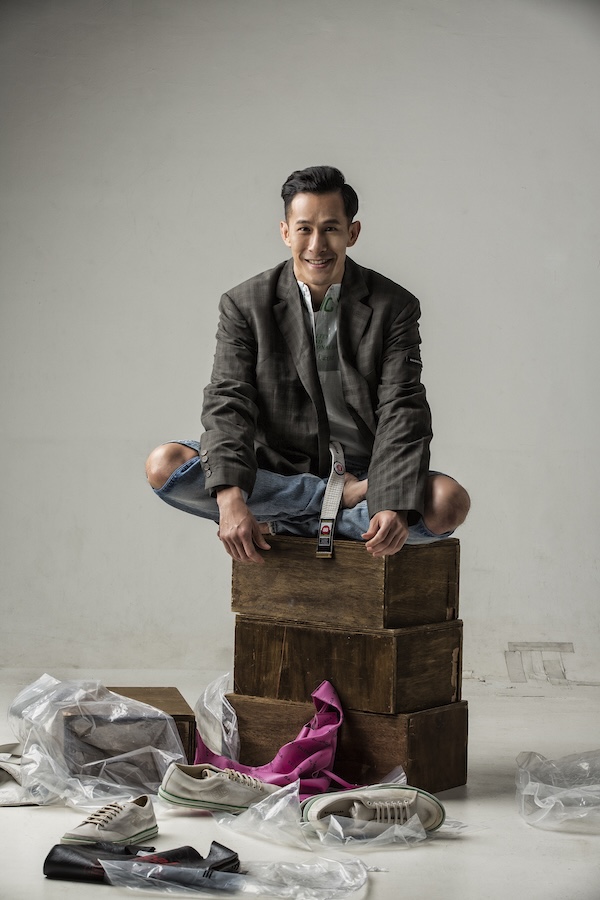
To be fair, I asked for this. For our personality interviews, we ask our subjects if the conversation could occur anywhere else but at a café. Whether it be on an errand at the supermarket or walking the dog or jogging; all these can add “colour” to the story. So, when it came to Shane Mardjuki, he opted for a trek along the Kampong Trail at the Rifle Range Nature Park.
A low roar emanates from a gauze-wrapped sky. Mardjuki looks up and back to the ground. “Will you be okay if we get wet in the rain? You got nice shoes on and I feel bad man.”
I suppose my footwear is “nice” (Vans x Takashi Murakami slip-ons), but they have seen their share of wear and tear and will stand up to the scrutiny of the mud and rain. Mardjuki’s sneakers, however, are more appropriate for the woods, as are the rest of his fuss-free attire—a simple T-shirt (a pink Sole Superior top) shorts and a backpack.
Mardjuki looks like he was chipped from a marble block by Don Martin before it’s sanded down to a more defined state by a Renaissance artist. A dishevelled mop of black curls sits on his head; the sides are cut short. His small eyes are made smaller when he gives off that patented wide smile.
“It’s something that I try to do,” he says, “just for fun. So, when you asked where I wanted to go during the interview, I thought, what the hell, let’s go into the forest.”
He pulls out a familiar burnt orange cylinder from his backpack—OFF!—and offers it to me. I depress the nozzle and apply its contents like I’m spritzing cologne instead of a liberal coating of mosquito repellent.
The footslog into the jungle is an almost twice-a-week affair for Mardjuki. “It’s something that I try to do,” he says, “just for fun. So, when you asked where I wanted to go during the interview, I thought, what the hell, let’s go into the forest.”
Is this something you do on your own?
“Nah, I’ve a kid and I’d always bring her out with me for this. But she’s sort of reached the age where she sometimes voices her refusal to go with me.”
I try to imagine his daughter—cheeks puffed, brows knitted—the caricature of an adult, putting her foot down on an outing. I picture a tantrum thrown and the sky obliges with another grumble.
“Oh no. I was hoping the rain would not come.” Then, beaming, he continues: “But if it does, I’d say we get under the cover of trees.”
Isn’t that dangerous?
He squints as he peers up. “There’s no lightning. And the gods will shine upon us.” I wait for the punchline—a thunderclap, straight from the heavens—but it never comes.
Mardjuki is Indonesian in origin but that wasn’t always the family name; it was Tan. “A generation ago,” Mardjuki explains, “there was a huge anti-Chinese sentiment in Indonesia. They had to change their names to be less Chinese. When it came to our turn, my dad and his brothers picked a random surname: ‘Mardjuki’.”
His father, as Mardjuki describes, is a “free spirit”, who studied at the University of California, Santa Barbara. “His time there really influenced him,” Mardjuki says. “I think he really wanted to stay there but instead he moved to Singapore to marry my mom.”
So, Shane Mardjuki was born in Singapore and later, his family moved to Indonesia, where he resided for two years before coming back here. It’s interesting how memories work with each individual; for Mardjuki, he has no recollection of his stint in Indonesia but like a scene from a hi-def video, he remembers how his father looked like Tom Selleck from Magnum PI: Hawaiian shirt, moustache and all. His father also had a fiery temper, which often resulted in fist fights
with strangers.
Mardjuki’s mom is the polar opposite. A portrait of calm, she can bury her emotions underneath her everyday face for the public. “At home, I’d see her cry silently in her room,” Mardjuki says. “That’s something I never appreciated.”
Chalk it up to the impetuousness of youth, but the apple didn’t fall far from the paternal tree as the young Mardjuki was also quick to fly off the handle. This unbridled rage was seen as a positive trait, an emotional release. It would take years to extinguish this fire. “I’m doing pretty okay at the whole self-control, I think.”
A rustle in the trees to the left of us and Mardjuki slows to a stop. He points into the distance. “Do you still see the squirrel?”
I frown. I hear something ahead but it all looks the same. I try to recognise a familiar shape in this scattered jigsaw of leaves but my frustration climbs. To take the edge off, I ask what’s the most exotic thing Mardjuki has seen during a hike.
“Oh, snakes. Snakes are cool. They’re so hard to spot.” He starts walking and I follow suit. “One of my best walks was with my kid and my wife. See, she hates snakes and when they were in front of me, they came across this huge snake”—Mardjuki stretches out his arms—“huge. And then my wife ran away... and left our kid to deal with the snake.” He sniggers at the memory. “But that was an amazing moment.”
“I think I’ll falter when it comes to shows where there’s singing and dancing. But when we’re required to recite lines, I think I can bluff my way through the process.”
He continues his laundry list of animals he has encountered—lizards (“spotted one or two”), monkeys (“when a baby monkey approaches you, the bigger one swings in and you almost feel like you’re gonna die”), deer (“six of them escaped from the Night Safari once and I took a picture of them”), civet cat (“their eyes shine in the dark”) and colugo.
“They are kinda like flying lemurs. Those are hard to spot. Have you seen a colugo?”
(I haven’t even heard of the word “colugo” until now.)
We reach the end of the Nangka Trail and come to the start of the Durian Loop. It’s a forked path but as you can tell from the name, it doesn’t matter which way we take, left or right, we’ll end up where we started, but I leave it up to Mardjuki. He considers his options for a beat and takes a left.
Fresh out of the army, Mardjuki considered going into anthropology. The subject interested him but he had nary a clue about what he could do with a degree in the study of the human race. At the time, he owned a truck and with that, he helped a friend transport stage props for Act 3 Theatrics. When Act 3 needed a stand-in actor, Mardjuki gamely volunteered and soon he went from delivery van to the stage. His career snowballed with each gig and for the next 11 years, he performed in costumes at school assembly programmes and acted in stage productions like The Pillowman and Boeing Boeing; Mardjuki had become a working actor.
For someone who is a mainstay in the acting scene, Mardjuki lacks formal acting education. He learned on the job and has developed his own acting style. “I think I’ll falter when it comes to shows where there are singing and dancing. But when we’re required to recite lines, I think I can bluff my way throughout the process.” He downplays his acting but he is his own critic, watching videos of his performances, noting the missteps and how to become better. His acting style evolves through the years. “I wanna try different things,” Marduki says. “I’m trying to adopt a non-acting style, where I play myself to see if that gets the story across better.
“Then again, when you’re doing a scene with Tan Kheng Hua, I’d revert to my own form—emote better, do something, don’t screw up.”
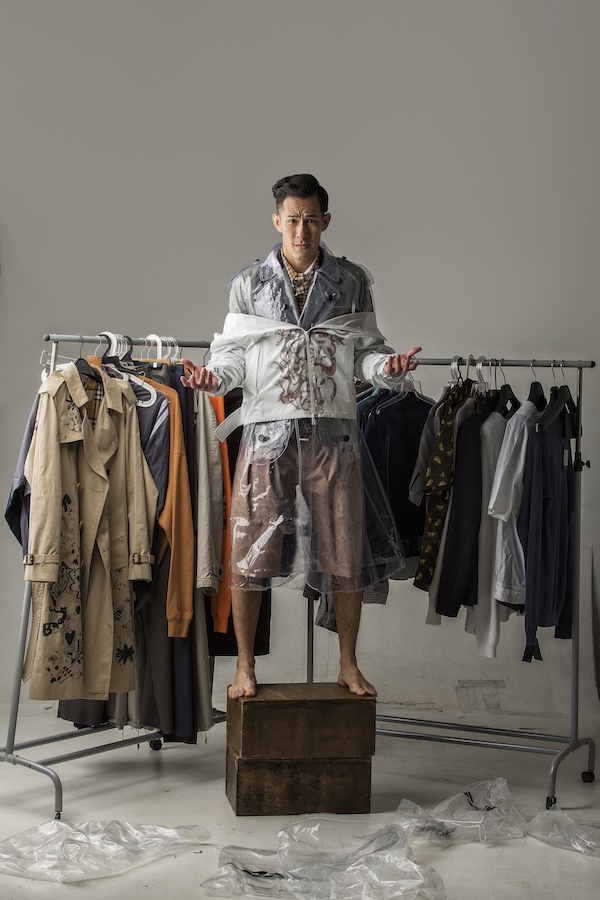
He opts for projects where he thinks it’ll be fun for him. When he does a show, everything fades away and for his two hours on stage is the entirety of his world. Mardjuki wagers that it’d be a distraction if he signs on for a show where he can’t get behind and his brain will be clouded with thoughts such as “this doesn’t work” or “I don’t agree with this direction”.
But that doesn’t necessarily mean that he can pick and choose any projects because the man is still beholden to his family. “I’ve read some scripts, and I thought, man, these guys are gonna do some sort of Shane-Pow-blackface kind of humour and [I fear,] that for that one episode, it would be a 12-hour day shoot that started from 6am; I’m tired, I’ve no more willpower, I just wanna get it over with and someone would give a direction, something dubious for me to do, and when I’m done, the backlash will be tenfold.”
The ground makes a sucking sound as we make our way down from an elevated plane. Mardjuki apologises for getting my shoes dirty, and I make a mental note to dress appropriately the next time someone suggests a traipse into the jungle.
As we make our way across a bridge that’s over a barely perceivable stream, Mardjuki gestures to the waters below. “The last time my daughter, and I came here, she would climb down into the stream. It’s illegal, and I’ve been warned by NParks not to do that.”
Someone from NParks happens to see your daughter...?
“Nah, the NParks guys stalk my Instagram [account].”
As I make another mental note on keeping my digital presence footprint-free, we hear a thud. Our heads swivel towards the commotion.
“That’s a durian,” Mardjuki whispers. We wait for the sound of another fall.
It’s not something that he talks about at depth but then again, who finds it easy to talk about one’s divorce? Two years, Mardjuki was married and then it was over. But the divorce wasn’t the knife twist in the heart—it was his idea of how a planned life can so easily come apart. Your clean bill of health? Here’s a cancerous lump. That nine-to-five job that you thought you’d have until retirement? Here are a retrenchment letter and a gold watch. The best-laid plans of mice and men.
It was the lowest point in his life. While one can point to parallels between his parents’ divorce and his own separation, Mardjuki started to see his friends experiencing their own marital severances. With the frequency of annulments, Mardjuki now accepts it as one of the many quirks of life.
“Yeah, I think acting is my own little minute study in anthropology.”
Perhaps to take his mind off this setback, he dove straight into work and jiu-jitsu. Every so often, in-between joint locks and chokeholds, Mardjuki could hear a peal of laughter rise above the pounding of the mat and the beating of focus mitts. It was a very specific cachinnation that came from the other side of the room where the Muay Thai practitioners would train, and for a newly divorced man, this sound of mirth buoyed him. It was less than a year since his divorce that he would date this laughing woman, Jin Pang. And it would be 11 months later that they would be wed.
Mardjuki knows how it looks. “Most of my close friends were concerned that it was a rebound thing but I’ve always wanted a family. I’ve always wanted to have children. I dig being a young dad and I found someone who has the same intentions and is keen to settle with me. I love it when she laughs. All the time, every day. I hope, I haven’t stolen some of that spark from her.” He smiles as he says this.
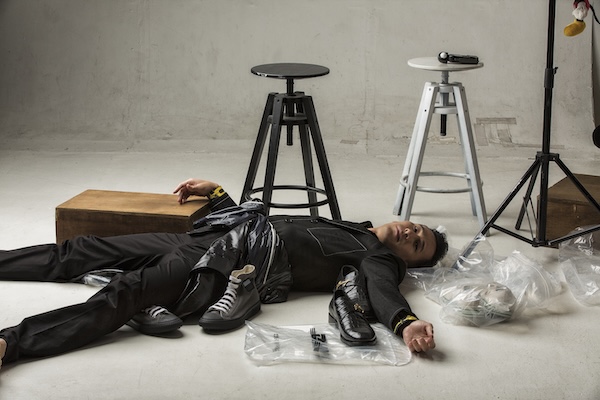
Given his time in acting, the clouds of doubt do sometimes hang over him. He second-guesses himself, questions his ability as a thespian. “Thoughts of ‘I suck as an actor’, ‘I cannot do it’, ‘I’m not right for the job’... but now I’m at the stage where I know that this sort of phase will come and will go,” Mardjuki says. He scratches himself, a waning effect of the repellent.
But for the most part, he enjoys the acting, the process… he even gets the tingles just thinking about it. The ennui hasn’t settled in yet... hell, it might not even happen to him. It’s like he won big in the job lottery.
“Yeah, I’d consider myself lucky. I remember this corporate gig—and you know that sometimes corporate gigs are just something you do for the money; it’s not necessarily something you enjoy—that was fun. It was a whisky launch and I pretended to be part of a poster on a touchscreen. So, I remain still until someone would come up to the screen and I’d come to life. I’m sure there are some actors who’d think that this is beneath them but to me, this is play not work. And with the involvement of whisky, it made the whole gig even better.”
And therein lies the problem: given his plethora of theatre, TV and film credits, Mardjuki isn’t a household name. Is it his inability to speak Mandarin (he took Malay in school and can speak it) which has put him at a disadvantage when working at Channel 8, the largest local free-to-air TV channel? But there are others who can’t speak a second language who achieved celebrity godhood.
Shane, why are you not more famous?
“Lack of ambition, there’s that,” he thinks for a while. “I’m secretly ambitious, not outwardly ambitious. See, one of the worst aspects of how I play the game badly is when I do go for an event, I’ll be introduced to the production head. I’m usually chatty in social situations, but when there is an agenda, when there’s something to be gained, I can’t string a sentence together. I’d stand there awkwardly until they switch the conversation to something else, and then I’ll slowly inch away. There’s a skill to [schmoozing], and I don’t have that man.
People close to him have advised him on having a goal, but he’s not the sort to concoct a goal for the sake of having one. “I feel like the opportunity will arise, that whatever will pop up is going to be far better than what I can work towards. In a strange way, that’s the way my life has sort of worked out and I don’t wanna jinx it. And if nothing happens… then, I’m cool with that too.”
Again, that smile appears, but this time, it’s a gentle but firm punctuation to that statement.
He might project a lackadaisical attitude when it comes to taking his career to the next level, but that’s just a facade. Like his mom, he is a duck in a pond—a stoic display to the public while underneath the surface is the frantic paddling of webbed feet. Mardjuki is a worrier—raising his kids right, providing for his family—but like his doubts, his concerns disappear.
“It sounds a bit stupid and Zen, but nothing matters,” Mardjuki says. “It could be a show that I’d always wanted to be in or a terribly big role that I really wanted to do, but it all returns to the same sort of equilibrium.”
We offer a theory about him—that his satisfaction in his lot is because... he has already attained it. While the rest of mankind struggles to cross some arbitrary finish line, Mardjuki is content with where he is in life—with a family, a job that keeps him happy—it would seem that sometimes when we go on a journey, we’d return to where we were always meant to be.
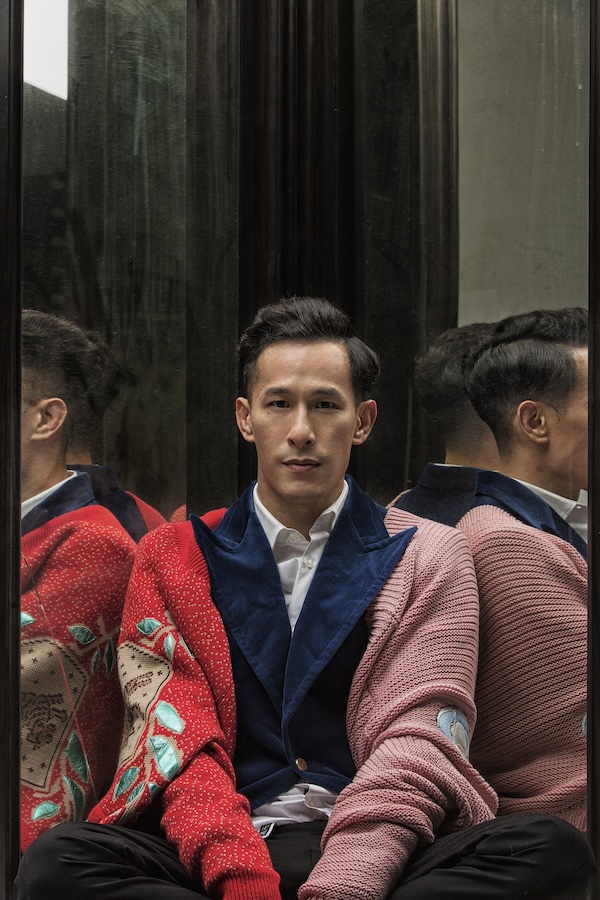
We return to the Durian Loop waypost and proceed to make our way back down Nangka Trail.
Days after our interview, Mardjuki will start work on a Kelvin Tong movie. Then, he’ll return for a season of Gunting on Suria. After which, he’ll appear in the nextShakespeare in the Park production, Julius Caesar. And after a four-day break, he’ll dive right into a W!ld Rice show. This back-to-back workload will run until July.
Given his packed schedule, it’d mean that his wife, who is a teacher at the School of the Arts Singapore, will have to rework her agenda in looking after the kids. His in-laws and mother will pitch in with the babysitting too. As usual, it will all work out.
We finally hit Rifle Range Road and—miracles of miracles, my shoes remain unsullied by the mud!—we continue walking and talking about movies and screenwriting. The cacophony of traffic is a welcome pat-on-the-back as we finally come up to the busy expressways of the PIE and the Anak Bukit Flyover. Something clicks in my head.
You initially wanted to go into anthropology, but have you considered that what you do with acting is a form of anthropology?
His eyes light up. “Right? When you research and learn about a bunch of different cultures... yeah, I think acting is my own little minute study in anthropology.”
And in our own ways, we feast upon the bounty reaped from such an examination.
Photographs by Ronald Leong
Styling by Eugene Lim
Grooming by Sha Shamsi using Yves Saint Laurent Beauty and Keune