The first Father’s Day David Lesaffre worked alongside his son, Xander, they cleaned up a suicide. A 14-year-old had fled to a friend’s house following an argument with his dad, barricaded himself in his friend’s bedroom, and shot himself in the head. Music was playing so loudly when it happened that the friend—in the next room—said he hadn’t heard the gunshot.
Lesaffre and his wife, Leanne, were just beginning their second careers. Their business, T.A.C.T. 48, is a biohazard-remediation company that specialises in cleaning up grim, often gruesome events. They are paid well for their work, often by insurance, and, at the time, the company was growing. They had only recently made Xander, then 15, their first part-time employee. He wasn’t much older than the boy who had died, but in those early days they needed him—and they needed to know if he was cut out for the work. “Being able to train through that, with his parents there, I think was the best course of action to determine if he had the fortitude to help people without allowing your emotions to overtake you,” David says.
When the call came in, the three of them drove out together to the small second-story apartment, where the friend’s mother had trouble finishing a sentence without breaking down in tears.
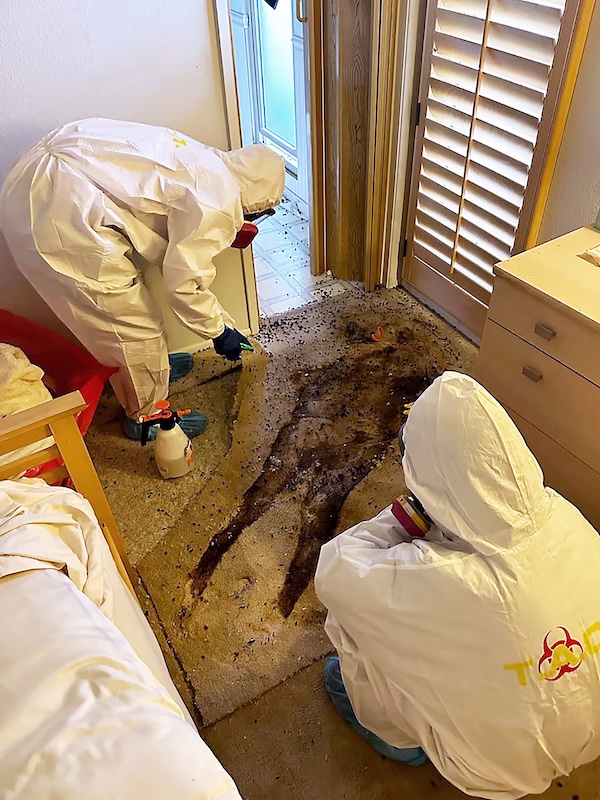
The boy’s body was gone, but the room kept a record of what had happened. David and Xander donned PPE to wipe blood off Nike high-tops and an Xbox. They cut out the carpet, sealed the floor, and bagged up bloodstained fragments of a small dresser. Leanne came and went, taking photographs for the insurance company. To anyone close to the tragedy, the room would never appear quite as it had before. But until it could be a teenager’s bedroom again, at least it would be clean.
Looking out at his son through goggles as a mist of T.A.C.T.’s proprietary cleaning sprays settled around them, David couldn’t help replaying the fights he and Xander had had over the years, as well as the ones that had scarred his relationship with his own father. The stakes of those disagreements now felt both trivial and monumental: Even the littlest things could change your life forever.
David and Xander put the room back together in a couple hours. Then the three of them went out for pizza as they waited for their ozone machine to complete its air-purifying treatment without anyone in the apartment. “It was a quiet ride home,” Leanne says.
They never learned what the argument had been about.
Trauma cleaners, as people like David Lesaffre are sometimes known, meet us in the aftermath of our most trying moments, making the places where the unthinkable has happened usable again. They take on the cleanup jobs where a mop and a vacuum would come up short. There are the ordinary problems—sewage backups, mould, and rodents—but most often the cleaning is a kind of excavation of lives come undone: tear gas, hoarding, murder, suicide. It’s a billion-dollar business. And amid the isolation, loneliness, and estrangement that haunt our age of convenience, when you can disappear into your living room for months on end and get anything you need dropped on the front porch, it’s an industry that offers an indispensable service: It helps us deal with the fallout from the modern condition.
Lesaffre would know, because he first encountered the industry as a customer.
The last time Lesaffre saw his father, Gerald, he had already been dead for eight days. David, then working as a travelling consultant for car dealerships, had just arrived at a hotel in Philadelphia when Leanne called from back home in Phoenix. Someone had found Gerald in his house. In life, he had been a loud, looming presence, a hard-drinking, womanising chef whose thick French accent hung around even after 40 years in Arizona. But when a friend went inside and called Lesaffre over FaceTime so he could say goodbye, there Gerald was, crumpled on his living-room couch, still in his customary loafers, khakis, and favourite Stella Artois hoodie, the life sapped from his hollow cheeks.
Lesaffre recalls his dad as grumpy, sometimes violent, and only occasionally home when he was a child. A food-and-beverage director for a series of hotels and resorts, Gerald went to work before breakfast, and if he came home for dinner, he was usually drunk and gone again before long. The closest Gerald came to playing catch or taking his sons fishing was building a model train track to occupy them while he was out. “From zero to 16, he was a ghost,” Lesaffre says. “We canceled vacations because of my dad’s work.” The family bounced from the South Rim of the Grand Canyon to the suburbs of Paris and back until Lesaffre’s parents finally split when he was a teenager. For a while, he went to live with his father, but it only made their relationship worse. By his early 20s, Lesaffre was paying rent and working full-time as an electrician; Gerald, between jobs and drinking more than ever, still wanted to boss him around. The fight that made Lesaffre move out started as a disagreement about cleaning up dog poop and ended in blows with hockey sticks. After he left, they didn’t speak for a decade.
They eventually reconnected for the sake of the grandkids, but it never quite took. They saw each other in church on Sundays, until Gerald started to skip the occasional service to be at peace with his television and his Heineken. It wasn’t unusual to find him 10 beers deep at 10 in the morning. At first, Lesaffre made a point of checking on him every time he no-showed, but Gerald would only shrug and say he didn’t feel like being around people. As the old resentments crept back in, Lesaffre took his father at his word and stayed away.
By the time Lesaffre deplaned in Phoenix and made it to his father’s house, the medical examiner had cleared the scene. Lesaffre’s first impulse was to get out a bottle of Fabuloso and churn through the cleanup. He thought of himself as a fixer, and with an unrelenting consulting schedule that required living out of hotels and boarding up to six flights a week, he was anxious to secure his father’s guns and get to the briefcase with his banking information and a copy of the will. It was time to get back on the road. Instead, he found people in Tyvek suits coming and going from the house with red garbage bags and spray bottles full of unfamiliar chemicals, barring entry to everyone else, including him. Lesaffre paced on the sidewalk, trying to reach their supervisors by phone. They were cleaners, hired by the homeowner’s-insurance company to deal with the vomit that choked Gerald’s last breaths and the fluids that leaked from his body as it decomposed over eight long days.
Weeks later, a USD16,000 check appeared in the mail, so much money that Lesaffre called the insurance company to confirm that it was payment for the biohazard firm that had done the cleanup. At the time, he’d spent 23 years working for car dealerships—mostly supervising their service and repair departments. The work was well paid, but it required long hours and stressful juggling between customers angry about how much it cost to get their cars running again and bosses always angling for the upsell. (Colleagues joked about offering customers a radiator flush and a “wallet flush.”) “Your cell phone rings constantly dealing with unhappy people, basically,” he explains. He’d been looking for something new. Googling around, he started to think biohazard remediation looked like a recession-proof business with good margins and low overhead. The equipment and the chemicals aren’t expensive. Mainly you need a truck and people who can stomach the work.
Lesaffre started watching YouTube videos of rodent clean-outs and clips of the reality shows Crime Scene Cleaners and Hoarders at night whenever he travelled. None of it seemed to bother his sleep. Then, in the summer of 2021, he and Leanne flew to a suburb of St. Louis to meet and train with Matt Lovasz, a former cop who’d started a biohazard-cleaning franchise called Trauma and Casualty Team, or T.A.C.T. Lovasz clicked through a slideshow and shared tidbits from his most memorable jobs—a pinball-machine collector whose body had decayed for six months before anyone checked in; a suicide by sliding miter saw; the Mandalay Bay shooting, in Las Vegas, where the FBI shut down the whole operation every time a cleaner found another bullet fragment. Then there was hoarding, one of the industry’s most reliable revenue streams, which David and Leanne vowed to avoid: too gross, too time-consuming, too emotionally complicated. When you clean up after violence or a death, “You’re doing it for somebody else—you’re not doing it for the person that caused it,” Leanne says.
The Lesaffres opened T.A.C.T. 48 in January 2022, nine months after Gerald died, drawing start-up funds from their retirement accounts. Their first biohazard job was a car clean-out after a woman unexpectedly gave birth in her front seat. “Kismet,” says Leanne, whose first career was in auto insurance. They had been motivated to start the company by something a friend told David once his father’s house had been cleaned up: “I’m so glad you hired someone so you don’t have this as a memory.” David hadn’t hired someone, but he took the point. He and Leanne knew there would be plenty of depressing days to follow, but this felt like an especially auspicious start. Leanne started keeping a journal, jotting to remind herself that “all bio isn’t bad.”
Steadily, the family affair became the kind of business David Lesaffre had imagined. He and Leanne spent their evenings listening back to calls with potential customers, looking for opportunities to build rapport and telegraph the right blend of deference and authority. David’s early sales calls bear the mark of the decades he spent reading people over the phone in his work for car dealerships. “Thank you for calling T.A.C.T. 48. This is David, I can help,” he says in a reassuring, nasal baritone. Let’s start with this: What’s your name? ...So, we’re professionals ...I heard what you said about your sister... When would-be clients hesitate, he suggests the possibility of “an invitation to come out to see the home” and emphasises the team’s “white truck, white trailer” to underscore their discretion.
The process could seem ridiculous, but underneath every minute decision was the emotional messiness the Lesaffres had been reluctant to wade into, then learned to accommodate.
They learned to avoid marketing to property managers (too cheap) and to submit one-line invoices so that insurance adjusters took the time to call them back—too much detail and they’d simply write down half the charges without discussion. Slowly they became attuned to the seasonality of the industry: The heat of summer exacerbated loneliness and depression and sent odours wafting beyond property lines.
Even as the biohazard industry underwent one private equity roll-up after another, the Lesaffres found their way, accumulating war stories at a dizzying pace. That their first job was a birth was fortunate, because it was a reminder that life begins as a mess, that even a family’s happiest day requires clean-up. Most of the time, the job was not that. There was the house where a man and his Rottweiler died and went undiscovered for 13 months—all his bills had been on auto-pay. The green-carpeted lakeside home where a couple who hadn’t been able to conceive children shared four thousand square feet with 150 parrots. Next door to an upscale restaurant in a converted gas station, a bar closed fully stocked and sat locked for six years as rats threw a long bacchanal.
After four years of bootstrapping, T.A.C.T. 48 has three growing franchises and a dozen employees on call. Most people avoid the bedbug-infested apartments and death-scented homes that fill Lesaffre’s calendar, but his days unfold with an easy rhythm he never found at the car dealership. Coffee. Shower. E-mail. Wait for the phone to ring. More coffee. Answer a call, troubleshoot, check the schedule. Lunch. Drinks. Wait for the phone to ring. Go out to the smoker, smoke some meat. “And then as soon as the phone rings,” he says, “it’s, like, six minutes of action, you know?”
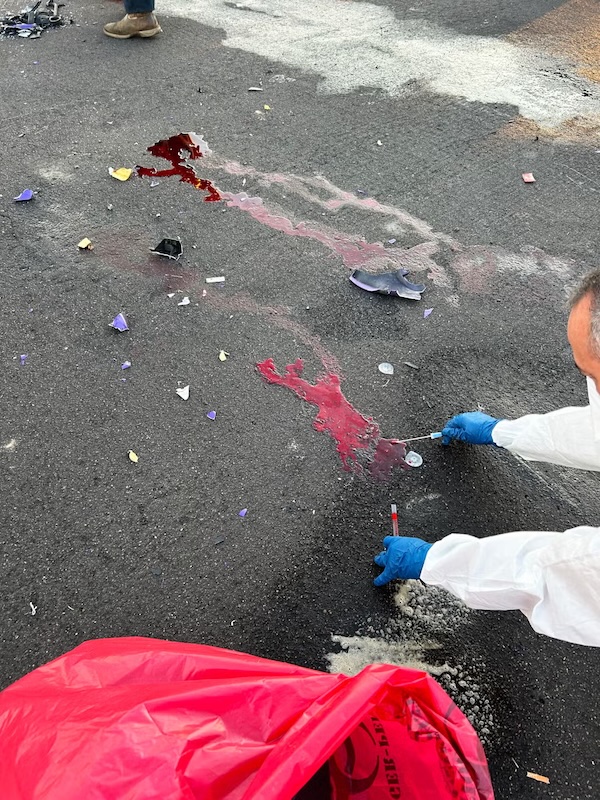
One morning in May, Xander and another colleague, Miguel Parades, manoeuvred a pickup truck into position by the Lesaffre-family garage. Somewhere west of the city, a worker on a concrete job was using a chop saw when its 14-inch blade, spinning at about 60 revolutions per second, flew off and hit him in the neck, severing his carotid artery. Arterial bleeding can be fatal in as little as two minutes. Rather than wait for an ambulance, colleagues rushed him to get care in the passenger seat of a Ford F-150. Miraculously, he survived, but his blood was everywhere.
For this job, Miguel was “red,” working directly in contact with the body fluids, while Xander, “yellow,” stood behind him like a golf caddie, making sure he always had the right tool at the ready. Miguel stripped the upholstery from the front seat and folded it into a red garbage bag. Xander, wearing two layers of gloves and battered black sneakers, crouched on the pavement and tore an entire roll of paper towels into three-sheet sections as Baby Keem played in one AirPod. The truck’s seat was gently reclined, with splotches of dried blood clinging to the dashboard and droplets splattered throughout. The remains of a homemade lunch—beans, indeterminate meat—sat undisturbed in a glass container on the floor.
For this hot, gross, necessarily meticulous service, T.A.C.T. 48 would collect USD4,000.
While they worked, Lesaffre stood in a strip of shade working his cell phone: “Thank you for calling T.A.C.T. This is David, I can help.” Slight and upright, with birdlike posture and an easy, understated manner, he’d switched from the slacks and starched shirts of his dealership days to black T.A.C.T. 48 tees, black jeans, and black Vans. The tools of his new career surrounded him: white truck, white trailer, snow shovels, paper towels. The mannequin he dressed in PPE for events and conferences was strewn in parts atop a six-ton portable air conditioner that kept his employees cool while they worked, even if it was 110 degrees outside. Beside him, a gardening shed repurposed for biohazard waste awaited a trip to the incinerator. Everything inside it was evidence of the messes they’d cleaned up. This was no wallet flush. For David Lesaffre, this, it turned out, was what happiness looked like.
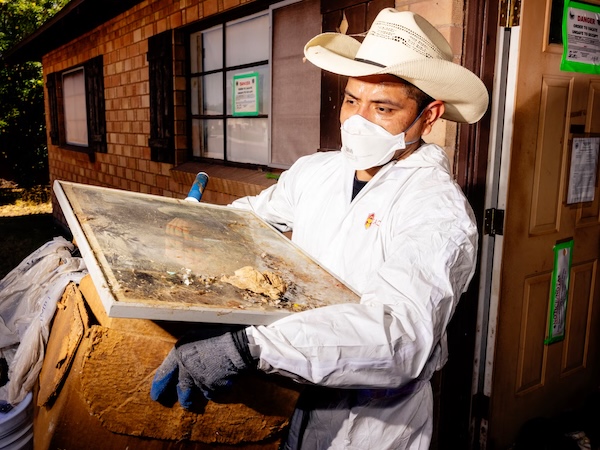
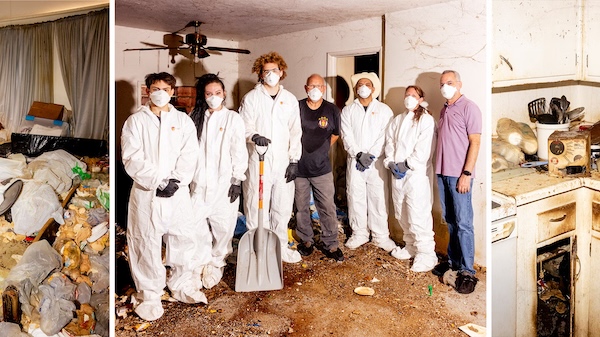
From the start, Leanne and David had agreed that they weren’t interested in cleaning up hoarders’ homes. I’m not gonna do that, Leanne recalls thinking during Lovasz’s training, as he described cleaning a pile of sex toys that a client insisted on keeping. It wasn’t simply unappealing work; insurers often refused to cover hoarding cleanup, in part because most policies have provisions excluding damage from missed maintenance or neglect. In literature, references to hoarding behaviour go back to Dante’s Inferno, but the American Psychiatric Association started recognising hoarding as a disorder only in 2013. The canonical case in the US is from 1947, when police trying to find the wealthy, reclusive Collyer brothers had to enter their Harlem home by ladder through a second-floor window; it took three weeks to find Langley Collyer’s decaying body as thousands of people gawked from the sidewalk.
The Lesaffres learned quickly that if they cleaned up after unattended deaths, they would encounter hoarding. It was a pattern Lovasz had described, in which the trauma that drove hoarding’s suffocating grip on people’s homes eventually caused injuries that forced moves or even death. “There’s always a catalyst,” as David puts it. The Lesaffres also came to see the wisdom in something else Lovasz had pointed out. If you only cleaned up the deaths covered by insurance, you’d inevitably end up leaving families to clean the filth and chaos that remained after the blood was gone. “What about the rest of the stuff?” they’d ask. To truly help, you had to clean it all. So T.A.C.T. 48 started taking hoarding jobs.
Lesaffre shudders at how casually some of his competitors discuss the facts of unattended deaths and suicides. “If ever I’m at that point, then I have to exit,” he says.
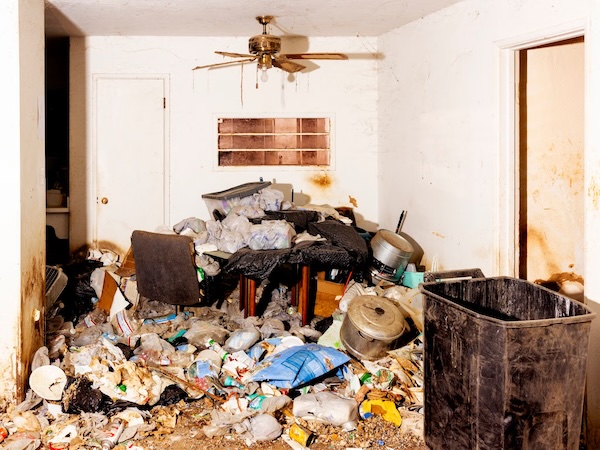
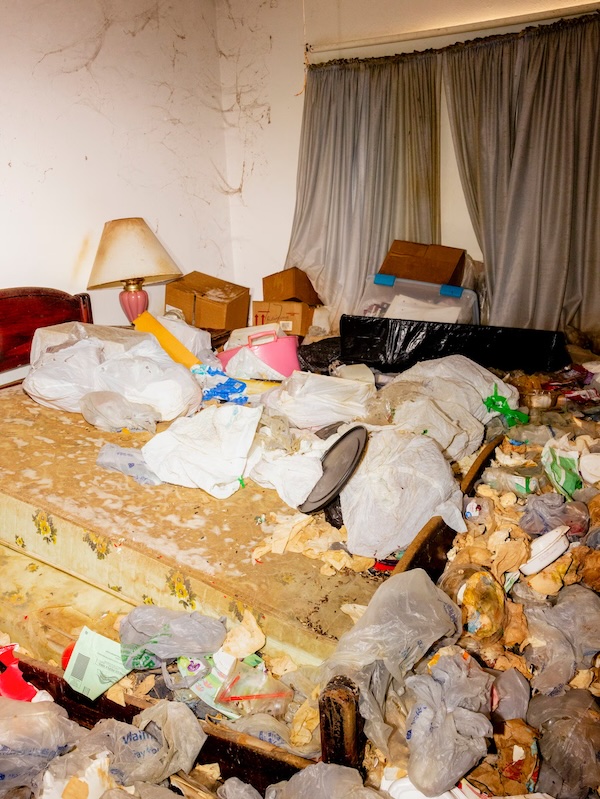
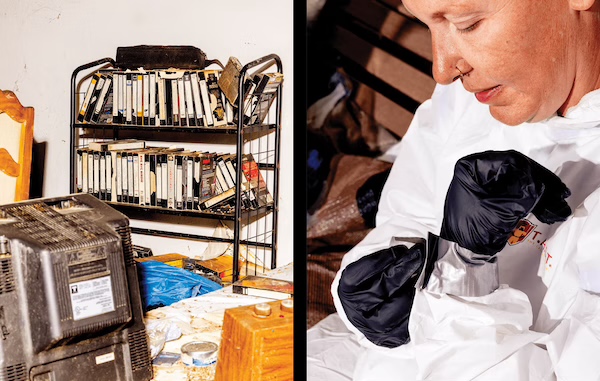
It wasn’t wholly unfamiliar. Gerald Lesaffre hadn’t been a hoarder, but his death bore some of the same hallmarks the Lesaffres came to know well, as isolation severed his ties to a wider, shared reality. By the end, the TV and the bottle were the only companions he could abide—not so different from hoarders who consoled themselves with tinsel and unopened toys that would never make it to their grandchildren. The difference was that in a hoarder’s house, you could see the world shrinking in real time, stuff gradually filling in liveable space until there was nowhere left to accomplish the most basic tasks: wash your hands, grab a tissue, rest a stack of folded clothes, put a wrapper in the trash. Eventually, people almost always ate in bed because they only really had one comfortable place to be.
It’s not clear whether or how quickly hoarding is growing, but there are clear accelerants. “Amazon and Uber Eats are like the two number-one things you’re going to find in a hoarder’s house,” Lesaffre says. The ability to acquire stuff at home has been transformational. So have the things that keep us home—some purposeful, some not. “I was surprised when we got into doing this how many people said they were good until Covid came along,” says Lynn Dorsett, Leanne’s stepfather, who also works with T.A.C.T. 48. Today, hoarding accounts for 30 per cent of the company’s revenue and 60 per cent of the hours it puts in on jobs.
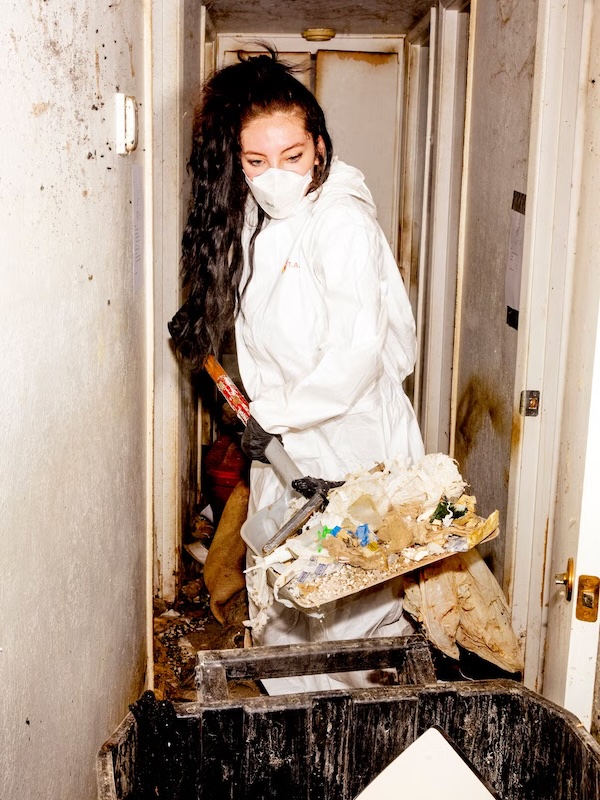
In May, Lesaffre took on a job he called one of T.A.C.T. 48’s largest ever, prepping a ranch house in the suburbs for a move after more than 40 years. There were, at last count, 53 cats and one pure-white peacock on the property. The homeowner was a celebrated artist who’d raised a large family there with an ethos of self-reliance and a warped sense of thrift. Her daughters still quivered at the grudge their mom held over a long-ago pantry culling, in which one of them had thrown out baking powder from the 1960s. A narrow path traversed the home, as in a haunted house. Here and there were Post-it notes with sketches outlining aspirational layouts—“Family Room Vision,” “Living Room Vision”—with accessible furniture and dramatically less stuff. A note on a shelf containing thousands of DVDs read, “Movies are on probation: if not watched by 7/23/19 they are OUT.” That plan, if it ever had any chance of success, had been interrupted by health problems. The father, sick with ALS, heart disease, and dementia, had finally tripped amid the clutter and broken his arm. A catalyst. “That’s what catapulted this whole thing,” a son-in-law said.
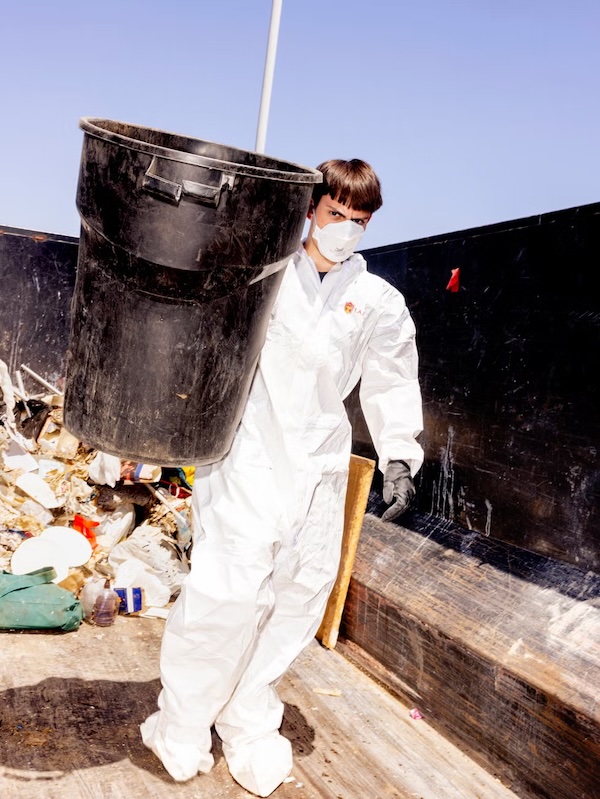
Once a dumpster was dropped in the driveway, Lesaffre called in two of the artist’s daughters and their husbands, who were in charge of the weeklong push that would end with their parents moving closer to their children, in another state. “What’s most helpful to us is if you can be in sorting mode,” Lesaffre told the sisters. His seven-person team would work from the front of the house to the back, clearing out space as they went and staging anything the family wanted to keep in the garage, so that the movers, set to show up with two semitrucks later in the week, would have a place to pack while they kept cleaning. “We have to be done by Friday. Challenge accepted,” he said.
It was Monday. The daughters had 48 hours before the movers would arrive, and in that time they had to decide what would join the parents in their new lives. One prized possession was a 50-year-old washing machine that began as a wedding gift and gradually became a totem of the couple’s union. “That’s definitely going,” one daughter said. “It still works. My dad has been fixing it their whole marriage.” And yet, she knew she couldn’t possibly honour all her parents’ desires. “You just have to kind of treat my mom like a drug addict,” she said. “We’re not taking everything she wants, and we’re gonna deal with the consequences.”
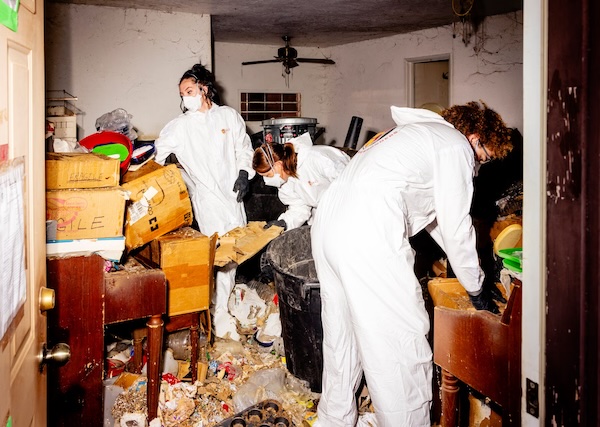
The timing didn’t allow for anything but the most ruthless triage, a sprint to recast the congested taxonomy of the artist’s home into a simple scheme: keep, trash, donate. Into the discard pile went full cans of paint and baskets of folded bedspreads; whole shelves of Sunday-school materials; jars of peanuts; hand tools; extension cords; tens of thousands of nuts, bolts, and screws in tiny boxes; side tables and nylon plants; car jacks and electric sharpeners; tomato cages; a whiteboard; a microwave; bags of chicken feed. At one point a son-in-law walked a load into the open dumpster, hesitated, then turned around to rescue a red steel-enamel toolbox.
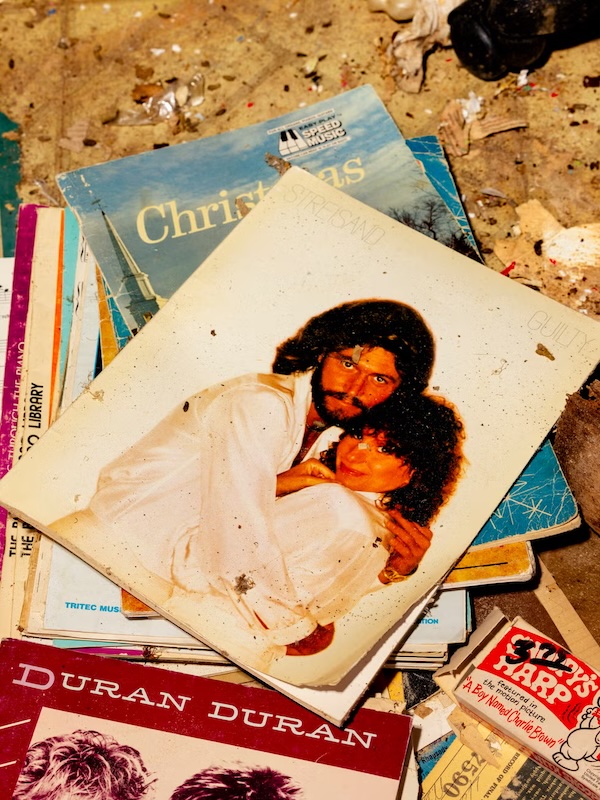
Larger disagreements surfaced periodically in the shadow of a ceramic figurine or some other object bound for either the mantel or the landfill. One daughter and husband joked, or maybe debated, whether the cleanup would lead the other daughter and husband to divorce. The process could seem ridiculous, but underneath every minute decision—okay, keep the banana stand but not the bananas—was the emotional messiness the Lesaffres had been reluctant to wade into, then learned to accommodate. So much was embedded in cleaning house. For the daughters, at least, it meant a million small reckonings, not just with each object but with their childhoods, their grief, their guilt and aspirations.
Lesaffre and his team wear the dramas of their customers’ lives lightly. The work itself requires a kind of split consciousness—they need enough empathy and awareness to steer past the emotional asteroids orbiting their work while maintaining the ability to plug away at the task list with mechanical detachment. Nimble, judgment-free, firm.
“Am I going too fast?” one sister asked. “You go as fast as you can and I’ll keep up,” Xander said. In the kitchen, he entertained deliberations about what dishes and utensils to keep, nudging everything plastic toward the trash—cheap, dirty, easily replaceable—and teasing out definitive decisions from the sisters’ running, ambivalent commentary.
In another room, as one sister explained her attachment to a gnarled piece of driftwood—“This is really dumb, but...”—Miguel jumped in: “Don’t justify the decision, just make the decision.”
By the time the movers showed up, Lesaffre’s team had carried out enough trash to fill 10 full-size dumpsters, the equivalent of 4,000 wheelbarrows. Like that old wedding gift, it wasn’t all trash, but for the parents’ sake, there was nothing else for it to be. In the end, the washing machine got tossed too.
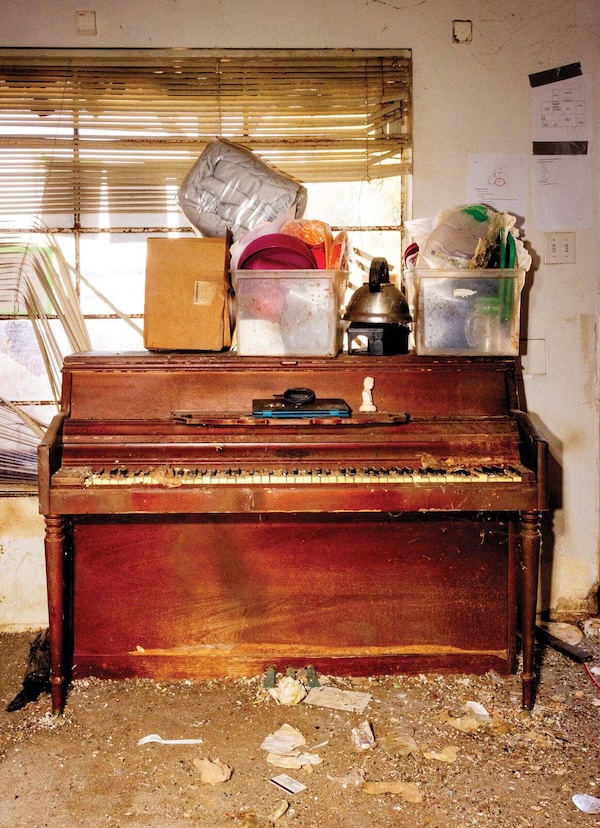
Behind every trauma-cleaning job—a lonely death like Gerald’s, a vomit-flecked cop car, a living room overflowing with fast-food trash—is someone who’s lost hold of one of life’s crucial anchors. It’s hard to ignore the personal stakes that animate the task of cleaning up after society’s open wounds. But if you do the work long enough, it’s easy to become inured to them.
Lesaffre comes across as an enviably uncomplicated person: content, present, untroubled by regret. He is not shy about his enthusiasm for the profit and lifestyle upgrade T.A.C.T. 48 represents over his first career. The Lesaffres’ plan is to try to double the size of the business, turn it over to Xander if he’s interested, or sell it and try something new. But the job has changed David. Leanne says he’s become more empathetic, a better listener. He is deeply invested in the purpose of what he does.
Growing up in the shadow of his father’s absence, Lesaffre became especially close to his maternal grandfather, an aeronautical engineer. After his grandmother died, it was Lesaffre who accompanied him to the funeral home. “They laid it on thick,” Lesaffre remembers, offering his grandfather everything from a cardboard box to a USD38,000 mahogany casket to transport his grandmother’s body to the crematorium. “How would you like to transport your loved one?” his grandfather was asked. Furious at the implication that spending less might somehow be unworthy of his lifelong love, Lesaffre’s grandfather chose the cardboard box, then brought his wife’s ashes home in a simple plastic urn. Lesaffre still keeps it on his mantelpiece.
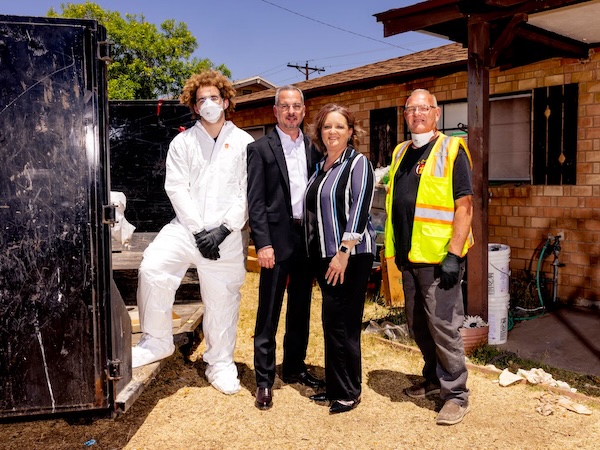
Today he shudders at how casually some of his competitors discuss the facts of unattended deaths and suicides. “If ever I’m at that point, then I have to exit, because life is too precious,” he says. It’s a constant struggle. “What I really worry about, and it’s already happening, is we’re so busy and we do so much work, and we’ve got so many things going on at any given time, that a week or two from now somebody’ll say, ‘Hey, do you remember this and that about Peter’s job?’ and I’ll say, ‘Which one was Peter’s?’”
The hard work of trauma cleaning, in some way, isn’t the shovelling or the chemicals or developing the strong stomach—it’s holding fast to the particulars that attach each job to a human life.
It wasn’t until days after he arrived in Phoenix, and his future competitors had gone home, that Lesaffre was able to get into his father’s house and take stock of how Gerald lived out his last moments. He found the scene he encountered inside puzzling. The home smelled of metal. The couch was gone and the tile below it chipped out, replaced with a coat of shiny, thick, white paint. His father’s fridge, which had always overflowed with butter and wine and the makings of rich French cooking, was empty.
As he went through Gerald’s belongings, there were hints of intimate riddles about the life he’d led, things Lesaffre might have known if his father had been a different person or if they’d been able to repair their relationship. He’d known his father suffered terribly from gout; now he found needles and receipts for insulin, presumably to treat diabetes he’d kept secret from his kids. There was pack after pack of cigarettes—a habit his father had said he’d given up years earlier—and, at the door, a procession of older women more distraught about Gerald’s death than his own son was. “Five marriages that I know of,” Lesaffre says, based on the evidence in his father’s papers.
The week Gerald finally died, Lesaffre had twice ridden his motorcycle within blocks of his father’s house and found reasons not to stop by. He was tired, stressed, stretched for time. He’s just going to be grumpy, he’d thought. No one had missed Gerald until he failed to show up in church for the second Sunday in a row. Lesaffre doesn’t make much of the connection between his second career and his father’s death. He’s an uncomplicated person, a fixer. Still. There was one concrete change Lesaffre could think of in his day-to-day life after his father died: He developed a sudden distaste for Heineken, his father’s lifelong beer. That could be nothing, but then, you could also see how it might be everything.
Photographs by Cassidy Araiza