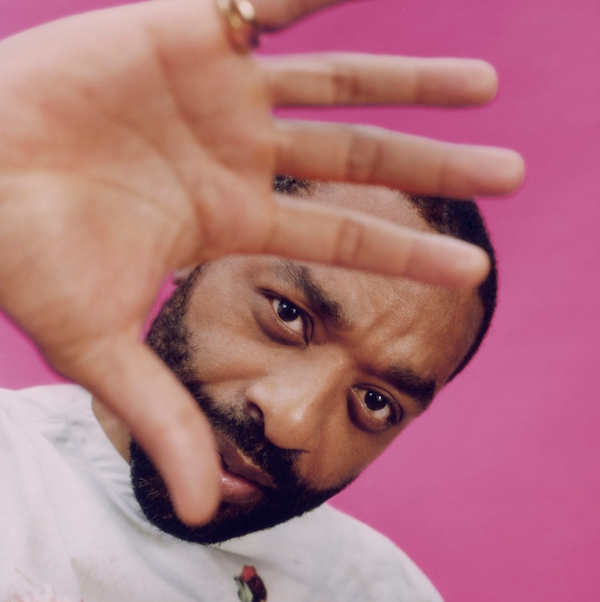
Chiwetel Ejiofor has always been fascinated by the water. He thinks it might have something to do with being a Cancer; the actor’s early-July birthday means he is, as you might have surmised, a water sign. Whatever the reason—astrological or otherwise—he has always found peace at sea: during lonely periods living in new places, and especially in his twenties, he would always try to get on a boat and see the world from a different perspective. The London-born actor has lived in waterside cities, such as New York, and during a stint in Los Angeles, he even sailed in races. “It right-sizes everything in a weird way,” Ejiofor says, two steps away from rhapsodic. “It makes it not as intimidating and complex. It’s just this place, you know, that’s all it is. I can go back into it and not feel like it’s crushing.”
Listening to Ejiofor explain this, in a voice that is both resonant and familiar, I am right there with him. He has a knack for transforming interior feelings into memorable scenes: a quality that has made him so convincing in roles as diverse as a drag queen (Kinky Boots), an underground resistance leader (Children of Men) and a crime boss (American Gangster). He is, in short, both an adept storyteller and a masterful shapeshifter.
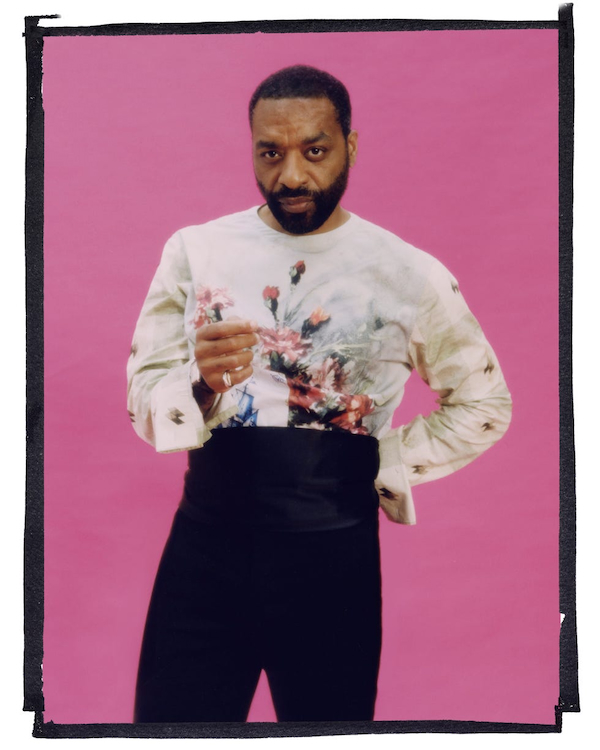
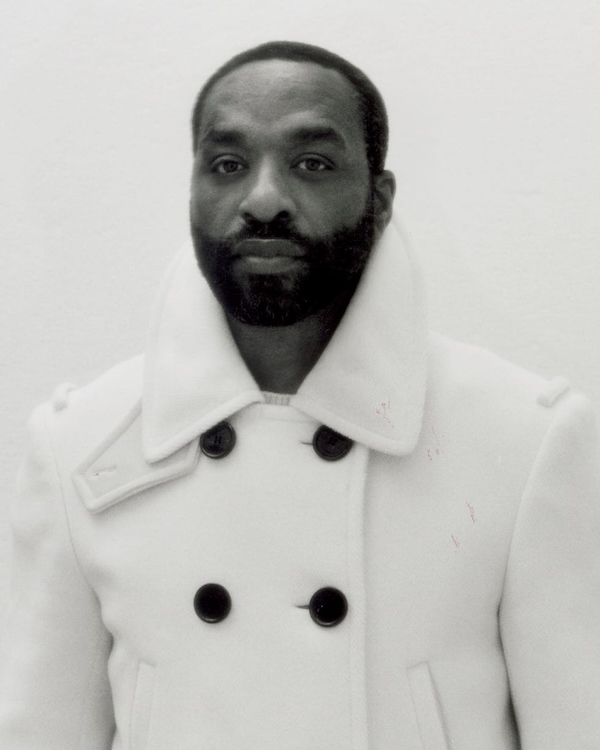
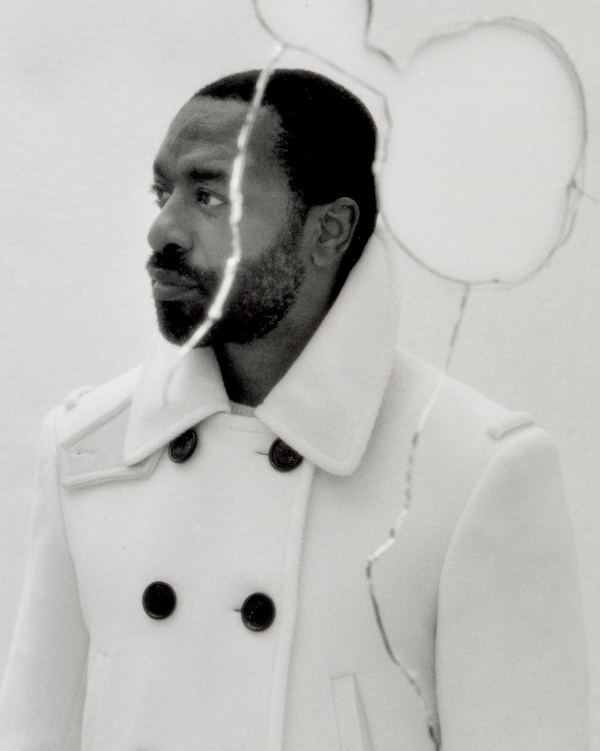
When we meet, we are nowhere near the water. It’s the very start of September, and Ejiofor and I are on the top floor of an east-London office block. It’s an unsettled day in the capital: grey skies, late-afternoon heat. (And thick, oppressive air: I imagine it would be a lousy day for sailing.) The actor—classically handsome and visibly fit even beneath loose knitwear—has been shooting in the adjacent studio for the cover of this magazine since late morning. He’s one of our Better Men: an individual whose contribution to culture, in all senses, runs deep.
The day, as these days tend to, has run late, so we’re an hour past our scheduled interview time. But he soon slips off his reading glasses and unscrews a water bottle. In the next room, a set is being disassembled; crew members are heading home. And even though we are not on a sailing boat, sinking instead into an enormous leather sofa, Ejiofor seems very much at ease.
We start with Backrooms, this year’s defining horror film. Ejiofor plays Clark, a disaffected owner of a furniture store—“Cap’n Clarks Ottoman Empire” specialises in pirate-themed pieces—who stumbles into another dimension via his shop’s basement. This is a liminal space: endless, yellow corridors that are populated by a murderous entity. The movie was made for just USD10 million and has taken in almost USD400 million at the box office since its May debut. Critics, including this one, enjoyed its elusive approach to the genre.
Ejiofor had a feeling that people would be into it. The 21-year-old director, Kane Parsons, had found attention online by creating a 25-episode YouTube series about a spooky meme that originated from the community forum 4chan. That means, as Ejiofor points out, the film’s storyline had effectively been “pressure-tested” by people online. “They feel free to really give you their opinion, for better or worse, or ignore you entirely,” he says. Even still, the stratospheric success took him by surprise: YouTube virality does not automatically equate to ticket sales.
The movie takes place in San Jose, California, but was filmed in Vancouver, British Columbia. The streamlined cast—Renate Reinsve plays Clark’s therapist, who eventually follows him into the nightmarish zone—were acting on a 30,000-sq-ft set. “I didn’t find myself lost exactly,” Ejiofor tells me, pausing to recall this strange, specific experience, “but I would definitely just be trying to find the bathroom and end up at the wrong side of the stage.” He recalls opening a door and not knowing where he was. This had the intended effect: “It disorientates you and makes you feel like you’re a bit untethered.”
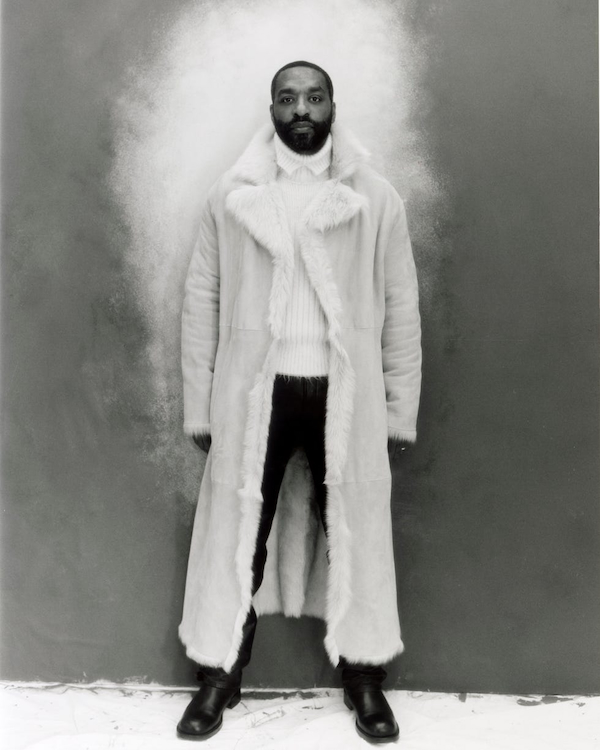
Backrooms is eerie. There are jump scares and monsters and suitably creepy scientists. But do you know what’s more frightening? Human nature. In Ejiofor’s hands, Clark is a desperate and lost man. He has failed at an architectural career; he has failed at marriage. He has a drinking problem. I found the character’s desperation, and the lost potential that fuels it, moving. Ejiofor nods in agreement; Clark’s trajectory has resonated with a wide audience. “It’s just something in the psyche and in the atmosphere at the moment,” the actor posits. “That feeling of being untethered and a bit lost and wanting to reconnect and to be understood.”
Ejiofor was born in Forest Gate, east London. His parents had emigrated from Nigeria during the Biafran War in the late 60s; his father was a doctor, his mother a pharmacist. Later, when they moved to south London, Ejiofor attended the fee-paying Dulwich College. His first role, in his early teens, was in a school production of Measure for Measure. “I really fell in love, not just with performance, but also literature—I became excited about these forms of self-expression,” he says, and for a moment, that boyish wonder is alive in the 49-year-old’s face. “Things that I considered to be interior, and seeing them presented, written, spoken about.” In retrospect, Shakespeare’s thorny legal drama was a very suitable entry point for Ejiofor, who speaks equivocally about almost everything.
At 11 years old—and just a few years before his stage debut—Ejiofor was heading to a wedding in Lagos with his father when their car hit a lorry. His father was killed; Ejiofor was seriously injured. A scar is still visible on his forehead. When you watch Ejiofor’s face in films and you know this story, it is hard not to think of the tragedy. I am trying not to play armchair psychologist—though our seating arrangement makes my approach seem especially inelegant—but finding an outlet for those emotions must have helped him at that age. “I think that’s probably true,” he says. “There are certain things—traumas and emotions—that need a release. And art obviously can do that. Or it can become clear through art that it’s necessary.”
He says he would have fallen in love with drama anyway. “Seeing characters in Shakespeare, in heroic and in dastardly ways, pursue their own goals ferociously, was interesting,” he recalls. “I just didn’t know, before engaging with literature, that that was allowed. That you could think of yourself in this way. That you could think of your own future in this way. That you could pursue your dreams.”
Later, he attended the London Academy of Music and Dramatic Art, though left during his first year after he was cast in Steven Spielberg’s slave drama Amistad. In an art-imitating-life flourish, he played a sailor. Ejiofor never went back to drama school. Throughout the 2000s, he instead made progress onscreen, in the human-trafficking drama Dirty Pretty Things and the divisive festive staple Love Actually. People still approach Ejiofor to discuss the film from Christmas to Valentine’s Day.
Before engaging with literature, I didn’t know that you could think of your own future in this way and pursue your dreams.
In 2007, Ejiofor played the title role in Othello at the Donmar—he had played the tragic hero a decade before—and won an Olivier. Ejiofor was 30 at the time, and beat out competition from Ian McKellen, Patrick Stewart and Mark Rylance. In The Guardian, the theatre critic Susannah Clapp wrote: “He is the best Othello I’ve ever seen: the best for generations.” If you were hoping that Ejiofor might revisit that role, complete a hat-trick, then you may be waiting a little longer. “Once you’ve done a character, it’s hard to revisit unless there’s a really compelling reason,” he says, “unless something has really shifted, and I’m not sure if that’s happened yet.”
The film 12 Years a Slave tells the story of Solomon Northup, an African American free man who is kidnapped, taken from New York to the deep South and sold back into slavery. Northup really existed; in Steve McQueen’s 2013 dramatisation of his life, we watch as a proud, intelligent man is toyed with by slave owners over the course of a dozen years. The film is 134 minutes long. With McQueen’s direction, the story moves along at a clip. It is a testament to Ejiofor’s power that the performance feels lived-in, wholly his own, unlike countless other hagiographic biopics. You are watching 12 tortured and desperate years of this man’s life.
He bagged the Bafta for that performance and also became the first Black actor from Britain to earn an Oscar nomination for Best Actor. His co-star, Lupita Nyong’o, won the Academy Award for her supporting role, and while McQueen just missed out on Best Director, the film scooped the top prize at the end of the night. How does Ejiofor look back on that time? “It’s complicated,” he says, proceeding to delineate the process of making the film and the campaign afterwards. “It just felt so singular in its own way,” he says, “that you don’t think you could ever repeat it, and wouldn’t want to in that sense.”
Ejiofor was not just interested in Northup’s narrative. He was fascinated by the ways “in which people aren’t able to talk about—or weren’t at the time—their exposures to other people”. By exposures, Ejiofor doesn’t just mean physical violence, he’s talking about harassment or bullying, any injustice. “When the film came out, all of that was just on the cusp of being spoken about in a global way but hadn’t, and so the film was somehow speaking into this space,” he says.
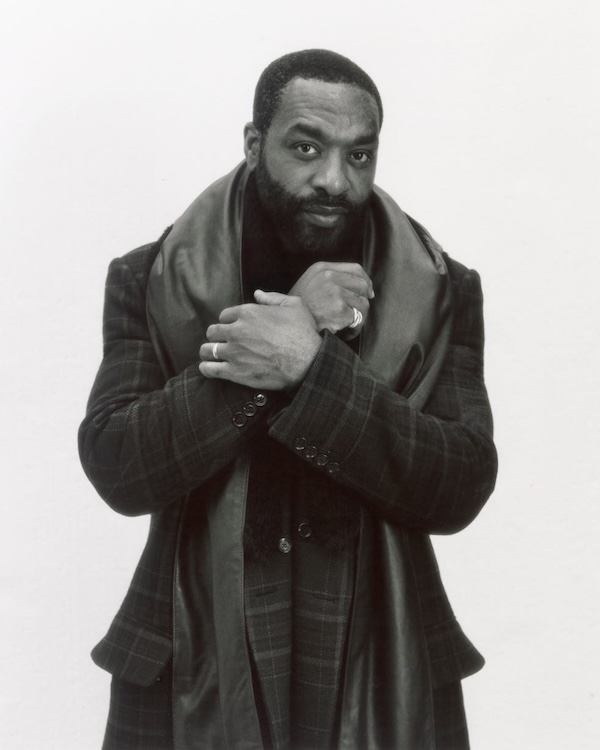
He mentions the #MeToo movement, which became mainstream in 2017, as well as Black Lives Matter, which gained international attention in 2020 after the murder of George Floyd. “None of that, prior to that, was spoken about very much, and then here’s Solomon Northup,” Ejiofor says. “We’re looking at a story that’s hundreds of years old about slavery, and yet within that are all these themes, these personal dynamics, these unspoken realities, these hidden relationships.”
Later, as I transcribe this conversation, I realise just how often Ejiofor, in his low, determined rumble, returns to this idea: the pursuit of self-expression. It’s why he was drawn to Shakespeare at school and, throughout his career, to characters that are, in some way, “untethered”. When I ask about an audiobook he narrated during lockdown, he discusses “using voice to express these emotions of this character in this extraordinary circumstance”. Often, when I am asking a question, he asks me to expand on a point so he can better understand where I am coming from. Ejiofor is, often compulsively, on the lookout for the right word.
It is fair to say that 12 Years a Slave changed things for Ejiofor. His value stateside rocketed, and in the years following his Oscar nomination, he has played a Nasa director in The Martian, the Marvel baddie Karl Mordo in Doctor Strange and Scar in the photorealistic reboot of The Lion King. But for other Black actors in Hollywood, progress was slower. The year after 12 Years a Slave swept the Oscars in 2014, only white actors were nominated in the leading and supporting categories. Immediately, a new hashtag: #OscarsSoWhite. That movement prompted a diversification in the Academy’s voting body, which seems to have effected change: earlier this year, Michael B Jordan scooped the top acting prize for Sinners, becoming only the sixth Black man to do so. Is there more recognition for Black actors now? “There’s no doubt,” Ejiofor says, though adds that it is a “continuing” process.
“If I’m sitting down to watch a film, there’s no part of me that’s either drawn to it or repelled by it by the nature of those racialised dynamics,” he tells me, “and so it’s still surprising to me that for so many people that is a part of it. You know, I can watch films with white people and not think I’m watching a white-people film.” He understands the flipside, too: that it can be important to watch a movie and feel like you are represented. “One just wants to get to a point where people are able to engage with things on the merits of what they are, as opposed to who people are. That’s not that revolutionary, I suppose.”
If Ejiofor has a way of making the ideal sound attainable, we ought to thank his forebears. They raised an ambitious group of children; one of Ejiofor’s sisters is a correspondent for CNN, and the other is a doctor. “We were encouraged, in some ways, to think of ourselves as important, that we were precious,” he says. He recalls visiting his grandfather in Nigeria, who bestowed a sense, that when it came to his grandchildren, “everybody was epic in their own way”.
Ejiofor spoke with that same grandfather at length when the actor reached another milestone: the offer of an OBE in 2008. His grandfather had worked as an accountant for Nigeria’s mining corporation, which was intimately entwined with British colonialism. “In a very front-line way, he had encountered all these different dynamics, and had a fascinating relationship with [the UK],” Ejiofor says. “On one hand, there were things that he really responded to and engaged with, [but there were also] things he thought were just devastating and cruel and unnecessary.” Ejiofor concludes his grandfather was “fascinated” by the idea that attitudes could change. That was partly why the actor eventually did accept the OBE. Seven years later, in 2015, Ejiofor was upgraded to a CBE.
In the days leading up to this interview, I undertook routine preparation: I watched Ejiofor’s films, I listened to him on a podcast. I also spent a lot of time on his Spotify profile. This month, he clocked in nearly 34,000 listeners. His most popular song is The Lion King’s “Be Prepared”, which has almost 12 million streams. But the real gems are from the Kinky Boots soundtrack, which he sings in character, as a drag queen called Lola. I tell Ejiofor that, during an at-home spinning session, his sultry rendition of “Yes Sir, I Can Boogie” provided as much pep as any Top 40 hit. “That is kind of an inspirational song, especially for a spin class,” he notes.
Perhaps it was because Ejiofor had been living inside my ear for the past week, accompanying many a sweaty moment atop a stationary bike, but it’s easy to feel like you know the actor personally. He has starred in so many beloved films that I’d forgive most people for feeling like they have a sense of connection to him.
But, as my research turned up, Ejiofor is a very private man. In past profiles, he demurs on most personal matters. In this conversation, he is rarely evasive, but he does guide a few individual stories to professional observations. It is easier to discuss roles than romance, and this is not an unusual redirect when interviewing actors. But even still, Ejiofor has done a very good job at maintaining a sense of privacy. “I don’t necessarily want my life to be advertising,” he says, when I ask about this tension: how we know very little about a man who is so well-known. “I don’t want it to be an extension of trying to get people to see things that I do.”
What we do know is that Ejiofor has a partner, Sacha, and a child. “My wife is French,” he tells me, and so he’s brushing up on the language. Like most British children, he studied it at school. But Ejiofor is taking it up a notch: last summer, he spent a lot of time in Paris having lessons. Now, he is reading Le Silence, the French-language translation of Dennis Lehane’s Small Mercies, which he picked up in a New York bookstore. I wonder if fatherhood has influenced his acting choices. Does it inform any parental characters he might play? “They’re just more accessible to you. You understand a few other different colours of the rainbow and that’s, you know, massive.”
Ejiofor’s grandfather, the one who believed his descendants to be epic, would approve of his grandson’s upcoming blockbuster Children of Blood and Bone, an adaptation of Tomi Adeyemi’s young-adult novel that sold more than three million copies worldwide. We enter the fictional land of Orïsha, where magic once ruled supreme but has now been stamped out by a brutal monarch. That would be Ejiofor’s character: King Saran, a dictator who plays his children, Inan (Damson Idris) and Amari (Amandla Stenberg), off one another, with committed performances from the young leads.
He was familiar with the three-part book series, so when the director Gina Prince-Bythewood called up, Ejiofor had an idea of the role she was thinking of for him. One of young’uns? Ejiofor laughs—he has, as you might expect, a good laugh—and begins to describe the complexity of the role. “It’s not just lost in fantasy,” he says about the movie, “you can feel it being grounded and emotionally real for the people involved. The experience of shooting it was a bit like that.” Another noticeable feature? Ejiofor is still jacked. When I point that out—how he has not really aged since Kinky Boots—Ejiofor thanks his personal trainer. (He describes his experience at the gym in two words: “pain room”.)
The film is not without controversy. Adeyemi has distanced herself from the adaptation, even though she co-wrote the screenplay with Prince-Bythewood. “I have not seen the film, and I will not watch it,” Adeyemi wrote on a post on TikTok. The exact reason for the author’s discontent is not clear, though it has been the subject of plenty online conjecture. Was Ejiofor aware of it during filming? “It’s completely not for me to talk about in this context, so I won’t,” he says, and we move on.
It is a cliché of profiling to ask what advice a celebrity would give their younger self. But I am curious what Ejiofor, the Oscar-nominated Hollywood star, would say. Would he even need guidance? He was 19 when he starred in his first feature film. “I definitely needed to relax,” Ejiofor says. On reflection, that period—one day he was at drama school, the next in a Spielberg film—was both “chaotic” and “terrifying”. He spent a lot of energy pretending that he was fine, not feeling like he could admit to any of that insanity. “And as you get older, you are allowed to understand,” he says, “and find it emotional and, you know, important.”
Here is an oft-quoted story about Ejiofor. Early in his career, he was advised to change his name. This is the type of casually shocking tale that pervades the entertainment industry: just change your identity, and you will be more successful. Ejiofor doesn’t think that would happen nowadays: “There are enough people who have done very well and navigated a notoriously difficult profession with different names,” he points out, though he wouldn’t have a problem with anyone who did want to adapt. “But if someone doesn’t want to make a choice like that, I think they can,” he says, “I think there’s a roadmap—of which I’m included I hope—of people who have done that.”
It would have been a shame if he had. Chief among them: his name sounds great. In Igbo, one of the native languages of Nigeria, Chiwetel means “God brings”; it is not particularly hard to pronounce or spell. And, I suspect, this would have betrayed something in Ejiofor’s nature. Here is someone who has done things his own way. When I ask what he’d like to do next, Ejiofor is unsurprisingly single-minded. There are directors he’d like to reunite with, yes. And he has thought about the stage. But he really wants to think about his hometown.
Born in the east, raised in the south, he now lives in the west. “I feel like London itself is underexplored cinematically,” he says. “And I’ve had such a rich experience of being in this city.” He’s intrigued to hear how his home town is represented—perhaps more accurately, misrepresented—in the press. Whether as a writer-director (he has helmed two feature-length projects already) or actor, he is not quite sure. He would just like us all to reconsider the capital.
From the water? These days, Ejiofor spends more time on land. He does have a Dutch barge, but it has been a while since he’s been “chunting around on the canal circuit”. Life is busy enough: there’s an upcoming reboot of The Exorcist he has just finished filming, his family and the small matter of mastering French. “It’s a weird thing to say that one feels like one still has a lot to do,” he says, “and that maybe I am still kind of in the first part of my working life.” I tell him that I don’t think this is weird at all. “Yeah,” Ejiofor says, sounding as though he had genuinely been waiting for my opinion. “And I’m optimistic about the future.”
Styling by Rudy Simba Betty
Grooming: Marcia Lee at Forward Artists.
Set design: Murdo Hepburn.
Styling assistant: Emma Kennedy.
Tailor: Summer Lahti