
His Marvel movie Blade has long since fallen apart, but Bassam Tariq is still studying the sword.
The Pakistani-born filmmaker, who grew up in New York’s Astoria neighbourhood and spent his teen years in Houston, cultivated his interest in martial arts during the making of a vampire superhero tentpole that never was. “While I was working on Blade, I picked up the sword,” he tells me. “My teacher, Sensei Ryan Robertson, taught me the sword is an extension of you. It’s an extension of your ego. You have to strike with intention.”
Tariq’s newest film, Your Mother Your Mother Your Mother, is more than an action thriller with faint echoes of the popcorn movie he and Oscar winner Mahershala Ali had in mind. It seizes on the talents of its lead actor, whose months of weapons training just couldn’t go to waste, to be a personal and graceful movie that meditates on masculinity and fatherhood through the specific lens of Muslims in working-class Texas.
Following its buzzy premiere at the Toronto International Film Festival, where Tariq received the Rising Talent Award, Your Mother Your Mother Your Mother is now in theatres from Amazon MGM Studios. The story follows Latif (Mahershala Ali), a Muslim American hitman and widower who searches for breast milk to feed his infant child. His journey is a treacherous one as Latif finds enemies everywhere, from gun-toting Christian preachers (played by a revelatory John Cho) to the American health-care system in all its banal, bureaucratic oppressiveness.
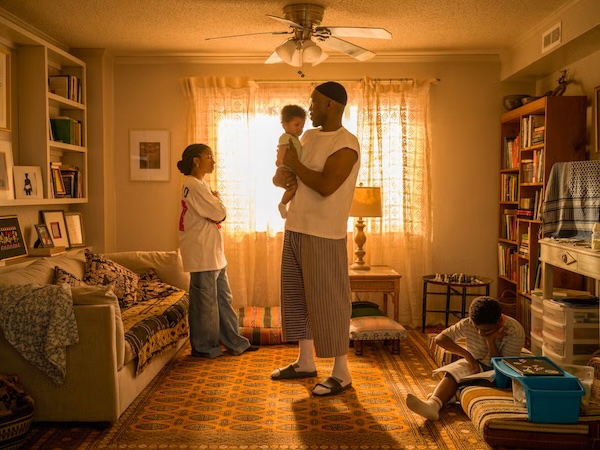
Tariq has lived this story, in fact. (Minus the part where he’s a hitman.) In 2014, the filmmaker became a father. But his wife suffered a post-birth infection, which left her incapacitated in a part of the hospital where newborns weren’t allowed. With his child unable to digest formula, Tariq searched high and low in New York City for breast milk—a “needle in a haystack” situation with a vicious ticking clock. The stressful ordeal led Tariq to agonize over his faith. After all, if good men lead good lives, then why does God still let his followers endure such hardship?
The title, Your Mother Your Mother Your Mother, comes from the prophetic sayings of the Prophet Muhammad that emphasise the threefold importance of mothers (Sahih al-Bukhari 5971). In a story about a single father trying to fulfil both parental roles, the shadow of mothers still looms large. To Tariq’s ears, it also sounded like a curse, an outburst of rage when mercy is needed.
“[The title] felt like there’s an urgency,” Tariq observes. “It makes you stop. ‘Wait, is this a comedy?’ The mother’s not in the movie, but she [leaves] these large shoes Mahershala is trying to fill. A lot of what we spoke about was how you carry dignity and grief. It’s a difficult performance, because he’s having to carry multiple things at once.”
While Mahershala Ali can’t help but be a Hollywood leading man with the mystique of someone who dwells in darkness, he sheds all semblance of a superhero in his portrayal of Latif. The character deals in death by trade—the film opens in the middle of a contract kill—but he is steadfast in his faith and his job as a father of three. He is a walking contradiction, a predator and protector all at once. Ali stands six-foot-two, the same height as Captain America, but he walks with an awkward gait, as if the world is too small to ever make room for him. Instead of superpowers, his tool is the Southeast Asian martial art of silat, which has been passed through oral tradition in regions with significant Muslim footprints. “Our stunt coordinator was like, ‘We should find something that feels specific,’” says Tariq. “Silat is so connected to Islamic spirituality. There are rules of engagement with Muslims. It’s always about mercy, but when push comes to shove, you have to know when to protect your family.”
He points to a conversation in the movie that Ali’s Latif shares with Giancarlo Esposito’s character, Abdul Malik, an elder in their community. “In the mosque, he goes, ‘The Prophet always engaged with mercy.’ Violence was a last resort. He doesn’t understand mercy, which I think is his whole journey in this film.”
For his film, Tariq mined inspiration from Jim Jarmusch’s 1999 film Ghost Dog: Way of the Samurai, in which Forest Whitaker plays a Mafia hitman who adheres to the Bushido code. But the director felt it was important to “break out” from the worn-out fetishising of Japanese nationalism. After all, Latif would “look in different places” for spiritual enlightenment in a modern world. “When people talk about religion or codes of ethics, they always go to this medieval era, something that takes place in a faraway land. I loved Ghost Dog because it was [about] this man trying to live with an ethical code in this world. So I thought, How do I bring that idea of ethics but have an urgency with it?”
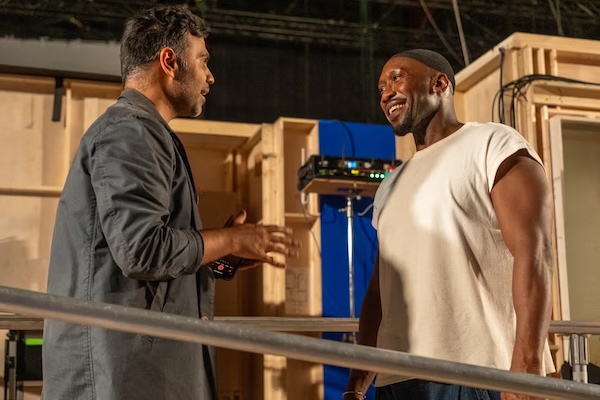
Tariq found further instruction from his time at Marvel. Until Blade was unceremoniously cancelled, the director still spent time learning from the studio and its figurehead, Kevin Feige, whom Tariq calls “a beast” and “a genius.” “Whether we see it in their films or not, I always knew that [Feige] has a desire to find the truth of the character.”
Learning the importance of the audience’s entertainment was crucial to Tariq’s self-discovery as an artist. He’d watch rough cuts of new Marvel projects with producers, who would talk among themselves about things like “cheer moments.”
“I’d be like, What the hell is a cheer moment? And then I’d be in the theatre, and I would see them all cheer, and I’m like, Wow, this is exciting. This is what collective theatrical experiences are. People can call them a roller coaster, call them whatever you want, but they’re feeding something that people are in need of. For me, to start seeing the audience as an important part, and what will get people to theatres, was something I didn’t think of before.”
The revelation wasn’t just about movies for Tariq. It was to “think bigger” and to “be bolder” as a person and a storyteller. He brought that into Your Mother Your Mother Your Mother, which punches above its weight class as an action thriller with more violence than its solemn tone might let on. “I’m an immigrant working-class kid. To take up space in any of these spaces was always new to me. Do I really belong here? But to see the big swings they are pushing you to take, it’s exciting.”
When it comes to Tariq’s story with Marvel and Blade, it’s a closed book. But the doors are open. “I’ve learned the importance of operating with compassion and love with whatever we do. Those are weird words as we talk about this capitalistic industry. But I believe they [at Marvel] are great people, and you find your champions, and you continue working with them.” He found one champion in Mahershala Ali. “We were really excited about what we were building,” he says, “and I think what we’ve done here, Mahershala and I can look at each other and say this is what we wanted to do. We wanted to tell this story. So I’m grateful that Mahershala and I were able to make Your Mother the way we did.”
He adds, “It’s almost like a samurai film, of a man who has to shed or kill all ego he’s built up to be the father he needs to be. That’s me. I think I know what it’s like. I have to surrender to something bigger and listen.”