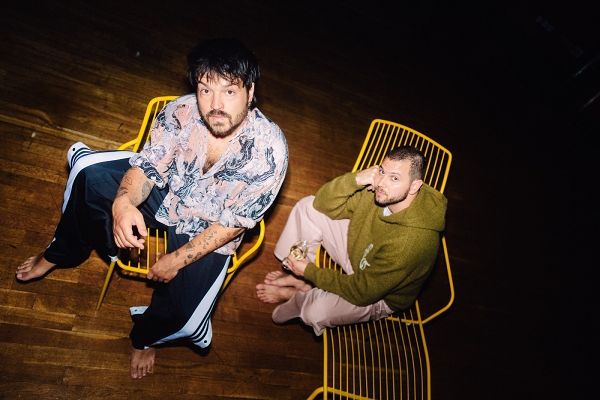
The year was 2013. Moustaches and thick-rimmed black glasses were printed on any and every mug you could find. Vine had just launched. YOLO was still used within the internet’s lexicon. Everyone and their mothers were doing the Harlem Shake. “Stolen Dance” by Milky Chance had just been released.
Most of that has since gone away, but the band has not. With an easy, folk-led guitar groove paired with a warm raspy voice, they managed to soundtrack the spirit of an entire age. But because of their ability to bend genres—often shifting between acoustic ballads, relaxed reggae, and electronic rhythms—their sound has endured throughout the years. This has resulted in over 5 billion total streams on Spotify, placing the duo in a very exclusive club: the top 100 streaming artists on Spotify of all time.
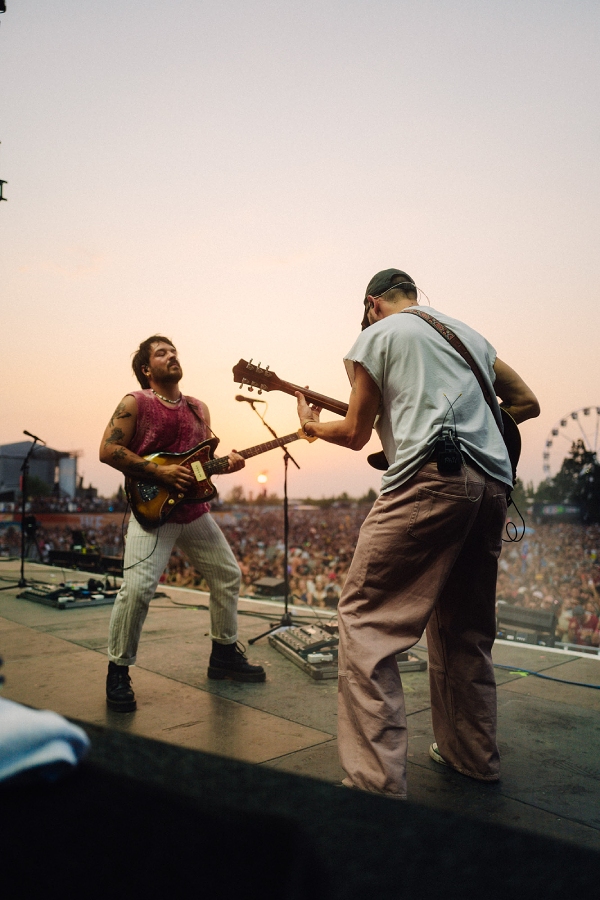
Now, for the first time after 13 years since their debut, Clemens Rehbein and Philipp Dausch, are finally performing in Asia—in Singapore, no less. They'll play as part of Formula 1 weekend on 9 October 2026, where a whole new audience will have the chance to either introduce, or reintroduce themselves to the duo. Ahead of the show, we got the duo to talk about hawker-centre satay, growing up with Michael Schumacher on the telly, and what "authenticity" means when you're crossing the border into a new chapter.
ESQUIRE SINGAPORE: You guys are playing at Formula 1 weekend in Singapore as part of the festival rather than a standalone Milky Chance concert. Does that change how you think about the audience?
CLEMENS REHBEIN: Yeah, it's a festival, so I'd expect it to feel like one. There are a lot of really cool artists playing, and that's always a different situation from playing your own headline show. There will probably be people who wouldn't have bought a ticket to see us, but they've come to the show and want to know what it's like. So it's a bit like: "This is us, we're a really cool band, and we want you to love what we do." At the same time, we don't overthink it too much.
ESQ: This will be your guys’ first time performing in Asia?
PHILIPP DAUSCH: Kind of. We've played in Lebanon, like that part of Asia, for sure. We haven't been to East Asia at all.
ESQ: So what took so long?
PD: (Laughing) There's just so much of the world, and only so much time. Sometimes things fall into place at the same time, and you have to make tough decisions. You also need to put time into building something. So it took a minute, but here we are, and we're really excited!
ESQ: Do you both follow F1 at all?
PD: No, that would be a lie.
CR: (Laughing)
ESQ: We respect the honesty.
PD: But there's definitely a nostalgic feel to it. Growing up, we had Michael Schumacher, and it was a thing in the household. My dad liked to watch it, and I remember those summer nights when there were races. As kids, we'd just sit there and watch the cars go by. It looked cool, so there's some emotional affection there. But following it? No.
ESQ: In your opinion, what would make the show a success?
PD: I think success is if we, as a band, had a lot of fun, and the people out there had a lot of fun, and we could feel that. If we all had a good time together, then it was a success.
ESQ: What's one Singaporean thing you absolutely have to experience while you're here?
CR: Well, you'll have to tell us!
ESQ: What are you into? Food? Views?
CR: We're a foodie band, for sure.
PD: We like eating out and trying new things. We're also the kind of band that orders a lot and shares it. We put a ton of food in the middle, and all try a bit of everything.
CR: I also read about the outdoor food centres, the hawker centres, where you can go late at night and eat satay and all the nice street food. I want to do that.
PD: Are there rental bikes and things like that?
ESQ: Yeah, we've got city bikes.
PD: Then we'll hop on a bike, check out the places and get some good food. That's what we're really looking for.
ESQ: You both grew up around jazz in school. Where does that training still show up in your music today?
PD: We grew up listening to jazz, and we went to a school with a jazz influence. We learned the standards and had a phase of going into it, but we're not jazz cats who studied their instruments obsessively. Where it shows is in our love of the craft, because jazz is, in a sense, the highest point of being able to do your craft. It shows in our love of detail and our drive to get really good at what we do. That's less about genre or sound, and more about wanting to put our best effort into the work.
CR: I think it also taught us how to improvise. When you play jazz, you're in the moment: you see what everyone else is playing, jump onto that and improvise.
That's where it starts: listen and improvise. That's something very special about jazz. It's also about all the different genres influencing what you do, the grooves and the wide range and mix of it. That's very important to us.
ESQ: You've spoken about trusting your intuition, which is similar to what jazz draws out of artists. But intuition can also become habit. How do you know when you're following your instincts rather than repeating old habits?
PD: That's a great question. One way is that we're already a duo, so collaborating gives you an outside signal. Another is to do it consciously: start things differently, play a different instrument, record in a different way. You deliberately set yourself a task where you think, "This isn't how I'd normally do it."
CR: Yes, consciously stepping out of your comfort zone. When you always do it the same way, you're good at it and you feel safe. But if you want to go further and try something new, you have to take the next step.
In the best case, the two work together: you know where you're coming from, but you also know you're going somewhere you haven't been, and it feels exciting and good.
PD: It also comes with staying curious and open, rather than thinking, "I've done it this way, and it's the right way, so I'll keep doing it this way."
ESQ: Clemens, as the primary songwriter for Milky Chance, have you ever worried that someone in your life might hear one of your songs and recognise themselves in it?
CR: We write a lot of songs together now. In the very beginning I wrote them myself, but since then we've collaborated.
But no, we've never written a song like, "Hey, Jimmy, I don't like you."
That's the great thing about songs: you can say something very personally to someone, but at the same time say it out to the world. It doesn't have to be addressed to anyone.
PD: It would also be bold, or almost weird, to write a song about someone, release it, and then feel strange if that person felt spoken to. That's the point of releasing it. As an established artist, you know it will be heard. You can't release something and then be surprised that someone thinks it's about them.
ESQ: You've both said that success is something you can't really control or explain. Looking back, what do you miss most about being an unknown band?
PD: There's a specialness, a magic, that you only experience once in your life, when nobody cares about what you do. You'll never create as freely again. That's a bit of a fact. It shouldn't sound like we're not free now, like we're enslaved artists, but it's a different situation from before anybody knew of you. Now you can make yourself free, but it's different. I'd say I'm grateful for it rather than that I miss it, because "miss" sounds like something you're trying to get back but can't, which would be a bit of a tragedy. It's not devastating or anything.
CR: Same for me, really. It's having no outside expectations. There's a certain magic to doing something for the first time, in this case releasing music.
PD: It doesn't have to be the first time, though. You could make five albums and still be unknown. It's more about creating absolutely freely, very focused on yourself, because nothing is coming in from the outside.
CR: True. But you can also create very unfreely when you're unknown, because you care so much about people listening to your stuff. So it's really about a state of mind that you somehow have to get to. That's the aim, whether you're unknown or not. It's probably just more hard work to get there when you're already known.
ESQ: You both have grown exponentially over the years: tours, merchandise, flights, thousands of people coming to see you. Has that ever made it difficult to stay authentic?
CR: I have to think about what authenticity means, from the outside and from the inside.
PD: A lot of it comes down to the two of us already being really good friends, and to having more good old friends on our team. Having a solid base of people and building that environment around us helped us stay authentic, if we use "authentic" to mean creating something where we can be ourselves, feel comfortable, and carry that outside. That has always been important to us.
But there have definitely been difficult times, with turbulent people situations where you had to steer in one direction or another, and it didn't feel comfortable. For me, "comfortable" and "authentic" go together, because being authentic means being your true self and carrying that to the outside.
ESQ: And where do you think you are now with authenticity and your art?
CR: I feel like we're crossing the border into a new chapter, where we're trying to go somewhere we haven't been before creatively.
PD: That connects to what we were saying about what authenticity means. In that sense, being authentic means not trying to do the same thing we did 13 years ago.
ESQ: Could you elaborate on that?
CR: It's something that evolves and changes. If we try something new or reinvent ourselves as a band, and we put out an album with a new sound or style, people on the outside might feel it's different, or that it doesn't feel authentic anymore: "What are these guys doing?" But for us, being in that process all the time and doing all the work, it feels really close to who we are right now. It's a changing process. It moves.
PD: That's what Clemens meant earlier about authenticity being two things, from the outside and from the inside. From the outside, someone is authentic if the way they appear and act seems to be genuinely them, as if they're not playing a role. From the inside, it means evolving, because change is the only constant. You need to stay in touch and connected with that change, even if it ends up very different from what it was.
From the outside, you can quickly judge, and I say that about myself. You see an artist doing something and think, "He's trying this or that," but who am I to say? Maybe he's on a journey and connecting with something that feels very authentic to him. So I think it's quite complex, what authentic means to the outside versus the inside.
ESQ: You started as friends. Has success changed how you two hang out when you're not working, or is it still the same?
CR: You mean our private lives?
ESQ: Yes.
PD: We do hang out. We actually did just two days ago. We all have families and kids, and our kids are friends. It's special and really nice. We often get feedback from the outside that this is surprising, because we spend so much time on the music project and it's intense. But because the basis is friendship, we also spend time together as friends and with our families. You could easily think that sounds overwhelming, but it's a safe basis and a safe space for us.
ESQ: You were both in your early twenties when "Stolen Dance" took off. What's something you believed during that period that you completely disagree with now?
CR: (Long pause) That's a very broad question. It opens up a deep hole. Personally, I'm thinking about therapy, because my early 20s were when I started it. You try to look at yourself from a more outside perspective, with some help. You start understanding yourself in a new way: you realise that this is how you act, but you can change, and you understand why you did things a certain way and why you feel the way you do.
You look at your family and your background and see how strongly connected it all is, but also that you can evolve, process it, and unlearn things, including habits and beliefs you just grew up with. We're all socialised in a certain way, but it doesn't have to be like that. That's something I look at differently now.
PD: I also think that at the beginning of your 20s, you feel immortal. There's no sense of an ending. Now that we're in our thirties, with children, and with parents and grandparents, we realise more that life has a start and an end. That makes you long for, and practise, being in the moment.
It's funny: becoming convinced that we're actually going to die someday brings us back to being very present.
CR: Life only makes sense because there's an end to it. If life were endless, there'd be no meaning to the moment.
PD: In our early 20s we were probably more in the moment, but we weren't very conscious of it. You think, "Life is endless, I'll just do whatever." Then you look back, and even with the positive things, you realise you didn't really feel them. Now we're much more conscious of the present. That's something I'd definitely say has changed.