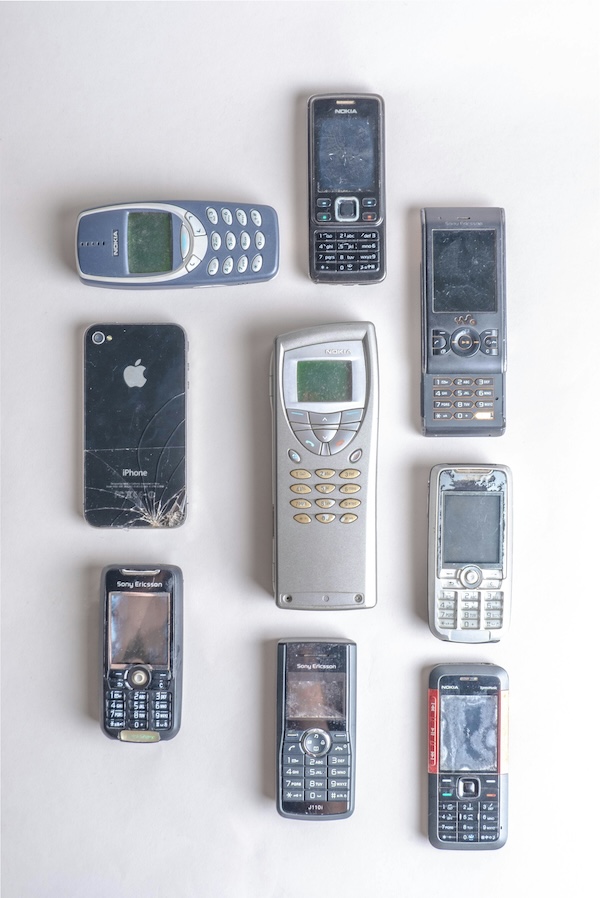
Phones used to serve a primary purpose—to communicate. But as technology evolved, the average phone became more. It had better cameras, powerful chips, longer battery life. We basically have a tiny, powerful computer in our hands.
But today, all smartphone releases look the same. The market is saturated with the same design that has been the default for close to two decades. Why is that? Why have technological advances made everything look so... boring?
Three years ago, out of sheer boredom and a deep desire to relive my teenage years, I bought a used BlackBerry 9900 on Carousell. While I had dabbled with a BlackBerry back when I was a teen, I was an iPhone user, and I missed out on experiencing the Blackberry in all its glory.
With the device in hand, it started to come back to me: The feel of flicking your flip phone with your thumb; the smoothness of sliding your phone screen up to expose the T9 number pad, or even the clicking sensation of tapping on a physical keyboard...
Back then, what really stood out was the 2004 Nokia’s fashion line—a trio of phones marketed mainly to women who wanted to express themselves through their accessories; one model was even dubbed the “lipstick phone”. The Pussycat Dolls and Jennifer Lopez—the epitome of female tastemakers at the time—had them.
When Apple released the iPhone in 2007, it completely upturned the mobile phone industry. The absence of a keyboard, the slick touchscreen made the iPhone so successful that it became the gold standard for the years to come. Today, most of the world owns what is essentially the same smartphone look. With the exception of the addition of cameras to the back, the smartphone remains pretty much the same.
So, why the ubiquity? We got so reliant on the smartphone’s convenience that we became ok with it looking like the same lifeless slab. I remember there used to be variety in smartphones: American high-school girls with their T-Mobile Sidekicks, the finance bros carrying around their Blackberrys, or the upper echelons with their exotic-skinned and diamond-encrusted Vertu. Those were the days of expression.
So, in a world of iPhones and Galaxys, I had to go on a deep dive on a r/dumbphones subreddit for phone recommendations.
They needed to meet certain criteria: the phone needed to be unique and customisable, but still be installed with the basic apps like Internet banking and ride-hailing.
I bought a CMF Phone 1 and a Motorola Razr Ultra and tested them out. Although the Motorola Razr Ultra was a dual-screen touchscreen flip phone, it lacked the tactility of its predecessor. The CMF Phone 1 was modular and customisable. After testing them out, they still felt too modern and similar to the iPhone.
Then, I discovered the world of keitai.
Also known as Japanese flip phones, the keitai usually features a physical T9 keypad and a D-pad navigation system (modern keitai may also have touchscreen capabilities). Japan is the only market that still manufactures modern-day keitai, with brands like Kyocera and Sharp having released their latest models—the Kyocera Digno A202KC and Sharp Aquos A205SH—in late 2022.
I fell deep into the rabbit hole of research, and I went down hard. I now own four keitais, and two of their Korean equivalents. Most of them run a stripped-down version of Android OS, which allows users to download common apps like WhatsApp, Spotify and Instagram. But due to the compact nature of these tiny phones, they aren’t made for heavy usage; hence, the slower processing power and the shorter battery life. But who cares! The phones encompass my entire identity; I feel so chic holding one. The phones were a great conversation starter at parties and events, and, not to mention, that satisfying feeling of snapping the phone shut after a call.
Owning a “dumbphone” isn’t always sunshine and rainbows. Like its namesake, the device isn’t as advanced when compared to modern smartphones. I would hold up lines when my PayNow wasn’t loading properly (or at all); I wouldn’t be able to install an e-sim when I’m overseas. Surely, I can pay the price of
self-expression?
In the middle of 2025, news circulated that a pre-order for a Zinwa Q25 “BlackBerry phone” had opened. Zinwa Technologies modified the Blackberry Q20 by using an existing Blackberry Q20 chassis and combining it with a custom motherboard. The Zinwa Q25 would have the Blackberry Q20’s backlit QWERTY keyboard and trackpad; improved Android 14 OS; camera; battery; nano-SIM and USB-C ports; among other new features.
I was sceptical at first. There weren’t many live demos or official channels one could look into. It wasn’t until the YouTube channel, Returning Retro, interviewed the Zinwa Technologies founder that sold me on the Zinwa Q25. I placed my USD400 preorder and waited patiently.
In January 2026, the Zinwa Q25 finally arrived. It was everything as advertised. It took time to adjust to the QWERTY keyboard, but finally, dumbphones are fun. I bedazzled my Q25 device, as Paris Hilton did in the early 2000s. The device became my “daily driver” phone—a term used by redditors to describe your main, everyday smartphone used for calls, apps, messaging and photos. I spent less time doomscrolling thanks to the squarish screen, and it really did wonders for my productivity.
More and more independent phone companies are producing modern “dumbphones” that emphasise productivity and functionality. People are starting to seek out functional phones with unique designs to express themselves. Clicks, the company behind the viral QWERTY phone cases, will release their own version of the QWERTY keyboard phone, the Clicks Communicator, at the end of 2026, while brands like iKKO and Unihertz will release their own versions—the iKKO MindOne and Titan 2 Elite.