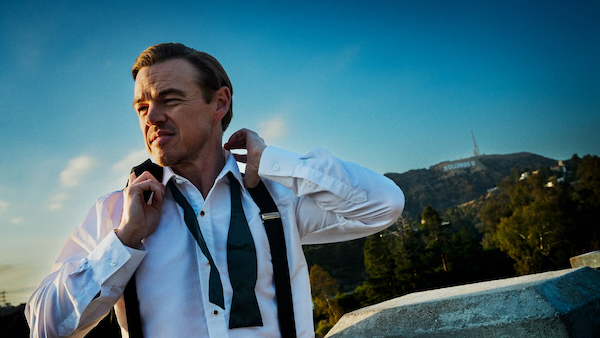
Stop me if this is out there,” he says. He scrunches his face and subtly tilts his chin. It’s a familiar expression—narrow eyes, slight grimace, a contemplative wince. But is it his? Or just something mirrored from the man he happens to look remarkably like?
“We can’t imagine,” he continues, “but, if you could somewhat imagine the idea of no time, no space, infinite distance...” He takes a sip of his Smithwick’s. It’s a Tuesday afternoon on the west side of Los Angeles. Sitting in a booth with his back to the door at a mostly empty pub, he nibbles at a Scotch egg and, rather breezily, unpacks the nature of cosmic fluctuations. Also: cosmic duplications. “We are the nothingness and the something at any given moment,” he says.
His sentences have a dreamy quality to them, and right now, at least, he sounds like he’s delivering a monologue from the sci-fi thriller Inception. His name is Ben Cornish, and though he and that film’s star, Leonardo DiCaprio, have never met, Leo is aware of Ben, and Ben, of course, is aware of Leo. Ben, like Leo, is an actor. He makes his living around Hollywood, and occasionally around the world, popping up at glitzy gatherings in a black tuxedo with slicked-back hair. He gives toasts and poses for selfies with baffled strangers. People who know Leo have texted their famous friend pictures of this curious guy with a confounding resemblance to, well, him. Like Leo, Ben has mastered the art of pretending to be someone else. Unlike Leo, Ben is a non-celebrity who lives with a face that is at once his and does not belong to him.
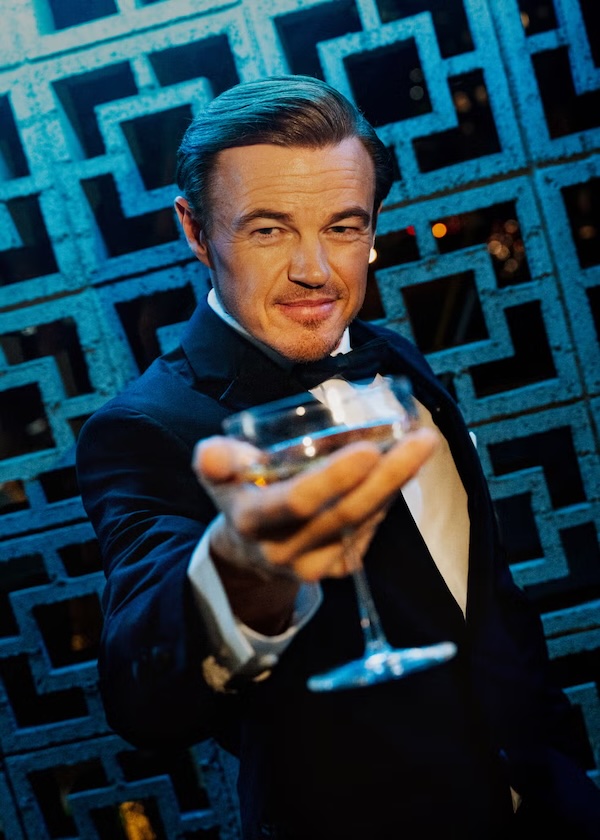
As he walks along Venice Beach, passersby do double takes. That couldn’t have been... right? It’s been like this for a while. There was that time at an Angels game when a fan was convinced that the notoriously private Oscar winner really was sitting in the bleachers at the ballpark that day. There was that evening at a buddy’s birthday party when multiple women at a Chinese restaurant came up to have their pictures taken with Ben. Some of them even followed him into the parking lot.
Are any of us actually living unique lives as time lumbers by? Perhaps that’s the wrong question.
Ben and Leo were born three months and three thousand miles apart. Like virtually all humans, Ben spent years searching for a sense of identity. Unlike practically any other human, though, Ben’s identity is intertwined with one of the most critically and commercially successful actors who ever lived. But that wouldn’t have mattered so much if Ben didn’t want to be a successful actor too.
In Venice, after a shirtless guy on an e-bike zooms past us with a giant speaker bungee-corded to his rig, executing a Superman-style pose while blasting techno music, Ben lets out a little sigh. “That’s what I worry I am when I do my work,” he says. His work these days, most of it, at least, revolves around impersonating a man who goes to great lengths to be unseen. A man who looks exactly like Ben.
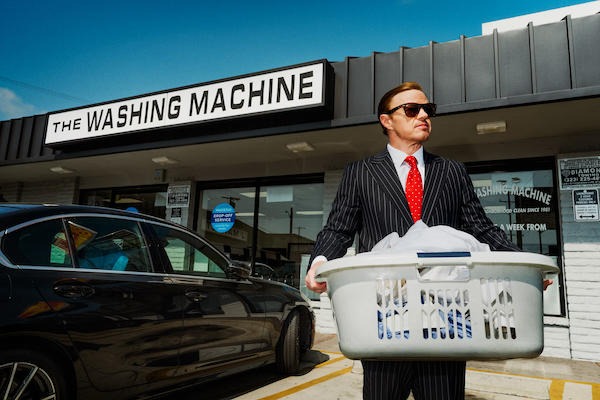
Impersonators play in a markedly different league from the comedians who do zeitgeist-y impressions on Saturday Night Live. They’re mostly struggling actors. They’re also distinct from stand-ins, stunt doubles, and photo doubles (people twin-like enough to appear out of focus in place of an actor so they can film other things). All of those jobs are part of the actual cast and crew of a production, working in collaboration with the principal rather than operating in a parallel universe where a star is none the wiser. Real impersonators disappear into their subject, less craven than the people who dress up in Marvel costumes and bait tourists for cash on Hollywood Boulevard, more authentic than the guys who play Santa at the mall for impressionable children.
Ben has become close with some of Hollywood’s finest: a Jack Nicholson impersonator, an Austin Powers impersonator, a Margot Robbie impersonator. “We spend half of our lives dreaming and half of our lives awake, and the same goes for our impersonations,” says Evan Ferrante, one of Ben’s closest friends. Ferrante has mastered Tom Cruise’s voice and mannerisms, but their faces are quite different, so he wears big sunglasses and a leather jacket to heighten the illusion. “I don’t know where my life begins and Tom Cruise’s ends,” Ferrante says. “Our psyches are definitely merged. It’s like Fight Club a little bit.”
Impersonators amuse and delight, and, sometimes, they can unsettle. Not all of them adhere to the same code of ethics when floating through the world as someone else. Ben avoids outright saying the sentence “I’m Leonardo DiCaprio” unless he’s certain his audience is in on the joke. He has a sharp sense of humour and is charmingly self-deprecating. But he also tries to push what he does closer to the realm of “art” than what you get from simple cosplay. He loathes the idea of being a cardboard cutout, a mindless prop. He wants to create an experience that a paying client will talk about for a long time. When he’s speaking, you can almost see the gears turning behind his eyes: He’s bending reality, trying to collapse the distance between himself and his character, and himself and his character’s characters.
“Most of my work is living in the liminal zone between me and Leo,” Ben says. At the age of 51, he is still in the process of figuring out how he ended up in this peculiar space and, for that matter, why he chooses to stay in it.
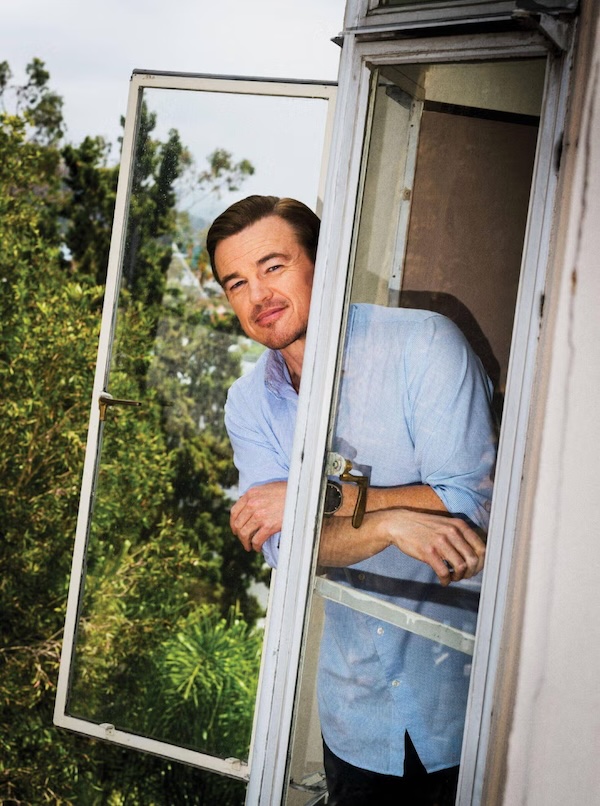
Impersonating, or even traditional acting, was never his plan. Ben grew up in suburban Boston, then went off to Groton for boarding school, where his teenage experience, or a fictionalised version of it, was immortalised in his classmate Curtis Sittenfeld’s best-selling novel Prep. After lights out, the dorms would take on, in Ben’s words, a Lord of the Flies vibe. Hazing was unavoidable. He gravitated toward visual art and became adept at making human-driven sculptures. From a young age, he could mould any character that he saw in his mind. He sculpted an exuberant Teddy Roosevelt on safari with a mischievous monkey on his shoulder.
When he was a teenager, School Ties, the 1992 prep-school drama, hit theatres, and Ben was constantly hearing how much he looked like one of the film’s young stars, Matt Damon. He never really knew what to say in these situations.
“Ben is deeply self-critical at times, sometimes almost to the point of a kind of paralysis,” a high school teacher once wrote in a letter of recommendation. “Some might call this a fault. I see it as the cost of a deeper level of creativity that the more ‘normal’ world doesn’t possess. Because Ben has had quite a bit of early success, both as an artist and a writer (he is almost equally adept in both mediums), he is consumed by the worry that he will not be able to produce work of the same quality again.” It was almost as if he was competing against some invisible force, both inside and outside of himself. The famous-person comparisons didn’t help.
Not everybody gets what’s going on. Some people earnestly ask about shooting specific scenes. One person flat-out said, I don’t believe you. I think you’re him.
After college, Ben moved to San Francisco and found a job at a medical-device manufacturer that shared an office building with American Zoetrope, the production company founded by Francis Ford Coppola and George Lucas. Coming back from lunch in Chinatown or North Beach, Ben would often see Coppola sitting at a café table, dining with a leading actor. At the time, Leo was ascendant in Hollywood. “I would notice tourists following me around when I would just be out and about,” Ben recalls. “I’d be out at the bars with friends and people would be staring or coming up.” He was still sort of floating, unsure of what to do with his life. After the company was acquired, he backpacked through Europe, then landed at a dot-com-era startup called Clickability, which sent him to New York, where he lucked into an idealised Manhattan existence, living in a company-owned loft in TriBeCa.
Still, he was restless. He missed being creative. He had been toying with the idea of trying to write a book or a screenplay but could never get past his fear of failure. Then, one day, he signed up for an acting class at T. Schreiber Studio in Chelsea. As a kid, he’d been an adept public speaker and had sung onstage at summer camp, but now he began to feel something crack open inside of him.
“The first class I was in, it wasn’t even scene study or anything. It was just all of these exercises and theatre games, and even doing that, I would leave those classes feeling...” He searches for the words. “It was like I’ve let so much out that I’ve been bottling.”
Not long after, he was on the phone with a friend from Groton, Jute Ramsay, who had been making it in Hollywood as a film and TV editor. A rent-controlled unit was about to open up in his apartment complex.
“Get on a plane,” Ramsay said. “Fly out here.”
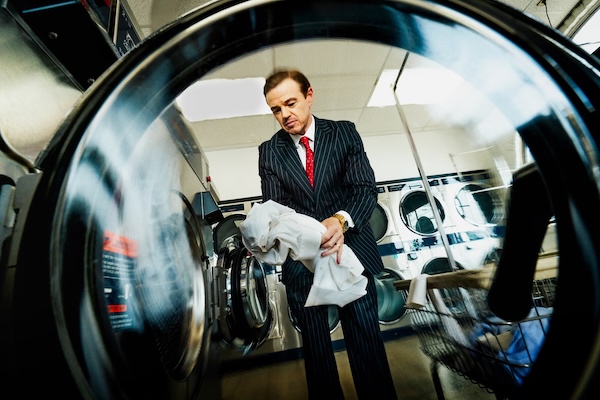
More than 20 years later, here’s Ben, peering through the wrought-iron gates in front of Bungalows de Primos del Mar, in the Hollywood Hills. A plaque affixed to the wall outside commemorates how these units “were built in the Silent Film Era and housed Hollywood’s most prominent hopefuls.” Ben still romanticises the old-Hollywood vibe of it all. He used to jog past vintage movie-star homes in the area around Beachwood Canyon or hike behind the giant white letters of the Hollywood sign.
Back then, he worked all manner of odd jobs: cater-waiter, daytime bartender, headshot-taker. He took more acting classes, this time at a Meisner program, and auditioned widely, but parts were slow to materialise. An internship at a talent agency got him representation; another internship, at a casting office, taught him how actors pop when putting auditions to tape. One of the films he observed the casting process for was Synecdoche, New York, which featured Philip Seymour Hoffman and Michelle Williams. The movie was written and directed by Charlie Kaufman, known for his brain-bending screenplays such as Adaptation, Eternal Sunshine of the Spotless Mind, and Being John Malkovich, the latter of which is about everyday people experiencing life through the eyes of a celebrity. Kaufman had long been one of Ben’s favourites, even before he saw what was taking shape with Synecdoche: a movie about an ever-expanding play that collapses the boundary between art and life, complete with doppelgängers. Ben loved the way Kaufman understood, as he puts it, “endless refraction.” This, too, was how he experienced the world.
Ben used to walk the three-and-a-half-mile loop around the water at the nearby Hollywood Reservoir and work out his lines for auditions. One of his first real bookings was a spot in the pilot for Shameless, working opposite Emmy Rossum. In 2011, he landed a minor role in The Dark Knight Rises, playing a stockbroker, and even shared camera time with the film’s villain, Bane, played by Tom Hardy. He couldn’t get over the size and detail of the set and how the director, Christopher Nolan, nonetheless made it feel like an intimate production.
He knew his lines by heart, but, as a precaution, tapped them into his character’s smartphone in a scene in which he was getting his shoes shined. Aside from Hardy, Ben’s main scene partner was a fellow unknown, who, like him, was handsome with blond hair. As the hours ticked by, Ben confided in the guy, telling him how he always gets so anxious whenever he’s on set and how wanting to do a good job consumes him. He remembers how energetic and confident the dude was, how thrilled he was just to be on set, watching the action. His name was Glen Powell.
The movie was huge, but Ben’s career remained, well, small. He had a string of minor credits, but substantial parts still weren’t coming his way. Which is how it goes for most people in Hollywood. Their dreams foundering on the shoals of other actors who look like them, are just as pedigreed—if not more—and have the luck to get their call. But Ben? Ben looked exactly like another guy, and that guy had a ton of talent.
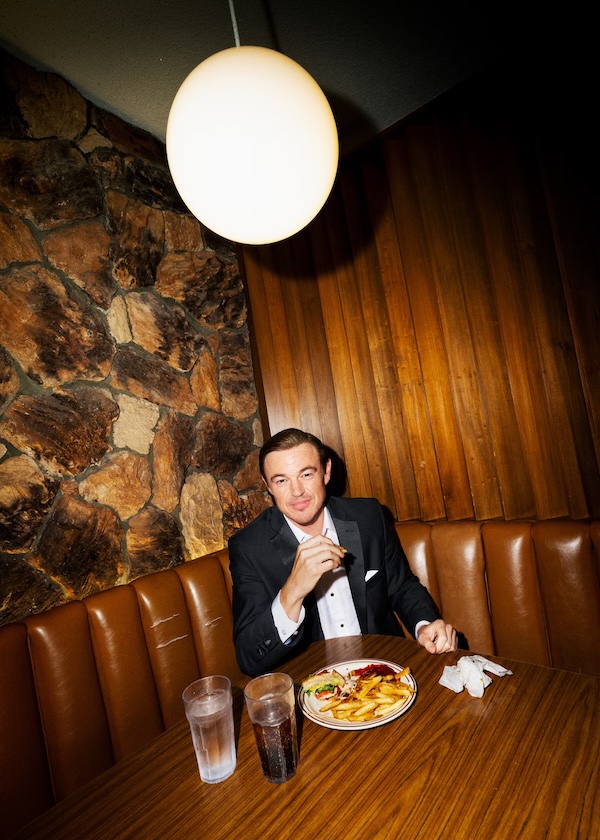
He booked a walk-on part on a major network comedy, one with household-name stars. As Ben recalls, he had one of the last shots of the filming day—a “martini shot.” He spent some time nervously pacing in his trailer, then decided it’d calm his nerves to go wander and meet other actors and extras. Person after person kept remarking how much he looked like Leo. The gossip eventually made its way around the production-assistant radios and, finally, to the director, who called him in hours before he was to shoot. He stood there watching the show’s bigwigs look him up and down. They asked him to shave. He messed with his hair and tried other subtle tweaks to make himself look less like Leo. His call time came; he shot his scene. But when the episode aired, he learned he’d been cut entirely. Ramsay, still working in Hollywood, eventually heard the backstory: Ben’s resemblance was too distracting. Now Ben’s head was spinning. How many other times had something like this happened?
He was dejected, and the problem was getting worse. As he aged, he began to look even more like Leo. They each have a wide face, piercing eyes framed by crow’s-feet, and a tan, creased forehead. What he once viewed as a coincidence now seemed like a professional liability. But then, in 2012, his agent called with an intriguing opportunity.
The Scary Movie spoof franchise was looking for a fake Leo to parody Dom Cobb from Inception. He put his audition on tape, got the part, and was sent to meet with a vocal coach. Eventually, he was flown first class to the set in Atlanta. “They’d all been there working and hanging out for weeks, and I show up and then I kind of have to be the person dominating this scene,” he says. The script was being rewritten on the fly. Charlie Sheen was in it. Lindsay Lohan was in it. He was just trying to keep up. He fondly remembers a string of post-shooting nights as the film’s writer, David Zucker of Airplane! and The Naked Gun fame, regaled him and others with Hollywood stories at the hotel-lobby bar. He went to the premiere, walked the red carpet, saw the film, read reviews of his performance. “I kind of thought that was a one and done,” Ben says. “And I thought, All right, now back on to other acting gigs. I’ve exorcised the Leo demon.”
Then the calls started coming.
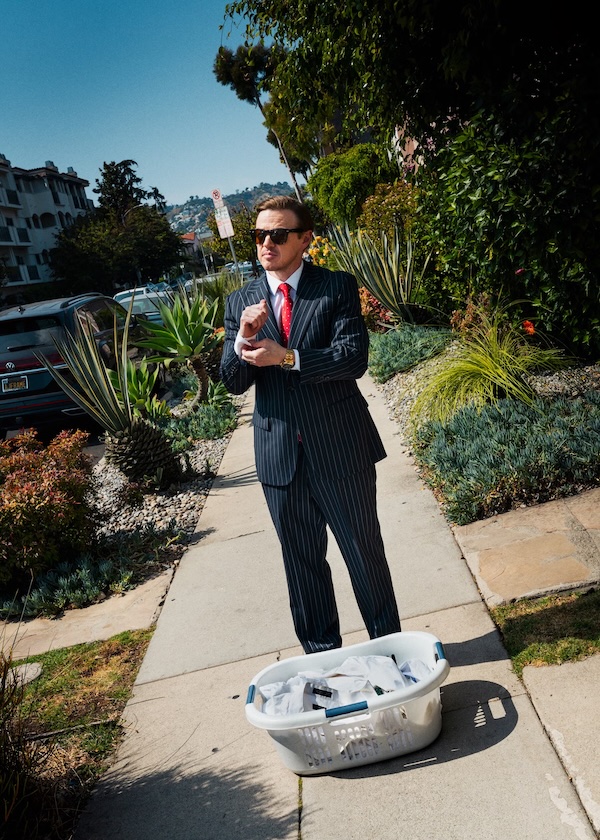
Ben was wary of doing more Leo, but on a lark agreed to work a Great Gatsby–themed party in Palm Springs. To prepare, he rewatched Baz Luhrmann’s 2013 remake and reread F. Scott Fitzgerald’s book.
“I kind of went into it like, ‘Okay, I’m in character. I’m going to be talking about Daisy and the green light, trying to internalise that deep yearning for something that I can never grab, a misplaced yearning for something that is constantly escaping me,’ ” Ben recalls.
As the night got under way, he stood near the door, hoisted a glass of Champagne, and greeted guests, uttering versions of “Welcome, old sport!” But after everyone arrived, he had no idea what to do. He eventually stood outside and gazed out over a golf course at a light in the distance, hoping that sinking into Gatsby, or Leo as Gatsby, would make him feel more grounded. Some guests finally noticed that the Leo guy was off by himself. They approached him.
Hey there, what are you doing?
“And I was like... ‘Do you see that haunting green light through the fog?’ ”
Crickets.
He realised he needed to loosen up.
Beyond Ben, the organiser had also hired women dressed as flappers and had brought in Susan Griffiths, one of the world’s preeminent Marilyn Monroe impersonators. Griffiths has been playing Marilyn for decades: in a Las Vegas revue, in Pulp Fiction, on Nip/Tuck, on Curb Your Enthusiasm. She oozed charm and glided across the room with ease. “I was a little taken aback,” Ben recalls. He stared at her, slightly dumbfounded. He finally understood how people reacted when they believed him to be Leo.
By then, he’d already been in LA for a while. He’d seen celebrities in casting offices; he’d catered parties where he’d have small interactions with film icons like Al Pacino. He’d been an extra on The West Wing and spent a rain delay chatting with Martin Sheen. He’d known the feeling, the one anyone gets around a really famous person. “You’ve seen them a million times and you know their face and you kind of feel like you know them, but you don’t know them,” Ben says. “And there’s this kind of tingly thing in your chest, somewhere between excitement and nervousness and depersonalisation. Your circuits kind of cross.” That night, he really felt like he was in the presence of Marilyn, who had been dead for decades. “I remember walking with her,” he says. “I had her on my arm as we walked through this party. I remember her turning her face to me and it was just like I had that hit. Oh my gosh, I’m with Marilyn.”
Griffiths herself was also struck by Ben. As the night wore on, she took him under her wing. He pressed her for advice about the impersonation business. “And I remember her asking me a lot of questions,” Ben recalls. “And I was like, ‘Well, I’m an actor and I’ve been in these roles and I want to continue pursuing acting as other people.’” He pulled up his phone and showed her his headshot. Griffiths responded delicately. That’s going to be a challenge.
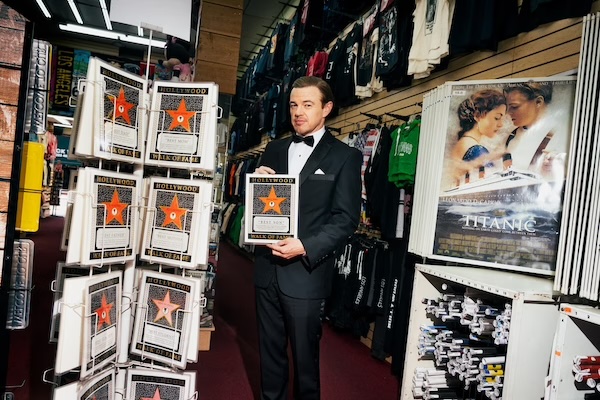
Ben was once offered to serve as Leo’s photo double on The Revenant. He weighed the pros and cons with his agent. It would be a gruelling, months-long shoot away from L. A. and his wife, but it would also be a chance to learn from Leo up close and to meet the director, Alejandro Iñárritu. He was wrestling with a question: Would being a photo double steer him further away from acting and auditioning? Ultimately, he and his agent decided to demand a salary they were sure the producers would never pay. They were right, and that was that. Leo, meanwhile, would go on to win his first Oscar for the role.
In time, Ben began finding ways to have actual fun with impersonating. These days, he may join a CEO onstage to pump up a sales team as Jordan Belfort from The Wolf of Wall Street, or evoke Jack at the gilded Titanic banquet. He’s particularly good when improvising with a guest. “You know, a woman can say, ‘I’m over 25, I think I might be a little old for you...’ ” to which Ben will winkingly tell them he could make an exception. But not everybody gets what’s going on. Some people earnestly ask him about specific scenes and what it was like to shoot them. One person flat-out said, I don’t believe you. I think you’re him. Show me your driver’s license. Ben did. The person called it a fake.
He still has to psych himself up ahead of a gig. “Before he leaves for an event, he is often feeling a bit anxious,” Ben’s wife, Lori, says. What am I doing with my life? he might (jokingly) ask her. Lori and Ben met about 20 years ago in acting class and were friends for many years before they started dating. Though she’s since left the industry, Lori had the distinction of playing one of Brad Pitt’s love interests in The Curious Case of Benjamin Button. The two shared an onscreen kiss. Lori is Ben’s rock, and she has a front-row seat to the other side of impersonation: exhaustion. In crowds, she might whisper to her husband, “You’re getting it from three o’clock.” When people come up to him and say, “You know who you look like?” she sits through what is often a long, strained pause. Ben is humble, she says, and has stopped answering that question altogether, because he feels awkward suggesting a stranger thinks he’s an attractive celebrity. She’s always trying to remind him that when he gets home from a gig, he’s energised and excited; that he feels good making people smile.
But most people know that Ben is Ben, not Leo—certainly the people paying him to appear know. Why, though, do so many seem to like it? What do they actually get out of it?
99.999 per cent of us will never meet Leo. But suddenly, for a moment at least, it can feel like Leonardo DiCaprio cares about, say, your niece’s volleyball tournament.
Recently, Ben had a late-night conversation with Ramsay, who helped him understand that the simple act of playing Leo was giving other people permission to momentarily escape reality too. “It’s coming from your past experiences and how your mind processes movies and TV,” Ben says. “It’s giving everyone that little tickle in their chest.”
Ben’s performance is a conduit. Leo is famously private. At this year’s Golden Globes, Nikki Glaser joked that the last interview with him she could find was from when he was a teenager. (His was, in fact, interviewed in this magazine last September.) Needless to say that 99.999 per cent of us will never meet Leo, let alone have a conversation with him. Partygoers may tell Ben about their lives. His friends and family told me how he is an extremely good listener, how he can make you feel like you’re the only person in the room. Suddenly, for a moment at least, it can feel like Leonardo DiCaprio cares about, say, your niece’s volleyball tournament. In a world with generative AI, it’s trivial to make Leo appear on a screen. To get that effect in person, you’ve got two options: Leo, or Ben.
Millions of people have a uniquely deep emotional attachment to Leo’s movies. They remember how old they were when they first saw Titanic or that nostalgic feeling of sitting around the family room watching Catch Me If You Can some holiday weekend. In 2019, Ben bought a ticket to go see his likeness’s new movie, Once Upon a Time... in Hollywood. Leo’s character, Rick Dalton, is ageing and on the verge of Hollywood leaving him behind forever. He spends the film fighting gravity and the natural forces of the entertainment universe. DiCaprio’s performance is especially lived-in: the pride, the vanity, the insecurity and self-loathing. He runs lines while floating in his pool with a big drink the night before a big shoot. He dunks his face in a bucket of ice water to calm his nerves. “The torture of trying to get through these scenes and forgetting the lines and not getting it right,” Ben says. “You know, it’s him stopping himself. It’s him being his own worst enemy. I can relate.”
In one scene, Dalton retreats to his trailer after a take and beats himself up for a subpar performance. “I was sitting there, and it’s crushing. And it’s actually supposed to be somewhat comedic,” Ben says. He knew every emotion Leo was conveying. He himself had been that guy. He sat in the theatre sobbing. He’d spent decades being mistaken for Leo and nearly seven years playing him. Now, for a scene at least, Leo was playing Ben.
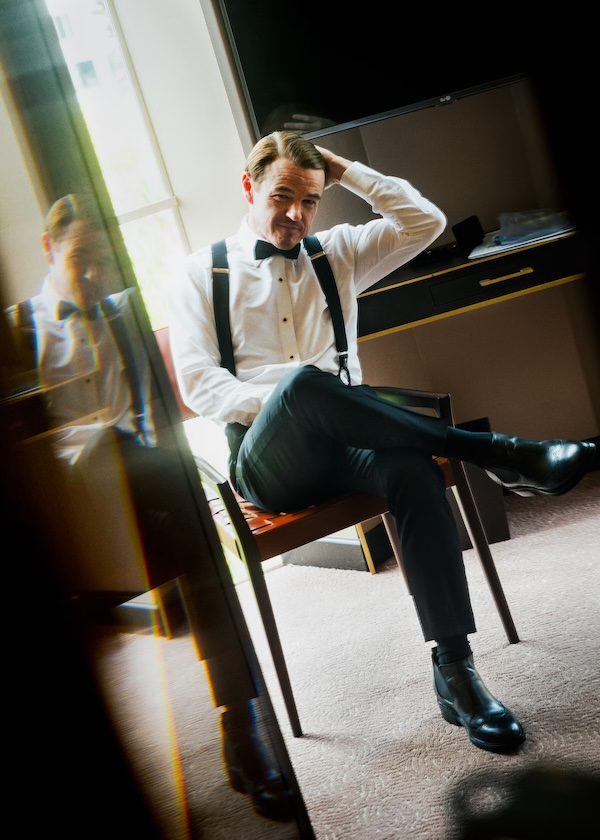
Frequently, at gigs, someone who claims to know Leo offers to introduce the two of them. But Ben never follows up. He doesn’t need to. Yes, he’s impersonating Leo. But at this point, his Leo is just that—his. He keeps tinkering with it—part art project, part science experiment.
Not long ago, Ben uploaded a decade’s worth of his professional photos into ChatGPT. He told the AI how much he weighed when each photo was taken, then had it evaluate them against a library of Leo photos. The AI produced a report, including a four-pound weight range that would give him a full-enough face yet properly defined jawline for maximum believability. Ben found the exact colour to dye his hair and started collecting “Leo hairstyle reference photos” to show his barber.
His height was a little trickier to solve. Naturally, he went shopping for shoe lifts. Until he dialled them in, subtle but high enough to get close to Leo’s stature, he would periodically have someone come up to him and say they thought Leo was taller. The process taught him something interesting: When he put the lifts on, he felt different. They helped him get into character. Height is immutable; what actually sold the illusion was acting. Ben was perfecting his craft, which is what he’d always wanted to spend his time doing, going back to that first acting class in Chelsea, and even earlier, when he was writing or sculpting.
Ben would still like to be known for his own work, not merely in the context of someone else’s. “He’s told me how frustrated he is, but also, like myself, it’s a necessity thing,” Ferrante, the Tom Cruise impersonator, says. But Ferrante also points something out: “We make people happy.”
Throughout our conversations, Ben insists how privileged he feels, how grateful he is for his relationships with his wife, friends, and family, how much he appreciates all the novel opportunities impersonating has brought his way. He also tells me why he’s not dying to meet Leo, though he admires him. “What am I trying to get, some sort of seal of approval, or rubber stamp? Okay, I met him. It feels like it’s more about me than it is about him, if that makes any sense,” he says. “If his people were to reach out and be like, ‘Hey, you know what? Leo’s seen some stuff you’ve done, he’d love to sit down for a drink to meet you.’ I’d do that. I’d be flattered. It would be interesting. If that was something that he wanted.”
For now, he’ll just keep living and working in an uncanny valley, one in which his doppelgänger is a generational actor and global celebrity who, for whatever reason, exists at the same moment in the same universe as Ben Cornish, whose Prius is parked out back.
Photographs by Ethan Noah Roy