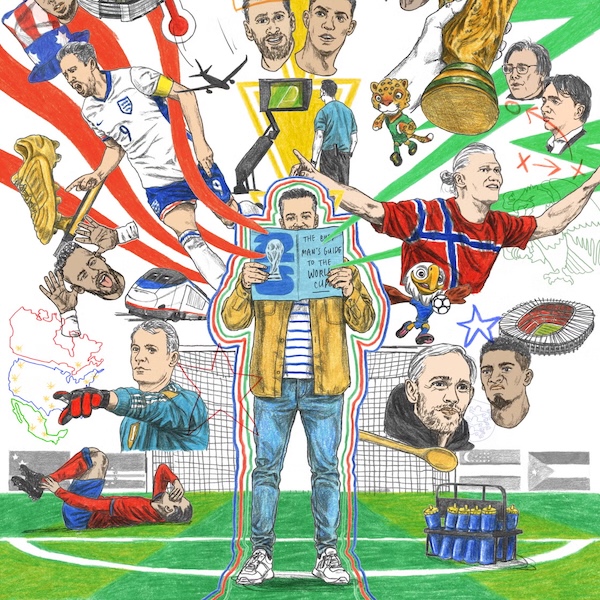
At last, the Don and Gianni show has rolled into town. The first FIFA World Cup to feature three host countries (USA, Canada and Mexico, in case you’ve been in hiding) promises more teams, more groups, more matches and—by sheer force of mathematical certainty—more goals than ever before!
It will also be the longest ever World Cup, requiring five and a half weeks (39 days) to cram in all the action until the final on 19 July. Stamina will be a big factor—for you, as much as the players—as will a rudimentary briefing on the managers, teams, issues and opinions that could help get you through the summer. Which is where our guide comes in. As The Simpsons put it (see below): “It’s all here. Fast-kicking, low-scoring and ties? You bet!” Let the games begin.
If you only watch five games in the group stage, put these in your calendar:
This modern football rivalry continues in Texas with a game that could determine how good—or not—England really are.
The first real test for the reigning world champions, in the form of a well-organised team managed by former Man Utd manager Ralf Rangnick.
Scotland will be in dreamland territory if they beat A Seleção in their first World Cup in 28 years. If it’s via a McTominay bicycle kick, even better.
Finally, we’ll see Erling Haaland in a World Cup, up against the favourite for the golden boot, Kylian Mbappé.
If USA bomb out in the group stages, it’s hard to know how the country—and Trump—will react. But it’s not outside the realms of possibility...
It used to be a realistic ambition to watch every game at a World Cup—a breeze if you were unemployed—but this time around that looks more like a charity fundraising challenge than a viable goal. With 48 teams, up from a 32-team format used since 1998, you’re gonna need a mural rather than a wall chart to keep track of the 104 games, sometimes five a day.
There are plenty who might say more football can only be a positive thing. FIFA for a start, who tell us it’s to allow more smaller teams and developing nations to compete at football’s top table. Yay.
Naysayers might suggest that, in a world where football overkill is real, the words “bloated”, “watered down” and “moneygrab” spring to mind. There’s also a distinct lack of jeopardy in the group stages—after 72 group games, only 16 teams will actually get eliminated (out of 12 groups, third place will be enough to go through in eight of them), which may well suit the big boys in the long run anyway. Shucks.
Do they have a snowball’s chance in hell? Or at least in late-June Mexico City?
big-name coach + high-expectations - form = group winners but early exit
low expectations + home crowd + young talent = second round
huge support + altitude + pragmatic football - star players = quarter finals at a push
Heard the fan-theory that The Simpsons has already predicted the 2026 World Cup final? The 1997 episode “The Cartridge Family” features the line: “This match will determine once and for all which nation is the greatest on Earth—Mexico or Portugal!”
It’s set in a stadium that some say bears an uncanny resemblance to the MetLife in New Jersey (another theory puts New Jersey as the “real” setting for the show), that will host the 2026 final.
If it sounds a little shaky, what’s more likely is that the episode predicted how Americans themselves might embrace the tournament: initially upbeat and excited, before the USA exit and the novelty wears off.
Expect broadcasters to be preparing some extra-special nation-specific zingers this summer
“This is a true fairytale of New York” (if Senegal beat France)
“You’re sleepless, we’re in Seattle” (for the Egypt vs Iran 11am kick-off)
“It’s looking like a shoot-out in old Mexico” (it’s gone to penalties at the Azteca)
“Will there be brotherly love in the air tonight?” (Brazil vs Haiti kicks off at Philadelphia Stadium)
“We’re not in Kansas anymore...” (after the quarter-final at Kansas City stadium finishes)
“Houston, we have a problem” (when Curaçao go 2-0 down against Germany)
“Start spreading the news, France have arrived at this World Cup” (when Mbappé scores a couple against Senegal)
The breakout broadcast star of the last World Cup in Qatar was undoubtedly ITV’s Ally McCoist. Had we finally found an enthusiastic, likeable and occasionally insightful co-commentator? A chink of light to counter the dourness of Lee Dixon and Martin Keown after so many barren years? Well, let’s just say that “pally” Ally has been very visible in the four years since. His “I can’t believe what I’m seeing” from-the-heart schtick has morphed into a full panto act and it’s hard to see how he comes back to terra firma again. With Alan “back of the net” Shearer likely to be chief analyst for the BBC, we hope some breakout stars are waiting in the gantry.
If eccentricity and intensity are hallmarks of the world’s very best coaches, then Thomas Tuchel really could take England all the way. Here’s why:
• He’s a perfectionist: famed for his in-depth tactical know-how, he demands his players know their job in minute detail.
• He makes teams better, quickly: he took over an ailing Chelsea team in January 2021 and won the Champions League in May the same year.
• He gets people on board: he once imported 200 crates of his favourite German biscuit so he could give them out as presents for staff.
• He’s ruthless when he needs to be: he has no time for people who don’t buy in—or lazy excuses, like the old story that the pressure of playing for England weighs heavy on the team.
• He’s unpretentious: he says one of his favourite things to do at home is to listen to Simply Red on vinyl on his massive speakers.
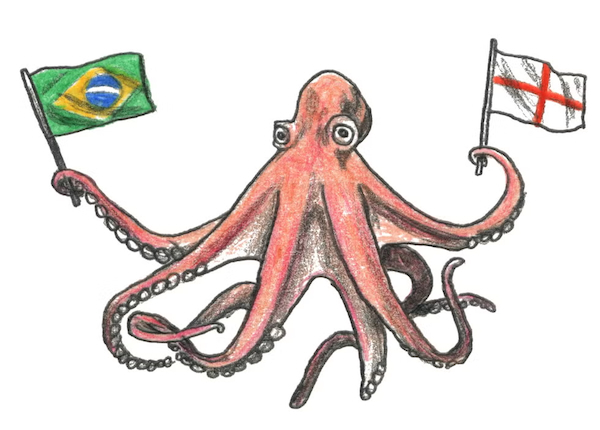
You may or may not remember Paul the Octopus, a psychic cephalopod who correctly predicted all seven of Germany’s 2010 World Cup matches, and the eventual winners, Spain, by choosing one of two boxes for his dinner. While this year’s heart-warming animal clairvoyant has yet to emerge, the closest we have for 2026 is Joachim (Klement) The Economist, whose frankly less fun but possibly more intricate data-modelling system has successfully predicted the last three World Cup winners. His verdict this time? The Netherlands. A result likely to surprise the Dutch as much as everybody else...
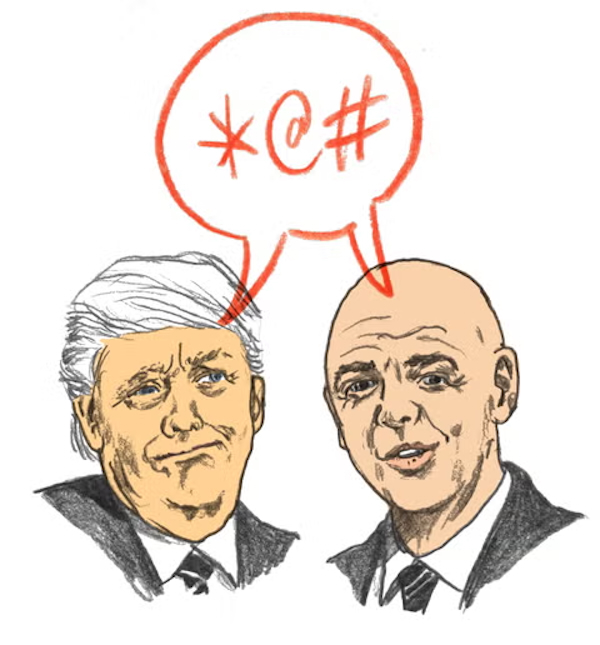
The FIFA and US presidents are peas in a pod.
[Answers: all pearls of wisdom from FIFA President Gianni Infantino]
Yes, after 20-plus years, they are still slugging it out. And we’re still debating who’s the greatest. In World Cups at least, we officially have a winner.
Age: 41
World Cups played: 5(2006–2022)
Games played: 22
Goals: 8
Assists: 2
Best finish: 4th place (2006)
Age: 38
World Cups played: 5 (2006–2022)
Games played: 26
Goals: 13
Assists: 8
Best finish: 1st place (2022)
Ah football, a game so simple that all you need is a ball. Except the official World Cup ball—the Trionda (below centre)—is anything but simple
✴ Connected chip technology in the layer of one panel sends ball data to the VAR in real time
✴ Textured surface to cope in wet and dry conditions from Toronto to Mexico
✴ Tested in seven host cities with different altitudes and humidity
✴ The design includes a star for the USA, a maple leaf for Canada and an eagle for Mexico
✴ The name: “Tri” for the three host countries and “onda” meaning wave and vibe
✴ Gold detailing to reference the World Cup trophy
✴ Panel shape and groove lines to improve aerodynamics
✴ NB: True success for a World Cup ball comes from not being talked about
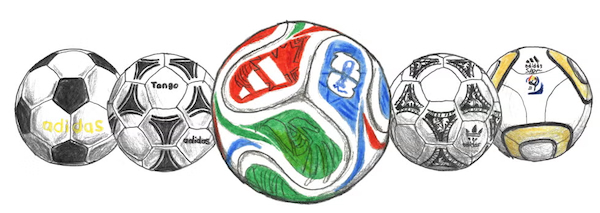
• 1970, Telstar: the first black and white ball [far left]
• 1978, Tango: The birth of a legend for the World Cup in Argentina [left]
• 1986, Azteca: Tango gets the Mexico treatment [right]
• 2010, Jabulani: Famous for being hated by players for its unpredictable path [far right]
Not a football fan but want the gist of England’s line-up? Then imagine their attempt to win the World Cup as an Ocean’s Eleven-style heist movie (if you will) and this might be the crew...
The gloryboy: Jude Bellingham
Fast-talking, quick-firing, slow-pressing main character on a redemption arc.
The whiz kid: Bukayo Saka
All the talent in the world, but can he cut the right wires when the cop sirens start to sound?
The pro: Harry Kane
Won’t have the most lines, but he’ll disable the security alarms precisely on time.
The enforcer: Jordan Pickford
Moody and combustible, but England’s keeper comes into his own when the fighting starts.
The driver: Declan Rice
Solid, reliable, trustworthy. The engine behind any hopes of pulling off a score.
The maverick: Eberechi Eze
When Plan A isn’t working, this guy can find an answer.
The old-timer: Jordan Henderson
Called out of retirement for one last job. But he ain’t going back in the can.
The mastermind: Thomas Tuchel
Has plotted every detail in the control room. But will his high-wire plan for world domination send him totally crazy?
Which kits to buy
Five jerseys you might want to wear. Spoiler: it’s all about the away strips this summer.
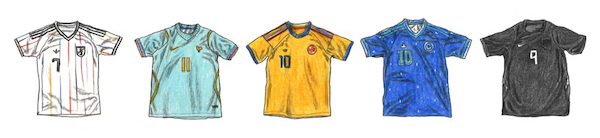
From left to right:
Japan Away
Gives the life-affirming impression of a retro Adidas kit that’s been upcycled with colouring pens, the red line being a nod to the Japanese flag. Strong.
France Away
The collar, the texture, even the minty colour gets a chef’s kiss. Plus, the bronze badge references the oxidisation of the Statue of Liberty (yes, really), a gift to the US in 1884.
Curaçao Away
The colour palette is apparently taken from the buildings of the capital city, Willemstad. We’re sold. If they fail to make an impact with their football, this kit will leave its own legacy.
Germany Away
Referencing some classic German training tops of the past, this one could well divide the crowd, but it’s a bold step for Die Mannschaft and odds on it will age very well.
Norway Away
Football’s answer to stealth mode, this all-black design was apparently inspired by Viking berserkers. Picturing Erling Haaland in this could give you nightmares.
It's a game of two halves/four quarters!
Mandatory water breaks—three-minute breaks midway through each half. Verdict: good for hydration. Great for advertisers.
More VAR—will now cover yellow cards and corners. Verdict: like VAR doesn’t already cause enough trouble.
Time-wasting—new time limits for throw-ins, substitutions and to prevent fake injuries. Verdict: any attempt to speed things up has to be a win.
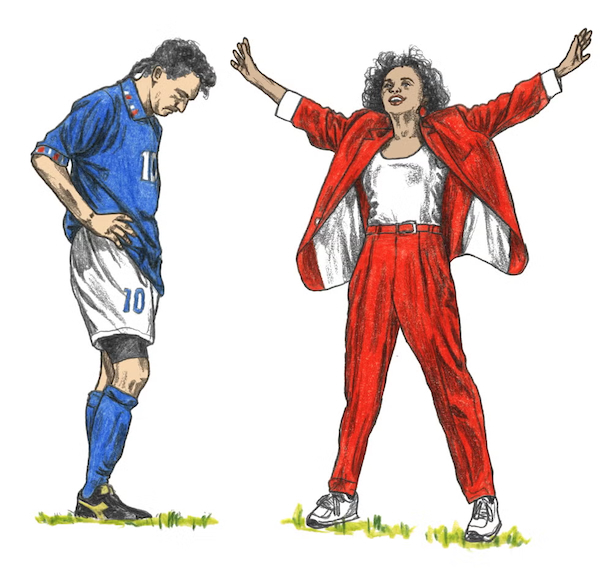
It’s not the first time the World Cup has been in the USA. The 1994 edition was also billed as an opportunity to grow the game in the world’s biggest economy. And here we are 32 years later on a similar ticket.
It was a tournament bookended by two of the most famous missed penalties in World Cup history.
The first by Diana Ross as she lip-synced “I’m Coming Out” at Soldier Field, Chicago, for the suitably loud and starry opening ceremony. She only had to roll it in to make the oversized goal posts break apart but after several feints, she scuffed the shot horribly wide of the lefthand post.
“I’m not sure that was supposed to happen,” said commentator John Helm.
Four weeks later, a torturous final between Brazil and Italy finished 0-0. It was be the first time a World Cup would be decided by penalties. The best player in the tournament, Roberto Baggio, he of the divine ponytail, who had dragged his team through the competition despite being injured, had to score to keep Italy in it. He blazed his kick way—way—over the bar. Brazil cartwheeled onto the pitch. Baggio stared at the ground.
“If I had had a gun, I would have shot myself. At that moment, I wanted to die. That’s how it was," he later said. Oof.
Murat Yakin, Switzerland—Miami art dealer
Vincenzo Montella, Türkiye—luxury hotel GM
Sebastián Beccacece, Ecuador—ice-skating choreographer
Julian Nagelsmann, Germany—tech bro who’s just hired a stylist
Zlatko Dalić, Croatia—Scandi noir homicide detective
The dark arts, formerly called gamesmanship, newly named “shithousery” in some quarters, have become a feature of World Cups. We’re talking about diving, time-wasting, rolling around, haranguing the referee: yes, everyone does it, but South American nations including Uruguay, Argentina, Brazil and Colombia have traditionally done it much better—or worse—than anyone else. The reason goes pretty deep, says Tim Vickery, co-author of Mundiales: A South American History of the World Cup.
“These are societies where humiliation is extraordinarily powerful, because people often feel humiliated in their daily lives, and so football is a kind of revenge mechanism on the First World: ‘You lot might be better at this, that and the other but football is our thing.’
“The national football team is a symbol of the nation to such an important extent, that a figure like Pelé is Harry Kane, Lord Nelson and Winston Churchill all rolled into one.
“There's a famous quote from the Uruguay coach Ondino Viera, when they came to England in 1966: ‘Other countries have their history, Uruguay has its football.’ It’s so true. And it means that losing in front of the whole world is a huge, huge humiliation. It feels like your country is being invaded.
“So, part of that ‘dark arts’ stuff just comes from how unbelievably important this is to the nation. There is also a sense of isolation here. The distance between Buenos Aires and Mexico City is equivalent to the distance between London and Mumbai. The stronghold of football in South America is the south cone, which is Uruguay, Argentina and the south and southeast of Brazil. You look one side, and there’s a whole lot of ocean. You look the other side, and there’s a whole lot of ocean. You look below, and there’s a whole lot of ocean down to the pole.
“So, every four years, you have this opportunity to make a noise that you don’t have the rest of the time.”
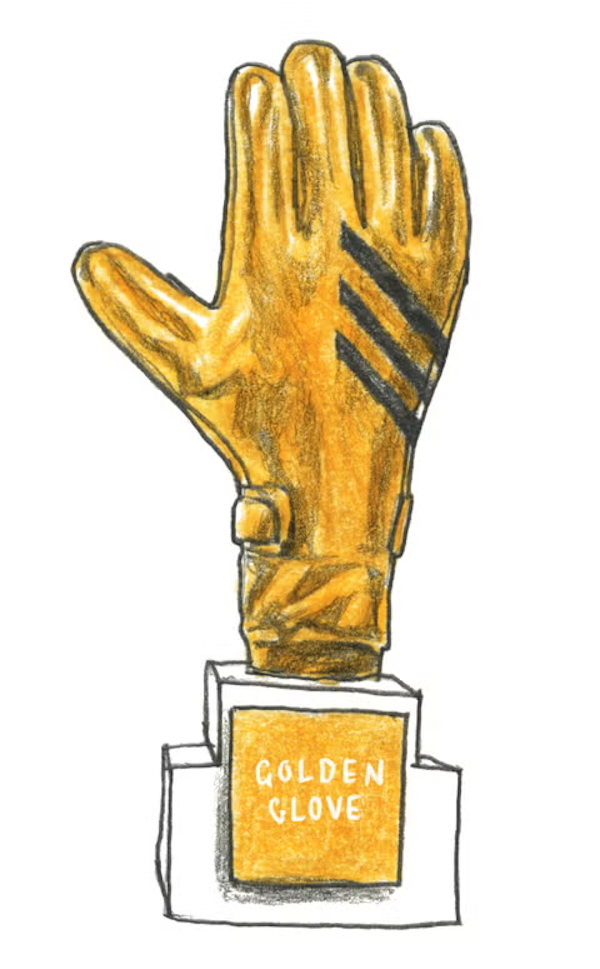
Thibaut Courtois, Belgium. If Earth were playing Mars, you’d put him in goal.
Alisson Becker, Brazil. A good showing could take Brazil all the way.
Emiliano Martinez, Argentina. Hard to love but more importantly, hard to beat.
Manuel Neuer, Germany. A World Cup too far or a heroic last hurrah?
Mike Maignan, France. “Magic Mike” is another reason France are many people’s favourites.
Who’s best placed to come out of nowhere on a charge for the semi-finals? Germany are a work in progress but can never be called “dark horses”, ditto Portugal and the Netherlands, which leaves Norway, Belgium, Colombia and Japan as the best-priced nations in the “disappointed to draw in the work sweepstake until someone told me they have an outside chance” category.
The upside of a big tournament is that four countries are making their World Cup debuts—Curaçao, Uzbekistan, Jordan and Cape Verde, which becomes the smallest country by land area to ever qualify for the World Cup. It’s also unique as a country whose diaspora is larger than its population—1.5 million living abroad compared to 500,000 residents. Integrating these foreign-born players has been a crucial part of their qualification.
“I think that’s our biggest weapon,” Cape Verde-born goalkeeper Vozinha told FIFA.com. “Since the start and still now, whenever someone new joins up it feels like they’ve been there for years... They could be Cabo Verdean or the son of Cabo Verdeans in Europe, we never lose touch with our people.”