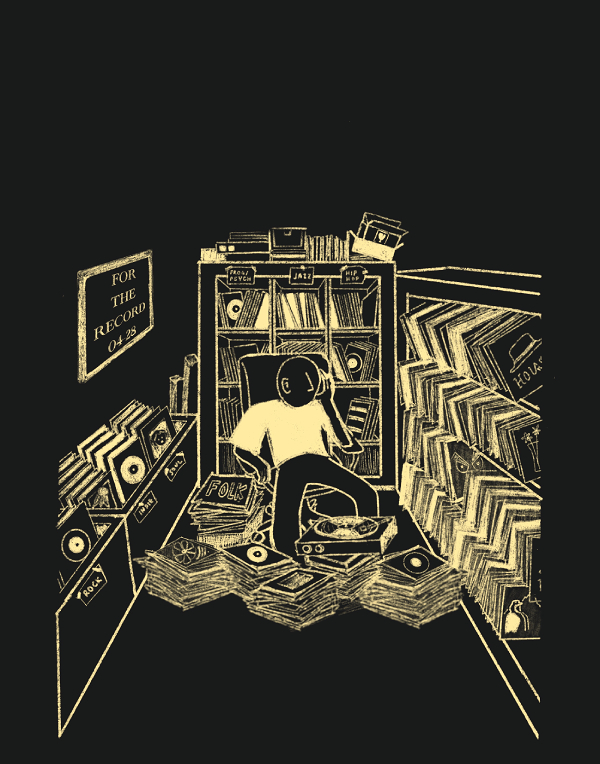
Mr Giri lifted his elbow off the armrest, moving the cigarette closer to his mouth. The office chair he’d been sitting on gave an old, quiet squeak, slicing through the thickness of quiet in the air. Then, a slow exhale before a gentle wreath of smoke. His neck fell back against the edge of the chair, chin up, watching.
Surrounding him were continents of vinyl; a geography of them separated by genre on shelves: jazz, blues, soul, pop, punk, etcetera, etcetera. Some unfortunate vinyl records were stacked on the ground, climbing over one another; others were plastered proudly on wall shelves above the rest. All of them were personally handpicked and bought for his own pleasure—all 25,000 of them.
His eyes had been resting on those exact wall shelves for the past 30 minutes, holding three rows of albums. Vinyl records that, altogether, made up an assortment of his rarest, dearest collection. Vinyl records that he could not reasonably imagine parting with.
He went through them all from the top again, eyes slowly touching one sleeve to the next. He began with his all-time favourites: Sgt. Pepper's Lonely Hearts Club Band, Revolver, and Rubber Soul by The Beatles. Every time someone asked what his favourite albums were, he’d point to this corner on the wall. These are first pressings, all of them mono versions. Look, one of them even has a printing error in the credits. This simple act of recollecting made his chest bloom like an open field of flowers.
But this was short-lived. An unsettling feeling suddenly swelled within him. It was as if an incoming storm had been waiting at the edge of the scene, deciding when it would enter.
He’d just returned from the hospital an hour before, where his doctor had told him the news. The test results had come back. What we’re seeing suggests a form of muscular atrophy. He’d looked at his doctor, with hair that looked too short, and nodded his head profusely. A volley of questions shot out from within, but each of them was immediately returned by his doctor. By the end of it, all he could hear was the faint lub of his own heartbeat in his ear canals. Thump, thump, thump.
Mr Giri massaged his earlobes; they were warm. The thumping returned, but rubbing them seemed to soften the rhythm, so he continued. He glided his gaze to the next album: All Things Must Pass by George Harrison. This was the first album he’d ever bought with his pay from national service in 1972—though this particular copy was not that copy. He had kept the original for over 50 years before selling it in exchange for this rarer pressing. It was, objectively, the more sensible decision, but his heart still grew heavy and uneven at the thought of the original one. He rolled his eyes onto the next album.
Woman, Woman by Gary Puckett & The Union Gap. He remembered the first time he had heard it. He’d been on a ship to somewhere he couldn’t recall, travelling to compete in a track and field competition. As the long-distance kingpin of junior colleges during the late ’60s, he was a star athlete who dominated the 800 metres, 1,500 metres, 3,000 metres, and 2,000 metres events. Four years later, he would go on to break the 4-minute barrier for 1,500 metres in 1972—the first Singaporean to do so.
But right now, he wasn’t thinking of the glory. All that permeated his head were faint visions of a man he had seen in the saloon of that ship, seated on a stool, a guitar resting on his lap. He felt the sway of the ocean and the twang of guitar strings accompanied by a powerful, husky voice. What a time. He opened his eyes. Onto the next one.
This copy of Ritchie Blackmore's Rainbow by Rainbow wasn’t a rare pressing, nor was it particularly desirable in the stratosphere of vinyl collectors. Yet, it remained one of his most treasured albums simply because it had been a gift. After his stint as an athlete, he’d transitioned into a government job in the audit department, where he stayed for most of his professional working life before retiring and opening the record shop. Ritchie Blackmore's Rainbow was a parting gift from his colleagues.
The fleeting moment floated to the forefront of his mind, led by a few mental snapshots—toothy smiles, the endearing wince of an eye, a warm embrace cutting through crisp lighting. Surrounded by the stifling silence of his record store, it was easy to maintain this image uninterrupted. He held it for a moment, resisting the storm that threatened to push through the curtains and onto the stage where his memory performed.
Without warning, his mind suddenly wandered to an old man who had been visiting the shop regularly. The first time he entered, he began by asking some general questions. How long have you had this store? Do you have any kids? The next time he visited, he started talking about himself, reminiscing on his younger days. When I was in the military... My son is actually...
Each time, the old man would leave without spending a single dime. It became evident to Mr Giri that he was not someone who knew, or possibly cared much for music, let alone vinyl. But he decided to entertain him, nonetheless.
Mr Giri used to visit an old folks’ home every Saturday. He would bring food and chat with the elderly. Sometimes he’d worry whether they were enjoying the food at all, until he eventually realised that what the residents wanted, more than anything, was just someone to sit with them. Since losing his mobility as a result of his muscular atrophy, however, he had had to do less of it recently. Talking to the old man had given him a version of it back.
SUDDENLY, A LOUD PEAL
The storm had been at the curtain long enough. The shape of ashen clouds swelled against the drapes—his mind could no longer stave it off any longer. His body tightened as it ripped through the blinds of his mind. Time was running out. It flogged past the imagery of him sitting quietly with the elderly. Was I not a good man? The moment of him accepting Ritchie Blackmore's Rainbow from his old colleagues in the office was inhaled into the grey. I’m not afraid. The man on the ship with the guitar came apart along with the hull. There has to be more. The clouds grew more bulbous by the second, thick with weight and dark with woe. A white streak across the sky. A boom. Then, finally, a droplet—followed by another, and another.
The door swung open. Mr Giri collected himself, pulling his shirt over his face and stabbing his cigarette against a nearby shelf. He stood up to find a girl wearing a tudung browsing the aisles, walking towards him. The closer she got, the clearer he could make out her age; she was no older than 15.
“Hi, Uncle,” she said when she reached him. “Do you have any Judy Garland?”
Mr Giri looked at her, silent for a moment.
“Is this for your mother or your grandmother?”
“Oh, it’s for me,” she smiled, hands grazing the stack of vinyl beside her.
His eyes widened, and he leaned forward. Judy Garland made music in the ’40s, a period even before his generation. How on earth did someone as young as her know about her? His eyes darted to his dear wall of vinyl, where the Judy Garland Souvenir Album had sat on the shelf for years, undisturbed. It was one of the oldest pressed albums in his possession. The thought of possibly parting with it was a thought that had never even knocked on his consciousness. He opened his mouth, relinquishing himself to the moment he had rehearsed a thousand times.
But the shadowy cloud had now invaded reality; it loomed over him, a gentle suspension, soft overhead. There was no loud clap this time, not even a cautionary streak when it began pouring. Mr Giri remained still beneath the cloud that cried only for him.
He felt the splatter of rain on his skin and the weight of his clothes grow. Strangely, the heavier it felt, the lighter he would feel. When the difference between wet and dry no longer mattered, a giddying sensation of freedom took over. A smile slowly formed on his face, wider and wider. Before he knew it, he felt himself ripening over like a fresh fruit.
This is a work of fiction inspired by a real interview and does not represent a verbatim account of any individual's life or experiences.
Illustration: Tammie Tan