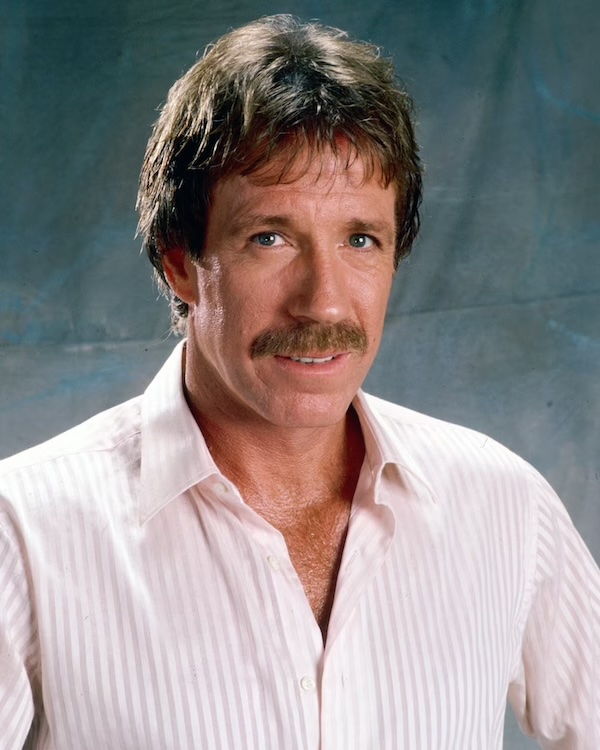
When Chuck Norris looked Death in the eye, the Grim Reaper winced. On 20 March, martial artist and actor Chuck Norris died at age 86, according to his family, in what they called "a sudden passing," per the Associated Press.
While Norris's fame as the star of mid-tier action movies is tied to the late 1970s and 1980s, his greatest cultural legacy may be owed to Internet message boards in the 2000s. In the early-aughts Internet, you could not escape web forums with exaggerated claims about Norris' machismo. You know, like:
The legendary profile of Norris is owed to some credibility as a badass. Before he was an actor, Chuck Norris was Carlos Ray Norris, who joined the United States Air Force in 1958 and was stationed in South Korea. There, he began studying Tang Soo Do, a Korean martial art. Upon returning home, Norris dedicated himself to the martial arts and competed in tournaments; in June 1967, Norris won the S Henry Cho All-American Karate Championship in Madison Square Garden. He also had a chain of karate schools that claimed Steve McQueen, Bob Barker, Priscilla Presley, and Donny and Marie Osmond as students.
Sometime in 1968, Norris met Bruce Lee, another rising martial arts legend who was breaking into Hollywood with the TV series The Green Hornet. Shortly after making his screen debut in the 1968 spy film The Wrecking Crew (in which Lee worked behind the scenes as action choreographer), Lee cast him to play his rival in the 1972 Hong Kong action-noir Way of the Dragon. Their climactic fight scene remains among the all-time greatest fight scenes in action movie history.
Norris' own fame rose between the 1970s and 1980s, as the star of action movies like A Force of One (1979), The Octagon (1980), Silent Rage (1982), Missing in Action (1984), and Code of Silence(1985). The latter movie was hailed as Norris' breakout, allowing him to ride the same wave with the era's swole icons like Arnold Schwarzenegger, Sylvester Stallone, Bruce Willis, Harrison Ford, and Kurt Russell. In 1986, Norris starred in The Delta Force with Lee Marvin. The film was poorly reviewed but a modest box office success that spawned sequels.
By the 1990s, as Norris' stardom dimmed on the big screen, he moved to TV. That's where he arguably found his greatest recognition as an actor. In 1993, Chuck Norris starred in Walker, Texas Ranger, a modern Western procedural in which Norris dished out justice as Cordell Walker of the Texas Rangers. The show was a smash hit that ran for nine seasons of 200-plus episodes, as well as TV movies and a short-lived spin-off. In 2019, Jared Padelecki portrayed Norris's lead in a reboot titled Walker, which ran for four seasons on The CW.
Norris' image of a tough guy lasted into the 2000s. That's when early Internet users (maybe with memories of watching Norris' movies on rental or reruns of Walker, Texas Ranger) latched onto him and came up with the so-called Chuck Norris Facts. Norris acknowledged the jokes and generally embraced them, and even starred in a World of Warcraft commercial in 2011.
The absurdity and playfulness of Chuck Norris Facts are a big enough distraction from the man's real-life politics. A devout Christian and staunch conservative who supported Ronald Reagan in 1984, Norris spent the latter years of his fame championing right-leaning policies—such as California Proposition 8 and endorsing the "birther" conspiracy of President Barack Obama—in his regular column for WorldNetDaily, a far-right news and opinion website. In 2013 and 2015, Norris voiced support for Prime Minister Benjamin Netanyahu during the elections. In 2019, Norris became a spokesman for the gun manufacturer Glock.
While Norris's recognition as an actor never reached the same level as his contemporaries—making the same movie for several years straight will do that to anyone's career—Norris still defined an era and a leading male archetype that has largely gone extinct in the 2020s. But maybe they only went extinct because Chuck Norris was around.