Zenith. That’s a word denoting the highest point in the sky. The watch brand of the same name, has long been known for its mastery in chronological precision; it was, after all, the pioneer behind the first high-frequency automatic chronograph movement: the El Primero. Its influence was so pervasive that it caught the attention of other watchmaking behemoths (ye who shall not be named) to adopt the movement.
Since then, Zenith has continued pushing technological boundaries in the world of horology. In 2017, it introduced the Defy El Primero 21, which shattered records with its ability to measure 1/100th of a second. In 2022, they managed to fit two independent tourbillons into a single watch, the Defy Extreme Double Tourbillon, one of which completes a full rotation every five seconds for the chronograph function. Yet, for all its ingenuity, scaling the heights that the El Primero reached proved to be a tougher challenge than expected.
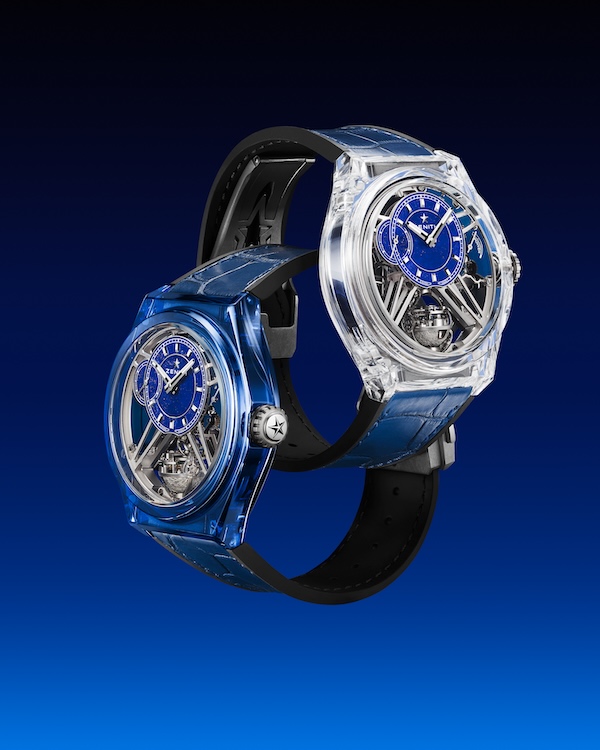
The Defy Zero G looks to change that narrative. The watch itself might sound like something plucked from a sci-fi comic—but no, Zenith isn’t kidding. It is able to name the watch that because of that peculiar little escapement at six o’clock. It looks like a tourbillon; it’s where tourbillons usually live. In fact, it even serves a similar purpose to a tourbillon. But it’s actually something else entirely. This is Zenith’s patented Gravity Control module, a mechanism that took over seven years in the lab to birth.
Well, a tourbillon counters gravity by constantly rotating the entire escapement in a cage, creating that mesmerising motion it’s famous for. This helps to alleviate gravity’s wear on accuracy by averaging out its effect on the entire escapement as a whole, relieving pressure on specific parts of the movement.
The Gravity Control module, on the other hand, draws inspiration from marine chronometers of the past, designed to remain level and steady aboard ships. Especially for long-distance travel across the ocean, you can imagine how the rocking and rolling of waves could disrupt the precision of a chronometer. To compensate for this, their movements were suspended in a gimbal system, allowing it to remain horizontal at all times.
Zenith first debuted the Gravity Control mechanism in 2008 with the Defy Extreme Zero G. It was a technological marvel, but its movement was bulky—70 per cent larger than the one today, making it borderline unwearable. A decade later, in 2018, it returned in the sleek body of the Defy silhouette we’re more familiar with, a 44mm titanium/rose gold case with a skeletonised dial. Then in 2021, Zenith encased the movement in a fully transparent sapphire case that extended from the mid-case, bezel and to the back—a first for the brand. The 2025 Defy Zero Gravity is a continuation of that trajectory.
If you didn’t already know, sapphire is the second hardest mineral on earth after diamond, so for the new references to be cut entirely from sapphire blocks is no easy feat. It’s probably a driving factor behind why each reference is limited to only 10 pieces. At 46mm, the cases come in either full blue or full transparent, allowing an unfettered 360-degree view of the Gravity Control module.
The dial itself is crafted from lapis lazuli, peppered with flecks of pyrite to evoke the intensity of a deep night sky. And because it’s open worked, we get glimpses of the skeletonised El Primero 8812S calibre in action, which winds manually to beat at a pace of 5Hz, and generates 50 hours of power reserve. It powers not only the hours and minute dial at 12 o’clock, but the small seconds subdial at nine o’clock, and the power reserve indicator at three.
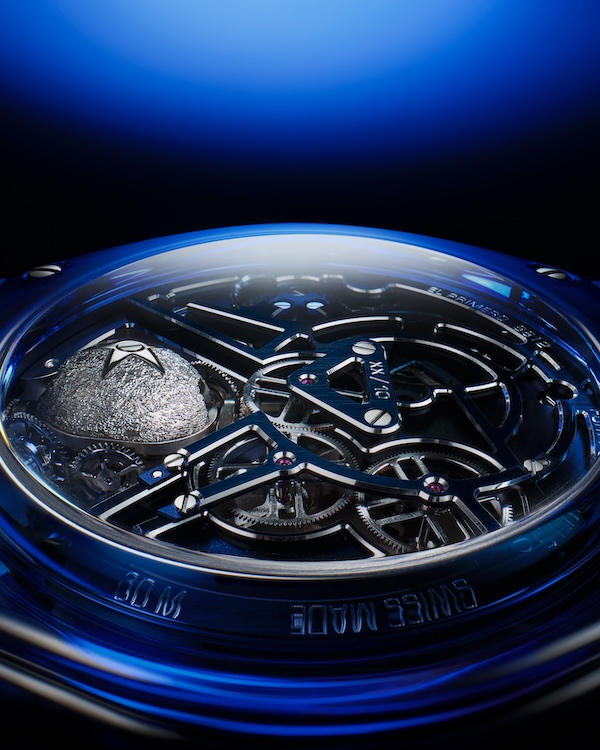
At the bottom is where the Gravity Control module lives, suspended in space by itself as if it were a lonely satellite making its round across the midnight sky. The intrigue deepens when you turn to the rear of the mechanism. The platinum counterweight latched onto the back is laser-engraved to form a celestial body, which strings connections to the moon. Even the structural bridges themselves echo the brand’s affinity with the moon and the stars, coming together to form the brand’s signature five-pointed star motif.
At the beginning, we broke down how the word “zenith” refers to the highest point in the sky. In astrology, however, it signifies the highest point in an arc travelled by a star, planet or another celestial body. Every component of the watch discussed thus far—the Gravity Control gimbal, the speckled lapis lazuli dial, the power reserve indicator, and the El Primero 8812S calibre—all of it lies beneath the brand’s iconic star logo, which is situated at the crescendo of the watch. Its zenith, if you will.
In this sense, I believe no other watch under Zenith’s storied catalogue embodies the brand’s identity and what it stands for quite like the Defy Zero G. From its cosmic symbolism subtly dispersed through design language to its creative audacity to rework and create what is essentially an “anti-tourbillon”, it manages to capture the artistic integrity and precision that define Zenith.
The Gravity Control module will probably never gain the widespread recognition of the tourbillon or the El Primero, considering it has patented the mechanism for itself, but that’s the point. The brand has charted a course that only it can tread—a path only it can challenge, and a height that only a brand with a name like “zenith” can fittingly reach.