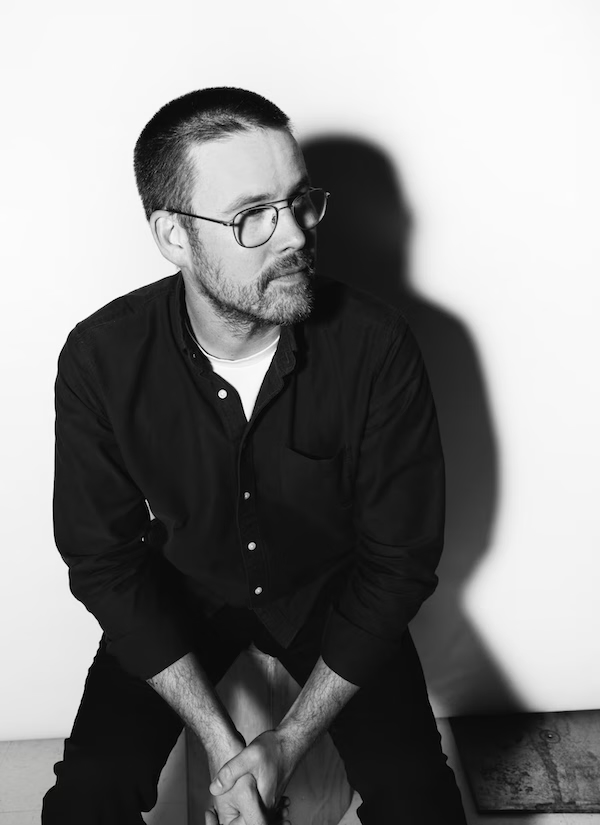
Zach Cregger is a young boy watching a movie he shouldn’t be seeing yet, tracking a five-year-old pedalling around a haunted hotel on a tricycle. He watches the child turn a corner, stop dead in his tracks, and lay eyes on ghastly twin girls, blocking the end of a hallway. Young Zach would never forget it.
That was one of the first times, and maybe even the last, that Cregger remembers being truly afraid. He tells me now that he doesn’t scare easily—or, if he’s being honest, ever. But when the director wants to remember what it’s like to feel desperately afraid, he remembers himself as a boy, wincing through Stanley Kubrick’s The Shining.
“I want more than anything to be scared so badly,” Cregger, 45, tells me over Zoom. “You have no idea.” He’s calling in from his office in Los Angeles, where he lives with his wife, the actress Sara Paxton. Cregger describes that feeling of watching The Shining like an addict chasing the high of their first hit, knowing that it’s never going to be that good again. So when he wrote the award-winning Weapons, about a witch who terrorises a suburban neighbourhood—or his debut, Barbarian, about a monster who lives in the basement of an Airbnb—he claims it was just to make his own skin crawl.
“I’m trying to make what Zach would least want to see happen in this situation, and that’s what goes in the movie,” he says. “I’m not trying to terrify people. I’m trying to terrify me.”
Cregger is ascending in the industry just as once-lucrative superhero blockbusters are running dry at the box office. The one constant for audiences? Horror. The genre remains Hollywood’s greatest hotbed of creativity, partly because it doesn’t cost much to net a good scare. Weapons, which made roughly USD270 million worldwide on a budget of USD38 million, was a risk that established Cregger as a major talent. With his next film, Resident Evil, which is out 17 September, Cregger’s looking to reinvigorate a tired franchise with new ideas. “We’re coming to the end of something in Hollywood that has been taken for granted,” Cregger says of Tinseltown’s overdue return to original storytelling. “I’m all for Hollywood showing me something that I’ve never seen before.”
Yes, Resident Evil has been around for 30 years, but you can bet Cregger will deliver a feast of new sights. Just look at Weapons. The film follows a schoolteacher (Julia Garner) and a father (Josh Brolin) who search for an entire third-grade class that woke up in the middle of the night and ran away. The haunting, Stephen King–inspired film reveals that all the children were mind-controlled by a campy witch named Gladys, played by Amy Madigan. The veteran actress won an Oscar for her performance.
Turns out, Weapons was just the proof Hollywood needed to continue investing in low-budget horror films from young, savvy filmmakers. Curry Barker’s Obsession, a modern monkey’s-paw story about the dark side of dating, made more than USD350 million this spring. Same goes for A24’s Backrooms, a trippy film about people trapped in a maze directed by 20-year-old YouTube creator Kane Parsons. Now every studio is racing to replicate magic that neither the C-suite executives nor the box-office prognosticators even understand themselves. Nor may they ever. That’s why they keep coming back to creatives like Cregger.
“If you write something deeply personal that you think maybe is only for you, odds are that will be the thing most people are interested in,” Cregger says.
Cregger wrote the script for Weapons during a promising yet turbulent time in his life. Barbarian was a massive success, but the one-two gut punch of Covid-19 and the 2023 Writers Guild of America strike was about to stall his sophomore effort. He was also grieving the death of his best friend, Trevor Moore, with whom he formed the sketch group the Whitest Kids U’ Know in the early aughts. Moore and Cregger both grew up in Virginia but didn’t meet until they attended the School of Visual Arts in New York—where they became inseparable. Cregger’s pain fuelled Weapons, but he kept the film’s real meaning close to his chest for a long time. He didn’t want to influence anyone’s experience before they saw it. Now Cregger’s a bit more comfortable talking about it.
“Weapons is a thinly veiled metaphor for what I lived through as a kid,” the director says. “I had a great dad, but he was an alcoholic. He succumbed over the decades to alcoholism, and it changed his behaviour. It changed the dynamic of my house, and it felt like a foreign entity had taken over my dad and turned him into a
different person.”
When Cregger’s family staged an intervention, his father left. So they took his father’s favourite cup—the one he used to drink out of—and they smashed it with a shovel. “That was a very cathartic thing for me,” Cregger says now. “Those kids chasing Gladys and tearing her apart in a weird way is like me smashing that cup all over again.”
Gladys is set to return in a prequel for Paramount that will reportedly explore the witch’s origins. Cregger scrapped a chapter in Weapons that dived more into her backstory, but he teases that audiences should expect an entirely different kind of movie from Weapons. “It would be a weird thing for me to move into telling Gladys’s story and be like, ‘Don’t forget, she represents alcohol entering the family,’ ” he says. No one needs that catharsis twice, not even him. But before audiences learn more about Gladys, Cregger has another new fright-fest out first: Resident Evil.
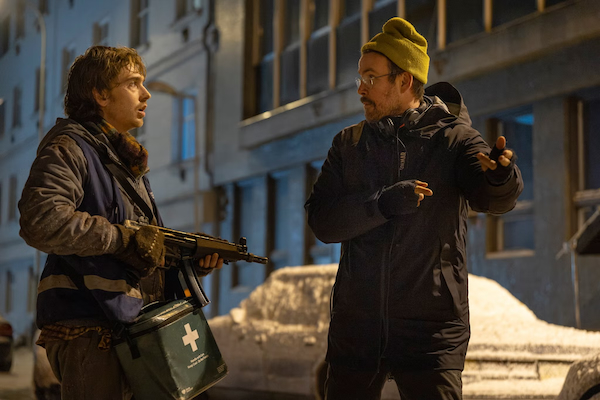
There isn’t much that Cregger wants to reveal before the survival horror hits theatres this fall. For now, he describes the video-game-inspired film as a real-time, on-foot journey that takes place over the course of one snowy night. The protagonist, played by Austin Abrams, is a medical courier who is caught in a viral zombie outbreak. Cregger’s goal? “Grab you by the throat at minute eight and never let go,” he says. “That was the challenge I set for myself. Can I make a 90-minute movie where 82 of those 90 minutes I am flooring it?”
Cregger shot Resident Evil in the Czech Republic during a punishingly freezing winter, when the director went from battling pneumonia to suffering a debilitating stomach infection. His crew was basically nocturnal, shooting only at night in frigid temperatures. It was killing them. But rest assured, there is a deeper dimension to the big-budget thrill ride outside of pure survival.
“Even though this is about a guy fighting a zombie infection, the through line of the issues that these characters are confronting are what I’m dealing with in my life,” he says. “That’s what keeps me engaged.”
Sony is hoping that Cregger’s vision rubs off on Resident Evil, much like how Christopher Nolan transformed Batman for DC. “They knew that they needed to shake up the franchise,” Cregger says. “But they didn’t know if I had another good movie in me.” Maybe Cregger didn’t either. “It was a real leap of faith,” he says.
You know who else tossed the car keys to Cregger? Steven Spielberg. Around the same time Cregger was writing Resident Evil, the director signed on to produce his next movie. It was awkward timing. In addition to starting on Resident Evil, he was finishing up Weapons. But with the writers strike around the corner, Spielberg told him that he had a week to come up with a new idea for a film that they could push through before Hollywood shut down. Cregger panicked.
“I had one week where I was like, ‘Oh my God, I have to think of an idea for Spielberg,’ ” Cregger remembers. He recalls watching the 2019 sci-fi film Ad Astra, which stars Brad Pitt as an astronaut. Cregger’s wife said something along the lines of “There’s nothing scarier than being trapped in space.” It was all he needed. “Really?” he asked her. “What would be the scariest thing?” He came up with an answer and pitched it to Spielberg. He loved it. “Good man,” Spielberg told him. They sold the idea for the film, titled The Flood, two days later. It’s set for release in 2028.
“You have to really listen and let your subconscious be open to whatever signals are going to make your creative tuning fork resonate,” Cregger says. Because, for him, it’s always about solving one question:
If that didn’t scare me, what would?