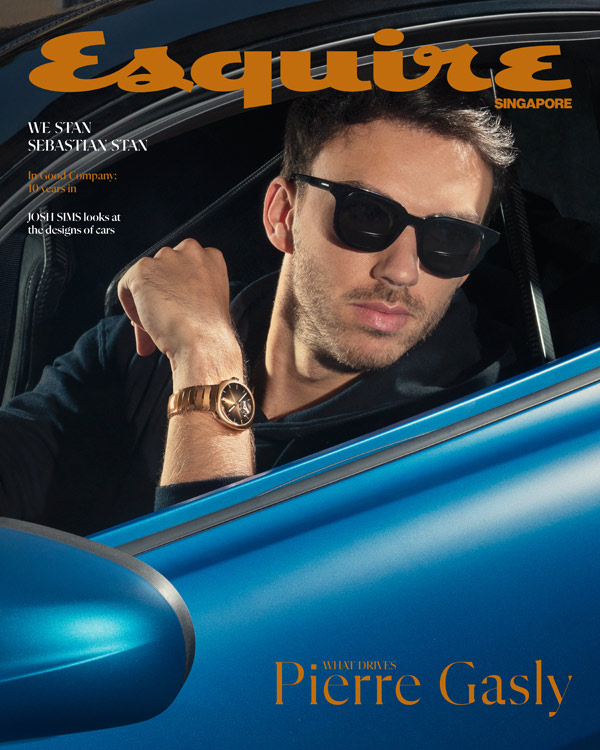
There are two types of time that define the life of a Formula 1 driver. There is the external one, measured with a stopwatch, broadcast to an audience of millions while their body is folded tightly into a cockpit that seals itself into a rolling oven. Sweat pools underneath layers of fireproof material as temperatures soar up to 50 degrees Celsius or more. Every corner and gear shift subjects them to the crushing strain of the G-force.
Then, there is the internal one, the one we're more familiar with. This sort of time is measured by the strokes of lines on our forehead and the sum of the lived experiences we accumulate. Instead of relentless lap times, it's marked by achievements and milestones that we manage to wrestle out of this thing called life.
These two tales are no strangers to Pierre Gasly.
Motorsports and his family are intertwined—his father competed in various categories of racing (karting, endurance, rallying); his grandfather karted; his grandmother was a regional karting champion; three of his stepbrothers (each of Gasly's parents sired two children each from their first marriages) are racers. Given enough time, was there ever doubt that Gasly would end up as a gearhead?
He first climbed into a go-kart at six. In an recent interview with Formula 1, Gasly described his first time thusly: "If I close my eyes, even right now, I can just visualise exactly me leaving the pit lane for the first time, going down that straight, going through the grass, because it was the first-ever time, trying to find out my lines and stuff. I just remember that feeling of excitement, fear and adrenaline. It was like a cocktail of emotions. I loved F1 before, like watching on TV, but really that feeling of speed and being so low in the kart from the ground really made me fall in love with it."
That moment, that feeling, left such an indelible impression on him that he dove headfirst into the sport. Gasly has since won at every level of motorsport he's competed at. From junior categories to Formula E, Formula 2 to Formula 1—Gasly is one of only a handful of drivers on the current grid to have won a Formula 1 Grand Prix.
But the road to being an F1 driver wasn't always a straight track.
Racing cost a pretty penny, especially when it's at a competitive level. Gasly's parents invested everything into his career to a point where the tax advisors paid them a visit because they couldn't afford to pay taxes.
But the sacrifice bore fruit. Gasly would leave for a programme organised by the Federation Internationale de l'Automobile in Le Mans. There, his performance on the track caught the eye of Red Bull talent scouts. In December 2013, Gasly was signed into the Red Bull Junior Team and in 2017, finally made his Formula 1 debut at the Malaysian Grand Prix with Toro Rosso.
In an interview with Sports Illustrated, Franz Tost, the team principal of AlphaTauri (formerly known as Toro Rosso), saw Gasly's prowess on the track.
"He has a fantastic technical understanding," Tost says. "And he knows exactly how to set up the car in which direction to go. He has a very good understanding in the races from the race strategy, and also, he has a good feeling [for] what the other drivers are doing."
It was high praise for the 22-year-old at the time but Gasly was still finding his footing.
Gasly and Brendon Hartley were Toro Rosso's drivers for the 2018 season and Gasly ended that season in 15th place. He was promoted to Red Bull Racing the following year. But with two pre-season crashes and lacklustre showing of 63 points after 12 races, Gasly was sent back to Toro Rosso.
Despite the setback, Gasly pushed through the ups and downs of his career. In 2020, the Italian Grand Prix in Monza would prove to be a definitive moment for Gasly.
He'd started the race in 10th but gained an advantage when an early pit stop allowed him to slip past several racers who were forced to wait for the pitlane to reopen under the safety car. That move lifted him into third. Lewis Hamilton, who led the pack, was penalised for a 10-second stop-go, which put Gasly in the lead.
From there, Gasly held his own against a relentless late charge from Carlos Sainz Jr and crossed the line to claim his maiden Formula 1 victory.
This was a fairy tale moment for himself; the first Frenchman to do so since 1996 when Oliver Panis won the Italian Grand Prix.
While few achievements will ever rival the euphoria he had felt at Monza, yet oddly enough, his latest collaboration with H. Moser & Cie. seems to come pretty damn close.
From the choice of movement down to the colour of the dial, the palette, the textures—you'll find his fingerprints pressed onto every component of the new watch he conceived with the 200-year-old Swiss watch brand: the Streamliner Tourbillon Pierre Gasly.

"To actually see the final product that came from the creation of myself and the work that we've been doing together is really something very special and emotional," Gasly tells us at the launch event of the new watch at Le Pristine in the Grand Hyatt. He likens the feeling to Monza—a victory born out of years of work he'd put into a vision.
Monikered as Chocolate fumé, the dial wears an antiquated shade of brown that hypnotises in its ability to play with light. That fluidly is perpetuated through its iconic streamliner bracelet, which is given the red gold treatment. Why the brown you ask? Oh, because it's profound, subtle, slightly mysterious—qualities Gasly wanted the watch to reflect on himself.
Like the Streamliner Cylindrical Tourbillon Skeleton Alpine Limited Edition, the Streamliner Tourbillon Pierre Gasly will also be paired with a rubber strap (chocolate in this case) that wrings out the watch’s sporty edge.
Whatever strap one chooses, there will, however, be a constant: a one-minute flying tourbillon rotating endlessly in its cage, forever ironing out any inaccuracies caused by the pull of gravity.

For Gasly his constant is his drive. His childhood and his family spur him to push forward through hell and high water. Perhaps that's why his journey holds such fascination; it's the retelling of an oft-told tale, where the protagonist overcomes adversity. But more importantly, it's a story where the hero gets up again; to carry on even when all hope feels lost.
ESQUIRE SINGAPORE: How do you balance the need for winning with enjoying what you do?
PIERRE GASLY: I enjoy winning. But ultimately, l enjoy the process. I absolutely love racing. I love the competition, the teamwork, the emotions.
At the end of the day, even if you don't win every race—you work so hard for that goal, and when it comes, the emotions are extreme. That's what I wake up for every day. I know my purpose. I know what I'm doing. I want to be a champion.
ESQ: What's the most fun or challenging corner on the Singapore Circuit for you?
PG: First of all, it's a street track, so it's extremely difficult because it's between walls. The weather makes it unpredictable too. I would say the most challenging... there are so many corners, but I hope I don't get it wrong [replaying the circuit in his head]—it's corner 10. The whole section is a fast left-hander before a tight right-and-left chicane, in sector two. It's very twisty, very narrow. You're millimetres from the walls at crazy speeds. You get good adrenaline.
ESQ: How has your relationship with time evolved as your career matured?
PG: Well, I've got less and less time as my career evolves [laughing]. Life has gotten busier. As a driver, time is everything in our life. Since go-karts I've been racing against time—milliseconds, hundredths. But it's really a sport where time is everything—chasing time all the time. As a kid, in the space of 24 hours, I felt like I had so much free time and had time to do so many things. Now, with my occupation and schedule, the pace of life feels a lot different. As you get older and go through different stages of your life, you have a different appreciation of time.

ESQ: If you could have a watch designed after a specific car, what would it be and why?
PG: After an Alpine. It's got to be after an Alpine [laughing].
ESQ: For the Streamliner Tourbillon Pierre Gasly, between the rubber strap and the bracelet, which is your favourite?
PG: I'm not going to lie, initially I was sure that the rubber band was going to be my favourite. But the first time I actually got both watches in front of me, somehow it just clicked with the metallic and rose gold bracelet. It's a different look. It's got a different power to it. Different weight, different price too. It's almost like a different watch, but I love them both. I'm so happy with the watch itself and both versions, but the metallic is probably slightly more powerful.
ESQ: How would you style them differently?
PG: The colour combination for me was very important because these are colours I really love to wear. Cream, white, beige, light brown. These are colours I find very fashionable. I don't like things that are too flashy. I find it elegant, but at the same time quite powerful. It blends in nicely with the type of colours I wear. So yeah, I stay in this sort of whitish, creamy, brown type of colour.
ESQ: Beyond the colour of the watch, is there a feature or element here that feels most you?
PG: I would say the tourbillon for me is something I love. Most of my watches are actually with a tourbillon. I find it fascinating and quite mesmerising. When Moser came to me initially and offered to collaborate, I said okay, but I want the tourbillon to be present. Personally, it's my favourite complication.
ESQ: Could you go a little deeper into how the process felt personally for you, as well as the materials, the colours, and everything you chose?
PG: It was a truly unique process. Obviously, I don't come from that industry. But I've liked watches, really, from the moment l got into F1 and had better access to that world. With Moser, I was able to put a foot in this world, going to the manufacture. I appreciated what they do with the materials, the movements, the whole process and artwork that goes into these pieces.
It was eye-opening. I loved the creativity part and the fact that it was to my liking—the design I wanted, the movements I wanted, the colour combination I wanted. From the start, I knew the sort of watches I like and the sort I don't. So for me, it was quite clear. Straight off, I knew exactly what kind of watch I wanted to do.
ESQ: Where did that certainty come from?
PG: I've always liked artistic creativity since I was a kid. My mom was a textile designer, working with fabrics and creating pieces. I think I got it from her. I've always been curious, looking for inspiration in different industries. I also know what I like and usually have clear ideas. When I told Moser what I had in mind, they came back with a hundred different options—but one of the first ones was exactly what I wanted. That was amazing because people interpret things differently, but they understood me perfectly.
ESQ: If you could slow down one moment in your career and live inside it for an hour, which would it be?
PG: I would say the podium in Monza for my victory. I actually took some time for myself there to really take in the emotions. I worked all my life to get to that position, to actually be a Formula 1 race winner. I know when you do a podium celebration, you get the trophy, take the picture, and then you leave. But it's fast. I haven't worked for 18 years to just have two minutes there and then go away [laughing]. So if I had extra time, that's where I would use it.
ESQ: Looking back at the collaboration, what surprised you most about the watchmaking process?
PG: The most interesting part for me was visiting the manufacture in Switzerland. It makes you appreciate the work and the piece in a different way because you see all the steps it goes through—the attention and focus on every detail from all these people. I knew already how complicated watchmaking is, even though I keep learning all the time. But it was really eye-opening in terms of how difficult it is and how much we should appreciate these pieces.
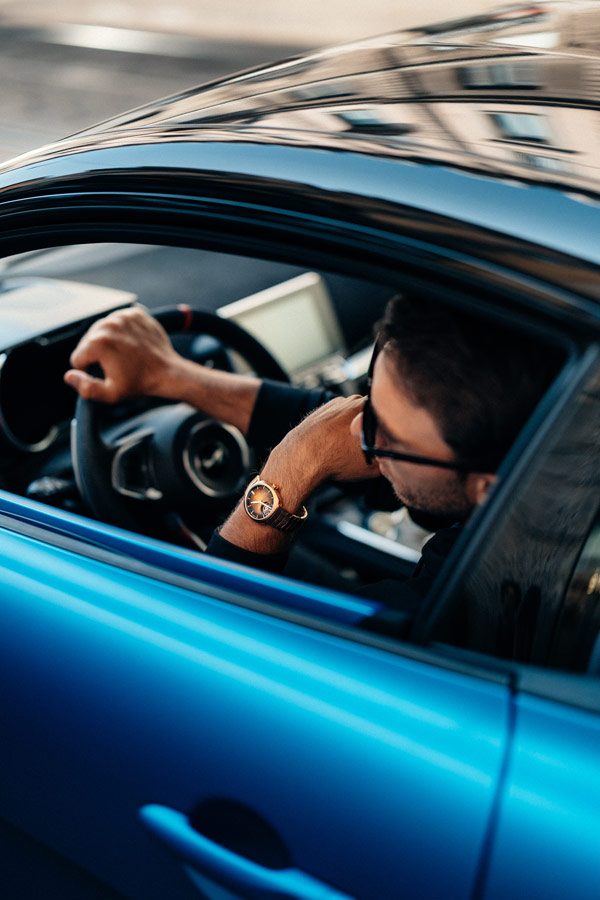
ESQ: Collaborations can sometimes feel very marketing-heavy. What did you want to avoid so that this project felt authentic to you?
PG: That watch is exactly me. You might not like it, but I do—and that's what matters. I wanted it to reflect my taste and what I wanted to achieve. Some people might like it, some won't, and that's fine.
That’s why my name is only at the back. I’m not someone very flashy. I don’t like big logos. We added subtle touches instead—like the diamond on the dial at 10 o’clock, which is my race number. People might not notice at first, but when you know, you understand the connection. It’s subtle, it’s elegant, and it feels true to me. [Editor’s note: Gasly’s piece is a unique reference with the diamond. Customers can also opt for that 100-piece limited edition or the 10-piece limited edition with the ruby at 10 o’clock.]
ESQ: Imagine a future where you're long retired and invited to give a TED Talk. What would it be about?
PG: Resilience. As an athlete I'm pushed every day to be strong mentally, to overcome challenges and tricky situations on and off the track. I know exactly what I want to achieve in Formula 1, but it's not always bright days.
Before and after you get to Formula 1, you imagine an ideal career path, but the reality rarely goes that way. That's where resilience comes in. I'm sure after my career, with more free time, I'll have many topics to talk about. And I can talk [laughing]—so I'm sure I'll be invited.
ESQ: Was there a racing fear you had growing up that you had to overcome as you got older?
PG: It's a strange feeling. As a kid you're more careless, right? You don't really understand the race. That's why you're so pure, so genuine—you're just going out in the world trying to grab everything. I wasn't really thinking about fears. I remember seeing my mom shaking next to the racetrack and I never understood why. For me, I knew what I was doing.
Of course, every time you step up the cars go faster and the risk increases. I've also lost people I knew in the sport. It doesn't bring fear, but it makes you realise it's dangerous. When I get in the car, I never feel fear. I just know there is a risk, and I accept it. If you don't accept, you stop racing. For me, I'm not stopping because I love what I'm doing. It's there, it's okay. It is what it is.