
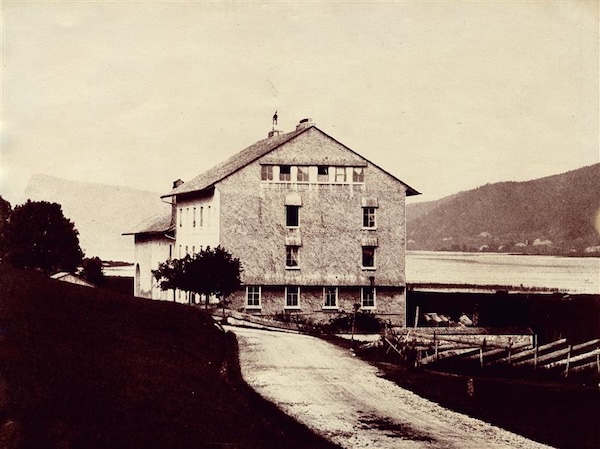
This is how it began.
After feeling religious persecution in their home country, Huguenot refugees settled in a hidden valley in the Swiss Jura. Called the Vallée de Joux, it was an unspoiled land, an area of forest and rocks—harsh, dangerous, but replete with possibilities of a new life. Among these French Protestants, was Pierre LeCoultre, who bought a piece of the land and built a farm on it.
Back then, agriculture was all the peeps at Vallée de Joux knew. The summer brought bounty but with the valley’s isolation and severe climate, the winter halted farming. Invention is the mother of necessity and this impasse forced many farmers to seek alternate means of income. They built domestic forges within their chalets, and specialised in metallurgy: blades, buckles, locks and such.
Among these innovators is Antoine LeCoultre, who worked at his family’s forge to produce new alloys and materials for music boxes, razors and, even designed a watchmaking chisel. And when he wasn’t working the forge, Antoine was teaching himself watchmaking. In 1833, Antoine turned his family forge into a watchmaking atelier, but he still lacked an établissage—an ecosystem of small workshops, each specialising in a watchmaking craft.
Thirty-three years later, Antoine and his son Elie gathered all the watchmaking crafts under one roof to establish the first fully-fledged Manufacture in the Vallée de Joux. Now LeCoultre was cooking with fire. With all the watchmakers’ different skills under one roof, it became a hotbed of the exchange of ideas, which stimulated ever greater inventiveness in watchmaking.
Today, the Vallée de Joux is a verdant landscape, still blossoming with the presence of watch manufactures like Jaeger-LeCoultre. The original structure still remains. New workshops were built around the original historic building, which serves as part of the brand’s museum.
Possessing more than 430 patents, Jaeger-LeCoultre stands as a true Manufacture-Atelier. Uniting 82 ateliers, 108 watchmaking métiers and 69 signature savoir-faire under one roof, the House sits as a testament to its heritage and watchmaking.
Showing no signs of slowing down, what the brand bought to Watches and Wonders Geneva in April was a reminder why Jaeger-LeCoultre is widely known as the Watchmaker’s Watchmaker.
Talking to Jaeger-LeCoultre’s CEO Jérôme Lambert, the 57-year old wants to take the Maison to new heights. “That’s why we brought ‘The Valley of Inventions’, or the Vallée de Joux to this year’s Watches and Wonder,” Lambert says. “We want to create a link between where we are to the eternal idea of a watchmaking miracle on your wrist.”
The House presented 15 new timepieces, from the average chronometers to very complicated timepieces, Jaeger-LeCoultre can rest assured that its Watchmaker’s Watchmaker title remains intact.
From the novelties, we point to the brand-new calibre—the 738—that runs the Date Power Reserve. Dressed in a dial that borrows its DNA from the 1951 Futurematic, you have two subdials—a power reserve on the left and the date on the right. This is the first watch to debut Jaeger-LeCoultre’s rigorous High-Precision Guarantee (HPG) certification.
Fitting a full perpetual calendar into a 39mm case that’s only 9.2mm thick, the Perpetual Calendar also has a Calibre 868 inside it. With a 70-hour reserve, the timepiece is good until the year 2100 without you touching a corrector as long as you keep it wound.
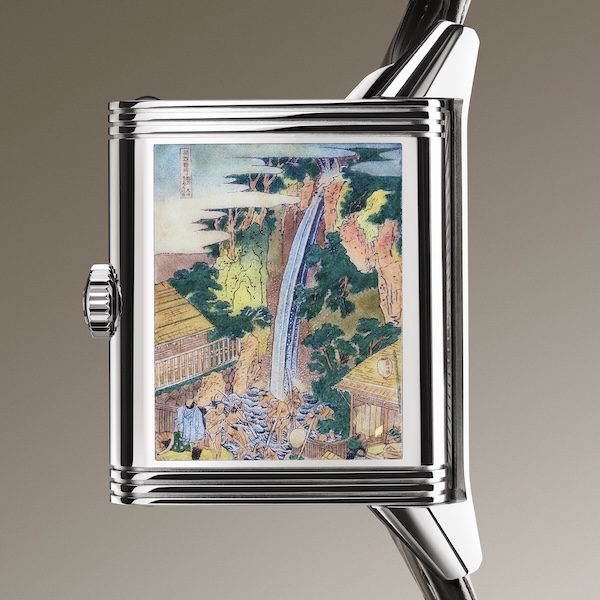
What’s a JLC novelty without mention of the Reverso? Its “Or Deco” family adds five to its fold, all gold and bracelet-driven. The brand also concludes an artistic trilogy that started in 2018, with the final four prints of Hokusai’s Waterfalls of the Provinces series. With a hundred hours of meticulous enamel application, it’s the equivalent of an art piece on your wrist.
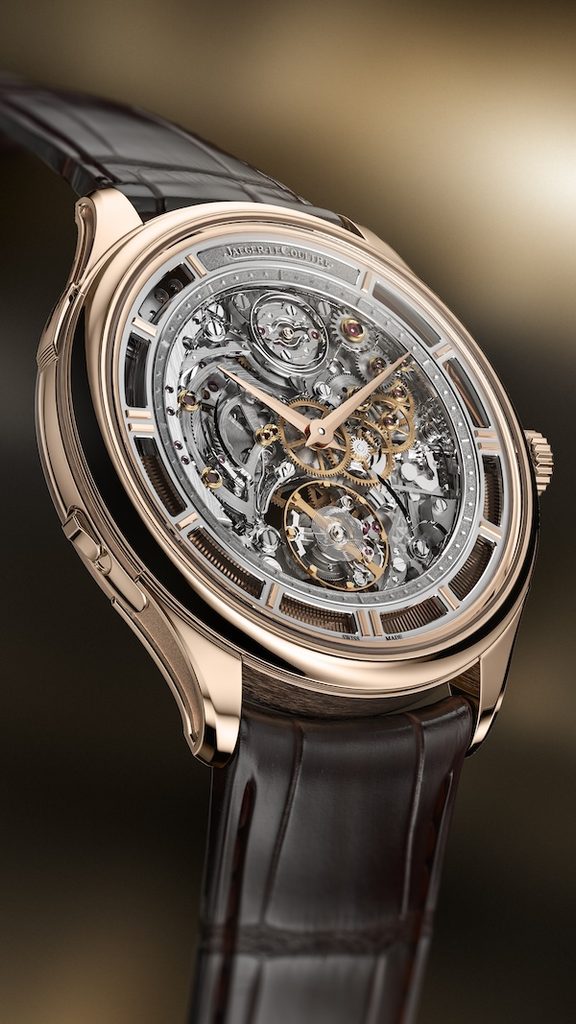
The Hybris Artistica Calibre 179 is another masterclass in high watchmaking. It’s a hand-engraved Reverso that took a single craftsperson 180 hours to finish, with another 14 hours spent bevelling the tourbillon cage. It’s a duoface complication, where the front dial presents its artistry, and the reverse displays a second time zone, and a 24-hour indicator.
We continue with the Master Hybris Mechanica Ultra Thin Minute Repeater Tourbillon—a minute repeater, a flying tourbillon, and automatic winding all stuffed into a case just 8.25mm thick. Powered by the Calibre 362, and driven by a pink-gold peripheral rotor. It is an ambitious piece, one that almost borders on magic.
A new platinum version of the Duomètre Héliotourbillon Perpetual has a triple-axis tourbillon that’s embraced by a perpetual calendar. Three finishings (opaline, brushed, azuré) are applied to an anthracite dial, where its colours shimmer eldritchly under the light. Made from 40 parts, the 44mm savonette case has integrated lugs that are linked to a specially-designed brand-new five-row platinum bracelet.

“Originally, when the tourbillon was invented in 1795, it was to counteract the effects of gravity on pocket watches.” Lambert elaborates. “Pocket watches were either linked by a fob, or they were carried in a jacket pocket.”
Watchmakers would build on the humble tourbillon. The removal of the upper bridge that held the cage, self-winding feature, multi-axis tourbillons… the sky’s the limit. Jaeger-LeCoultre would release the Gyrotourbillon à Stratosphère, an opening salvo from its new line called Master Hybris Inventiva.
While triple-axis tourbillons were around since the 1980s, Jaeger-LeCoultre improved on it with three titanium cages that are fixed in an XYZ orthogonal structure, which allows for each cage to rotate at different speeds. This layout covers 98 per cent of all possible positions, which renders the effects of gravity almost negligible.
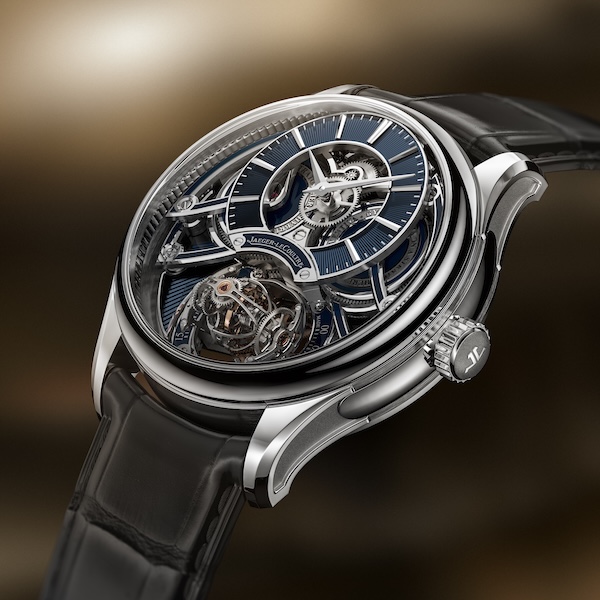
Lambert adds that the Gyrotourbillon à Stratosphère was a result of “seven years that the team worked on”. What makes the Gyrotourbillon à Stratosphère a technical marvel is the miniaturisation of the entire 189-component tourbillon that weighs 0.783 grammes. Housed in a 42mm platinum case that took 65 hours of hand-bevelling across 55 parts. The manual-winding Calibre 178 sits as the Gyrotourbillon À Stratosphère beating heart. With a power reserve for 72 hours, the front ring of the dial is decked with guilloché and coated with translucent blue enamel. A blue alligator leather strap with 18K white gold adjustable folding buckle lends another level of sophistication to the piece. Due to the complexity of the assemblage, only 20 pieces were made.
It’s interesting to see the thread of Jaeger-LeCoultre’s history. In the bid to fins a new home, the Huguenot refugees also found their calling in horology. An integrated bracelet here, a triple-axis tourbillon there, decades of watchmaking know-how and métiers d’art, Jaeger-LeCoultre has done so much, but it also feels like there’s more tapestry the brand could leave its mark on.