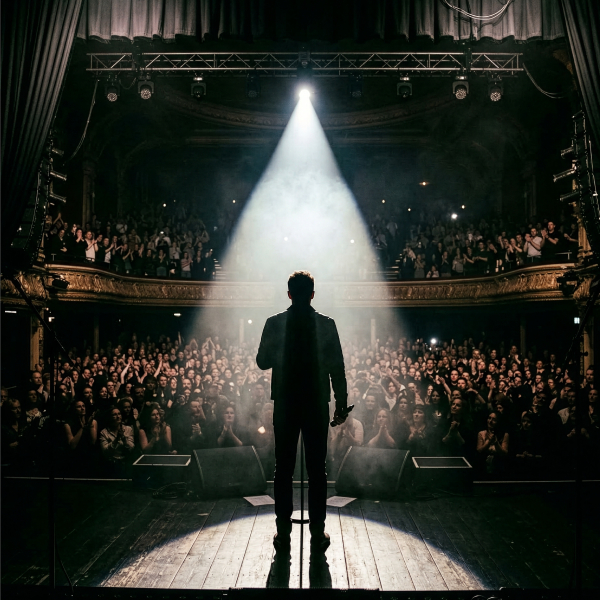
You are not the audience. I need you to sit with this for a moment, because everything that makes social connection tolerable is built on the assumption that you are. That you’re performing for an audience, however small. That somewhere, someone is watching, and your actions are legible to them, and that legibility matters. Here’s the thing about the fantasy of “the social life you wish you had”: it’s entirely constructed around being observed.
You wish you had a social life where your gatherings are effortlessly cool, where your conversations are witty, where you’re surrounded by interesting people doing interesting things in interesting rooms. And implicitly, where this is all visible. Where the experience is legible. Where someone—your friends, your inner circle, the abstract “people who matter”—sees you in these moments and recognises them as moments. But April is asking us to sit with something more complex:
What if, when you’re actually with people you care about, you’re not performing and being observed—you’re just there, and you’re not narrativising it, and nobody’s keeping track? The word for this month is “ordinary.” Not ordinary in the diminishing sense—not “boring” or “unexceptional.” Ordinary in the sense of “without rhetoric,” “without performance,” “without the distance between yourself and the moment that comes from knowing you’re being watched.”
I spent years in social situations with a split consciousness. Part of me was genuinely present—listening to the person across from me, enjoying the drink, feeling the warmth of the gathering. But another part was observing that first part, narrating it: this is a moment I’m having, this is the kind of person I am in this setting, this is something I’ll remember, this is being registered. I was simultaneously in the moment and watching myself be in the moment, and the second consciousness was constantly asking: Is this legible? Am I being seen?
I also realised it was quite lonely. Because if you’re always performing the experience rather than having it, you’re always alone. There’s always that gap between you and the moment, that space where the observer lives.
The cruellest thing about social performance is that it guarantees the very disconnection you’re supposedly trying to prevent. You gather with others to feel less alone. But you do so while performing the gathering to an invisible audience (whether that audience is your friends observing you, or you observing yourself being observed).
And that gap between you and the moment means you’re actually more alone in the gathering than you would be sitting by yourself. Here’s what I’ve noticed about people who seem genuinely at ease socially: they’re not performing for anyone. Not because they don’t care how they come across—they obviously do, to some degree. But because they’ve somehow dissolved the audience.
They’re not monitoring whether they’re being read correctly. They’re not constructing the story of the gathering as it happens. This is terrifying to most people. Because it means you can’t control how you’re perceived. You might say something awkward and not have the option to silently laugh at yourself for it, thereby leaving the interpretation to others. It means you might be boring, and that self-awareness won’t mitigate it.
You’re not the audience anymore. You’re just the person at the table. A colleague of mine stopped posting photos from events. Not dramatically, not as a statement just quietly stopped. I asked him why, and he said, “I realised that the moment I took out my phone to photograph something, I left the moment. I became an observer instead of a participant. And the photograph was always worse than the experience anyway, so I was trading a real moment for a documentation of it that was simultaneously fake and inferior. What was I doing?”
He was acknowledging that the audience ruins the presence. Or rather, the assumption of an audience does. Because once you’re aware you’re being watched—whether by actual people or by the future version of yourself who will review the memory—you’re no longer fully there. You’re partially here, partially in the projection of how this will be perceived. April is asking us to do something radical: to show up for the actual moment, not for the story about it.
To be with people without narrating it. To have a conversation and then forget most of it, because we were actually in it rather than observing it. To do something face-to-face, then have no way to prove it happened, and find that it doesn’t matter because it happened to us and we were there.
Not in the performance of being connected—the carefully curated photos, the witty anecdotes, the moments you’ve pre-shaped to be shareable. But in the actual ordinary exchange: the tangent in a conversation that nobody will remember, the joke that lands quietly, the moment where you look at someone, and they look back, and something is understood without needing to be stated or documented or proven to exist.
I’ve been sitting with a group of friends every other Thursday for four years. We meet in the same place. Nothing remarkable happens. We talk. Sometimes about important things, sometimes about nothing. The conversations are rarely witty. They’re not photogenic. They wouldn’t make a good story. Most of them are forgotten by Friday. But they’re the real social connection I have.
Because I’m not performing them. I’m not observing myself being in them. There’s no gap. I’m just there, and everyone else is just there, and nothing needs to be witnessed or legible beyond that small group. This is what “the social life you wish you had” actually is. Not the fantasy version with elegant gatherings, interesting people, and perfect moments. But the ordinary version: face-to-face interaction where you’re not the audience.
Where the moment is enough because it doesn’t need to be anything beyond itself. The people who make you better aren’t the ones who see you and recognise who you want to be. They’re the ones you can just be ordinary with. Completely unremarkable. Utterly unglamorous. Without needing to narrate it, perform it or prove it happened.
Here’s to April: to showing up for the actual moment instead of for the story about it, to being with people without being observed by yourself. To face-to-face interactions that are so ordinary, so unremarkable, that nobody will remember them, but you’ll carry them anyway. You are not the audience. You’re just here. And that’s enough.