When the world ground to a halt, you could get by on the bare minimum. The days stopped being dictated by a need to do more. Whiling away a weekend on Netflix was not only accepted but also encouraged. A testament to your willpower, in fact—by resisting the temptations of the outdoors, you were carrying out a public service.
Those days are going away now, and a return to normal—although it’s a cause for celebration—comes accompanied by a sobering truth. Life before the pandemic wasn’t free of complaints. Commutes are making a comeback, dressing down is fading out of fashion, and things feel as they did at the end of 2019: confusing.
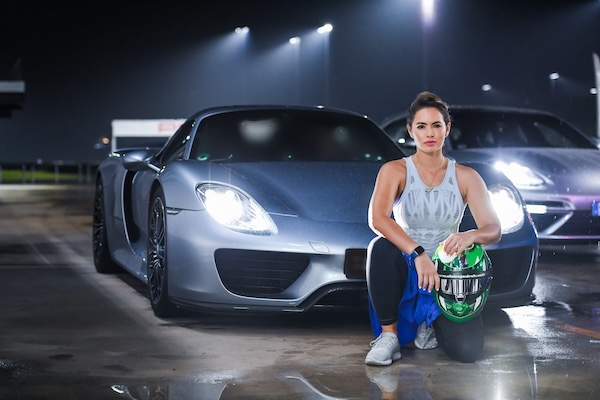
As we step out into this faster world—with busy roads and people who walk with a purpose—getting up to speed can be a real challenge. Racing driver Claire Jedrek likens life to the asphalt. “If there’s a big turn coming up and you go full speed ahead, you’ll never make it,” she says. “You’ll get understeer and crash into something.”
"Slow entry, fast exit" seems to be the mantra then—whether you’re doing a 180 on the circuit or in your career path. Approaching change calls for a focused mind and a clear objective. “When you’re in a high-pressure situation, you need to be able to make objective decisions,” Jedrek explains. “You have to cut out the emotions and rely on facts and experience.”
This isn’t an ability which she naturally inherited. “Prior to [racing], I was a pretty emotional person,” Jedrek continues. “I’d struggle with receiving feedback or understanding people on things I didn’t agree with.” Her time behind the wheel was, in her words, “a brain retrained”. “People say that your world view is defined in your [formative years] but I definitely think that you can change the way you see things.”
Jedrek was already 31 when she started her racing career in 2014. It was a decision spurred on by her husband and a fellow professional, Yuey Tan, and her lifelong love for extreme sports. Jedrek’s first race was preceded by almost two years of training or, as she recalls it, “quite an ego check”. “It’s a sport about communication and feedback, and if you can’t take that when you’re pissed off or unhappy, you won’t get very far.”
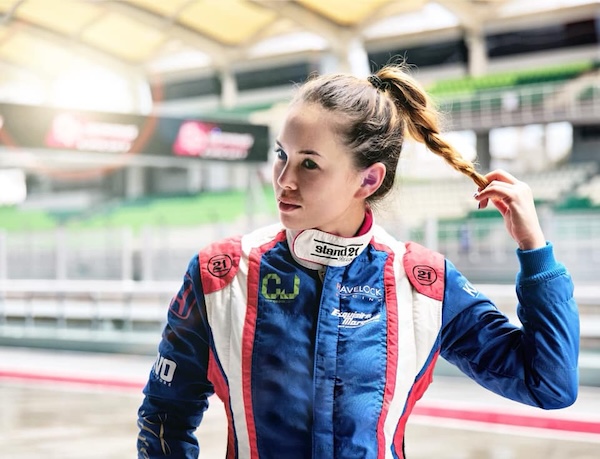
Although the initial plan was to participate in two or three races, Jedrek found herself competing in the Malaysian Championship Series for the following four seasons. During this time, she bagged herself a podium finish at the Malaysia F1 support race, making her the first-ever female driver in the series to do so. “It was the last lap of the race,” she recalls. “I knew my team would be watching, thinking don’t try to overtake him now.” Given the context, it appeared to be a risky move, but by this point, she had learned to look out for facts only. “I remember I was reading the situation. His rear tyres were sliding out and he had no grip. I really believed I could do it.”
Summing up her proudest achievement on the racetrack, Jedrek says, “I took that opportunity based on instinct.” In doing so, she zeroes in on a mindset that has stayed with her in life beyond the circuit. “Some people believe that you should act on your emotions but I’ve learned that it’s a lot easier to let go. To let go of the factors that you can’t control and really just work in the moment.
“I don’t like to waste brain space on ifs and buts,” she adds. “It could be a job interview, a pitch, or a performance I wasn’t happy with. Things don’t always go your way. If you’re trying to focus and get through your day, you need to have that mindset which says, ‘what can I do moving forward?’”
Two years separated from racing—courtesy of pregnancy and a pandemic—Jedrek has stayed on her feet through the turbulence. The initial plan had been to make a comeback to the circuit, but instead, she’s found herself venturing into robotics. “I’ve had to be realistic and stop waiting for something to happen,” she explains. “Usually, I’d be out of the country every two weeks. But with the borders shut, I can’t go overseas to commentate. The F1 is cancelled [in Singapore] too and that’s been my main job for the last decade. I had to adapt.”
While Jedrek’s optimistic about a return to her usual lifestyle, she doesn’t allow circumstance to have much of a say on her state of mind. “I don’t like to practise complaining about things. I love my job and I love travelling around, but being in the country I get to see my kids grow up. This makes me happy too.”