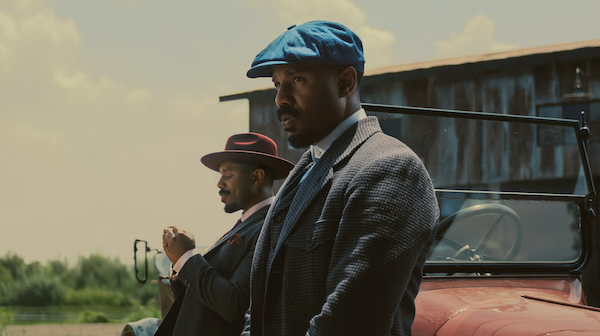
So, no black pathology, no Oscar win.
Such are the Oscars-so-white ways of Hollywood that, while Ryan Coogler’s Sinners was the most nominated (16) film in Oscars history, Paul Thomas Anderson’s One Battle After Another won the Academy Award for Best Picture. Sinners should’ve won. And the race shouldn’t even have been close.
OBAA, a dark comedy and action thriller set in a fictional California town, begins with a focus on Ghetto Pat (Leonardo DiCaprio), a member of a revolutionary group called the French 75, and his partner Perfidia Beverly Hills (Teyana Taylor), a Black woman. As they raid an immigration detention centre, Perfidia, who’s characterised as domineering and insatiable in her sexual appetite, humiliates Colonel Lockjaw (Sean Penn), a strife that sets off Lockjaw’s psychosexual obsession with her, a desire replete with a tryst. Perfidia becomes pregnant, and Pat trades the life of a leftist revolutionary for fatherhood. In the film’s long prologue, Perfidia abandons her new family, is caught, snitches on her comrades, and ghosts.
The second half of the film picks up when their daughter, Willa (Chase Infiniti), is a teenager and Pat, now using the name Bob Ferguson, is a washed-up, single helicopter parent. Lockjaw, who has been offered the chance to join a cabal of powerful Christian nationalists, starts hunting Willa to test his paternity of her and the attendant risks to his dreams of levelled-up white supremacy.
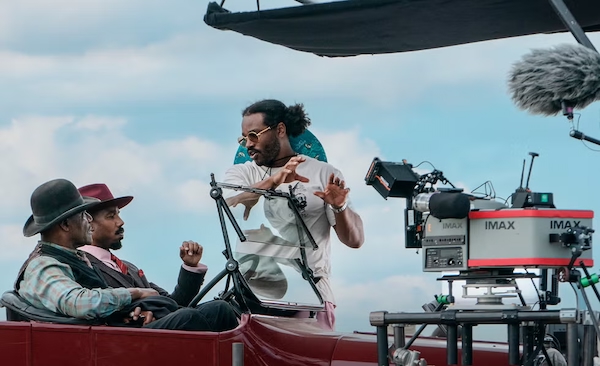
Before the PTA acolytes blaspheme me a hater: Kudos for writing Deandre (Regina Hall) and Willa, Black characters distant from caricature. Kudos for Sensei Sergio St Carlos (Benicio Del Toro), a calming force in the film and funny without straining for laughs. Kudos to Penn for the Oscar-winning performance with which he disappeared into the role of the racist officer, conflicted with unforgettable idiosyncrasies. Kudos for the pulse-gunning action of the film’s last third. Kudos to Anderson for dramatising a secret society of prominent white men who echo the Epstein files.
Critics have hailed OBAA as a “deeply humanist story of rebellion”, and proclaimed that “there is nothing trivial in [PTA’s] portrait of shattered lives and relationships, and of an American society shaken to its core.” But I found those claims to be untrue. The film was undeserving of the Oscar for Best Picture, most of all because its portrayal of Black people is somewhere between insidiously problematic and flagrantly anti-Black.
The most glaring example is Perfidia (not knocking Taylor’s talent, but a critique of the role), who the film sexualises to the point that I wondered whether she was satirised. While Black women, of course, contain multitudes, her hypersexuality seems grounded in the stereotype of the Jezebel and aimed mainly at titillation. Perfidia is also presented as a woman who is at least a second-generation revolutionary, and aren’t revolutionaries people of principle? It was tough for me to buy that the posterity of radicals would snitch so quickly on their coconspirators, if at all. After all, the “no snitching” dictum in Black culture is rooted in a legitimate mistrust of the justice system. That Perfidia and others in the group go from rebels to state informants in the time it takes a grenade to blow maligns the integrity of Black resistance.
Perfidia also abandons her infant, a decision I judged against the extensive discourse on a so-called crisis of broken Black families. Plus, Perfidia is the only member of the group who murders someone during their missions. And whom does she kill? A Black security guard.
The lone Black male member of the French 75 is Laredo (Wood Harris). Laredo has almost no lines, but Anderson saw fit to depict a moment when he kisses Mae (Alana Haim) and says, “Regular working white girl. Now do your thing,” before sending her off to a bank job. Cringe dialogue that reifies the trope of Black men objectifying and coveting white women.
OBAA’s questionable portrayal of Blackness extends to Junglepussy (Shayna McHayle), who jumps on a bank teller’s counter during that same lethal mission and declares her code name. While McHayle uses Junglepussy as her rap moniker, it’s telling that Anderson chose not only to keep the name for her character but to have her trumpet it—and that her appellation is the lone one borrowed from real life. Not to mention that Anderson christened a man in an interracial relationship with a Black woman as “Ghetto Pat,” which is a hella curious handle, isn’t it, given the long history of Black people being maligned as “ghetto”?
Deep into the action of the film, Sergio quips to Bob, “I’ve got a little Latino Harriet Tubman thing going on.” What was the point of having Sergio, a Mexican man, turn one of Black history’s most iconic figures into a punchline, when he could’ve mentioned someone like Manuel Luis del Fierro, the Mexican who safeguarded an absconding enslaved person from kidnappers in 1850?
While OBAA postures at it, Sinners is radical in that there are no white saviours, in that Black people are not the stock sidekicks of courageous white people but heroes at the heart of the film.
OBAA portends itself a film about a government that has devolved into an authoritarian regime and its relentless persecution of immigrants, about humanity and the measures the people employ to fight oppression. But it’s hollow on those subjects. Beyond showing Bob half-watching The Battle of Algiers, Anderson shortchanges the history of revolutionary social movements. Matter of fact, politics are treated with a flippancy that undermines the import of radical action and the people who dare it—the pure antithesis of the message America needs now. Furthermore, how could it not fall short of satirising a regime that has proven near boundless in its violence and corruption and blatant bigotries, that treats contrition as anathema? And if satire isn’t its crux, I can abide even less its antagonism toward Black people, not to mention how it trivialises resistance. Plus, the film recapitulates Hollywood’s familiar message: The battle for the fate of America, often synonymous with the fate of the world, is at base a battle between white men, struggles that evermore foreordain a great white saviour.
By striking contrast, Sinners, the genre-bending horror thriller set in Jim Crow–era Mississippi, centres Blackness. It begins with Sammie (Miles Caton), a young blues-loving sharecropper from Mississippi, being recruited by his twin cousins Smoke and Stack (both Michael B Jordan) to play their brand-new juke joint. On the juke joint’s first night, white vampires surround it and prey on the patrons, setting off a battle for lives and souls.
Before anybody gets to accusing me of overt bias: Critics contend that Sinners’ “moments of tragedy and violence are never dwelled upon properly.” Argue it’s a “messy picture that throws the kitchen sink at the genre, and yet, somehow, often misses.” But I see the film as a triumph for its deliberative treatment of violence. For how it coheres into a story that explores African folklore and the healing power of culture; Black freedom and self-determination; love of family and community; for how it models resisting injustice.
While OBAA postures at it, Sinners is radical in that there are no white saviours, in that Black people are not the stock sidekicks of courageous white people but heroes at the heart of the film. In fact, most of its white characters, including all who first surround the juke joint to kill its patrons, are depicted as hostile to the Black community. The character of Mary (Hailee Steinfeld), who, though she professes to love Stack, enters a veritable sanctuary for Black folks against warnings. Mary becomes the vampires’ first victim, which is also to say their first co-conspirator. The husband of a married vampire who’s a Klan member before he’s bitten. The Klansman who sold the twins the barn that became their juke joint and returns the next day to slaughter all present. And still, somehow, Sinners is so soulful that the lead vampire, Remmick (Jack O’Connell), is imbued with more humanity than most of the Black characters in OBAA.
Then there’s the fact that Sinners is just all-around extraordinary filmmaking. There’s the originality of Coogler’s Oscar-winning screenplay. There’s Ludwig Göransson’s superb Oscar-winning score. There’s the sublime one-shot scene by Oscar winner Autumn Durald Arkapaw in which Sammie’s singing conjures a journey that not only sets the stakes for the main characters but, as Coogler has explained, features “ancestor spirits from both the past and the future” of Black music: African drummers, an electric guitarist, a hip-hop DJ and dancer, even Chinese-opera dancers. There’s the indelible Oscar-winning performance of Michael B Jordan, who became two humans, each intimately connected and miraculously distinct.
Coogler’s Black Panther, also nominated for Best Picture, became a blockbuster and a cultural touchstone. Without the help of a superhero franchise, one of Hollywood’s finest auteurs did it again: delivered transcendent art that is at once ingenious, an astute story about America, and a paean to his people. Which is why when Nicole Kidman announced that last award, there should have been a whole lot of ecstatic Black folks behind Zinzi Coogler.
But alas, the message was clear: Next time, young buck, stick to what wins.