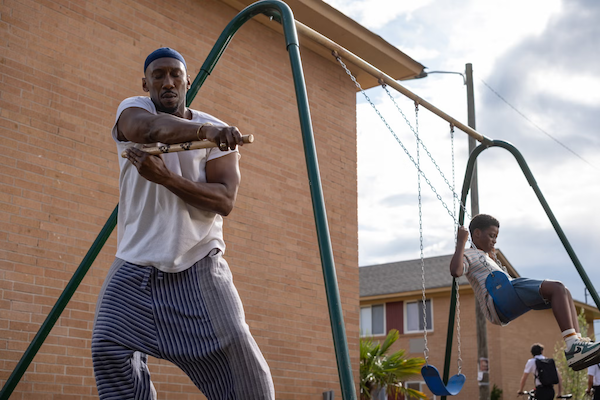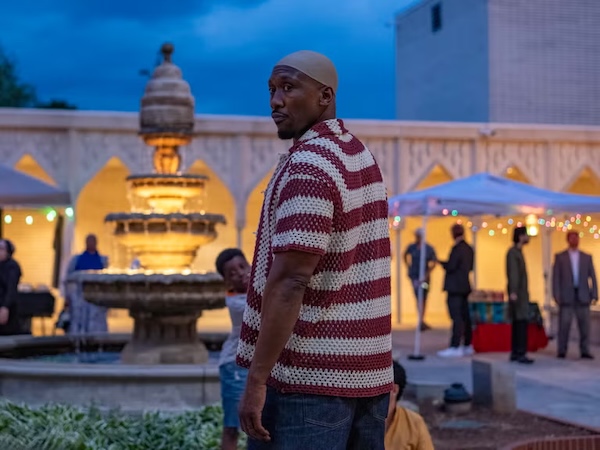
“Who deserves the best of me?” a man once asked the Prophet Muhammad. “Your mother,” came the reply. “And who next?” “Your mother.” And after that? “Your mother.” Only when the man asked a fourth time did the Prophet answer: “Your father.” This narration is a powerful lesson in faith, compassion and the importance of family. It’s also the unlikely starting point for an action thriller about a devout Muslim hitman.
In Mahershala Ali and Bassam Tariq’s electrifying new film, Your Mother Your Mother Your Mother, Ali plays Latif, a religious man whose faith sits uneasily alongside his less pious profession: contract killing. When his wife suddenly dies, Latif is left a widower with three children—including a hungry newborn in need of breast milk. What follows is a desperate, blood-soaked odyssey across Texas to protect and provide for his family, as his own spiritual foundation begins to crumble beneath him.
“If I’d said no, I would have lived to regret it,” Ali tells me with a bright smile. We meet on a Saturday afternoon to discuss the film, and he exudes an effortlessly cool aura in orange-tinted glasses, a twinkling nose stud and a tailored brown jacket. There's a familiar warmth and calm to him, even as he discusses the challenge of playing a man who wields a blade with one hand and cradles an infant in the other. “What you think doesn't go together, or is in conflict, Bassam found a way to weave together in a way that makes sense.”
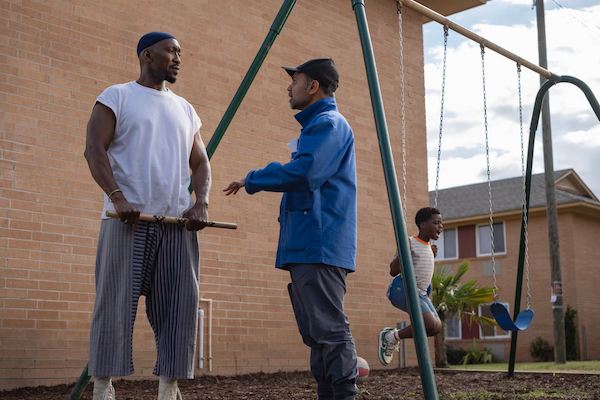
The film marks a reunion for Tariq and Ali, who first bonded over their ill-fated efforts on Marvel’s stalled Blade reboot. But here, the pair have switched gears completely, turning to an unexpectedly soulful exploration of grace, grief and the messy contradictions of faith in the modern world. From Qur’an verses recited between billows of vape smoke to blood-stained holy books, it was precisely the film’s contradictions that made the role so appealing to Ali.
“As an actor, you're always looking to surprise yourself with stories that have breadth and dexterity,” he shares, leaning in. “Here, you can't just play just one thing. You have to show up and offer up a certain type of range, and that was exciting to me.” That energy was made possible by Ali’s shorthand with Tariq, who penned the script inspired by a near-tragedy in his own life: the hospitalisation of his wife after the birth of their son.
Long-time friends and collaborators, the two share a creative trust that allowed them to navigate the film’s tonal shifts with ease—from visceral, John Woo-inflected action to moments of childlike comedy and familial tenderness. “He's so earnest and passionate,” Ali says of the writer-director, smiling. “There's a real purity behind his joy, his interest, and his curiosity around filmmaking. He wants you to trust him because he wants to take care of that trust as well.”
On set, that environment fostered a rare sense of community. “It's only the second set I've been on where you could just easily excuse yourself to go make prayer and it was understood,” Ali notes. “People would ask, ‘Where's Bassam?’ ‘Oh, Bassam's praying real quick.’ Being able to be yourself openly and to practice with no explanation behind it.”
"There's so much diversity within the faith, and that can get really sanitised once you start trying to please people."
That lack of explanation is also the beating heart of Your Mother Your Mother Your Mother. At a time when Muslim representation on screen remains a rarity—or is often confined to the tropes of taxi drivers and terrorists—the film refuses to get caught up in the specifics. Arabic greetings are spoken without translation, religious references are left unexplained, and Sufi gatherings unfold without becoming an exotic spectacle. “You can trust that the audience is smart enough to connect to the things that are very human,” Ali reflects. “People understand grief, trauma, justice. What you don't understand is okay.”
While representation is monumental, it can also be an unspoken yet burdensome tax for minorities on screen. When I ask if he felt that pressure stepping into Latif’s shoes, Ali doesn’t hesitate. “To be honest with you, I try not to,” he shares. To explain why, he traces the intersections of his identities that have required a lifetime of hypervigilance.
“Growing up as a Black man in the form that I am in America—meaning I'm 6'2", and I've been 6'2" since I was 14 years old—you move through the world differently. You figure out how to clothe yourself so that you're not reacted to in fear, so there aren't assumptions of guilt because of how the world is trained and propagandised to react to you. You begin to quietly defend and humanise yourself. That's exhausting.”
“Then you convert to Islam,” he continues, referencing his adoption of the faith at the age of 26. “Then, 9/11 happens, and your whole life is this argument or statement around your humanity. So, then you've got to ask yourself, ‘Well, who are you trying to convince? Who are you centring? Who are you performing for, right?’ Part of me wants to reject that, especially at this stage. I just want to play human beings.”
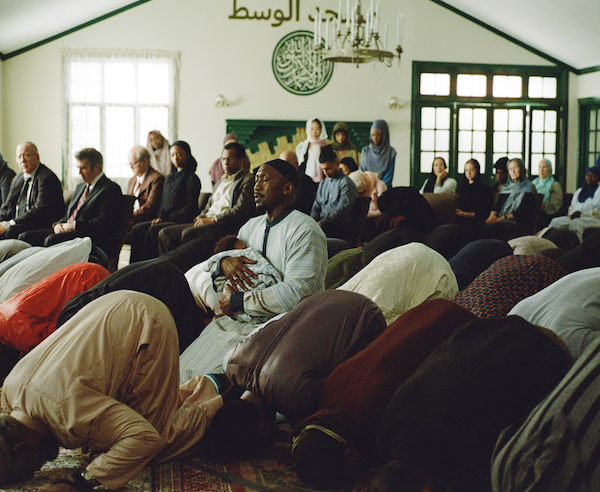
But Ali still recognises the weight of storytelling for underserved and often vilified communities. “Muslims watch movies, and Muslims are accustomed to not seeing themselves. When they do see themselves, they're accustomed to not being fully human or fully realised. So, I get the desire for our community—and communities within it – to want to see itself portrayed accurately. But, the catch around that is that we're not a monolith as a faith. There's so much diversity within the faith, and that can get really sanitised once you start trying to please people. There’s all this pressure to make sure that we continue to show how safe and peaceful we really are. For me as an artist, it can just get tiresome.”
Instead, Your Mother Your Mother Your Mother leans into the grey, and by not trying to represent an entire community, it does so with nuance and care often unafforded to Muslim stories. The film also sees the paradoxes of faith tested to their limit, and it’s a tug-of-war that Ali knows well. “I'm sure that there are people who have achieved that stage where they're happy with their Creator and their Creator is happy with them. I don't think I'm there yet; I've got a way to go,” he smiles. “When I look at our story, there's so much grace for Latif. I think the film itself is sort of a larger statement about God's patience, grace, and mercy around allowing someone to go through a whole journey without necessarily reprimanding them. It allows that character to come out on the other side of it being better for it.”
Since the film debuted on the festival circuit and in the US before making its way to British cinemas, the response has caught even its leading man off guard. It hasn’t just been adrenaline junkies praising the blade-wielding choreography or viewers celebrating the cultural specificity. “I've heard a couple of people tell me that they want to be better people as a result of it,” Ali says. “It was people across faiths and none thinking about how they relate to God and wanting to be deeper in their practice. People are being really gratified by the journey that they went on in seeing the film.”
"I want to tell stories that sit with people. I want to do lasting material."
As he looks ahead—with a second season of the HBO crime drama Task alongside Mark Ruffalo, and a new, unannounced project on the horizon—Ali remains guided by the same compass that led him to Latif. Hollywood may still struggle to know what to do with a leading man who refuses to fit neatly into a single box, a reality shown by his years spent waiting in development purgatory on franchises that never materialised. Ali, however, is no longer interested in waiting for a call and is focused on making the call himself.
“I really want to tell unique stories,” he says. “I really want to be involved in things that humanise characters that we just have yet to see on screen. I would love to find who we should land that camera on. I want to tell stories that sit with people, where the next day they're still thinking and reflecting, and feel like they need to see them again because they want to re-experience something that they felt or share it with somebody else. I want to do lasting material.”
In Your Mother Your Mother Your Mother, Mahershala Ali delivers precisely that: a bruising, tender and unapologetic portrait of a flawed yet complex man who refuses to sit in a box—much like the actor himself, who is clearly now wielding a stronger blade than the one that passed him by.