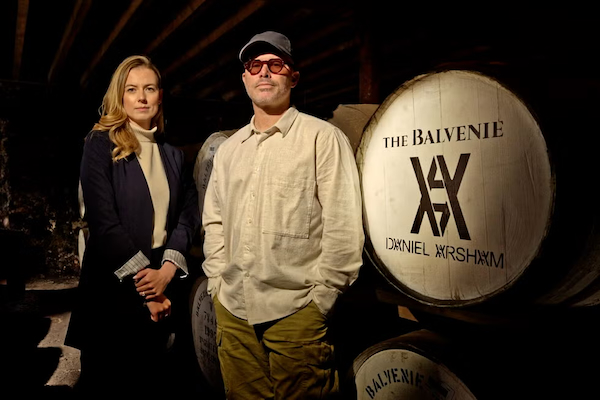
The late May morning sun doesn’t mitigate the chill in the Scottish air as I step into a warehouse numbered 24. Inside, the temperature drops another 10 degrees. It’s appropriately moody for a dunnage built a century ago; particulate drifts through sparse beams of light, the aroma of whisky-soaked oak sits heavy, and wooden stairs creak underfoot as I climb to the second floor. Here stands The Balvenie’s malt master, Kelsey McKechnie, lit by a pin light. Beside her, the artist Daniel Arsham is washed in the same pale hue. A short, mysterious video plays, scored to a crescendo that would not be out of place in a Hans Zimmer film. Once it ends, servers approach from the rear of the warehouse, each balancing a tray of fluted drams.
The theatrics are warranted. I’m about to taste the oldest Scotch whisky ever released for sale: The Balvenie 88.
Several houses have battled for the title of “oldest Scotch.” Just last year, Gordon & MacPhail bottled a whisky from The Glenlivet that was aged for a 85 years, setting a benchmark that displaced The Macallan's 84-year-old from its 2024 Time:Space collection.
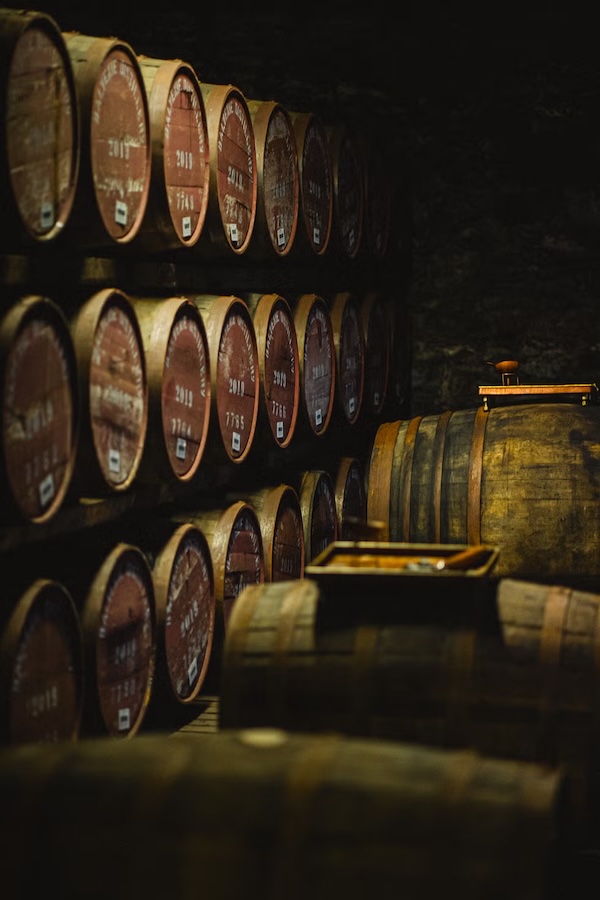
Now we have The Balvenie 88, which was distilled way back in 1931. At the time, Scotland was two years into a Depression that was gutting its core industries; many distilleries shuttered or ran on skeleton crews. Those at The Balvenie who poured new-make spirit into a cask numbered 239 on 5 March, 1931, had ample reason to doubt there would ever be a market for what they were laying down. Yet cask 239 spent decades of its dunnage life innocuously maturing with other casks, McKechnie tells me. Only a handful of workers were aware of its destiny.
“It takes a lot of foresight and flexibility to be able to hold onto casks this long,” she says.
After nearly eight decades, the whisky left cask 239, a large sherry butt, and was moved into a smaller cask for its final 10 years of aging. When it turned 88 in 2019, the liquid was transferred into glass vessels where it resided for seven more years until the distillery decided the time was right to release it.
The Balvenie 88 was bottled at 86.4 proof, “the perfect balance between the flavour of the spirit and cask,” McKechnie says. When I finally take a sip, I’m not surprised to find the whisky transcendent. The nose opens on honey, melon, and hay. Behind them, green apple and toffee awaken, old oak arises from underneath, and a floral lift runs over the top. On the palate, I taste sweetness and salinity before warm leather and oxidised, sherried oak take over. A light pop of peat blossoms mid-palate then fades quickly back into honey. The finish carries petrichor and moss and a honey-nut-cereal note that outlasts everything else. What’s most surprising is how fresh and bright the liquid is. It’s jammy and juicy. The age is detectable, though it's never overly tannic. It drinks with a vibrancy that the 85-year-old Glenlivet did not possess when I tried it.
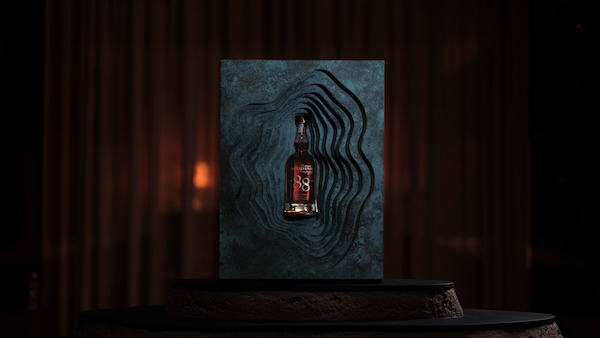
Such a beautiful liquid demands a beautiful presentation. The whisky is housed in a traditional hand-blown, gold-gilded crystal decanter, which fits into a sculpture designed by Arsham. He layered on eight tiers of hand-patinated bronze, one per decade, an homage to the oxidation he saw creeping across the copper stills while touring the facility. The back side features 88 layers of oak, and the bottle sits on a copper disc culled from a decommissioned distillery still.
Odds are low you’ll encounter The Balvenie 88 in the wild. Only 17 bottles exist, and most have sold to collectors at an undisclosed price. There’s no extra liquid, either. McKechnie has just one 50 millilitre sample bottle for herself—and only half is left.
Thankfully, the team is bringing a bit of its magic to a wider market through two sister releases, a 12-year and a 15-year. The Balvenie 1931 Collection 12-year was rested for six months in bodega sherry and is bottled at 95 proof. The whisky gives notes of sweet cereal with toffee and honey following and light spice through the middle; sherry shines at the edges without taking over. The Balvenie 1931 Collection 15-year—95.6 proof—is a one-time travel retail exclusive. That extra three years of ageing pushed the expression toward candied territory, with a warming toffee and caramel depth the 12-year doesn’t have.
As for The Balvenie 88, it’s unclear how long it will remain the world’s oldest Scotch. Would The Balvenie team only release something as special as this if they knew they could best it?
“We always aspire to compete with ourselves,” McKechnie says. “I want to continue to release older and older whiskies if the flavour’s right.”
Which begs the question: Is there a 100-year cask secretly mingling in a warehouse somewhere?
“I already asked her that,” says Arsham. “She wouldn’t tell me, either.”
“Maybe I’ll see you in five years,” she says with a smile.