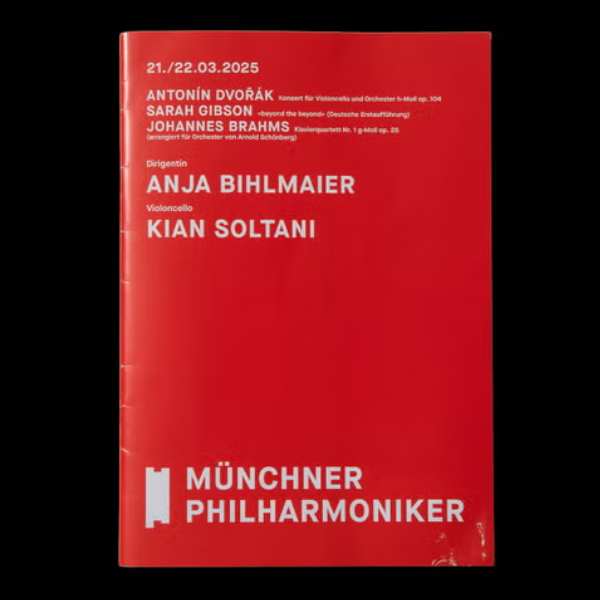
Antonín Dvořák died on May 1, 1904, in Prague.
Johannes Brahms died on April 3, 1897, in Vienna.
These facts can be found near the beginning and end, respectively, of the programme for two March concerts by the Munich Philharmonic Orchestra last year. I can’t imagine anyone outside of the most die-hard classical-music academics caring much about those facts.
In the middle of the programme, it was printed that Sarah Gibson died on July 14, 2024, in Los Angeles.
This is not a fact. This is a memory.
When I woke up, I turned in bed to find Sarah breathing but unresponsive. The people at the hospice service had warned us this day was coming, and now it was here, earlier than anyone anticipated. I squeezed her hand and then walked out onto our porch—painted Hockney blue, flooded with sunlight, the main reason we bought the house—and called the hospice hotline. “This is the final stage,” said the woman who answered the phone, empathy in her voice. “It may take as long as a few days.”
I began a rotation with Sarah’s parents, who were already there with us, making sure that someone was always with her and that someone was always with our ten-month-old son. They would cover the first two shifts.
I took the dog for a walk, trying to feel anything other than emptiness. The world felt like painted cardboard, the summer air like static. A dream that’s overwhelming and mundane at the same time.
One year before, Sarah and I were decorating a nursery for our first child. Her pregnancy was healthy, and we had no reason to suspect that she had an illness of any kind, and certainly not colon cancer that was spreading to her liver. By the time it was caught and diagnosed—ten days after our son was born—it was stage 4.
We tried not to panic. By coincidence, I’d had testicular cancer early in our relationship, years before, and while the treatment had been brutal, we now figured we knew what to expect. We had been through the fire of my chemotherapy and surgeries and came out on the other side stronger. We could do it again.
We thought we could. We really did.
The moment I stepped over the threshold back into our home with the dog, I heard Sarah’s father shouting her name. His booming voice was all ache, all plea. I ran to the bed we’d shared for ten years, and she was gone. My wife, who hated chocolate and loved throwing parties. The mother of my child, who vowed to make sure that he was raised with kindness, curiosity, and lots of silliness. My best friend, who knew every way to make me laugh.
Sarah was at USC when we met, working toward her master’s in music composition. After we married, in 2014, she earned her doctorate. As a composer and performer, she built a steady career, which became a booming career. She won prizes and commissions from renowned orchestras.
The rewards were never as interesting to her as the process, though. She loved collaborating so much that she cofounded a piano duo, and together they commissioned more than a hundred new works. Her favourite place in the world was a rehearsal, whether it was with her duo partner, Thomas, in our garage-turned-studio, or with an orchestra practising her work in a 5,000-seat hall.
In late 2022, Sarah got the biggest break of her career: She was commissioned by the BBC to write an orchestra piece to be premiered at the Proms in London’s Royal Albert Hall. When she called to tell me, I let out a whoop sound that confused my coworkers. But Sarah was hesitant and wanted advice. We were enduring the stresses of IVF, plus she was already feeling overwhelmed by other deadlines. She deferred the commission for a 2024 premiere.
And with that, she got to work on the last piece of music she would ever write.
By the time she was conceiving the sound world and structure of the piece, she was in the middle of her pregnancy. A significant portion of the work, though, came after our son was born and after her diagnosis. As the chemo cycles began, a friend and mentor sent her a supportive email, and in it was a line musing that the dual challenges of cancer treatment and newborn care must be “beyond the beyond.”
“That’s my title,” Sarah said to me. “Don’t you think?”
She kept composing. Surgeries were scheduled and cancelled, clinical trials denied. She struggled with flagging energy and writer’s block and the mental fog of chemo-brain. When Thomas, a brilliant composer in his own right, told her he’d help her complete the piece so she could focus on her health, we were so overcome by the gesture—and the sense of relief—that we cried into each other’s shoulders.
But hope started to flicker. The day before Memorial Day, I took her to the ER with severe abdominal pain. We didn’t leave for 16 days. Halfway through, a pain-management doctor pulled me aside and explained that it was time to start thinking about two mutually exclusive paths: treatment or comfort. And when he said, “If it was my wife...” he didn’t have to finish the sentence. I knew what he was telling me. She could suffer or she could not suffer; the end would be the same.
Sarah’s body started to vanish in front of me. Nurses taught me how to feed her through an IV. Her “elephant sister” friends flew in from England, Pennsylvania, Nebraska, Seattle to watch The Sound of Music together and say goodbye. In those last weeks, she set “beyond the beyond” aside. She was about 90 percent done and entrusted Thomas with her wishes for its completion. But when I gently urged her to relay her wishes for everything else, she couldn’t find her voice.
I tried, consistently, to understand what was going on in her mind, but Sarah barely spoke to me at the end. It’s a painful mystery I live with every day. Was it too hard for her, emotionally, to talk to me? Was she afraid of provoking grief in me that she didn’t want to see? Or was my timing just always bad, making attempts to connect with her when she was most exhausted? I still have no idea, and it wrecks me. She filled my life with so much music. At the end, all I could hear was an enigmatic silence.
Itook an Uber from an underground Bavarian restaurant in downtown Munich to the concert hall at the south edge of town. I had met up with Sarah’s family earlier that day so that we could attend the German premiere—only the second performance ever—of “beyond the beyond.”
The voices that had been murmuring in my head for months began to speak clearly.
This is the last time you’ll ever hear new Sarah Gibson music, said one.
This is the end of something.
This piece will encapsulate the most terrible moments of your life, said the most brutal. After all, wasn’t that what “beyond the beyond” referred to?
Sarah’s piece would be first after intermission, which meant that I had a lengthy Dvořák cello concerto during which to centre myself. But I didn’t centre myself. I seesawed between emotional detachment and a sadomasochistic tendency to relive her final days, hoping it might make me feel all the right things when the music started.
Did I not owe myself some peace? Did I not owe her an unbridled, showy grief? I’d force myself to focus on the cello soloist’s performance, switching my brain into a calm, analytical mode. Moments later, I’d feel guilty that I was thinking about anything other than Sarah, and I’d imagine her in the hospital bed, tapping on her iPad at the software she used when composing. Too long on that mental image, though, and I’d realise I was holding my breath, only to try to recover without gasping louder than the music onstage.
When “beyond the beyond” finally began, it opened with the whole orchestra playing together, an ethereal burst before families of instruments jumped in with flurries of colour. It didn’t sound like suffering at all. It sounded like a call from the edge of the universe, rife with tension but defined more by its reassuring beauty.
I should have known this. Sarah had played me a rough version of the piece once, using her composing software. She had told me that part of the work was inspired by humming to our newborn son when she rocked him to sleep. That it is part lullaby, part reflection. She had prepared me. But grief often yields a thick Sharpie, striking out segments of memories like redacted files.
The music—my wife’s wondrous, playful music—pulled me out of myself. I stopped projecting misery onto the composition. Instead, I tried to savour it, appreciating every single note. Sarah didn’t know she was going to die when she wrote most of “beyond the beyond,” but it now seemed undeniable that it was a message from a soul at peace.
Or, if not peace—I have a tough time conceding that there’s true peace in any of this—it at least sounds like the work of someone wrestling with acceptance. I hear in it a courage that, perhaps, she was never quite able to articulate in any other way, a courage I still struggle to find in myself.
Comfort was one of the last things I expected to find in that concert hall in Munich. And yet, after so many failed attempts to get Sarah to talk to me, here was her voice. Not an answer to my painful mystery, exactly, but a salve nonetheless. It was beyond space, beyond time, and beyond life, but finally, here it was, in my ear after far too long, telling me not to forget who she always was.