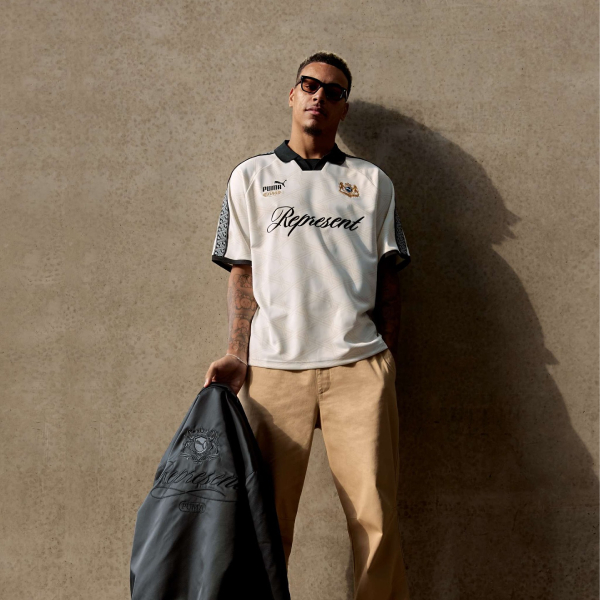
In 2011, brothers George and Michael Heaton started their clothing brand Represent out of their dad’s shed in Horwich in Greater Manchester. What began as a college project selling simple logo T-shirts has become one of the fastest-growing companies in the country, turning over £100 million in 2024. That’s not to mention the bricks-and-mortar locations they’ve opened in Manchester, London and Los Angeles. We spoke to George about what he’s learnt along the way
I was 18 when we launched Represent. There was a streetwear boom at the time; brands like Obey and Diamond Supply were on the rise. Stüssy and other US labels were becoming a much bigger thing in the UK. I was looking at what was coming out of the West Coast of America and wondering if we could do that with our own designs.
I found a print house in Cardiff in Wales. They had blank T-shirts from manufacturers such as Gildan and American Apparel. I just printed 25 of them with a box logo that said “Represent”—I came up with the name as part of a college project.
I fell in love with the process. I was learning things every single day. I didn’t know how long it would last or what we’d end up becoming.
Almost from the start, we decided to dress people from head to toe. I think that set us apart, because anyone could start a website and sell T-shirts—but we sold denim, custom fits and custom fabrics, even footwear. And although a lot of those silhouettes didn’t work, and a lot of things didn’t sell at all, it still gave the illusion that we were a much bigger brand than we were. We didn’t look like a bedroom brand. Soon, wholesale retailers wanted to get on board, including Harvey Nichols, Selfridges and Harrods. I was at Salford University for the first three years—we made around half a million in revenue in that time.
We struck a bit of luck, because Instagram had just launched. We learnt how it worked and posted our content on there. It’s about finding your voice, whether that’s through the product or the captions or a social-media post. So long as it’s authentic to who you are.
We have made costly mistakes. Early on, we put a shoe online—a crepe-soled slip-on boot—and we sold 300 in under a minute. I thought, “[Huh], we’re onto something here.” I went and had one thousand more made and they sold out in a minute, too. Then we ordered 3,000 of them in three more colourways—and that’s when all the suede on the tongues started ripping apart as people put them on. It was a bit of a disaster. We had to bring every single one back. I learnt that you can’t just reorder with a line sheet—you have to go and do the quality control and check the fabrics. Be on the line when they’re getting made, otherwise you don’t know what you’re going to get. You’ve got to get in the details.
Don’t go crazy over-ordering things. Some pieces have been bestsellers for years, and others only have a six-month lifespan.
When I wake up, I respond to Instagram DMs from customers. They come first. For us to go and design and create things that aren’t driven by what the customer is asking for would be stupid.
From 2017 to 2020, we were really stagnant. We chased trends and we were trying to be a runway brand. We did fashion shows in Milan and Paris and put on these big events that showed our collections six months before they went online. We lost touch with our consumer—that guy in our DMs. There was a big moment in 2019 when we realised we were bored of just sitting in one place and doing the same thing. We moved production to Portugal and decided to launch collections on a weekly cadence like Supreme, but at a luxury level. We stopped the fashion shows and really polished up our e-commerce. Soon, the growth of the company was snowballing.
When we went into Covid in 2020, my brother and I established ourselves as influencers for Represent on social media. People were coming to us with questions, asking about designs and how to build their own brands. I thought: “Why don’t we just leverage ourselves?” That was our massive growth moment—and it came at no cost at all. You’ve got to figure out if you want to be a spokesperson for your brand. Are you going to put yourself at the forefront? I recorded myself for two years before we even put anything out. You want to put your personality out there—but what if people don’t like it? They’re going to stop buying your brand. If you’ve already got a customer base, that could be detrimental. Now we have a YouTube channel for our behind-the-scenes video series, while our Instagram is like a daily diary. You can get success either way. I’ve got extremely successful friends who are behind brands and no one knows who they are. But you’ve got to choose your lane and not just dip your toe into it randomly.
It still hurts today when you launch something and it doesn’t take off. There are a lot of people relying on you in the business, all working hardon a new release. But you can’t take it personally. You have to move on to the next opportunity.
I’m not great with people. When we started growing massively, I had an opportunity to bring in a CEO. I wanted to try and distance myself from being a leader. I can do the hiring and firing, but I prefer to put my energy into creative. Design and content—that’s what I’m best at.
I was restricting the growth of the company because I wasn’t hiring the right leadership team. Even though I’d read all the books about business, there aren’t many that tell you how to strategise a team and how to build an actual fashion brand. Our new CEO had worked at Nike, adidas and Puma, and he grew our team from 25to 100 in 18 months. The brand absolutely exploded. I wasn’t hiring enough people in general. I tried to keep things super tight in the early years. I think we probably would have grown so much more if I had let go of that a bit.
I get so much clarity from running. That’s where my inspiration comes from. Me and Michael came up with the idea for the 247 pant on one of our first ever runs, and it became our bestselling product. You can’t fake a fast runner. It takes years and years to run a marathon under a certain time. You can apply that to business: you can’t just get from zero to a hundred in six months and expect it to work and not crash. You have got to do the legwork.
Ultimately, you shouldn’t make things because you think they’re trending. If this is going to be a brand you’re going to have for the next decade or two or five, you need to love the product.