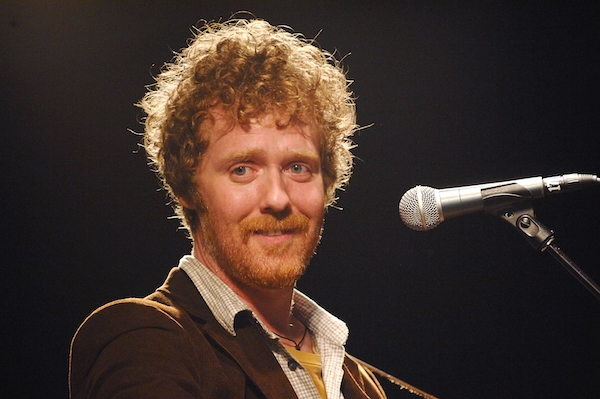
Having a guitar is like having a key to the world.” This is what Glen Hansard told me, sitting on the beach in Santa Monica many, many years ago. It was only one part of a bigger philosophy that guided who he was, and who he became. At the end of this tribute, you’ll see where he puts a fine point on the lesson, but before that I want to tell the full story of how he learned it.
As a journalist, I followed the John Carney-directed movie Once all the way from its Sundance roots to its indie blockbuster rollout, and onward to the Oscars, where it won the best song award for “Falling Slowly.” We had many interviews over that time, and when I learned today that Hansard had died at the age of 56 in a motorcycle crash, I felt my heart break. I went back to look at our talk on the beach from long ago, which broke it all over again.
This particular conversation happened in the summer of 2007, when Once was just beginning to catch on as a sleeper hit. The world needs more love stories, then and now, and Once is among the greatest ever made. It also helped turn Hansard into a kind of patron saint for buskers.
“It’s an amazing way to get to know a town,” Hansard went on. “You take out a guitar on any street in any city in the world and start playing, you’re going to end up at some party, you’re going to end up in someone’s apartment, you’re going to end up in some bar.” Through Once, his guitar really was about to open up the world in a more profound way than he could have imagined.
“Being out on the street, everyone is equal,” Hansard said. “You’re at the bottom rung, but one step above begging. You’ve completely humbled yourself because you’re not in any way a rock star. Your currency is at zero. But also your debt is at zero. So nobody can either judge you or slag you. It’s a great honour being a street musician.”
In Once, Hansard starred as one such Dublin street performer who develops a halting, gentle romance with a Czech pianist, played by Markéta Irglová. In real life, they performed together as the folk-rock duo the Swell Season, and working so intimately over time led to an actual romance. Hansard had been a working musician for years, having played with Carney in their band the Frames, but in his younger years he had also been a busker, playing his heart out on street corners as he made his way here and there.
It helped Once to have two true romantics as the leads, and Hansard was undeniably that. He poured his heart out in every song, no matter how many times he had played it. He felt things deeply, and he made everyone who heard him feel the same. Irglová was no less of a powerhouse performer than he was, but she acknowledged being more introverted. (In our interview, she seldom spoke up.) Hansard, who had a carnival barker’s enthusiasm, helped to draw her out.
Their personal romance did not last, but their musical partnership did. Irglová went on to marry Icelandic music producer Sturla Míó Þórisson, with whom she has three children and found success as a solo performer. But in 2022, she and Hansard reunited for a series of performances as the Swell Season. She said it was like no time had passed.
“One thing that did change, [was] when we’re on a stage together now, for the first time I perceived us as equals,” she told The Irish Times. “Glen had always treated me as an equal on stage. He always trusted me a lot and gave me a lot of credit for our collaboration, and he always spoke about me in a way that I didn’t see myself.”
The characters in Once didn’t end up together forever either, but the power of that movie is that they both came away from their connection inexorably stronger. That echoed in real life. “Throughout the years, when I had to become a little bit more independent musically, I did grow an inner strength and trust in myself,” Irglová told the newspaper. “So now, when we join each other on stage, I feel like that, too: ‘Okay, now we’re equals and we’re both bringing something to the table which makes this more than each of us are on our own.’”
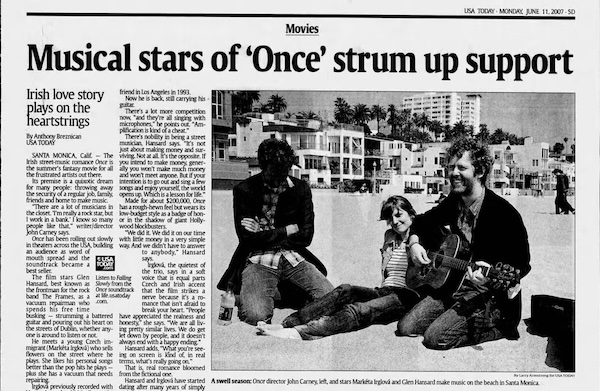
Years before, when he, Irglová, and Carney sat with me on that California beach—a whole world away from both Ireland and the Czech Republic—it was natural that our conversation turned to how far music can take you. That’s when Hansard made the remark about what a guitar can unlock in a foreign land. But it also opened up even more distant memories.
Hansard had been to this sunny California beach when he was in his early twenties. “I busked here in ’94 and ’93. I stayed in Santa Monica for about two months and I played in some café. I can’t remember the name of it. They were really kind. They gave me a spot. I came over here, just hanging out with a friend of mine who’s a DJ. I came busking every day here.”
The street performers were out in full force again on the day we visited. Various guitarists up and down the promenade strummed and sang soulfully, rappers amped up the crowd with hip-hop numbers, a preacher waved his Bible as he barked at passersby, and there was even someone offering mystical guidance from two “Psychic Cats” dressed in miniature fortune-teller costumes. Even they could not have predicted what was about to happen for the Once performers.
The street musician who actually caught their attention that day was a man in a grey fedora, singing at the top of his lungs into a portable mic as a boombox played the Frank Sinatra hit “That’s Life.” It wasn’t necessarily their style of music, but Hansard, Irglová, and Carney recognised the passion in the streetside crooner. “He really thinks he’s in the Sands Hotel in 1965,” Carney said. He began to sing along.
About eight months after that day on the sandy sidewalks of Santa Monica, Hansard and Irglová were back in LA, this time at the Academy Awards, where “Falling Slowly,” their most hauntingly beautiful song from Once, was up for best original song. During awards season, I saw them at a Fox Searchlight awards-season bash, where they stood on a tabletop and sang live for the crowd.
At the Academy Award rehearsals for their telecast performance, I was reunited with the duo again. Over the months, Once had helped them amass stories of meeting some of their musical heroes, and Hansard told me the pinnacle was getting to talk to Bob Dylan, although he struggled with what he should say to the legend. While shaking Dylan’s hand, Hansard said he told him, “This feels to me the way you must have felt meeting Woody Guthrie.” You can imagine that struck a chord with Dylan.
On the night of the Hollywood ceremony, Hansard and Irglová walked the red carpet together. He carried his battered six-string in a green guitar case marked with stickers from their travels. That guitar really had been a key to the world, and now it was leading them to the Oscar stage.
After John Travolta presented the pair with the award, Hansard told the audience: “We never thought we’d come into a room like this and be in front of you people.” His face red with excitement, he begged people at home: “Make art... make art.” After he stepped from the mic, Irglová walked up and said only a brief thank-you before turning away. But the room didn’t hear even that. The mic had been cut, and the orchestra drowned out her words.
As the pair walked behind the curtain with their trophies, Irglová was nonetheless all smiles. Hansard, however, was hopping with excitement. I was covering the ceremony from the wings of the stage, and Hansard slung an arm around my shoulder, clutching the Oscar just inches from my face as his phone agitated in his jacket pocket. He pulled it out and showed me the message: “A congrats message from Bono!” he said.
That’s when Jon Stewart stopped them on their way to the press room. He was apologetic. “They were going to let you say something,” Stewart told Irglová. “But they cut you off by mistake.” To make it right, the producers were going to do something unprecedented in Oscar history. When the show returned from its commercial break, they would send her back onstage to finish her remarks.
Irglová played along, but was taken aback. She had only ever intended to say a quick “thank you.” Now she had to figure out something more to say. Stewart guided them (with me in tow) to a small holding area at stage left, where he waited with them while the commercials finished airing. Hansard lightened Irglová’s nerves by making his Oscar kiss hers.
When the music rose and Stewart beckoned her onstage, Irglová’s improvised speech turned out to be even more eloquent and moving than even she expected. She spoke from the heart about every other artist like them who struggles to be heard or seen. Her message was simple: Don’t give up. “No matter how far out your dreams are, it’s possible,” she said. “Fair play to those who dare to dream.”
What was striking about Irglová and Hansard is that they could perform powerfully in the world’s biggest spotlight, but they also found the joy in standing on a tabletop to sing, and they never forgot what it was like to play for only one person, or maybe nobody at all, while standing on a sidewalk. That was the idea that guided who he was.
“It’s an amazing life being a street musician,” Hansard told me that day in Santa Monica. “It’s not just about making money and surviving. Not at all—it’s the opposite. It’s a complete wonderland, depending on your intentions. If you intend to make money, generally you won’t make much money and won’t meet anyone. But if your intention is to go out and sing a few songs and enjoy yourself, the world opens up. Which is a lesson for life.”
This was something included in the original draft but cut from my old story. I thought it was worth remembering him with it now.