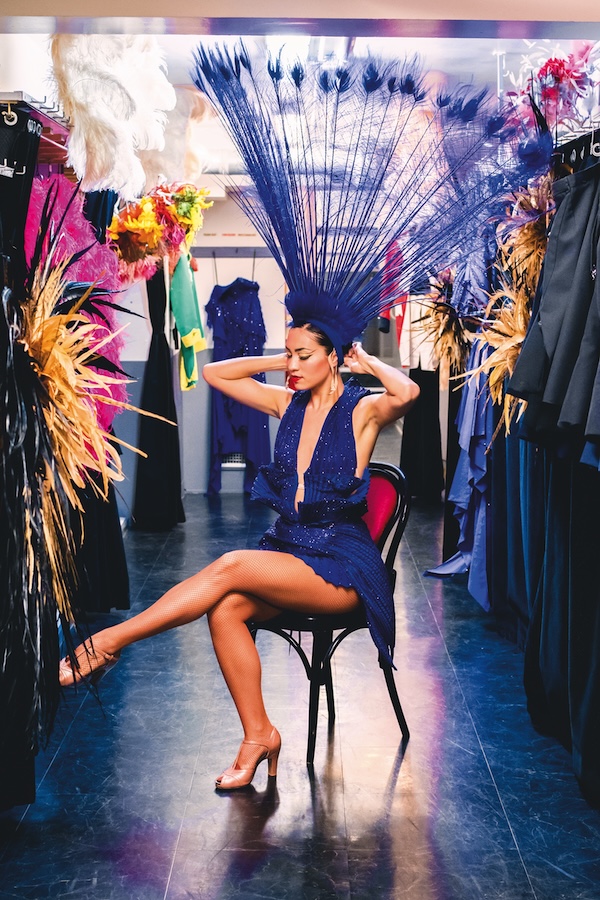
“I’ve been known to do my make-up in 10 minutes,” chuckles Victoria Chavez-Harrington. It’s saying something, because this is no ordinary make-up—it’s thick and stylised, high glam designed to be seen from the back of the 1,500-seater Paris Lido. She’s backstage, getting ready for the first of two performances at the acclaimed cabaret nightspot. It’s one of the city’s last few remaining alongside the famed likes of Moulin Rouge and Crazy Horse, with Folies Bergere and Casino de Paris long having switched to more mainstream theatre.
Indeed, the make-up is most of her preparation. As one of the Bluebell Girls, Chavez-Harrington may work her way through a dizzying number of spectacular costumes with each performance—some of which, with military precision, she has some 45 seconds to change into between numbers—but many of those costumes cover very little. They’re all intricate sequins, feathers and G-strings, colour and pizzazz. The Bluebells, after all, belong to that very French showgirl tradition of dancing topless. “That’s never bothered me. Being a Bluebell is to be part of dance history now,” says Chavez-Harrington, who trained in classical dance but, at 1.78m, soon grew too tall for the likes of ballet. “You become part of developing a massive show that will be talked about by future Bluebell Girls in 50 years’ time.”
The Bluebell Girls are all tall. In fact, it’s a requirement. If, in other lines of work, rejecting job applicants on the grounds of a physical shortcoming would contravene some employment law, if you’re not at least 1.75m, count yourself out as a Bluebell Girl. The need to meet a certain physical standard has always been the case, ever since the no-nonsense Irishwoman Margaret Kelly founded her dance troupe around 1932—working various theatres before coming to rest at the Lido on Paris’s most famous street, the Champs-Élysées, soon after World War Two. Aside from their professional bona fides and meeting a height criterion, wannabe-Bluebells also tend to have a similar look about them: these days that means pretty, with the athletic, gym-honed physique of the 21st-century dancer, and similar proportions to each other so as to create, as it were, a uniform front. As George Perry noted in Bluebell, his 1986 biography of Margaret Kelly: “If [a Bluebell Girl does wish to bare them] her breasts must be firm, round and attractive, not pendulous or minuscule, considerations which the girls readily accept.”
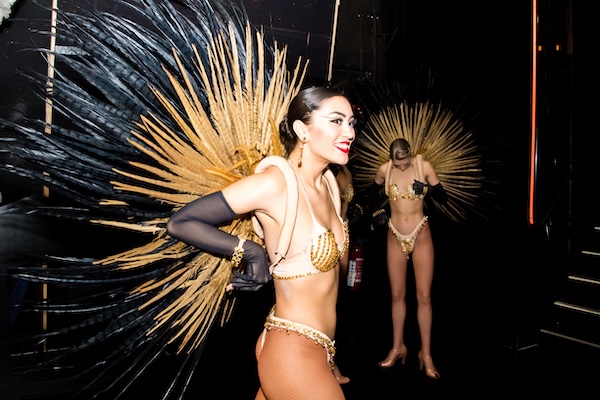
Breasts, in part, shape the tone of the show. “Well,” as the Bluebell Girls’ current ballet mistress (and one-time Bluebell Girl herself) Jane Sansby puts it, “if you’re topless you can hardly jump up and roll around—suddenly it doesn’t look very elegant. And there has to be a certain elegance to a Bluebell Girl, a femininity in face and body—the right silhouette. We know it when we see it. It’s about meeting that French image of the femme.”
This year marks an incredible 70 years at the Lido; incredible, in part, because their routines—exactingly choreographed, but more stately than high-energy, a kind of cat-walking with high kicks—belong to a bygone age of light entertainment for which, one imagines, there might be diminishing demand; incredible too, because it’s hard to imagine that the thrill of seeing half-naked showgirls on stage—roughly half of the Bluebells appear so in any one routine—hasn’t long been superseded by easy access to much harder stuff.
It wasn’t always thus, of course. In more prim times, one reason Kelly is said to have insisted that her troupe be comprised of only English girls—in 2019 there are 14 nationalities represented among the Bluebells—was because the French still had a deeply entrenched taboo against putting daughters on the stage. When, in 1947, Christian Dior introduced the New Look—with ankle-length hemlines—suddenly the bare and shapely legs of the Lido girls became an even more prized attraction.
But in the age of online pornography, the bubble might have burst; and that’s before consideration of its appropriateness in a rightly more feminist world, all the more so given the recent Me Too movement. Small wonder then that the show has recently undergone a €12 million facelift, with big LED backdrops, video projections, fountains and skating rinks that rise up through the stage devised by Cirque du Soleil director Franco Dragone, costumes styled by Nicolas Vaudelet (who dressed Madonna for Jean-Paul Gaultier) and a dialling down of the make-up and the outlandish headdresses so that the girls are more empowered, more natural individuals and less pancaked fembots. “There was a time when you couldn’t see a showgirl’s hair—there would always be some kind of feather or a big diamond on it,” laughs Sansby. But such small changes matter. Certainly, the subtle shift has caused something of a scandal in the French cabaret world, says Sansby.
“But modernising the show was the only thing we could do,” argues Herve Duperret, one-time hotelier but for the last decade the Lido’s general manager. “We can’t be fashionable but can be one step ahead. Most of the clientele want the classic Lido show—the feathers and all that—but now they want it with a twist of modern.”
In part that’s because cabaret hasn’t moved on for a long time. Striptease probably originated in Paris, in the music halls of Montmartre. In tableaux vivants, the performers posed stiffly as figures in re-enacted famous paintings, with plenty of simulated nudity. The first exposed female breast was seen on the stage of Folies Bergere in 1907 and belonged to the writer Colette, recently celebrated in the Kiera Knightley movie. Year by year, the undraped female form became more a part of ever more elaborate shows, encouraged by periodicals such as La Vie Parisienne, whose main artist, Raphael Kirchner, effectively invented the pin-up.
By the 1920s, some nudity—in the context of sumptuous costumes and sets—was more the norm than the exception, with then, as now, the girls divided into mannequins nues (nude models) and mannequin habillees (dressed mannequins). But, as Perry notes, the management was always “at pains to assure the world that they were all nice girls—their morals were carefully checked [and] even casual flirtations within the theatre were ruthlessly suppressed”. Parisian cabaret soon grew into a dazzling display of light, movement, sound and bosoms, but hardly advanced for the rest of the century.
But this new twist of modern is also necessary because, from a business perspective—and the new show has to run for at least six years to move into profit—Duperret is keen for the Lido to reach more than tourists; while half the audience is still French, most Parisians don’t go precisely because they see it as a touristic thing to do. Yet it’s also because this kind of cabaret is such a uniquely French tradition that many of them feel like they’ve seen it before.
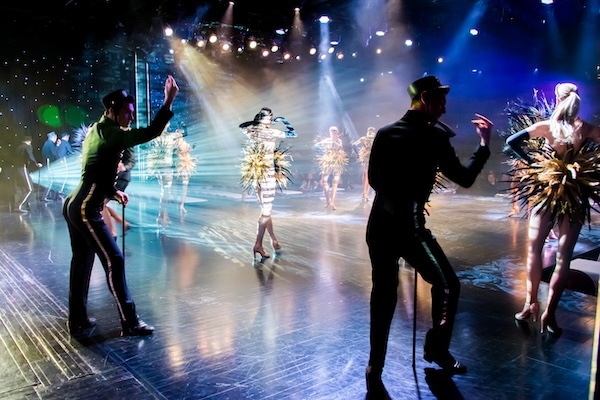
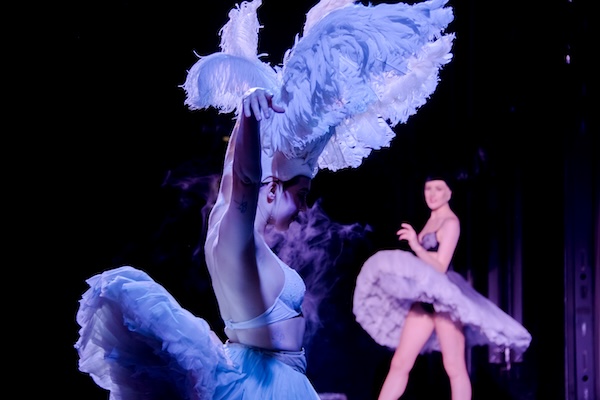
“In a lot of places in France ‘cabaret’ means two or three girls on stage doing the cancan,” explains Duperret. “Clients want more than that old image suggests you might get. They don’t want just some kind of nice catwalk show with girls who smile a lot. We need different cabaret styles like we need different forms of gastronomy in restaurants. They all serve good food, but they need to have a different feel about them. We have the attractions [the special acts between the dance numbers, from world-class contortionists and conjurors to mime artists] but we couldn’t have the Lido without the Bluebell girls. They’re part of what the Lido is. But they have to move on too.”
So, given the update, why not do away with the bare breasts? It’s hard to articulate why, concedes Sansby, but it’s simply an essential part of a specific kind of act that is an ingrained aspect of French culture. And that’s whatever the social climate, even one that has, for example, seen the UK’s The Sun newspaper do away with its topless "page three" model. And last year, Formula One stopped using scantily-clad "grid girls" to pose in front of the cars before races—a step which itself followed the Professional Darts Corporation’s decision (under pressure from TV broadcasters) to no longer use "walk-on girls".
“As a Bluebell Girl you don’t have to be in the topless line, though a lot of the dancers do both topless and dressed dances. Some don’t want to do it in much the same way as they wouldn’t want to go topless on a beach, though plenty of French women would do that,” explains Sansby, who has to work her way through some 500 desperately keen young women at each of the biannual auditions to join the Bluebell family. “The fact is that in Paris it still has a place because [toplessness is part of] what cabaret is here. Would nudity like that survive in other countries? No, it wouldn’t. But I don’t think we get people coming here to see the nude dancers anymore, they come to see the spectacle of the Lido. It’s not as though you get a wham-bam-boom kind of show, in terms of nudity.”
Certainly, once the typical audience member’s initial awareness of the nudity passes, the bare breasts cease to arouse any specific attention. They are, as it were, part of the proverbial furniture. “A lot of women still come to see the show not entirely sure what to expect and unsure about the nudity, but end up not even noticing it,” as Bluebell Girl Samantha Vastine suggests. “The nudity is all just part of the overall fantasy.”
Yes, it’s still a little odd, since this is no striptease. The new show is sassy rather than sexual, exotic rather than erotic—despite being loosely framed around the story of an uptight nerdy secretary type who gets to find her inner va-va-voom—but there the breasts are all the same. Certainly, compared to the deliberately provocative attitude of burlesque—another old-time entertainment to have found renewed fashionability over the last 15 years—it’s all pretty tame. One can hardly imagine getting as worked up over it as, say, Kelly’s mother, who inked over any of the naked breasts in the programmes her daughter sent home. And, of course, for the more recent phase of the Bluebell Girls’ history there have been the suitably buff Kelly Boys in support.
“Men and women come to the show. Men like to look at the girls, of course, but naturally women like to see the Kelly Boys. So these days there’s an equal opportunity in who you choose to look at,” laughs Sansby. “But this isn’t about the trashy side of life. It’s a more artistic vision. You have to remember that there is a prestigious way of doing [cabaret]. In fact, I think we’ve created a new template for French cabaret. There’s a freshness to it now.”
Might, because of this, the Lido’s shows be more a contemporary honouring of the female figure—adorned or unadorned—than our on-tap, over-sexualised world typically allows, in a way that’s tasteful and graceful rather than, as Vastine calls it, “that degrading, very graphic portrayal of women you get in pornography”? Might the survival of this theatrical art form, having once titillated, now in a way be a reminder of more innocent, flirtatious rather than full-on times?
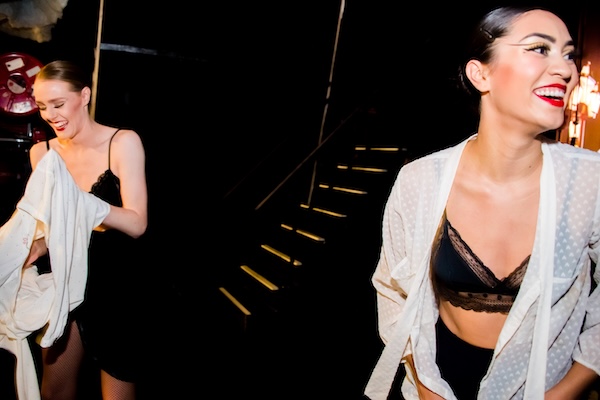
“The nudity is just expected. In fact, it’s upholding a tradition,” says Chavez-Harrington, as she puts the finishing touches to her dramatic eyeshadow and starts to pull on her first set of spangle. “But we also live in more body-positive times, in which women are striving to become more comfortable with their bodies, and this is a celebration of that, something we’re expressing by holding these elegant lines, showing off our costume, making it all look effortless as we dance down stairs in heels and headdress, which isn’t easy. But, you know what? We’re women; we have breasts. And there’s nothing wrong in enjoying the female form."