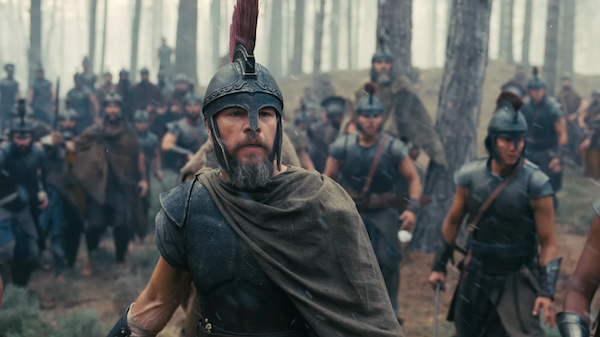
It’s difficult to actually get lost these days. The need to unfold paper maps from the glove box, scan through a spiral-bound Thomas guide, or pull over to ask a total stranger for directions has been completely erased by the smartphone (which, interestingly, Christopher Nolan says he doesn’t own). Still, anyone approximating the age of Matt Damon’s homeward-bound warrior in The Odyssey can probably relate to the old-school notion of “Wait... where on earth am I?”
But aren’t we more lost than ever in other ways? These same devices that help us get exactly where we’re going are also weapons of distraction. The minutes speed by faster when you’re doomscrolling. The vortex of TikTok’s and YouTube’s hypnotic algorithms vacuums away our days as efficiently as the black hole in Nolan’s Interstellar. Reliance on AI anesthetises our very need to think, create, and solve. We may not become physically lost anymore, but we are also seldom where we really are.
This is not to say that Nolan made The Odyssey to address the unintended consequences of cell phone addiction. That would be ridiculous. But I do believe he was seeking a way to explore the many ways human beings still struggle to make the most of what poet Mary Oliver famously described as our “one wild and precious life.” Devices are just one factor, but our best-laid plans can go astray in myriad ways. You pursue the paycheck rather than the dream and forever look back thinking of what should have been. You cling to a toxic workplace out of obligation or linger in a faltering relationship too long or succumb to the pressures and ambitions of others instead of finding and following your own path.
Damon’s Odysseus has many obstacles that delay him, but Nolan’s The Odyssey suggests his own mistakes cost him precious years of his life. Odysseus has free will in Homer’s epic poem, but he makes wrong turn after wrong turn on his journey back to Ithaca after waging war against Troy. Rather than being the passive victim of a litany of misfortune... maybe he’s stalling? Nolan makes the persuasive case for a little of both. Deeply buried regret over his life of violence and conquest may be blocking Odysseus and his men even more than the raging winds and waters of vengeful sea god Poseidon. This ancient hero is not so much lost in the world as lost to himself.
A lot can be said about the technical achievements of Nolan’s The Odyssey, but this clash between staying true to course and falling off the rails is the theme that gives their work its soul. This film represents a team of masters, all working at the peak of their powers to breathe impressive new life into this 2,800-year-old tale.
First, there’s the majesty of its IMAX scale, as immersive, mesmerising, and overpowering as it’s possible to get without being someone in real life. The earthy environments of this apocalyptic version of ancient Greece have been exquisitely manifested by production designer Ruth De Jong. Consider the eerie ambience of Hoyte van Hoytema’s cinematography, which pushes you up close with the characters without ever losing the scale of the menace that surrounds them. Ludwig Göransson’s concussive score is either perfectly mimicking your racing heart or pushing down the throttle to make it beat faster. Expert editing by Jennifer Lame ensures the audience is never sent astray, even as the story hopscotches in nonlinear fashion through time and space. The greatest compliment for the VFX created by Andrew Jackson and Scott R Fisher is that, apart from otherworldly elements like the Cyclops, the Sirens, and the witch Circe’s transforming spells, it’s hard to tell where reality ends and their work begins.
Most of The Odyssey’s behind-the-scenes artists won Oscars or were at least nominated for their work with Nolan on Oppenheimer, and it’s clear that the filmmaker and his team are among the few people alive who could take a story like this and, well... bring it home.
Film lovers can debate why Nolan has such affinity for out-of-order storytelling, but I’d argue he is fascinated by transformation, and this is a way to step back and see it in full.
At its centre is Matt Damon, who at 55 has finally shed the last remnants of his Good Will Hunting boyishness, delivering an Odysseus who is “a complicated man,” “a man skilled in all ways,” and “a man of many twists and turns,” as various Homeric translations over the years have described him. The early 1600s translation of The Odyssey by George Chapman describes the hero as a man that “many a way wound with his wisdom to his wished stay.” That’s the Renaissance way of saying “he learned things the hard way,” and Damon gives us all of this weary dimension and strength—and then some. His performance made me question whether there is dual meaning in Chapman’s wound, a reference not only to the character’s winding journey but to the bloodshed and scars Odysseus carries, both seen and not seen, as a cost of his victories.
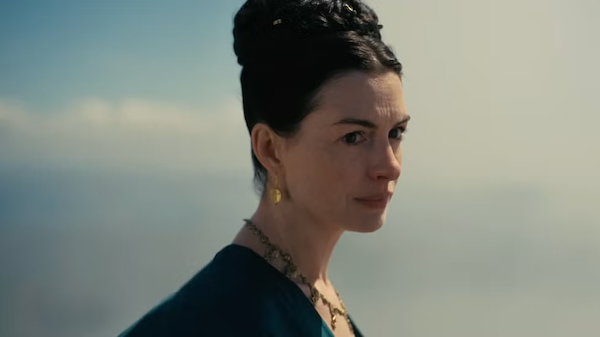
Nolan’s film, like Homer’s poem itself, shifts back and forth in time. Sometimes it even leaps into other stories. The director showcases the full telling of the Trojan-horse gambit by pulling from The Iliad and Virgil’s The Aeneid, and he simultaneously tracks the hero’s ill-fated journey home while contrasting it with the burgeoning threat that awaits him and his loved ones once he gets there. Keeping those home fires burning on Ithaca are Odysseus’ wife, Penelope, played gracefully by Anne Hathaway as a woman whose last bits of hope for her husband are literally hanging by threads, and their earnest but uncertain son, Telemachus, played by Tom Holland, who, like Damon before, still conveys the innocence of boyhood well into adulthood.
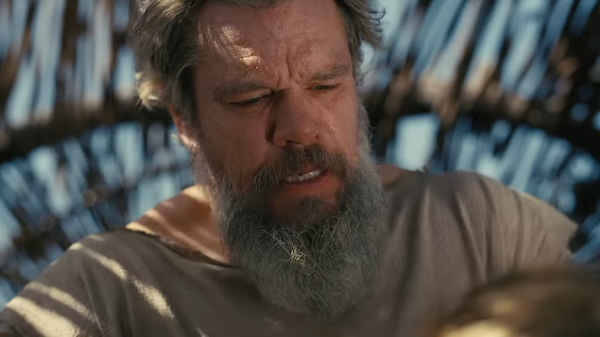
A group of “suitors” has taken over the House of Odysseus, led by Robert Pattinson’s Antinous, a shallow and scornful poser whose runaway ego and overconfidence make him believe he is capable of taking over and leading in the great man’s void. Pattinson’s sneering performance is all too familiar. While Odysseus might confront a gigantic Cyclops, Antinous is hardly picking on people his own size. He bullies Telemachus and torments Eumaeus (John Leguizamo), who was once Odysseus’s most trusted confidant but now is old and blind. We know for sure Antinous is irredeemable because he even picks on poor Argus, Odysseus’ faithful dog, who holds the key to identifying the hero upon his return.
Antinous represents the notion that if we don’t live our lives to the fullest, someone else will. Whether it’s love, opportunity, or legacy, the things we hold dear can always be taken away if neglected. He and the other suitors are merely biding their time like any scavengers, each hoping to claim Penelope’s hand out of not affection but greed. She is trying to stave them off long enough for Telemachus to mature and step into his father’s sizeable sandals, but as the years pass it seems more and more unlikely. All of this adds a ticking clock and heightened tension to the story, but Nolan is just emphasising the stakes that were already in Homer’s text.
While unrest simmers back home, Odysseus and his men wander the Mediterranean Sea, offending gods, provoking monsters, and whittling down their numbers with each stop. Standouts from this voyage are Elliot Page as Sinon, a character ported over from The Aeneid, who joins the war party as a physically small boy who is nonetheless big of heart, willing to make sacrifices that might just break yours. The Picasso-faced Cyclops is played with mournful resolve by Bill Irwin (yes, the rubber-limbed guy from the “Don’t Worry Be Happy” video), who makes the rageful character less of a fee-fi-fo-fum fiend and more of a tired workingman besieged by tiny, raiding warriors. Imagine what you would do if you came home and found a battalion of ants crawling through your kitchen or trying to claw their way into your eye as you slept. Odysseus is lucky any of them made it out of that cave in one piece.
Charlize Theron is effortlessly goddess-like as Calypso, who in the poem kept Odysseus drugged and captive on her island for most of his decade-long absence. Nolan presents her more benevolently. It feels reductive to say she becomes Odysseus’ seaside therapist, but she’s there to listen and makes sure that he hears himself too. This Calypso is more like someone who has found a wounded bird and is waiting for it to fully heal before releasing it from the cage.
Zendaya appears as Athena, who in Homer’s telling is the deus ex machina who appears to lend a helping hand when Odysseus is out of cards. In Nolan’s version, she is more ghostlike, the spectre of an ideal that he worships but has failed to live up to. Lupita Nyong’o takes on dual roles as Helen and her twin sister Clytemnestra, and her appearance is breathtaking, wonderful, but best left undescribed, since it’ll genuinely surprise audiences. (Per usual, the scorn her and Page’s castings have gotten from the ghouls of social media is ignorant in every sense of the word.)
Jon Bernthal plays Menelaus, the king of Sparta, a contemporary of Odysseus who becomes a brusque father figure to Telemachus and a source of optimism for Penelope with his assurances that Odysseus may still have the wherewithal to return. Finally, Samantha Morton steals the movie from everyone as the enchantress Circe, whose volcanic temperament is barely reined in by the mask of the feeble seaside fishwife she appears to be. Her power to transform people into animals is presented in novel fashion by Nolan, more like a sculptor or pottery spinner than spell caster.
Why does Odysseus provoke the gods, pursue pointless vengeance, and make so many wrong turns on his journey home? He is a very complicated man, as Emily Wilson’s best-selling translation of The Odyssey presents in her opening lines. Nolan seeks to untangle this by counterintuitively mixing the timeline. He told nonlinear tales to great effect in both Oppenheimer and Memento, and here it helps the audience compare and contrast the man he was, the man he can be, and the remnant he has become.
Film lovers can debate why Nolan has such affinity for out-of-order storytelling, but I’d argue he is fascinated by transformation, and this is a way to step back and see it in full. How does a brilliant scientific discovery potentially threaten the existence of all life on the planet? How responsible for the past is someone who can’t remember it?
Nolan is a man of control who wants to know where he is going, and so he maneuvers back and forth in the timeline to see it all at once. He considers the whole map of a life and invites us to do the same.
It’s a good way to measure your own journey, and Nolan’s version of The Odyssey is a kind of compass by which we can gauge the everyday in a timeless epic. By thinking about our destiny with that foresight, maybe we’ll value where we are, what we have, and what we want. And perhaps we won’t lose our way so easily.