
“When we really started doing scarves for men—I would say maybe 20 years ago with Véronique Nichanian (artistic director of Hermès’ menswear division)—we were free to do whatever we want because there wasn’t an archive for it. So we went in the direction of doing something with a touch of humour, something fun. We always think of Hermès as not joylessly serious, you know?” Christophe Goineau tells us. While Hermès may often be thought of as a pinnacle of luxury, the reputation hardly prevents it from challenging the traditional notions of luxury. The Maison’s silk creations have had much to do with cementing its playful nature.
Not unlike Nichanian, Goineau has spent most of his professional life at the Maison—close to 40 years now—honing a thorough know-how of its silk universe. He joined the Maison in 1987 at the age of 21, and eventually spent years as its men’s silk collection manager where he was tasked to develop tie collections and extend the textiles accessories collection. Goineau then became creative director of men’s silk in 2011.
Craft at Hermès is almost never a solo endeavour. Conversations are the cornerstone of every Hermès creation; while the different universes stand on their own, they also often intersect. Goineau, who works closely with Nichanian, helps add to the visual narrative she wishes to convey season after season.
Goineau informs us that the creative process of a silk scarf isn’t always linear, but can be traced down to two things. “The starting point of an Hermès silk collection is always a conversation with Véronique, because she always has a lot of ideas, wishes and desires. Then the second is, of course, the theme of the year, which is something quite important to Hermès. We have a theme each year that gives a new direction, a new way to see Hermès,” explains Goineau. This year’s theme of Drawn to Craft—one that pays homage to the art of drawing as the basis of every design at Hermès—holds significant importance for the silk universe. It’s often in silk designs that you’d be able to still see the imperfections of an artist’s hand—natural imperfections that uphold the value of human artistry.
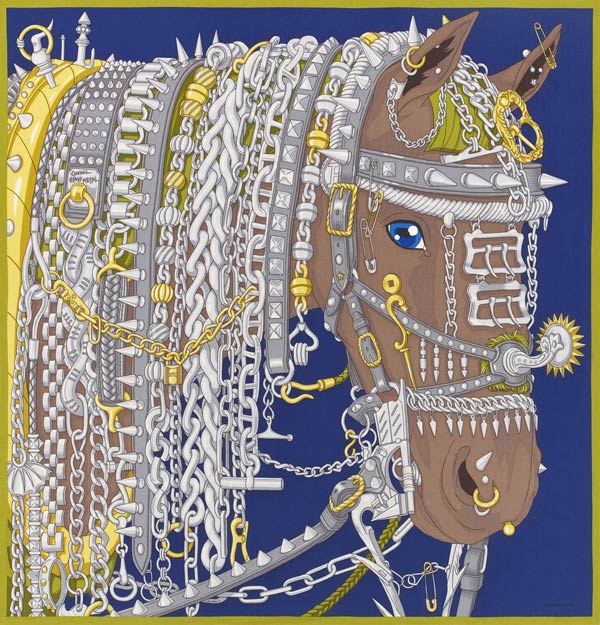
When working on a particular menswear collection, both Nichanian and Goineau would usually dig deep into what he calls the “refrigerator”—a repository of silk designs that have been created up to that moment. It’s then a process of selecting what designs would fit best, based on the rough direction of the collection. As tedious as it may sound deliberating on and choosing from what is possibly hundreds of silk designs, Goineau reveals that this process is relatively less time-consuming because there’s a collection deadline to work within.
As some of us may be familiar, Hermès enjoys doing things on its own time. You wait for a Birkin; you don’t demand for to have it presented to you at the drop of a hat. As much time as is required to craft and finesse an Hermès bag, the same ethos is applied to its commissioned silk designs. Yes, while Hermès has its own in-house design team, it regularly works with artists outside of its institutions to help tell its stories.
Part of Goineau’s role includes discovering these artists and initiating conversations with them on how they see Hermès. He explains that he would either approach artists whose works—whether seen in galleries or showcased as part of exhibitions of graduating art school students—capture his attention, or receive proposals from the artists themselves on what they could do for Hermès. Or, what he describes as being a “very Hermès way”, he would at times be taken by the work of an artist in the most unexpected, chance encounters. There are simply no artistic media that preclude one from being considered.
Early conversations with these artists are akin to a brief induction programme into the Hermès universe. “We very often explain to the artists how we work, and let them discover the Hermès archive so that they really get inside Hermès in order to enrich the Hermès universe [on] their own,” Goineau says. “This is what I’m trying to protect: to keep the artists’ points of view. Because sometimes if they try too hard to make an Hermès scarf, it turns out looking unauthentic, you know? It’s important for them to keep their style, while at the same time, think of Hermès and try to find a way to also say something.
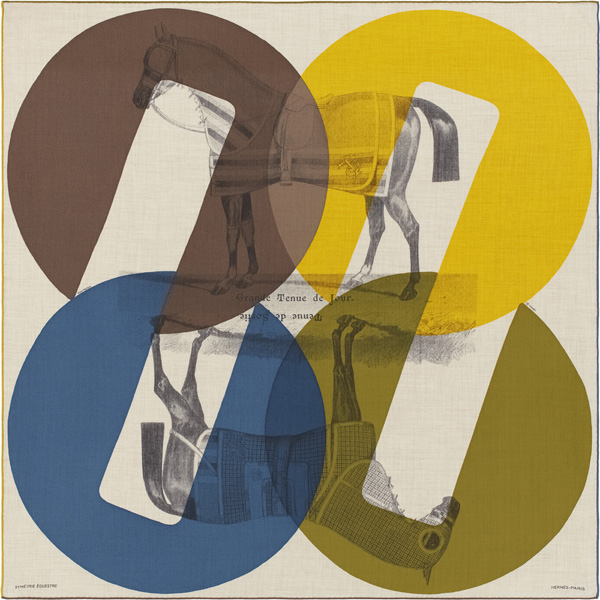
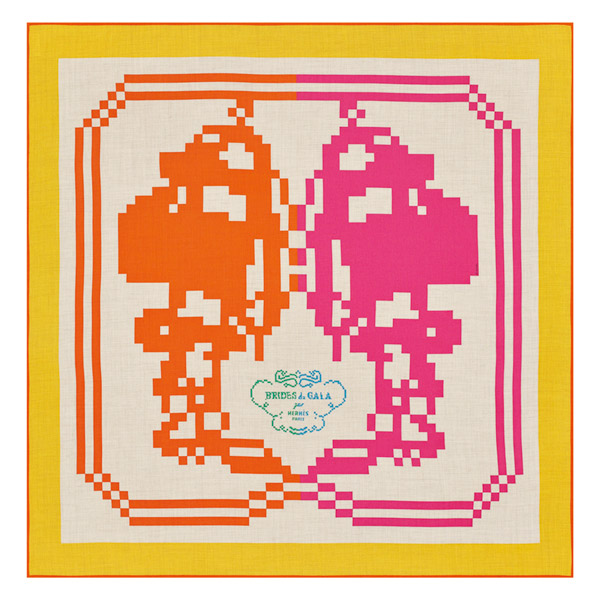
“The idea is always that during the first meeting, I’m really trying to be surprised. I won’t give the artists too much information so that they don’t feel confined. We give them free rein at first, and then after that we can fix and talk about details, composition, proportion, dynamic with the square—things like that—and then we work collaboratively. We go step by step,” he goes on to say. Goineau places utmost importance in the balance between an artist’s signature with the Maison’s codes, emphasising that neither should overshadow the other.
At the end of the day, a silk design for Hermès by an artist is a wholly original work. The Maison never buys a design of an already existing work.
You may be thinking at this point, what is the difference between a men’s scarf and that of a women’s? Goineau works on men’s silk, while his counterpart, Cécile Pesce, is the creative director of women’s silk. They are close friends and exchange ideas from time to time, but both envision their individual universes in different ways so as to each be able to embody the Hermès women and men. “What could be a men’s or a women’s scarf? I don’t really have an idea,” expresses Goineau. “The best way is to leave it to the customer to decide. This is also a very Hermès way of doing things, because if you were to ask me to do a genderless scarf, I think I won’t really know what to do, in a way. For me, I’m trying to create something that I think is quite masculine in terms of design, colour, topic and storytelling; Cécile does the same for women’s. Then we put them both in the stores, and I think Cécile and I, we are very pleased when a lady is buying a men’s scarf and when a man is buying a women’s scarf.”
This same open-ended approach translates to the boundless freedom Goineau and the artists have in formulating their designs. The creative process is free from market-specific sentiments; Goineau doesn’t have to think about coming up with specific designs for a certain market. Once a silk collection is shown to the Maison’s buyers in each market, they’re given carte blanche to select the designs that they feel will suit their customers best. This, Goineau affirms, helps to “keep a strong sense of creativity”.
Fashion being considered as a form of art may elicit debates, but none can deny that an Hermès silk scarf isn’t art. The silk carré is essentially a blank canvas that an artist uses to express emotions and tell stories. It’s no surprise then that the use of an Hermès carré as a framed artwork for display has gained traction, aside from its main intended use as a fashion accessory.
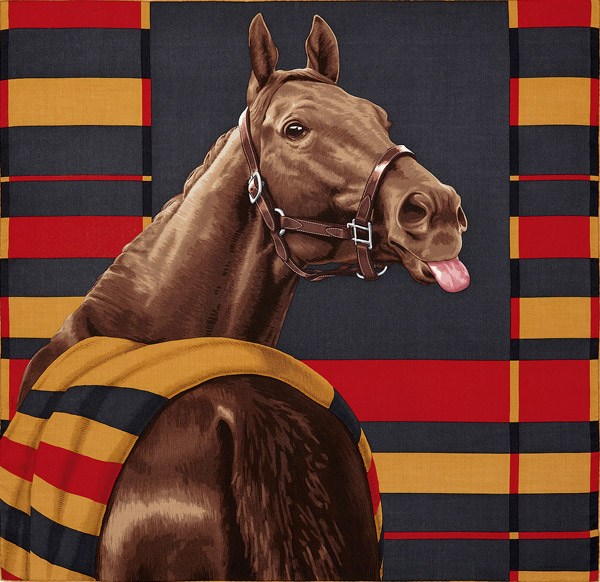
“I can understand that some of the silk designs are so beautiful that they could be framed as pieces of art. I have one in my office. [It’s framed] so that when I come into my office, it gives me joy. I love the idea. Even if I’m not doing scarves to be used expressly for that, I’m really fine with it,” Goineau says. He picks up a framed scarf with colours so vivid that it’d stop anyone in their tracks. It’s an illustration we recognise because the striking image left an impression when we first saw it during a presentation years ago. It’s the Rocabar de Rire—a 100 x 100 carré made with a blend of cashmere and silk, and designed by Paris-based artist Dimitri Rybaltchenko—featuring a horse with its tongue sticking out.
“I love this scarf because it’s a good balance between something which is… if you remove the tongue, it could be even a bit boring. But with this small detail, it’s really fun. You have all the elegance of Hermès with the horse that is so well done, so beautiful, but it’s not conventional, you know? It’s this fine line between being elegant and wearable, but trying to be on the edge,” Goineau tells us. The Rocabar de Rire captures brilliantly that quintessential essence of Hermès not taking itself too seriously, and how Goineau views the men’s silk universe as “fun” and “elegant”.
With decades of working within the hallowed, creative halls of Hermès, Goineau remains incredibly in awe of the level of passion that he finds himself surrounded with. He talks about how the artisans are more than willing to share ideas and innovations, all in the pursuit of trying to make something better, and experimenting with things that Hermès has yet to try.
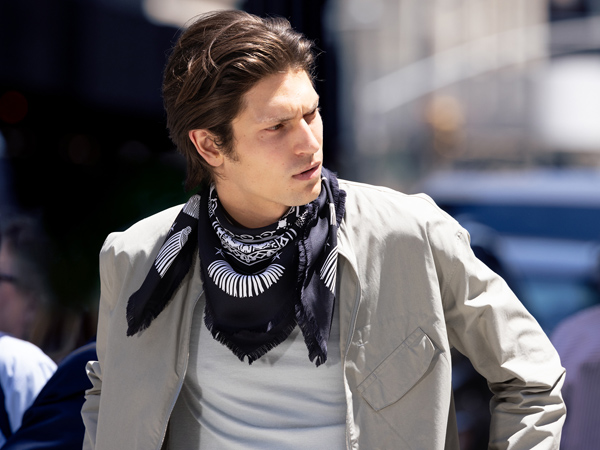
The silk universe is a uniquely important one for Hermès. It has become one of its iconic creations that holds more than mere illustrations. They are stories of unbridled artistic expressions branded under the umbrella of a luxury fashion house.
Goineau doesn’t necessarily think of the silk universe as fashion, however. He reasons, “Fashion for me is something that you have to rewrite every season—something completely different. But I think we are making carrés that you will keep for a long time. Whether it is the mix of colours, materials, and things like that, when there’s a good balance of all these elements, you’d have the same pleasure of wearing it today as you will in two years.” And isn’t that investment-worthy art?