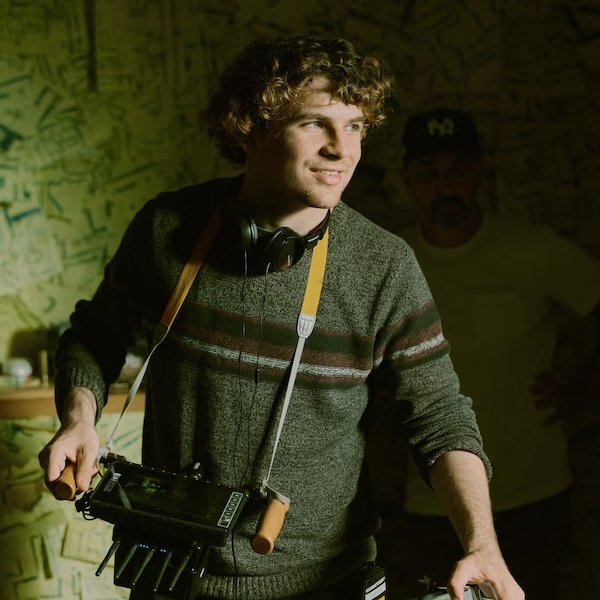
Last winter, Kane Parsons felt like his heart was ripped out of his body. It happened during a visit back home in Petaluma, California, a scenic Bay Area suburb in Sonoma County. It’s the kind of place you imagine raising a family: ocean-blue skies, verdant landscapes, an abundance of farms—“It smells like cows all the time,” Parsons says—and a walkable riverside downtown that typifies Main Street, USA. The rolling hills of “Bliss,” the default desktop wallpaper for Windows XP, are just a 15-minute drive from Parsons’s home.
But when he returned, Parsons found that his mother had broken down and removed their rotting backyard gazebo. He loved that gazebo, and he mourned it. “I have a strong attachment to inanimate buildings and structures,” Parsons tells me over Zoom. He thinks deeply—very deeply—about manmade structures. But not all buildings are so innocent. “You could look at buildings as a parasitic organism,” he says. People build them just to exist, like bees building a beehive. “Now the planet’s covered in structures that are gonna live longer than people,” he says. “The buildings are winning.”
How fitting, then, that Parsons’s first film as a Hollywood director centres on a hostile abyss of plaster and wallpaper. Backrooms, the buzzy new horror thriller from A24 set for theatres, is chiefly set inside a metamorphosing maze housing unspeakable nightmares. Adapted from Internet folklore and Parsons’s own DIY YouTube series that he made as a teenager, Backrooms is one of the most highly anticipated horror films of the year. It’s also an unprecedented task for its young creator.

Parsons, who is all of 20 years old, enters Hollywood like a glitch in the system. He’s an outsider—raised on a diet of video games, anime, and YouTube. In conversation, Parsons squeezes his origins down to “a subtle drip of many things since I was two.”
“I got access to the Internet around eight or nine,” Parsons says. “I would watch short films and be curious about the people who made the films. It was a lot of independent people who put an emphasis on the behind-the-scenes of what they do and how they do it, and I was constantly consuming that.”
Driven by a need to make fan art of his favorite games—namely Portal and Half-Life—Parsons learned how to put together visual effects using free software tools online. He completely credits, and blames, the decorated video game studio Valve with shaping his imagination. “Valve had the biggest grip on all of my creative preferences as a kid and have dictated where I’ve gone creatively over the years,” he says.
His imagination shaped some nightmares too. In one of his recurring dreams, he’s alone, exploring Aperture Science, the sinister laboratory in Portal. Parsons was only six when he learned to fear liminal spaces and entities that may not be present—the character Doug Rattmann especially. “The schizophrenic guy who would write on the walls—and was very cryptically hidden in the games—freaked me the fuck out,” he says. “There’s this wall where you can hear his voice. You don’t know if he’s dead or alive. He’s a faint Easter egg. That sound file would send me into a cold sweat if I heard it. I couldn’t be in a room alone because I got freaked out.”
During the Covid-19 pandemic, when the world took up bread making and other now-forgotten hobbies, Parsons played with the 3D creation software Blender. Even just through working on a “shitty laptop,” he soon found that his aspirations could go far beyond video game fan art. “I can make borderline photoreal stuff in an afternoon,” he says. “It’s like magic.”
In 2017, he uploaded his first short film: Sandwich. It’s a bizarre (intentionally so) 30-second video featuring Parsons, hunched like Gollum, swiping a “real sandwich” (a napkin labeled in Sharpie) from a classmate. Two years later, he uploaded Corpus Schizophrenic, a cryptic dive into the world of Portal from Doug Rattmann’s paranoid and fractured perspective. Then Parsons caught wind of something called the “Backrooms” online. Originating as a 2002 photograph of a Wisconsin hobby store amid renovations, the Internet latched on to its menacing vibes: the warm piss-yellow tint, the sparse decor, the uncanny valley where desolation and isolation meet incompleteness. After years of floating around Internet message boards as a joke, it was canonised into the Backrooms by an anonymous poster on 4chan.
“Creepypastas,” a fundamental feature of Internet folklore, are the Backrooms’ open-source DNA. No one owns the idea, and everyone contributes to it. The story evolves in blocks of text, photo captions, fake Wikis, and, yes, short films on YouTube. The Backrooms’ lore piqued Parsons’s interest. There was just something about its seemingly endless space of ever-changing rooms and hallways, accessible only by phasing through the walls like a glitching video game character.
“It would have been the week it was a meme,” the director says as he tries to recall when he first learned about the Backrooms. As much as the Internet can hard-code posts and messages to the minute, discovering a meme in the wild is still like glimpsing a ghost. “I started seeing it constantly for a couple of weeks,” he says. “I think it carried, and still does carry, this archetype of doom. Some form of annihilation that befalls people in a funny way. It’s kind of a comedically bleak death.”
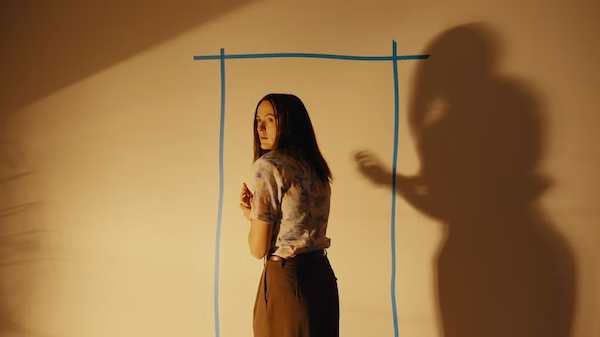
Over our hour-long conversation, Parsons zigzags through thoughts and topics as if the floors and walls really were shifting to the naked eye. Questions like “Where did you grow up?” and “What is liminal horror?” prompt him down rabbit holes. He is only 20, but he maintains the aura of somebody a decade older and wisened about the world. A strong jaw, a deep voice, a mop of curly nutmeg-brown hair all look at me through Zoom; if I saw Kane Parsons at my gym, he would not look out of place with all the other 20-somethings. Nor would he stick out in a university lecture hall, going long and being thoughtful on subjects he knows all too well in three, maybe four dimensions.
After Parsons proposes that humans are not hardwired to perceive reality beyond surviving and procreating—“We’re sitting in a sea of noise, and our brains only pick up a small sliver of what’s there,” he says—I feel sheepish trying to cover more ground. I ask him what school was like. “School was fine,” he says politely before kicking off a tangent about the insufficiencies of results-based learning in the American education system. A county-funded arts program in neighbouring Novato High essentially gave Parsons a semester’s worth of hands-on filmmaking, which complemented his very-online sensibilities. It’s now paying off.
When Kane Parsons began uploading his Backrooms shorts in 2022, he didn’t think it would attract attention. At all. By then, YouTube at large was entrenched in the new algorithm-driven paradigm. It was no longer the place for aspiring artists—it was a marketplace for content, vlogs, dance tutorials, gaming clips, and outrage podcasts. The short films that Parsons filmed at school with his buddies were not the kind of media that the algorithms rewarded. Not that he expected much for it either. “It was not serious in the sense that I had a desire and plan,” he says. “I didn’t think all the things I was putting out would stick. I assumed it would flop on YouTube.”
But he wanted to make something, engagement be damned. He crafted most of what would be the first Backrooms episode using Blender, obscuring visual shortcomings with the noisy grain of a VHS filter. (The technique effectively set the 1990s as the default period in all of Parsons’s Backrooms work, including the film.) One afternoon, he gathered classmates during lunch to help him lay the finishing touches. The footage featured a student phasing into the Backrooms through the ground. “I animated the whole thing, but I didn’t know how it was gonna start,” he tells me now. “I don’t think I even told them. I was just like, ‘Okay, I’m gonna back up and film.’ I gave basic directions. It was free-flowing. Then I slammed the phone to the ground. I still have it on my camera roll.”
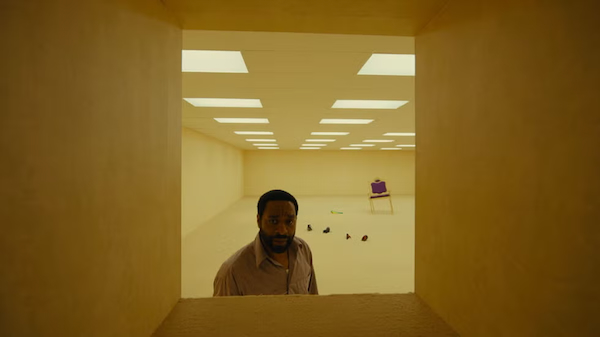
As quickly and violently as one enters the Backrooms, the Internet miraculously caught on to Parsons’s short. He expanded it into a web series, and it did gangbusters. YouTube essayists who Parsons was a fan of began dissecting his work. It enlightened him about a simple but unfathomable fact of life as an artist: It doesn’t take all that much to make art that people want to see. Beyond resources and time, “there’s technically nothing stopping you,” he says.
“When I was younger, there was this feeling that projects I looked up to were in the stratosphere... like they come from above,” says Parsons. “[But] realising that most people I treated as being in that above space are now casually aware of the thing that I did, it doesn’t feel any different than normal life. It was very calming.”
Then the time between Parsons goofing off at school and making his first film for a bona fide Hollywood studio happened in the blink of an eye. As the young director recalls, the popularity of the shorts drew the attention of James Wan’s Atomic Monster and A24. A year after Parsons uploaded his first Backrooms video, a deal was in place for Parsons to helm the feature. It was a major adjustment. For so long, Parsons had been making videos by himself, entirely on free software. Suddenly he was on a physical set—in a disorienting space where some crew members reportedly got lost while trying to navigate it—giving directions to Oscar-caliber stars like Chiwetel Ejiofor and Renate Reinsve.
But what made Parsons sweat the most was still how the Internet would respond. “I’m used to storytelling that is so online, where people are particular about details,” he says. “There’s always an underlying theory, or we connect the dots and find the hidden elements. That convinced me, subconsciously, that that’s just what you had to do to be taken seriously.”
He adds, “With every decision [we made] in the film, you weigh against this bible of information that will be checked by Reddit and Discord. If it doesn’t hold up, they’ll smell that and something will break and you can’t fix it. So I try to avoid anything accidental.” At the same time, he doesn’t believe in respecting any sort of limits either. “People accept whatever level you set yourself at,” he says. “I happened to just set myself at such a level where you know everything I’m putting on YouTube has built-in deeper levels to it. Like far, far deeper.”
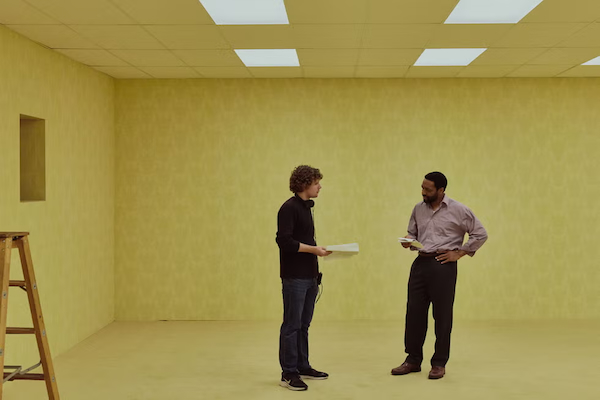
There’s still much more to explore with Backrooms—even after the movie. Parsons is forgoing a formal college experience to keep making films, which he hopes will include more Backrooms. As far as he’s concerned, making movies is his higher education. “There’s a lot more with Backrooms that I’m very optimistic we’ll get to explore. There’s absolutely more in the chamber, and that’s always been the plan. This film’s a good foot in the door with general audiences,” he says.
But of course, he’s still learning. At his age, Parsons is still coming to terms with what it means to make and break, to create and destroy. At the end of principal photography on Backrooms, during which he spent months inside a space he first birthed in Blender and then raised with various department heads, actors, and director of photography Jeremy Cox, it was an emotional experience tearing his own building down. He thought back to his childhood gazebo. “It was like looking at my child, and it was very sentimental,” the director admits.
On the final day of production, Parsons solemnly walked among the corpses.
“I don’t know what wires are crossed wrong in my brain, but they feel like people,” Parsons says. They feel alive.