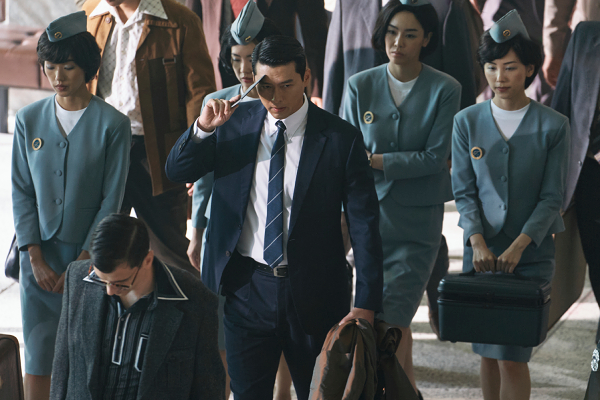
The 1970s in South Korea were a period of immense pressure, where much of the nation's future was forged behind the scenes—backrooms and secret coups, the works. Made in Korea, a Disney+ original series, sets out to capture that volatility, weaving a gripping fictional narrative with real modern Korean history.
The story centres around a Korean Central Intelligence Agency operative who secretly runs smuggling and illicit business networks to build power and wealth. Hyun Bin sheds his classic romantic lead image to portray the ruthlessly ambitious Baek Kitae. Enter Jang Geonyoung, a dogged public prosecutor who risks everything to expose government corruption, including Kitae’s secret operations. Played by Jung Woo Sung, their prolonged clash serves as the engine that powers the series’ explosive tension.
Esquire Singapore speaks with both men tasked with bringing this premise to life, joined by Roh Jaewon, who plays Pyo Hak-su, and Woo Dohwan, who portrays Baek Ki-hyun. The following pages will depict the actors speak candidly about what drew them to the script, the negotiations between ambition and vulnerability that shaped their characters, and the trust required to spar (sometimes literally) with one another on set.
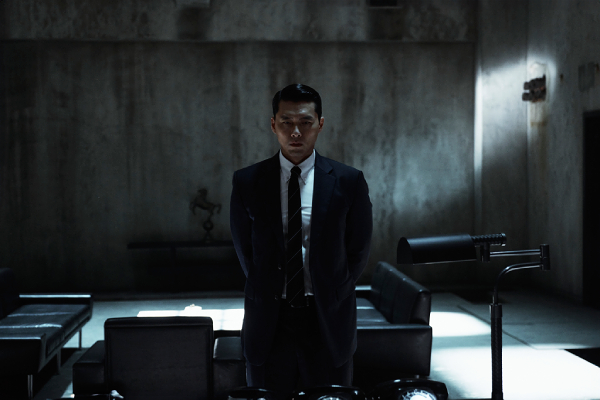
ESQUIRE SINGAPORE: What did you think of the Made in Korea script when you first read it?
HYUN BIN: I found it incredibly engaging. I was also fascinated by how each episode features a major historical event as the backdrop and spins various stories around it. Each character felt fully alive as well. I thoroughly enjoyed reading the script, and each episode felt like a movie in and of itself.
ESQ: How do you feel about starring in your first original series made for a global streaming platform, and how different is Made in Korea from your previous works?
HB: I'm incredibly thrilled to be able to reach viewers around the world through a streaming service. My previous film, Harbin, dealt with a painful part of Korean history, and portraying a historical figure from that period brought a lot of sense of responsibility and pressure with it. This series felt like a chance to break away from that and take on a fresh challenge. I'm looking forward to audiences seeing a side of me that they've never seen before. Baek Kitae is an incredibly charming character and uses this ability to further his ends.
ESQ: What did you focus on when portraying Kitae, and what drew you to him in the first place?
HB: I always look for something different whenever I choose a project, whether it's the story or the character I'm meant to portray. I'm always looking to offer something different to audiences. I was really drawn to how open Kitae is about his ambitions. It's very different from a lot of the characters I've played before.
ESQ: What did you discuss most about Kitae when working with Director Woo?
HB: One of the things we kept coming back to after working together on Harbin was "let's have fun with this". With Kitae, I could really shake off the weight of my previous role and have fun with the character. I had a lot of flexibility to create different elements of Kitae, and that really helped Director Woo have fun on set.
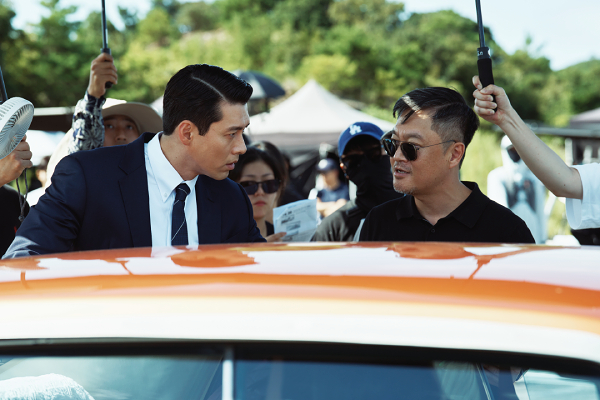
ESQ: What was it like to work with Director Woo Minho after collaborating with him on Harbin?
HB: Harbin carried a lot of weight, and it was incredibly challenging for both of us. Seeing how Director Woo led such a difficult project and having worked with him through that process, I have a tremendous amount of trust in him. I know how he works on set and how he runs a project from start to finish, which gives me an infinite amount of confidence in what he can do. I have faith that, whatever direction he gives and whatever situation comes up, the outcome will be strong. It gives me an immense sense of assurance and ease.
ESQ: Your character finds themselves in a prolonged struggle with Jung Woosung's character. What was it like working with him?
HB: Woosung and I have known each other outside of work, but this was our first real project working together. He knows how to make everyone feel comfortable on set, and he is incredibly kind.
As someone more junior, and his counterpart on set, I really appreciate that. He also comes up with a lot of ideas that makes the experience so much more enjoyable.
ESQ: You also performed with actors Cho Yeojeong, Woo Dohwan, Won Jian, Jung Sungil, Kang Gilwoo, Roh Jaewon, and Park Yongwoo. What was it like to work with them?
HB: All of these actors share something in common, they always come to set fully inhabiting their respective characters. Whenever I faced them as Baek Kitae, I felt thrilled to see the characters I imagined when reading the script fully brought to life by these actors. They made working on set incredibly fun.
ESQ: What in your mind is the highlight of the series that audiences should look forward to?
HB: First of all, this series spans such a wide range of genres—it feels like a political drama, but it shifts to a psychological thriller, or an action noir. I think being able to enjoy such a wide variety of genres in a single series is one of the many appeals of Made in Korea. It's also a great character-driven drama with a fantastic storyline. Each character feels so alive, and I think that's one of the greatest strengths of the series.
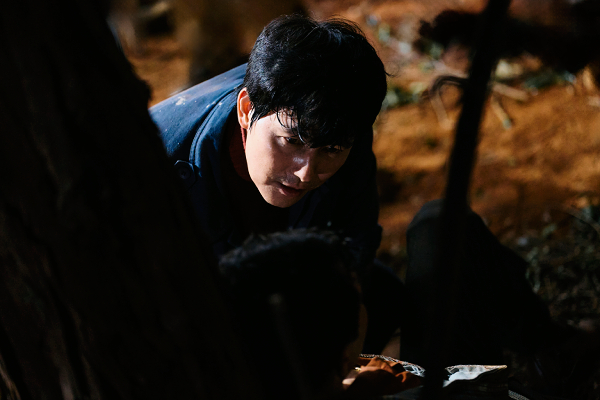
ESQUIRE SINGAPORE: What did you think of the Made in Korea script when you first read it?
JUNG WOO SUNG: I was surprised! Jang Geonyoung—an incredibly strong-willed and unbreakable person who stands in stark contrast with Hyun Bin's character, Baek Kitae—didn't quite match my real age. The story's universe, the tension between the characters, and the way that the script weaves fictional characters into historical events to create something entirely new was all very intriguing.
I could tell it was going to be a great series and felt that it would be successful. But as an actor, taking on the role of Jang Geonyoung felt a little daunting. I wasn't sure if I was the right age to play the character, and I shared this concern with the director. Director Woo saw in me the kind of resilience and humanity he wanted to see in Jang Geonyoung when we briefly worked together for my special appearance in Harbin. Eventually, Jang Geonyoung was revised and became a more seasoned, stubborn prosecutor who gets transferred from one district office to another with no interest in promotion.
ESQ: What was your focus when playing Jang Geonyoung?
JWS: Every person grows up with someone who has a profound influence on their upbringing and life.
For some, that influential figure imparts warmth, humanity, and love, but for others, that figure might leave behind deep emotional scars and insecurity. We often find that figure within our own family, and I think for Jang Geonyoung, that figure was his father, someone whose influence he probably wishes he could erase from his life. His father's influence always follows Jang Geonyoung around, propelling him to think about what he must strive towards as a prosecutor.
ESQ: What did you discuss most with Director Woo in regards to your character?
JWS: As we read the script, the director realised he wanted to add Jang Geonyoung's hearty, boisterous laughter throughout the series. For me, the laughter had to make sense rather than being conveyed as something out of the blue. I think that directional note made it easier for me to shape the character into someone more human.
ESQ: Your character finds themselves in a prolonged struggle with Hyun Bin's character. What was it like working with him?
JWS: They frequently clash with each other, and in certain genres this tension is created through very careful coordination between the actors—with Baek Kitae that wasn't the case. Kitae is polished and moulded to fit within the tightly regulated power structure of the era. People like him are disturbed by people who don't align with the system they live in. So, I didn't feel the need for a very measured approach to pre-calculate the chemistry. In fact, I deliberately used improvised movements, reactions, and my tone of voice to make Hyun Bin's character feel unsettled.
ESQ: You also performed with Seo Eunsoo-what was it like to work with her?
JWS: Oh Yejin is someone who follows Jang Geonyoung closely. The characters' dynamic was actually in line with our dynamic as actors on set. When we first filmed scenes where the two characters chase Kang Daeil, it was hectic. During rehearsals, I would ad-lib certain lines that felt true to Jang Geonyoung and suggested ideas to her. Then, once we started shooting, she would absorb these ideas and transform them into something uniquely hers—something distinctly Oh Yejin. Eunsoo was great to work with on set and I always looked forward to our scenes together.
ESQ: What in your mind is the highlight of the series that audiences should look forward to?
JWS: Audiences find satisfaction in different elements—it could be the visual elements, the narrative, or the characters. I think this series satisfies all of these elements. Made in Korea blends real-life events with fictional characters, making them feel like they were real people who shaped and drove major events that left permanent marks on Korea's history. I think viewers will enjoy the experience of discovering what actually happened during the 1970s in this fictional story.

ESQUIRE SINGAPORE: What was your first reaction when you read the script?
WOO DOHWAN: I was so eager to be a part of this project. It had an amazing script and I also wanted the opportunity to work with the director and the other members of the cast. When I first read the script, I thought it was going to be a challenging project to film. The emotional shifts were very dramatic, and I wondered how the series would recreate the era on screen.
I had to do a lot of preparation for the role because it was my first time working on a series set in a different era, and my first time playing a military officer. I was equal parts excited and nervous about the role.
ESQ: Can you tell us about your character Baek Ki-hyun, and what your biggest focus was when portraying him?
WD: Ki-hyun is an elite military officer who graduated at the top of his class from the Korea Military Academy. As Baek Kitae's younger brother, he admires Kitae, but at the same time, he very much wants to break out of his older brother's shadow. He grew up being called "Kitae's little brother," which undermined his self-esteem very much. Because of this, he wants to prove himself and achieve his ambitions without relying on Kitae.
What drew me to Ki-hyun was his loneliness. When I first discussed the character with Director Woo I told him that I saw Ki-hyun as being very lonely, and the director agreed. I've played many characters who suffer from loneliness, and so I felt compelled to take on the role and explore how I could best portray this emotion.
ESQ: You and Hyun Bin portray a relationship marked by mutual affection but that also carries a huge amount of tension. How was it working with Hyun Bin on these scenes?
WD: I always have a great time working with him. He always makes me feel at ease when we're working on set, and he's such a gentleman that I always find myself inspired by him while acting alongside him. After a take, he sometimes suggests, "Perhaps it might be better to try it this way?" and I give it a shot and discuss it with the director.
There's no right or wrong. It's simply about exploring different approaches, and allowing the director to decide what works best. We exchanged a lot of ideas and had conversations that elevated each scene. He's given me so much support. I always feel like we're truly working as one.
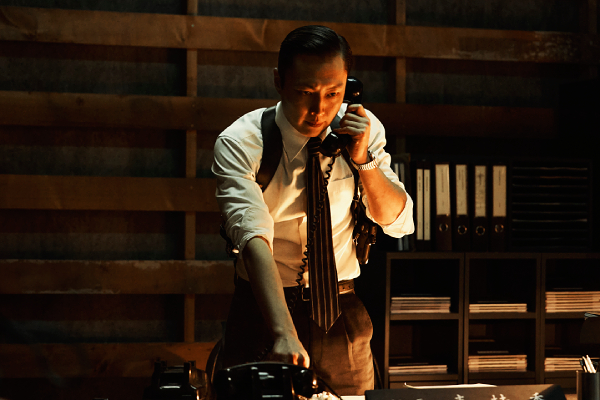
ESQ: What made you choose to play Pyo Hak-su, someone who can quickly read situations and adapt to shifting power dynamics? And how did you approach this role?
RJ: I took on this project because of the story itself and the director. As for my character, I saw him as someone driven by self-interest and as being hard to decipher. When preparing for this role and building this character, I approached him as someone who thinks, "I have something more valuable than you. I'm also smarter and more powerful than you."
ESQ: How did you prepare for the role as a KCIA agent? Were there any reference materials you looked into?
RJ: I watched many films set in that era and asked my parents and grandmother a lot of questions about what the period was like. I also researched how intelligence agencies work in other countries. Above all, I wanted to bring something uniquely my own to the role, so I tried not to confine my interpretation of the character to the KCIA aspect.
ESQ: What aspect of your character did you wrestle with the most?
RJ: Pyo Hak-su is someone who understands the dynamics between people very well. He's like a chameleon, adjusting how he behaves depending on who he's dealing with. What stood out to me while filming was building his relationship with the character Baek Kitae.
Since they are peers, Pyo Hak-su sees himself as equal to or even superior to Baek Kitae. Given that mindset, I thought that if Kitae started showcasing that he is better than Pyo Hak-su, a lot of jealousy and envy would kick in. On set, I portrayed my character with the mindset that he must always win, no matter what.
ESQ: What was the most memorable scene or behind-the-scenes moment on set?
RJ: Our first shoot was in Japan, and it was also my first time being in the country. I felt pretty intimidated, and everything felt very unfamiliar. After filming a close-up, the director called "cut" and walked over. He said, "It's not bad, but feels a little ordinary. Do you have anything uniquely yours that would make Pyo Hak-su stand out?"
I started wondering what I should do there and then had an idea, but I didn't feel confident enough to say it out loud and deliver. So, I simply said, "Let me try something." Then I did it. The director checked the monitor and said, “That's it. I love it.” That boosted my confidence and lit a fire in me.