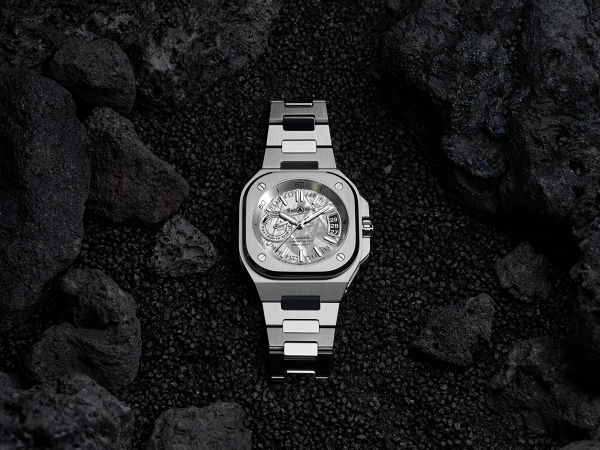
The year was 1906. In the rural Norrbotten region of Sweden—where celestial mountains climb to meet the northern lights in the sky—an iron meteorite was discovered beneath snow and earth. Humans gave it a name: the Muonionalusta meteorite.
It is said to have crashed into earth around a million years ago, laying dormant and undisturbed for a millennia beneath the Scandinavian permafrost. But the rock itself is estimated to have been formed around 4.5 billion years ago. 4.5 billion years spent floating around in deep space. We’re talking about an object that could have potentially bore witness to the birth of our solar system.
To help put its age into perspective, say its entire lifespan were compressed into a single calendar year. The 120 years it has spent on earth would make up just 0.84 seconds out of 365 days, that’s less than a single heartbeat. But alas, it has finally found a home on our planet, and now, thanks to Bell & Ross, it could also find a home on your wrist.
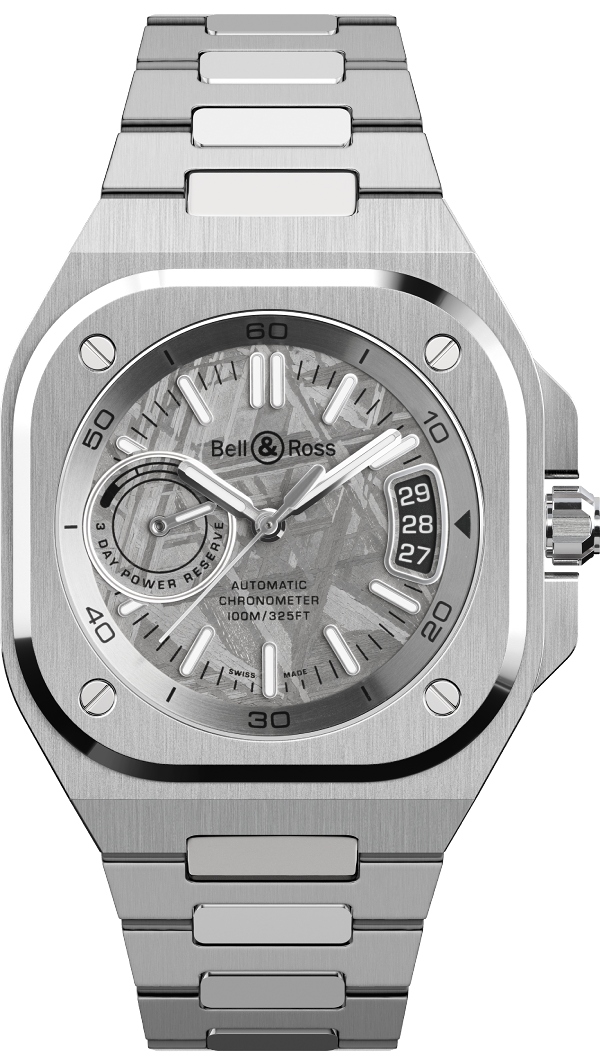
The French Maison managed to get their hands on a chunk of the meteorite, just enough to yield 250 little disks out of it to form the dials of the BR-X5 Meteorite. Each watch uses a cross section of the meteorite as its backdrop, revealing the Widmanstätten pattern: a natural crystalline structure created through a slow cooling process that can only occur through millions of years incubating in the freezing atmosphere of space.
The result is a dial that reacts with light to achieve an immense depth, shifting somewhere between grey, black, and ever-changing reflections. Naturally, because each fragment is so unique, no two dials are identical. This exclusivity is narrowed even further when you realise that this pattern cannot be artificially reproduced.
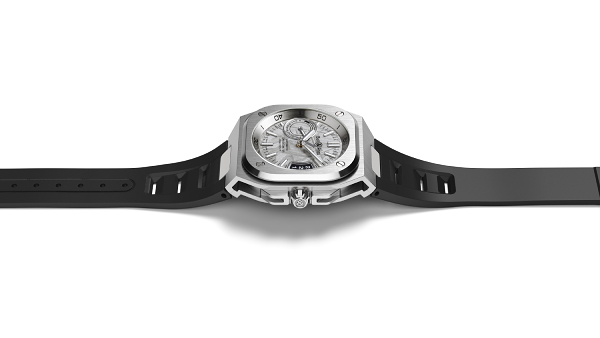
Thanks to its multilayer sandwich construction, the 41 case features an open-worked structure. Notice the spatial gaps on the sides of the case, which convey a sense of weightlessness. It's actually a practical decision, too, helping to reduce the weight of the watch.
The watch comes with either a steel or black rubber bracelet, but we’re partial towards the former. Steel creates a more consistent monolithic appearance, accentuating the dial’s metallic nature throughout. Besides, who doesn’t love a good brutalist design?
Finally, the watch houses the automatic BR-CAL.323 calibre, a COSC-certified movement that offers a large date display at 3 o’clock and 70 hours of power reserve, visualised through a sub dial at 9.
Truthfully, it feels almost sardonic to fit a 70-hour timer on a watch housing a meteorite as old as our solar system. In the grand scheme of all cosmic things, the time that it will spend on a wrist will be as significant to it as a passing fly is to us.
But isn’t it a romantic proposition? To be its fleeting custodian for the time being—before our planet eventually disintegrates to dust, and it’s left to drift through space for another billion years in its new form.
The BR-X5 Meteorite is limited to just 250 pieces worldwide.