Travel agencies tend to have a hook, a gimmick. These days, it’s not enough that your tour be straightforward—visiting sites, eating the local cuisine and shopping won’t cut it among the millennial market. They need more. Now, some agencies boast of yoga retreats, where you’re jettisoned to a remote ashram to restart your soul. Others have travel packages that will only let you know of the destination you’ll fly to on the day itself, all in the name of spontaneity.
For Unusual Expedition, its speciality is organising photography tours, which is kinda explanatory in itself. The agency’s portfolio is an Instagram clickbait: from the blue-tipped roofs of Santorini’s whitewashed domiciles to the auric light show cast by Norway’s midnight sun; all these exotic locales will assuage even the most jaded photographer.
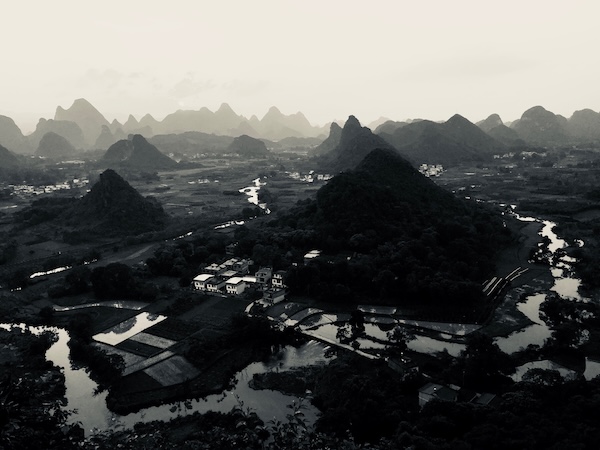
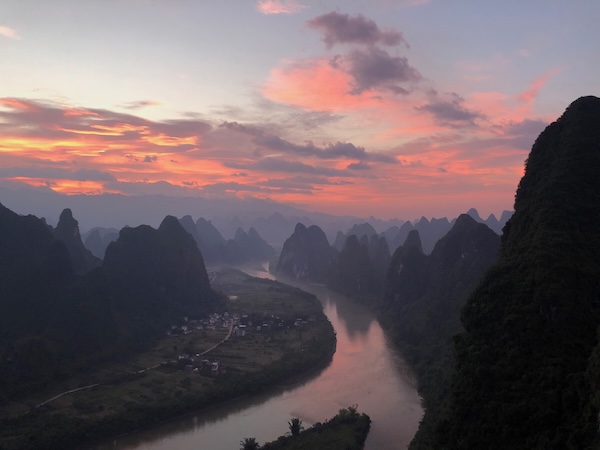
For this tour, I fly to Guilin, China; its natural scenery is so well-beloved that it became a well-known precept: “桂林山水甲天下!”—"Guilin’s mountains and water are the best under heaven". This area is situated on the west bank of the Li River, and it’s surrounded by scenic karst topography. Weathered by the elements, these carbonate bedrocks made of limestone, marble or dolomite turn into unique peaks and dolines. There is something unique about capturing the shadows formed when the slanted rays of the sun hit the pockmarked and craggy surfaces of these karst features; how the photo possesses depth and character.
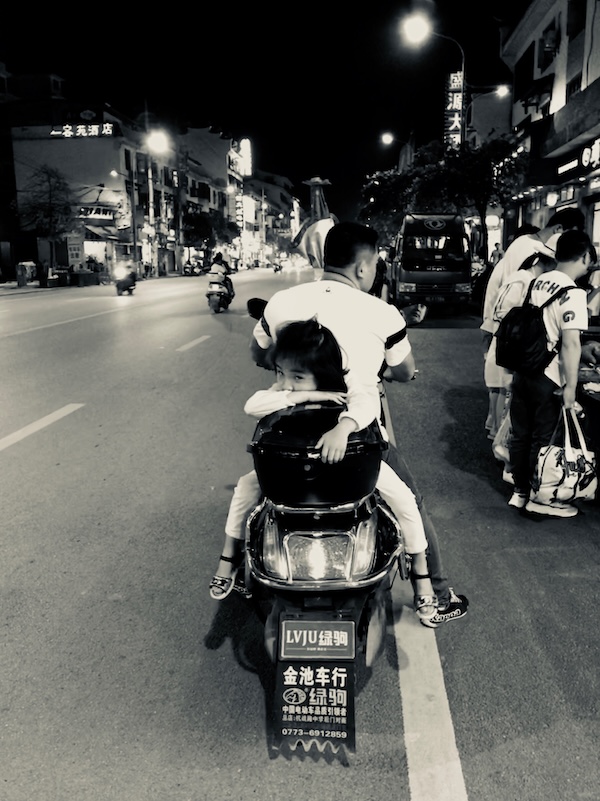
After a layover and seven hours of a numb posterior, I arrive at Guilin Liangjiang International Airport. There, I endure another two hours of travel before I reach bustling Yangshuo. What used to be a provincial town of "scattered houses" that backpackers would pass through is now a resort destination. Inns litter the streets, some announcing their vacancy via garish neon signage, others hidden behind narrow alleyways like Yangshuo Fanli Hotel. Its architecture confuses me. It reminds me of a Tardis—the hotel’s front entrance boasts nothing of its five storeys and many rooms.
Yangshuo has eateries and shops that line its street, but West Street is where you need to be. Tourists and diners and bars, oh my. It’s almost like Chinese New Year’s Eve in Chinatown—you’re jostled by the crowd, and the music from public speakers turns into a mushmouth of sounds and words. Before the sensory overload can occur, I decide to head back to my room. After all, there’s an early start tomorrow. There will be several early starts in the days to come.
When you travel in a group, you do not want to be the nail that sticks out. Punctuality is a must. No one wants to jeopardise the catching of the golden hour by being even five minutes late, especially so early in the duration of the tour.
And there we were, convened in the hotel lobby. It’s 4:30am, and it’s still dark out. Hours before, the sky had emptied rain all over Yangshuo. The ground is still slick; we carefully make our way down the uneven steps to board the bus that will take us to a bridge nearby.
Patience is another trait that’s needed for a photo tour. Often, you’re just sitting around, waiting for the moment to occur. Tripods are assembled, cameras face the east. Minutes pass. And soon, an hour swings by. A group of people wait for the bus down where we wait. Several joggers pay us no mind as they run past.
I’ve read about Ansel Adams, about how he would traverse long distances and heights or wait for the opportune moment before squeezing the trigger, all just to get the perfect picture. Now, the cobwebbed welkin and the morning fog wrap tightly around us, so that when morning finally arrives, the rays of the sun look like they’re muzzled behind gauze. Maybe there’s still a chance for this to turn around, I think to myself as the sun makes its natural ascension. Maybe we can return to this spot tomorrow? But that’s not to be. Mak tells us to get on the bus; this morning’s shoot is a bust.
Instead of being disappointed, everybody takes it in stride. Inclement weather is par for the course. You can plan down to the minutiae, but a freak storm can be a spanner in the works. To have something go according to plan is like setting all the tumblers in a lock to align. But you’re doing it in the dark. Also, you’ve no arms.
The founder of Unusual Expedition, Joseph Mak, is leading this tour. After much musing, I’ve decided that he looks like local Mediacorp actor Chen Hanwei. He strikes me as an articulate beng—speaking in a brusque manner that’s both endearing and alarming to non-Singaporeans and using words like "nonchalance" in a sentence. As a veteran photographer, Mak has led several groups on many photography tours around the world. Today, he introduces his two female models for a shoot in Xingping Old Town. He tells me that the non-local models usually know how to pose. One of them, who has a beauty mark near her eye, is someone Mak hired before and the other is new to this.
Dressed in matching qipaos and carrying paper umbrellas, the models start posing by a boarded-up old house. The women know how to speak to the camera as they make small adjustments to their posture and where they face. The newer of the two sees a bicycle parked by another house. She walks up to it and holds on to the handles for another round of cameras clicking.
One of the photographers is a Cambodian technician working in Singapore. He says he’d rather shoot landscapes, but he’ll give human portraiture a go. Someone gestures for Beauty Mark to stand underneath the green-tiled eave.
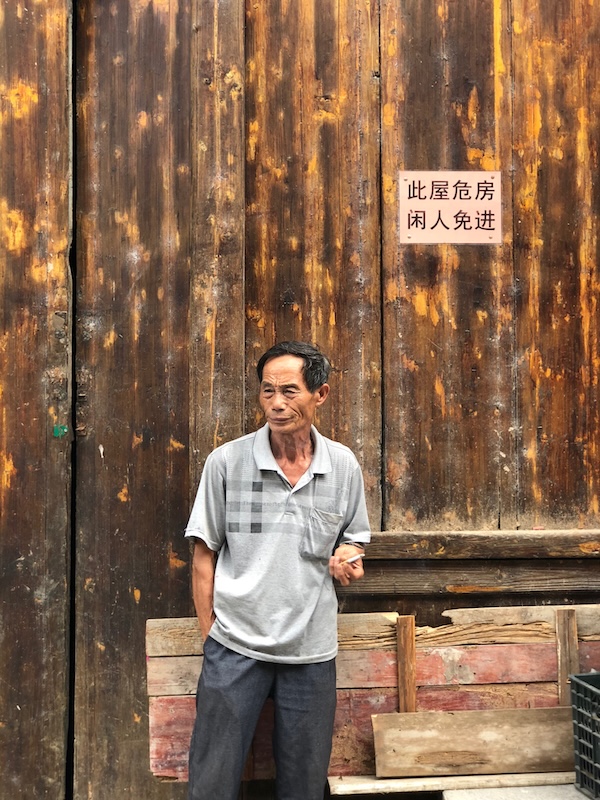
The architecture of Xingping is as much a character as the models. Recognisable by their sloping roofs and carved windows, the high walls of the buildings are as much pragmatic as they are aesthetic. Called horsehead walls, these Hui designs are a deterrent against spreading fire, especially in a densely populated neighbourhood like Xingping. These Ming and Qing dynastic buildings were constructed over 100 years ago, and they still house families. In one of the 48 residences, we see one that has three elderly women playing a sort of rummy game. Ignoring our presence, they chat and scrutinise their Chinese character hand of slim oblong cards. They don’t voice a complaint even when we start taking their pictures. Everybody in Xingping is used to interlopers.
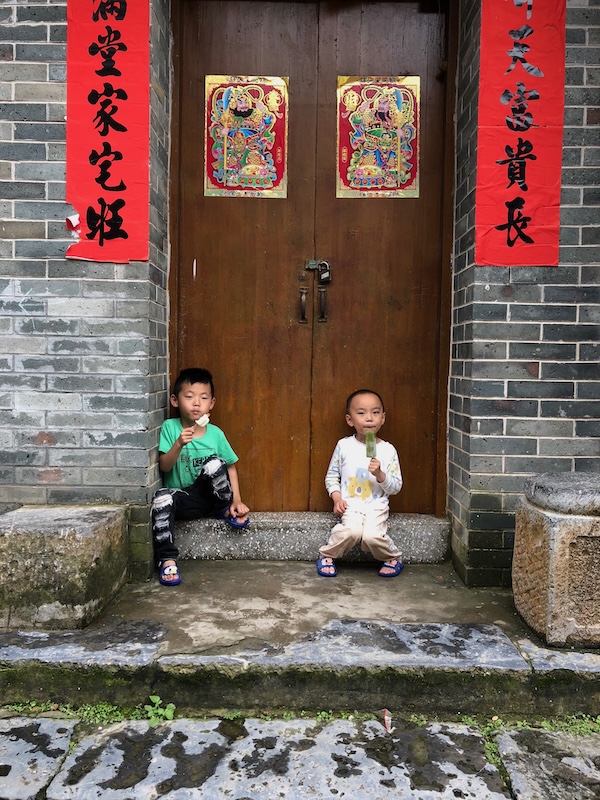
Cormorant fishing was big in the old days. These trained birds would dive into the waters to catch fish. A snare tied near the base of the fowl’s throat restricts it from swallowing the bigger fish, which the fisherman would retrieve from its throat. But better fishing methods have surfaced and the popularity of cormorant fishing waned due to the low yield of fish in the region. But these fishermen, who were raised in this trade, have kept their outfits, their rafts, and their cormorants just so that they can be utilised in a different manner—modelling.
When we approach an islet along the Li River, a shoeless Huang Yue Chuang, a famous face in those cormorant fishing pictures you’ve probably seen, is sitting on his modest-looking bamboo raft. Two cormorants, black and beady-eyed, stare at us like school delinquents spoiling for a fight. Huang, with his long wispy beard and toothless smile, rises to meet us. Then he grabs the nearest cormorant by the neck, dumps it into the dull jade-coloured waters and puts the bird on a stand where it spreads its wings. Huang turns his head to the side as he stands surefooted as the photographers start firing away.
I’m a little conflicted. Does the cormorant experience pain when it has its neck grabbed like that? Does the bird mind when it undergoes what is considered the barest equivalent of waterboarding? A little digging reveals that holding the cormorant by the neck is actually the gentlest method of handling the animal. Also, when a cormorant dip itself into the water to keep hydrated, it would spread its wings to dry off.
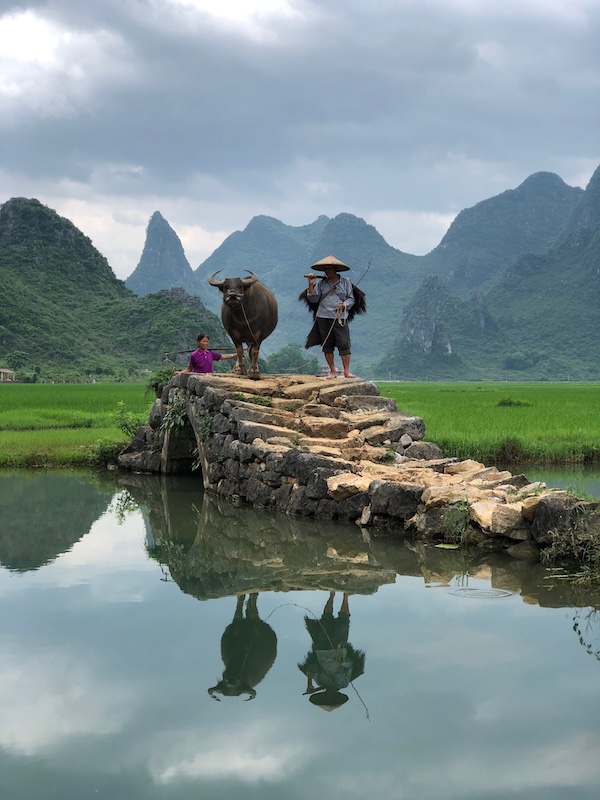
The cormorants aren’t the only animal we had to shoot. There was also an educated ox in Tian Xin village that is able to stop and pose on command, just long enough for us to take a shot. The beast and its handler, a farmer (or someone who dresses like one), slowly make their way over a small stone bridge where they stop to pose. It’s picturesque—the reflection in the water of the bridge, sky and mountainous background—it almost feels like cheating.
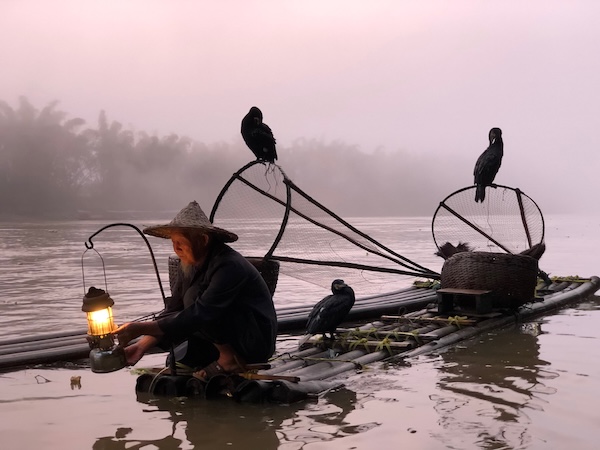
I’ve been pondering that since the start of the trip. Getting a good photograph usually requires equal amounts of talent and dumb luck. But now, camera tech has advanced to such a stage where even your smartphone is able to take a decent photo, and there are editing tools that can further enhance your image. And shots these days are set up for you. Mak has connections, stringers all over the world that can get you the props, model and access to locations. So, is it cheating? That we had the wherewithal to snap an image that professionals used to have to wait for to get? I don’t see it that way. It’s much easier, yes, but it’s also harder. With the same sort of available resources, everybody’s photos will look similar. Standing in the same spot, taking with the same aperture, your photo and others look like the same postcard at the souvenir shop.
So, that’s where the talent and inventiveness come in. You’re trying to set yourself apart from the others. There’s something about going on a photography tour; you’re suddenly injected with this yen to take better photos. You’re thinking about how to frame the shots, when to take it. Taking my cue from Henri Cartier-Bresson, I take a lot of impromptu shots, trying to capture the "decisive moment". Many are terrible, but I feel that I capture a few that I am pleased with. Am I a better photographer? I doubt it, but it’s a start.
On the morning of the final day of the tour, we are up early to capture the sunrise at Xianggong Mountain. The landmark, situated west of the Li River, became a popular photographic spot when an intrepid photographer reached the peak and took a photo of the view and got the bronze in an international photo competition for his trouble. We are told that hardcore photogs would arrive at 4:30am to secure their spots for photo-taking. It is four in the morning, still dark as we ascend each uneven step of the staircase. By the time we get to the top, there are already a good number of photographers with their cameras and their tripods who have claimed their spot.
Some of the people on the tour try to squeeze through the crowd; some of the photographers bark back at them in Mandarin, telling them not to move their tripod. Some of the Singaporeans try to placate them—an apology here, an excuse there—the tension becomes so thick that you could cut it with any Chinese photographer’s razor retort. A scuffle almost breaks out when an itinerant local tries to sidle her way in front of a photographer’s spot.
But in waiting for the sun to rise, there is nothing to do but make conversation with the other photographers. The ice melts as the exchange gets warmer, with some of them even offering tips on how to shoot, what aperture to use. The dialogue even takes a turn from the professional, venturing into topics of where one was from, where else that person has shot at. A buzzing sound occurs overhead; someone is operating a drone.
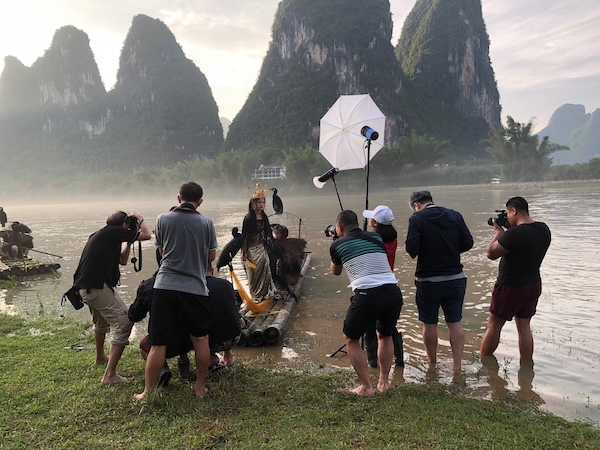
I remember the scene really well, even though I didn’t take a picture of it. It made an impression on me—when the first rays finally cut through the morning mist and strangers were of one accord as the chorus of camera clicks rose to a frenzy.