There are so many travel advisories right now. Scrolling through government travel sites, it feels as though half the globe has been plastered in sticky yellow caution tape. Some warnings are tied to geopolitical conflicts that made airspace unpredictable, while others stem from political protests, economic instability, regional tensions, or the ripple effects of wars that, while contained “over there,” can disrupt entire travel corridors. Climate change is increasingly a factor, too, like the extreme heat or monsoons appearing earlier and more intensely than before.
As airlines reroute flights and insurance companies adjust their policies, the once-simple act of going somewhere feels like an exercise in risk management these days.
I felt that shift personally when a flight I had booked to the Middle East was abruptly cancelled. The route had become complicated by regional tensions and airspace restrictions. Safety has to come first. But this experience was a reminder of how quickly headlines can reshape our perception of the world. One moment, a destination is an exciting adventure, and the next, we must all steer clear.
Normally, I stop in Dubai en route to Thailand to break up a long journey, but this year I decided to take a direct flight to Phuket. Virgin Atlantic has launched LHR to HKT three times a week, the only direct route between the two destinations, so I don’t even need to transit in Bangkok. It’s a 13 or so-hour journey, and I admit, I’m anxious about the duration (I’m considering sleeping pills); however, I’d be far more anxious if I were to stopover in the Middle East right now. I feel much safer going straight to Thailand.
You’ve probably seen all over the news that things in Thailand have been a bit touch-and-go in the past two years. There have been many political demonstrations, mainly in Bangkok, and environmental disasters have crushed towering apartment buildings. All of these have caused travel disruption, and well, frightened the crap out of us overseas.
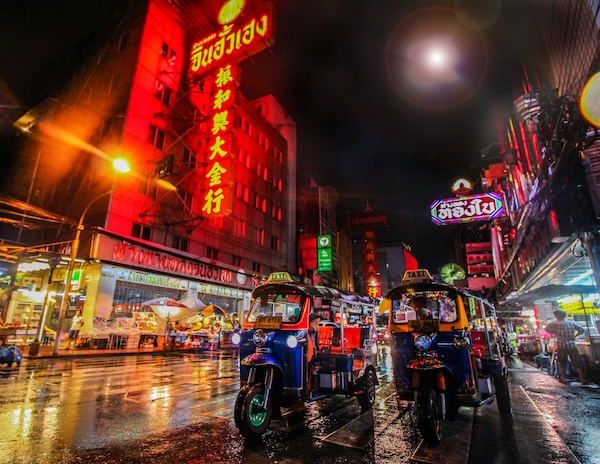
The thing is, Thailand isn’t closed. Millions of people are moving through its cities, islands, and countryside as they always have. Bangkok is still buzzing with the restless energy that makes it one of the world’s greatest urban playgrounds, and for one of my best friends living in Phuket (hi, Andre!), it’s business as usual. The perk of the negative publicity, he says, is that there’s more space on the beach. I. Cannot. Wait.
I don’t think I’m being reckless. I’ve done my research: I’m reading beyond the headlines, checking credible advisories, and asking pals on the ground. I’m also cautiously opting for a free-cancellation rental on Booking.com and am flexible with my itinerary, granted that I’m doing a long-term stay. At the time of writing, travel advisories warn us against visiting Dubai, for example, but Thailand doesn’t have anything of the sort. It’s all in the news.
Thailand remains exactly what it has long been. It’s one of the most welcoming, vibrant and endlessly fascinating destinations on earth. I love Thailand. I love the people, the food and the deep-rooted traditions. I love the cities, the beaches, and I just can’t get enough of their fresh dragon fruit. I also love that Lisa from Blackpink’s face is everywhere, since she’s basically
Thai royalty.
Tourism isn’t just a leisure industry in Thailand, but also a lifeline. Entire communities depend on the ebb and flow of visitors, from guesthouses to food vendors, scuba instructors to cabaret performers. Tourism supports millions of livelihoods. When travellers like me disappear because a destination has been painted too broadly as unsafe, the economic impact pours painfully through those communities.
I’m not saying to ignore real risks. If a protest is happening in a certain area, avoid it. If a region is experiencing severe weather, reroute. I understand that responsible travel means respecting boundaries, but it also means recognising that a country of 70 million people cannot be reduced to a headline. I think that, too often, our perception of risk is shaped by distance.
Think about it: a protest that affects a few streets in one city becomes, in the international imagination, a sign that the entire nation is unstable. One heatwave means a whole environmental collapse. The world has always been complicated, but things seem worse now because social media accelerates this effect, amplifying the dramatic while ignoring
ordinary reality.
Actually being somewhere tends to cut through that distortion. It replaces abstraction with experience. When you talk to people and walk the streets, you realise that the story of a place is always more complex, and usually more hopeful, than the version you read online. We modern travellers have more tools than ever to make smart decisions. With a bit of effort, we can build a pretty accurate picture of what’s actually happening somewhere, and when that picture says it’s safe to go, there’s a strong argument for going. Especially if you love a destination as much as I love Thailand.