There are secrets buried in the ice.
Take the vast (and slowly diminishing) Antarctic ice. Beneath kilometres of ice are ancient landscapes that include rivers, lakes and mountain ranges that are frozen for over 34 million years (or when translated in creationists' measurements: 4,500 years old). There could even be well-preserved artefacts and, if you watch too many films as I have, AGED-OLD BACTERIA THAT SHOULD REMAIN DORMANT AND NEVER TO BE RELEASED.
Even places like the Mont Blanc massif hold the past. The valley glacier, the Mer de Glace, is the longest and largest glacier in France and was described by Mary Shelley as the "most [desolated] place in the world" (alas, due to a warming world, the Mer de Glace is shrinking; in 2018, glaciologist Luc Moreau, said that the Mer de Glace “is melting at the rate of around 40 metres a year and has lost 80 metres in depth over the last 20 years alone").
As glaciers form and recess, felled trees of the past became subfossils and are pushed into a glacier's moraine (the dense mass of sediment a glacier deposits at its outer edge). Montblanc pays tribute to this geological formation with shavings of the preserved trees found at the glacier.
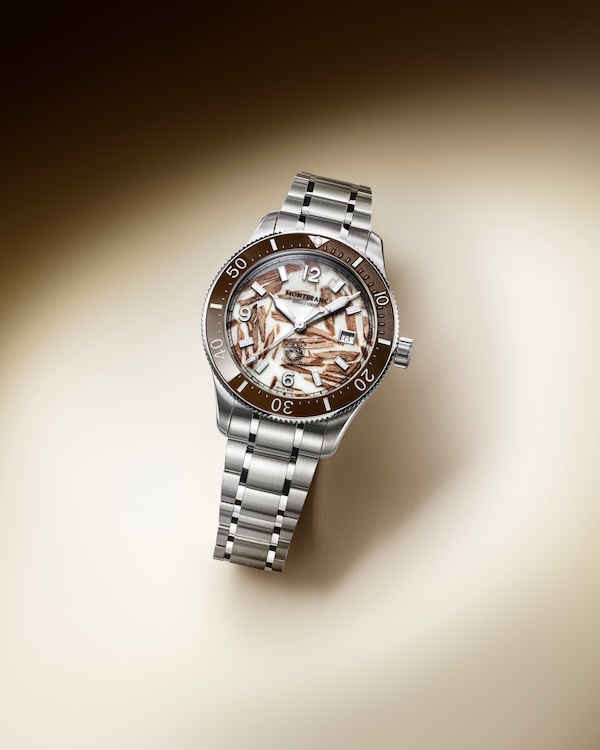
On the dial are wood chips that are "millennia old". A resin is coated over the wood shavings and treated with a frozen finish to mimic the look of striated crystalline patterns of ice. (Due to the random scattering of the splinters, no two watches are the same.)
White Super-LumiNova fills the applied hour markers and the hands; the Iced Sea logo sits above the 6 o’clock marker. Encircling the wood-and-ice dial, is a brown ceramic bezel; between the 0- and 15-minute markers, the section is lowered by lasers, which makes it visually and texturally distinct from the rest of the bezel. Laser-engraved markers appear in white, and a luminescent pip allows for precision timing deep underwater or in low-light settings.
Sitting in a 41mm stainless steel case is a Calibre MB 24.17—an auto-winding mechanical movement featuring hours, minutes, centre-seconds and a date complication. It has 38 hours of power reserve, and beats at 28,800 vibrations per hour). The timepiece has a 300m of water resistance and, like all Iced Sea models, comes with Montblanc's 0 Oxygen tech, where all oxygen is removed from the case to minimise condensation.
Oh, and it's limited to 700 pieces worldwide to reference the 7km length of the Mer de Glace.
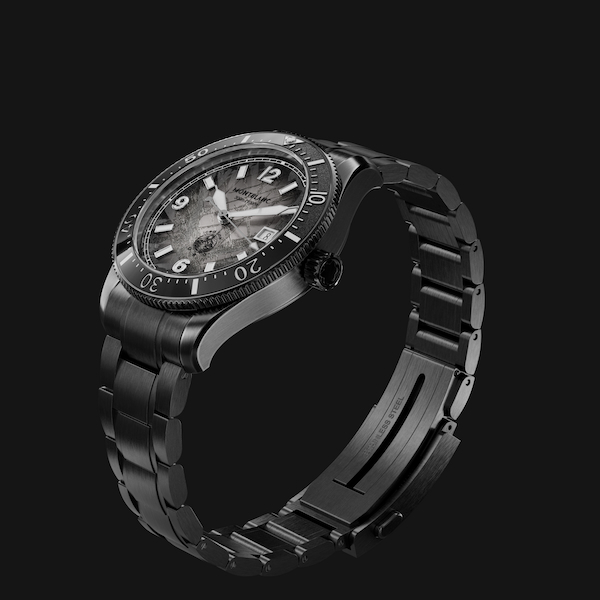
The watch brand goes for a distressed steel finish look for its Iced Sea Automatic Date 0 Oxygen. A black coating goes over the stainless steel case and bracelet and the mineral quartzite distresses them by washing and brushing.
As with all Iced Sea models, you have a glacier pattern dial to mirror the colour, and texture of ice. The pattern is still achieved by gratté-boisé, which takes four times longer to work on than a standard dial. On the dial, you have a grey sfumato finish; Bright white Super-LumiNova fills the applied hour markers on the dial and hands; the Iced Sea logo is highlighted above the 6 o’clock marker.
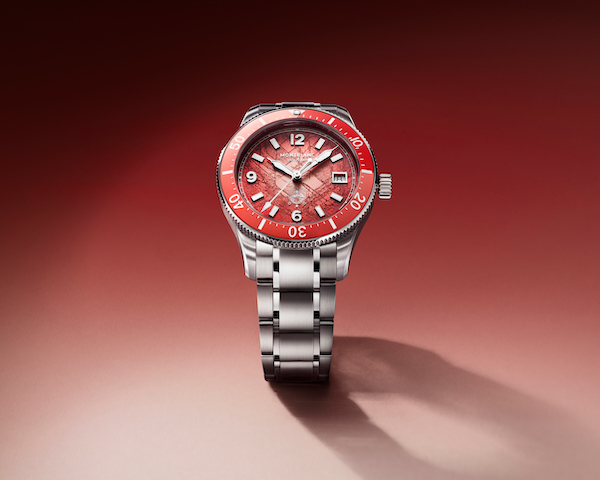
If you want a pop of colour, there's this limited edition colourway in a coral hue. While most Iced Sea models feature colours of white and grey (inspired by Mer de Glace), the glaciers also take on a balmy hue during the year’s warm seasons. During the summer, at dawn and dusk, a glacier will reflect the vivid sky.
You can find these "sun-soaked" palettes in this limited edition model's dual-colour aluminium bezel inserts. This model is limited to 300 pieces (and what do you know, there's no reference to that limited edition number).
Montblanc makes the 0 Oxygen tech accessible to previous Iced Sea models. You can inquire at your local Montblanc boutique for that.
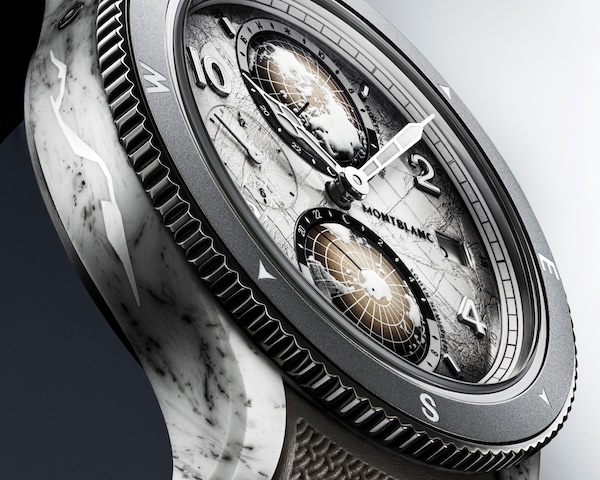
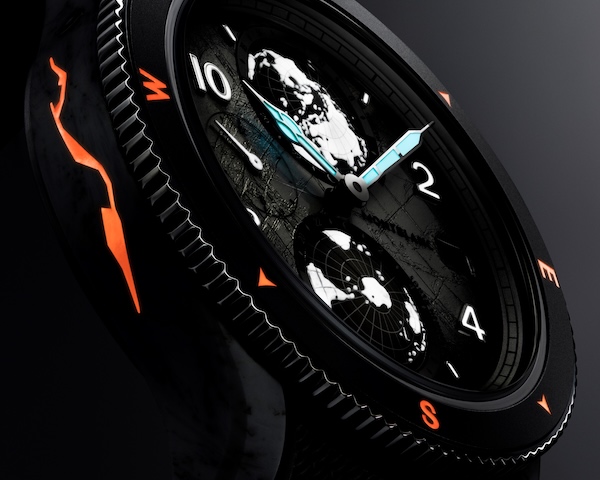
We had a dial filled with fossilised wood chips, and now we have one that has volcanic ash.
The Montblanc Geosphere model pays homage to adventurers, and the Montblanc 1858 Geosphere 0 Oxygen Mount Elbrouz Limited Edition celebrates the highest mountain in Eurasia: Mount Elbrus (the Elbrouz alternative spelling is French-influenced).
Housed in a 43.5mm titanium world-timer is Montblanc's Calibre MB 29.25, that has automatic winding, 42-hours of power reserve, the distinctive dual-hemisphere world-time function, a fully featured dual-time complication, and a date complication. On dial, the hour hands—one on the main, the other on a sub-dial at 9 o'clock—are independently adjustable in 1-hour increments.
A white and brown sfumato finish over a glacier-patterned base is heightened by white accents on the hands, hour markers, and bezel marking on the sides of the middle case that glow orange in low-light conditions. The continents on the dial and the 24-hour hand at 9 will glow blue.
The middle case is a proprietary composite of volcanic ash, aluminised basalt fibres, CaCO3 (calcium carbonate), and a bio-sourced resin containing 30 per cent vegetable matter. (As to the matter of whether the volcanic ash came from the dormant stratovolcano, we've reached out to Montblanc and will update this post when we get an answer.)
Once more, this model is equipped with O Oxygen tech and is limited to 829 pieces, a nod to the year 1829 when the higher of the two Elbrus peaks was first summited.
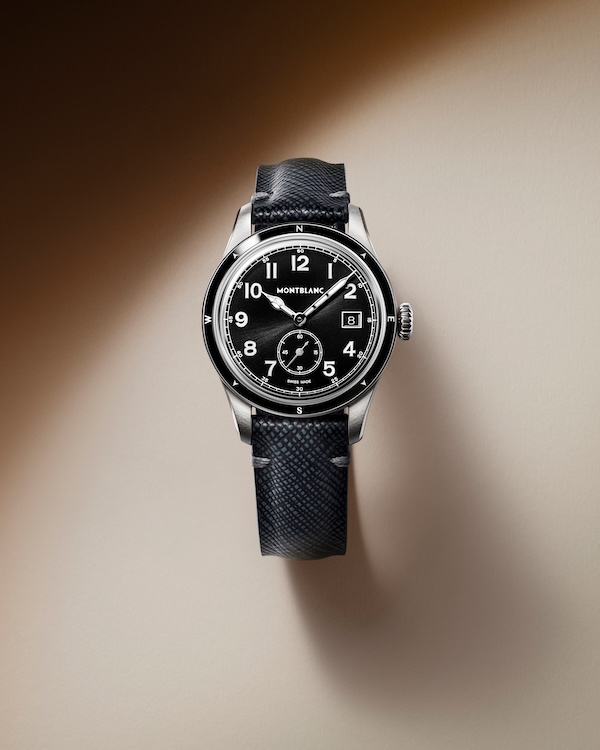
Another 1858 model comes in a new case size: a 38mm. What can you fit in a 38mm case? Well, how about a lacquered dial with a "railroad" minute-track around the outer edge; luminescent Arabic hand and indexes; a date wheel at 3 o’clock; a sub-dial for the running seconds. The timepiece is topped with a single-stitched blue-black Saffiano leather strap.
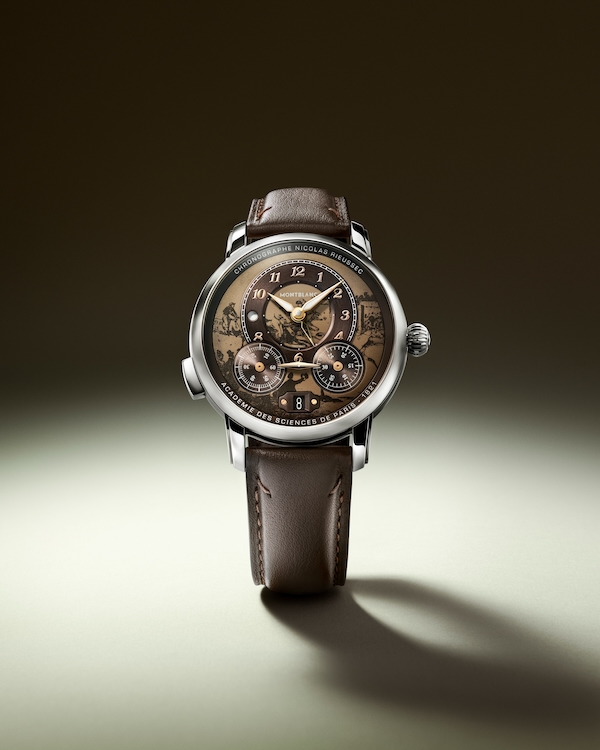
Another limited edition and tribute is to Nicolas Rieussec, who first recorded the horses at the races on Champ-de-Mars in Paris. His device used a fixed nib that drop ink on two rotating counters (one for the minutes, the other for the seconds) whenever a horse crossed the finish line. Rieussec presented his invention to the Academy of Sciences in Paris, and its members were so mad impressed by it that they called it a "chronograph". #themoreyouknow
At the heart is the Calibre MB R200, which includes a precise monopusher chronograph and a full dual-time functionality with a Day & Night indication (at 9 o'clock) and date complication (at 6 o'clock). You also have automatic winding of dual barrels for a full 72 hours of power reserve. You can witness the operations through a sapphire caseback, where the gear train and escapement do their dance.
With a 43mm polished stainless steel case, the onion crown reminds one of a traditional pocket watch. The dial has a recreation of Victor Adam's 1829 work, "Four Jockeys storm with their horses", where you have a quartet of jockeys mounted on their steeds at the Champ de Mars course. Giving it that old-timey look, a beige sfumato finish is applied to it. "Rieussec" is inscribed at 12 o'clock and, at 6 o'clock, a tribute to the Academy of Sciences in Paris.
The watch's two chronograph sub-dials (a 60-second counter at 8 and a 30-minute totaliser at 4 o’clock) feature rotating domed discs. You'd notice that between the two discs is a horizontal bridge that acts as a pointer, which recreates the layout of Rieussec's original chronograph.
Limited to 821 pieces, this, of course, takes inspiration from Rieussec's 1821 chronograph.
Three complications join the Star Legacy line, with all three watches have an exploding-star guilloché pattern—a graphic representation of the bird's eye view of Mont Blanc's snow-covered peak. A nod to Montblanc's leather craftmanship, you'll find the anthracite-coloured sfumato finishes on the watches. And finally, all three models have fully-polished stainless steel pebble-shaped cases and sapphire crystal casebacks.
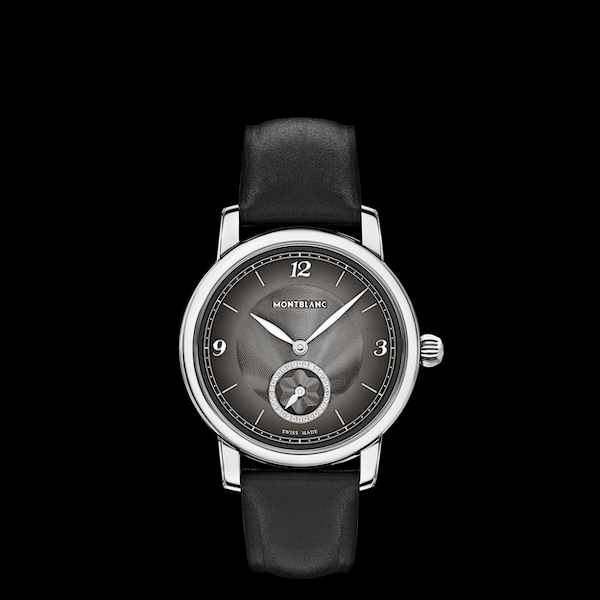
Like its namesake, the 36mm Small Second model has a small-seconds sub-dial at 6 o'clock. Thirty diamonds are set around the sub-dial, and the dial is completed with rhodium-coated Arabic numerals and hands with intermittent baton markers and a closed minute track at the outer edge. The 36mm Small Second model is powered by Montblanc's Calibre MB 24.16, with 38 hours of power reserve.
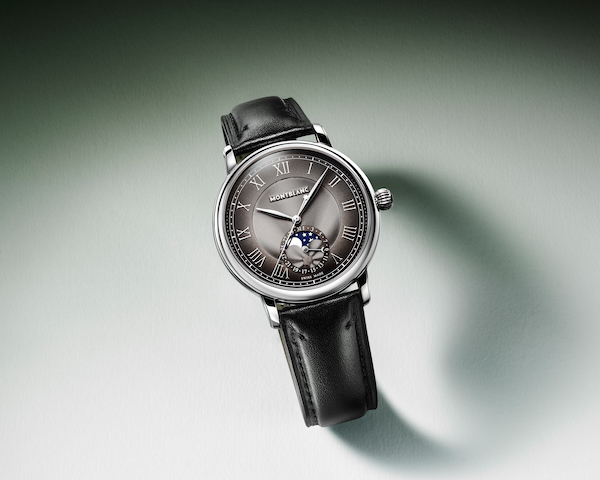
The other two 42mm models are a Moonphase and a Chronograph. For the Moonphase, you have a pointer-date and a deep blue moonphase complication at 6 o'clock. You have the months numbered around the sub-dial with the date indicated by a crescent-tipped hand.
Outside of the dial rim, is a raised section filled with rhodium-coated Roman numerals that's matched by the rhodium-coated hands. A traditional closed minute track finishes off the dial around the outer edge. To track the moon phases, a MB 24.31 movement powers this piece and has a 42-hour power reserve.
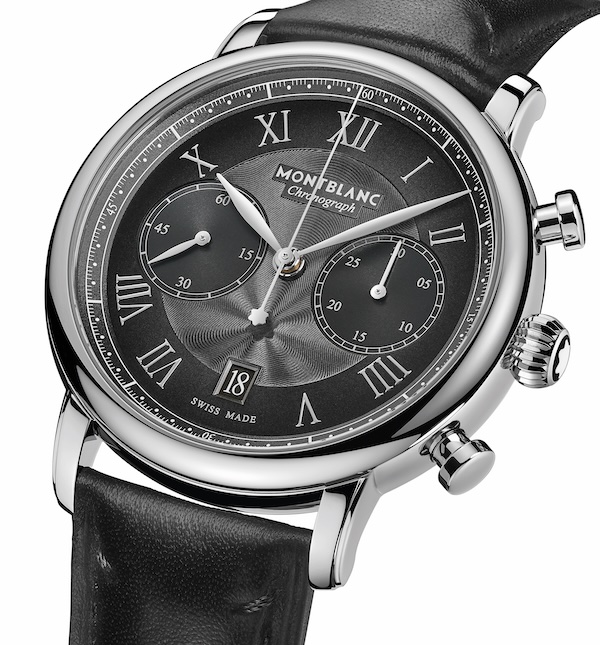
We come to the Chronograph that has a two-register layout and a dual-pusher scheme. At 6 o'clock, you have a prominent date window—a colour-matched date disc with an elegant Arabic-numeral font. The "Montblanc Chronograph" text sits atop a raised cartouche below 12 o'clock.
There are two sub-dials, with running seconds displayed at 9 o'clock with a traditional leaf hand and a 30-minute chronograph totaliser at 3 o'clock. Once more, rhodium is used for the Roman numerals on the raised outer dial. A traditional closed track is divided down to 1/10th of a second for exact stopwatch readings.