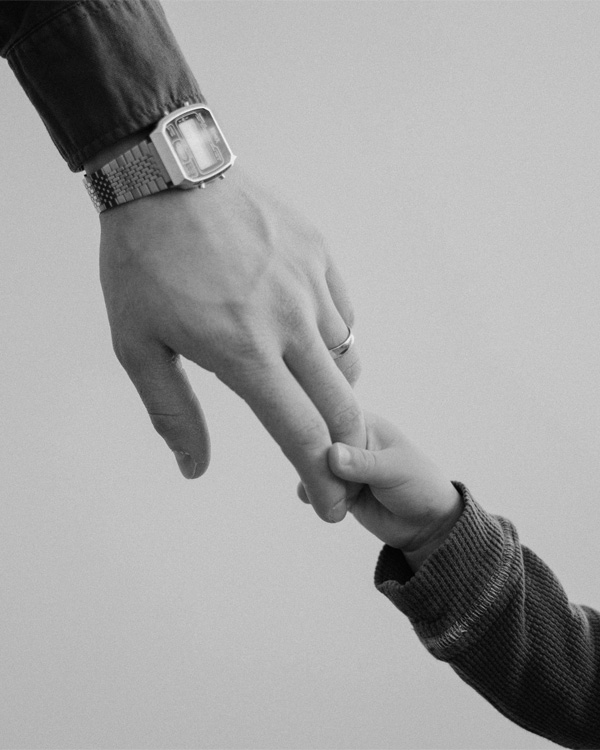
…I was five, I was the happiest whenever we took a drive—anywhere and no matter how short the distance. You had a pickup truck then, an upgrade from the massive lorry you had to drive for work. It thrilled me to sit at the open back with the wind beating on my face, and reacting to every bump and turn with glee as I treated the experience like a rollercoaster ride.
…We first moved into our first and only home as a family, it was important that you had a whole home theatre system complete with a LaserDisc player and karaoke paraphernalia. We’d spend some nights singing everything from English classics to Malay Pop, with every door and window closed so we wouldn’t disturb our neighbours too much. Little did you know that that would ignite my passion for singing and music in general.
…I was eight, you arrived late to my birthday party at home. You had a bag in your hand, and in it was a set of new clothes. You asked me to change into them for the party. I did, and then realised that you took inspiration from a Cerisi (a now-defunct ’90s kidswear brand) advertisement that was pretty much on every television ad slot. It was funny to me then, and in hindsight, makes me realise that you were still figuring out this whole “being a father” thing because I was your first.
…I was 10, we went for a big family trip to Australia’s Gold Coast. It was our first time travelling outside of Asia, and you opted not to follow a tour group. You’d spend each night figuring out the maps and planning out drive routes so we didn’t waste too much time travelling. This was before GPS became a common everyday tool, and because you hated spending money on maps, you printed out pages and pages of route information for subsequent trips to Australia’s other states. You taught me how to read them so that I could guide you whenever we were on the road.
…I was 11, you had your mother’s side of the family over for dinner at our home. As we started eating, you decided to announce that we were about to add another member to the family. You didn’t realise it then, but he would grow up to be almost a carbon copy of you in ways that baffle me to this day. I didn’t realise that I would eventually appreciate that, especially in the past couple of weeks, because we’re quite different, you and I.
…I realised that our birthdates were the reverse of each other’s, I thought it was pretty cool. I tend to forget a lot of things, but I could never forget your birthday.
…I was 16, my secondary school enrolled the entire graduating cohort in a motivational workshop (that workshop that is familiar to most Singaporeans). It was designed to help us learn nifty studying techniques and spur us to work hard for the upcoming GCE O-Level exams. Part of the workshop included a session where trainers would suddenly guilt-trip us by way of eliciting emotional responses in the hope of triggering a mindset change among us teens. I texted to say an unprompted I love you after that particular session. I don’t think I’ve ever said it to you again.
…I did horribly for my GCE A-Level examinations, you didn’t express disappointment; you sought alternatives. You brought me to a seminar to learn and understand more about studying overseas. “We have money set aside for your education,” you said. You felt assured after the seminar that there was at least hope that I could still be a degree holder, but you also knew that if I were to study overseas, the chances of my coming back would be slim. We ended up not choosing it because I didn’t know what I wanted to do at the time.
…I turned 18, and you paid for me to start taking private driving lessons. The instructor was your friend—one of the many friends you’ve made in your lifetime—and you’d check in with him to ask about my progress. To be honest, it wasn’t difficult at all because I grew up with you driving by my side. You were my first driving instructor, just as you were my first mentor in so many other areas. I learnt just by observing you.
…We asked for forgiveness every Eid since I turned 25; there was a consistent thing that you’d say each year. I want you to be more present and involved; sometimes I feel like I only have one son. It hurts every time I heard it, but it’s a reminder that I needed to hear.
…You were hospitalised for the first time ever; it was just the two of us at the observation ward. We talked about a bunch of random things, including how you were disappointed with the way a marital issue was handled by your side of the family. It was the first time in a long time that we agreed on something.
…You were first diagnosed with cancer, I felt the need to not visibly react to the news. We have a history of not being emotional in this family, and despite me being the most emotional one in every other circle, I couldn’t break down in front of the family. I went to my room, closed the door, and cried. I had just lost a friend to cancer a month before.
…It was just the two of us on our drives to the hospital for therapies and medical appointments, you’d attempt to make small talk about things remotely related to fashion. You’d mention a friend of a friend of a friend’s son who “dresses in expensive things like you” or ask me if Donald Trump’s economic decisions would affect my work. The latter inspired me to write a feature.
…You had to go through a six-hour chemotherapy session—or any length of one for that matter—you’d ask me to head back to the office, assuring me that you’d be fine on your own. I never did because I wanted to be at your beck and call. I felt powerless and useless because there was nothing I could do to help, so the best thing I could think of was to be around as much as possible. It was at those times that I witnessed the physical decline you were going through. For the first time, you could fit into my clothes—you’d wear my T-shirts that were mistakenly placed in your wardrobe.
…You were told the cancer had spread to your bones and other organs, you were crushed. I had never seen you sob uncontrollably until that night.
…You were admitted for two weeks in the hospital, it was the longest time you have ever spent in one. On one evening, I visited you after work. You were already asleep. I sat next to you and watched you stir and sleep for half an hour until visiting hours were over. It felt strange seeing you that way, and at the same time, made me realise how much time had passed.
…You had to get an IV drip set up by the nurse, I had to hold your hand because you kept trying to remove the nasal cannula that was supplying you with oxygen. You were in and out of sleep the entire day, and doctors had been telling us that your condition was abruptly worsening. Your chest suddenly stopped moving. “I think he’s stopped breathing,” I alerted the nurse. He tapped your chest and called out your name. It must have been 15 seconds before your chest moved again. And then it stopped.
…Your body had to be transported from the hospital back home for us to get ready for the funeral rites. I stayed behind to accompany you. It was four in the morning, and I had never experienced the hospital as quiet as it was. I sat silently in the passenger seat as we drove home; your body at the back of the van, and me attempting to process the last few hours.
…You were about to be prayed for before we made our way to the cemetery. I was surprised by the number of people who had turned up on a Thursday morning. My brother, uncles and I were sequestered in a room for an hour to clean and prep your body for the burial, and when we finally came out with you in all white, there were just too many people that we had to move the prayers to the void deck. It was a true testament to your friendly, social nature and how you valued relationships.
…I woke up the next day, it felt surreal. It still does. I spent the next few days nodding obligingly to relatives and your friends, who all seemed to have the same rehearsed line: “It’s now your responsibility to take care of the family.” I hated it. Because I don’t need a roundabout reminder that you’re no longer here.
…I wrote this; it had only been two weeks since you passed. I tried to go about my days as per normal. I tried.
…We talk about you now, we talk about you in the past tense; we refer to you as “late father”. But I choose to believe that while your time being alive has stopped, your time with us has not—like how grieving never truly ends, one just lives with it.