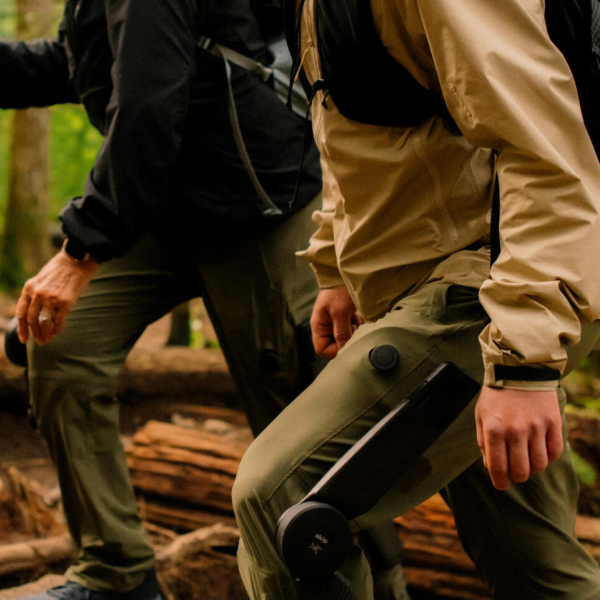
Imagine having a job in which you must contend with a lot of heavy lifting—in manufacturing maybe, or perhaps in healthcare. Imagine wanting to walk up a mountain, but knowing that you’d likely be tired out halfway up. Imagine, worst of all, being unable to walk at all after a serious illness or accident…
From Alien to Starship Troopers and Halo, science fiction has offered a solution in the form of exoskeletons—wearable, rigid devices that fit around the body and which can transfer forces to its other parts; that provide an extra boost to our limited human musculature. But increasingly the tech is real, albeit less full-bodied and not as shiny or bulletproof.
Indeed, you’re about to see it everywhere, in warehouses, in hospitals, on rescue missions or during fire-fighting, in space exploration and on the battlefield, on the delivery guy who comes to your door, on hikers in the countryside and just on pedestrians down your street. There will be multiple styles of exoskeletons for multiple uses. They will, it’s said, amount to a USD2bn business by the end of this decade, with global companies the likes of Lockheed Martin, Ford and Renault already investing.
“There’s been a huge change in thinking about exoskeletons,” explains Jaromir Van De Guchte, sales engineer for developer Laevo Exoskeletons—a popular choice among brain surgeons, because exoskeletons can also help when you have to hold yourself very still for long periods of time.
“Ten years ago, there was a lot of work on the kind of full-body Iron Man-style exoskeleton that weighed hundreds of pounds, but without asking what it was actually for. [Since then] there’s been the realisation that an exoskeleton needs to be as light as possible, as strong and durable, as comfortable, as cleanable, as close-fitting, but also the solution to a problem. And that’s what we’re seeing being made now.
“Advances in materials science and miniaturisation will only bring that in all the faster. Soon, wearing an exoskeleton in construction, for example, will be as commonplace a sight as the wearing of a hard hat,” he adds. “And soon enough, we’ll see them worn for leisure. Exoskeletons will be normal”.
The exoskeleton—sometimes called the wearable robot—is not new. It was first proposed in 1889 by scientist Nicholas Yagn, who, in service to the Russian Tsar, patented two mechanical devices for walking faster. But in the modern era, while the Mihailo Pupin Institute in Belgrade developed its hydraulic “kinematic walker”, the first exoskeleton for rehabilitation, almost inevitably it was the military—and its desire to create the super-soldier of tomorrow—that really drove the concept forward.
In the mid-1960s the US Office of Naval Research constructed a full-body powered exoskeleton known as the Hardiman—Human Augmentation Research and Development Investigation. DARPA, the Defence Advanced Research Projects Agency, would come up with its HULC—(geddit?)—or Human Universal Load Carrier. Another went by the fantastic name of the Man Amplifier. That’s something that’s still needed.
Soldiers today carry so much equipment over rough terrain, around three times the recommended weight, that there’s concern that they arrive at the conflict zone too tired to fight effectively: a blend of fatigue-busting exoskeleton and body armour, like the one recently developed for the GIGN, the French police’s elite tactical unit, perhaps offers a solution.

Certainly, it’s remarkable how quickly the idea of the exoskeleton entered the public consciousness, even creeping into Dean Martin movies: in the 1967 spy comedy The Ambushers Martin is introduced to a “power loader”. “It gives the average man the strength of a giant. It can handle a 1500lb load,” he’s told. “I know the feeling,” quips Martin.
“The idea of a device that increases strength or endurance has been around for a long time, but never really took off. The military developed prototypes and other commercial products were launched before the tech or the market was really ready,” explains Armin Schmidt, CEO of exoskeleton developer German Bionic—and yes, he remembers watching The Six Million Dollar Man as a kid.
“But people are starting to see the exoskeleton as a real product now, not as a novelty,” he adds. “The last five years have seen more and more companies create their versions—and we expect numerous other players to come—[in part] because the cost of components has dropped significantly, because there’s been advances in key components, like motors, but also because there’s a clear use case now. In many different environments, exoskeletons can improve your life. The idea of a device that empowers the human body in all of its weak areas—whether that’s in upper body strength for lifting, for lower body endurance for walking—makes perfect sense.”
That’s both in terms of people wanting to feel stronger and so able to enjoy their leisure life for longer—“why wouldn’t you wear something that allowed you to be more mobile?” asks Schmidt—but also because, with growing labour shortages, it will allow this ageing population to work for longer. This isn’t as nefarious as it sounds at first. Corporations are always looking for a better return on their investment—exoskeletons, whether mechanical or motorised —and this new sector is developing both, which could lead to fewer sick days and greater efficiency.
“[As a worker] you’d still be lifting something, still walking. The device would support you in what you already do—and I think it would need to be framed that way [to encourage uptake and tamp down resistance],” as Schmidt argues. Business doesn’t want to have to face down another Luddite rebellion. This is not a case of robots coming for your job. Not yet.
Before that happens, exoskeletons could prove transformative in many workplaces. Musculoskeletal health disorders, resulting from the strains of repetitive movements under stress, are the second biggest cause of workplace absenteeism after anxiety and depression, across all age groups.
According to Duilio Amico of technology company Comau, which six years ago launched its Mate exoskeleton, it’s increasingly beholden on employers—given increased regulation and especially in these times of CSR and ESG agendas—to ensure a workplace where employees are not physically worn out simply by doing what needs to be done. With blue-collar jobs in decline, but also more mobile between employers, supporting them through the provision of exoskeletons—literally and figuratively—would be one way to build loyalty.
That’s also why the Mate—that’s the Muscular Aiding Technical Exoskeleton to you—is all-mechanical. It’s not just because battery technology remains limited, or because mechanical exoskeletons may be simpler to maintain, but “because workers in the industrial market don’t feel comfortable yet with the sense of being driven by a machine—with being roboticised, so to speak,” says Amico.
“So they prefer a passive [non-powered] unit,” he reckons. “They want to get home with fewer aches and pains each day, but don’t like the idea of being utilised like a machine [which the wearing of a powered exoskeleton might encourage]. There has to be an awareness that while exoskeletons might be bought by management, they’re worn by the employee”.

Advances in exoskeleton technology for industry will no doubt have a positive knock-on effect beyond it, not least in rehabilitation. Exoskeletons have already had a profound psychological impact in helping people walk again.
An exoskeleton’s tireless precision means a patient can get in, say, 1,000 good practice steps in a therapy session rather than, without it, 30 so-so steps before patient and therapist are both exhausted, explains Ronan Langan, a neuro-physiotherapist with Dublin University’s exoskeleton research programme. And earlier this year, a robotics company called Wandercraft unveiled clinical trials of the first self-balancing rehabilitation exoskeleton, which it plans to launch in 2026.
“But the big question is whether exoskeleton tech can advance to the point where it can replace the wheelchair?” he says. “[Since sometimes this is about entirely replacing muscle control, balance and so on, not just powering up the ability to walk] it’s not there yet—in terms of stability, or negotiating uneven ground. It’s not dynamic or fast enough yet. But the wheelchair industry isn’t a small one [there are 130m people in need of a wheelchair around the world], which could incentivise development”.
But there’s one thing that will likely really drive both investment in exoskeleton development and a change in perception.
Earlier this year, the Chinese company Hypershell launched its X Ultra—with that suitably superhero-ish name—arguably the most advanced personal exoskeleton to date.
Targeting the device at enthusiastic outdoorsy types, Hypershell claims independent testing shows that wearing an X Ultra reduces fatigue when walking by 20 per cent and when cycling by 39 per cent. Worn—perhaps a wee bit self-consciously—over your clothing, it comprises an outsized padded belt, with a battery pack sitting just above your backside, and a small, lightweight but, at 1,000w, powerful motor at each hip. From those, a carbon fibre and titanium armature runs down each thigh and is fastened above the knee.
Motion sensors detect your movement and give each step a boost, gently in “eco” mode—which sees you for a good 30km—or more assertively in “hyper” mode. Just how much it gives each step a boost is most obvious when you switch the machine off and you suddenly return to your normal, lumpen, wheezing, biologically-powered self.
“We’re utilising technology to get there, but really this is all about enabling people to be stronger and to go further,” argues Kent Xu, head of brand for Hypershell, which was founded four years ago by a team of industrial robotics engineers who crowdfunded their seed money online.
“It’s about giving people more confidence to enjoy an active lifestyle. In 10 years, the wearing of exoskeletons for leisure will be entirely unremarkable. But the big challenge for us now is that most people have no experience of wearing an exoskeleton—it’s still such an abstract concept—and so little understanding of what it could bring them”.
“This technology is so new that even people who would benefit from it are worried to use it,” agrees Roy Kosmeijer of Physioparts, distributor for an exoskeleton developed by WIRobotics. “They think they’re going to be taken over. When I get them to try it on, sometimes I make a joke about how I could now control them from an app. Most people laugh. But some are very afraid. It has something to do with the exoskeleton being on the body, making the wearer feel like they can’t escape from it. But this is just an image problem to get over. And we will, as we see more people wearing them”.
That will also help with the lingering sense that exoskeletons are not enhancers for the already fit, so much as aids for people in some way diminished by some physical ailment or age. Indeed, Kosmeijer argues that we already have a test case for the likely trajectory of this tech in the form of e-bikes.
“Ten years ago, we were looking at e-bikes and saying ‘but why?’ or ‘only old people are going to use those’. And now their use is absolutely normal. Like e-bikes, exoskeletons are not about making us lazy either,” he laughs—nodding to the Pixar movie WALL-E, in which the starship passengers are all morbidly obese as a consequence of using electrified chairs to carry them everywhere. “They encourage activity that otherwise wouldn’t happen, and exoskeletons will do the same”.
The use of exoskeletons in rehabilitation and industry might put comfort at a premium—German Bionic, for one, has devised a way of augmenting its exoskeleton using AI for real-time motion data capture, which allows the exoskeleton to work in a more made-to-measure way for its wearer—but it does not necessitate sleek aesthetics.
Not so the consumer market, as the cautionary tale of the Google Glass revealed. These were the smart glasses launched by the tech giant a decade ago—offering wearers an Internet-connected head-up display—but later discontinued in part following the growing awareness that it also offered wearers the kind of eminently mockable ultra-geekish style they were not looking for.
Pulling off a stylish as well as a functional product is not easy: rare in the tech space, exoskeleton developers have to master not just the materials, but control systems, motors, springs, hydraulics, sensors, electronics, gyroscopes, textiles; consider everything from power sources to fit to coping with perspiration or rain; and then ponder style on top of all that.
German Bionic, for one, concedes that its first-generation device looked too technical. “It was not sexy. It looked like it had been designed by mechanical engineers,” says Schmidt. “In fact, it probably looked cool to them”. Its latest iteration is more at home within the consumer electronics world. “That matters—because people don’t want to feel they look like a robot,” he stresses.
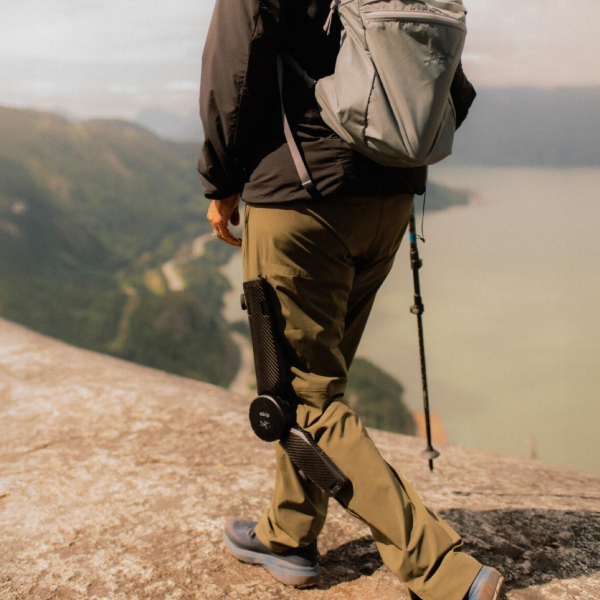
Skip, an American exoskeleton developer, has launched its Mo/Go product, or what the company calls “the world’s first powered pants”. If that concept sounds vaguely comical, Skip’s point is that exoskeleton uptake will be faster if the technology looks more like something already familiar—so it has integrated its exoskeleton into trousers, designed in collaboration with the fashionable outdoorsy brand Arc’Teryx. It’s calling this new clothing category “movewear”.
“As a result, the product piggy-backs on existing behaviours and becomes the core of people’s wardrobes rather than an auxiliary add-on that must be remembered when you leave the house, toted around when you don’t need it, and layered on top when you do,” argues Skip’s co-founder Anna Roumiantseva. “Like any wearable, movewear has a very high bar to clear when it comes to aesthetics because of the social signal it sends to the outside world. Aesthetics [have to be] a leading requirement and not an afterthought”.
German Bionic is finding that, while its product was designed for industry, with industry-friendly pricing, now some private individuals are even buying it. Careworkers and people who look after someone at home appear to be particularly keen—wearing an exoskeleton, even the slightest of carers can lift the dead-weight of an immobile patient, much bigger than themselves, for example.
But while consumer exoskeletons, at around SGD1,500, are effectively luxury products, more powerful industrial models are closer to 10 times that. That may not be prohibitive for big business—if exoskeletons can be shown to pay for themselves through increased efficiency—but will be so for individuals. It seems likely that rental arrangements will come into play—whether that’s by the month for use at home, or by the way to help you up that mountain.
But that’s because you lack foresight. After all, maybe you don’t know what it is yet, for your body to lose its capability. “Lots of young, fit people probably take part in activities or do jobs that strain their bodies and, sure, they don’t have any problems from that... yet,” laughs Van De Guchte. “But just wait. It won’t be that long before we start to think of the wearing of exoskeletons not as responsive but as preventive. Even people who think they don’t need an exoskeleton will benefit from one. We’ll all have some good reason to wear one occasionally”.