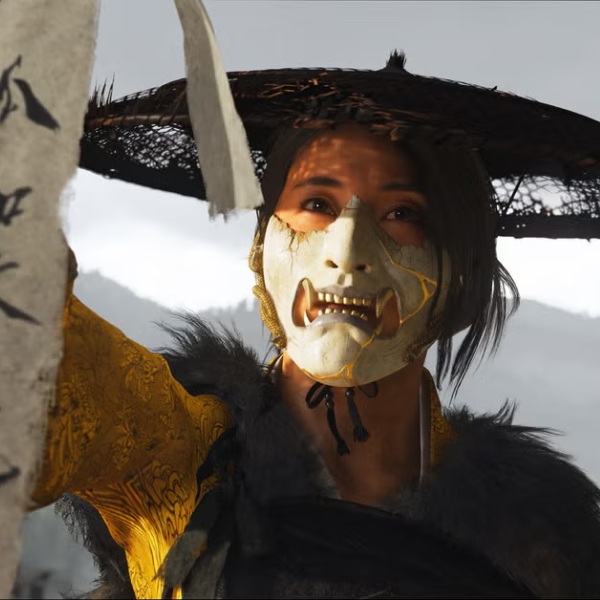
Picking up a video game in 2025 is a real commitment. Nowadays, players demand deeper stories, immersive experiences, and digital worlds that they can lose themselves in for hundreds of hours. Even people who enjoy video games, but wouldn’t necessarily call themselves gamers, find it impossible to finish more than one major studio release a year. So Esquire breaks down the absolute best the medium had to offer in 2025. If you’re looking to experience the best of the best, you’ve come to the right place.
For the second instalment (following our Game of the Year picks), we explored how—in the making of Ghost of Yōtei—Sucker Punch Productions studied the work of legendary Japanese filmmakers to pull off one of the year’s greatest gaming achievements.
A lone samurai summons a pale steed, galloping into view as if conjured by air. The armoured swordswoman, an onna-musha in medieval Japan, saddles on. Click the left stick and feel the PlayStation controller rumble as the horse tramples over verdant fields that lie under menacing purple skies. A storm is brewing over yonder. The camera pulls back. The frame widens. The black bars of anamorphic wide-screen close in on the top and bottom of the screen, squishing Mount Yōtei on the horizon.
If this video game isn’t “cinematic” enough for you already, pause the game. In the settings menu, flip on “Kurosawa Mode” and watch the golden rays of sun and the bright pinks of sakura trees turn black-and-white. The drawing of katana swords and verbal dialogue (either English or Japanese) become compressed, as if heard through an old machine. Where there had been 4K clarity, there is now the noise of film grain. Nothing has gone wrong. Everything is going exactly how it was envisioned. This is Ghost of Yōtei, a true Game of the Year contender if we ever saw one.
“It feels like for many years of our lives, we were preparing ourselves to make a game like this, because of the things we found inspiration from,” says Jason Connell, a 15-year veteran of Sucker Punch Productions and codirector of Ghost of Yōtei. “We watched a lot of movies and got a lot of inspiration to direct what we ended up making.”
A sequel to the 2020 smash Ghost of Tsushima, Ghost of Yotei tells a story of revenge, honour, and duty at the dawn of Edo-period Japan. Both games in the budding franchise have won acclaim from the gaming press for their immersion into the samurai films of yesteryear, not to mention painterly visuals that rival classic art. Importantly, both titles offer alternate modes that up the ante on the player experience to pay direct tribute to the auteurs who shaped the art form: Akira Kurosawa, Takashi Miike, and animator/musician Shinichirō Watanabe.
In 2014, the wind blew in a new direction for Washington-based video game studio Sucker Punch Productions. After a nonstop decade developing the Infamous series, in which players use parkour and X-Men-like powers to streak across cityscapes, the studio needed fresh air. Inspired by samurai films, they began work on Ghost of Tsushima.
Five years after Tsushima’s pandemic-era release in 2020, the series returned with the stand-alone sequel Ghost of Yōtei for the PlayStation 5. It follows a female warrior named Atsu who seeks revenge for her family in 15th-century Hokkaido, then known as Ezo.
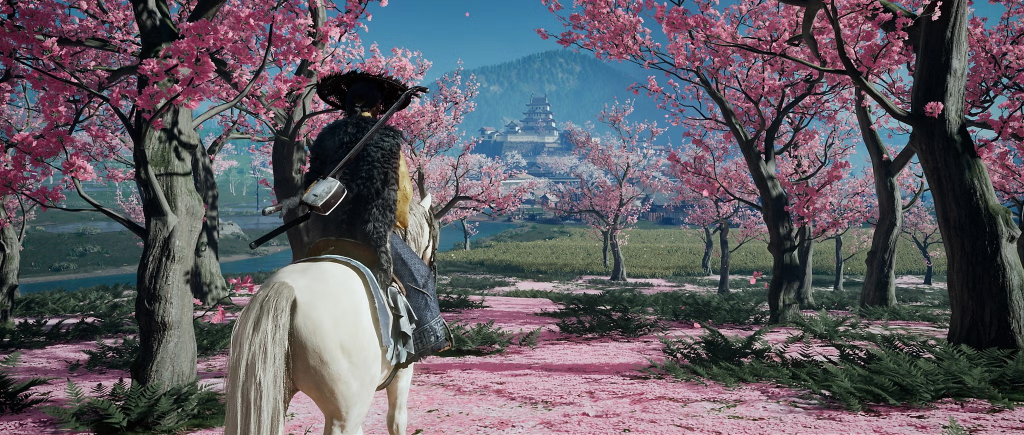
In Tsushima, Sucker Punch paid tribute to Akira Kurosawa with a fun feature: “Kurosawa Mode.” When switched on, the game adopts an extravagant filter that visually resembles an old movie, as if your console were actually a vintage projector. For Yōtei, a tweaked version of Kurosawa Mode returns plus two new features: “Miike Mode,” modelled after splatter-core director Takashi Miike (with whom they worked in direct collaboration) and “Watanabe Mode,” which substitutes the game’s orchestral music for ambient lo-fi hip-hop scored by anime legend Shinichirō Watanabe.
It’s in these modes that you can find the secret weapon of the series, Yōtei in particular. While it isn’t the only video game that marries cinema with gaming—there is also Death Stranding, Red Dead Redemption, Call of Duty, God of War, and Life Is Strange, to name a few—its invitation to play in a simulacrum of a director’s style is unlike anything offered anywhere else.
Ask Connell what movies Sucker Punch studied for the series and you end up with a killer watch list on Letterboxd. The list is made up of canonical Kurosawa classics like Seven Samurai, Yojimbo, and Ran, as well as a smattering of other Japanese fare like Lady Snowblood, Princess Mononoke, and the 2013 remake of Unforgiven. Takashi Miike’s 2010 blockbuster 13 Assassins was a major touchstone that informed how the studio approached combat mechanics.
“13 Assassins was significantly part of our references,” Connell says. “We’ve never made a core melee game before. You got to figure out which lane you want to go in and how you innovate. 13 Assassins is cool in the way they fight. It feels gritty, quick. It’s like a 40-minute action scene. That one we used quite a bit.”
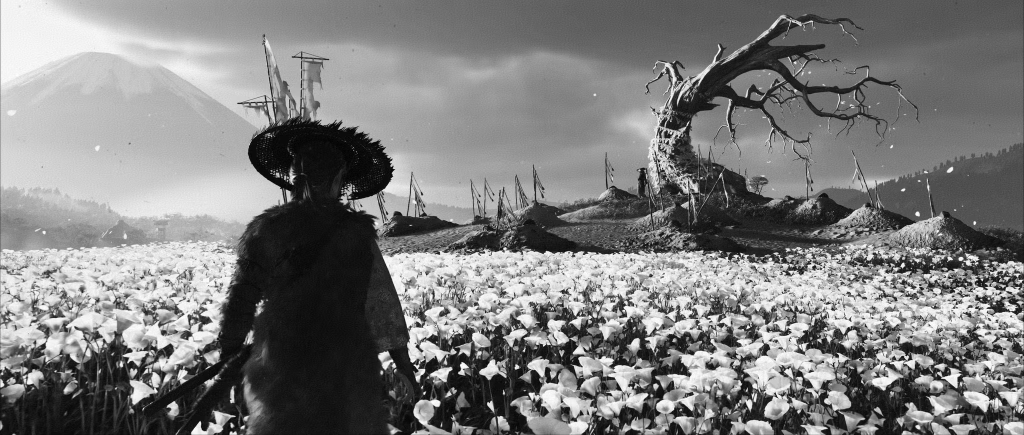
But Kurosawa Mode had broader origins in development. As Connell details, a producer came up with the concept during the early stages of Tsushima. It was meant to be little more than a novelty feature to evoke the aesthetics of classic samurai cinema. The studio spared additional time and manpower to make the suggestion a reality, with Connell recalling he personally performed “tone-mapping adjustments” for it.
“At some point, we realised we had an especially beautiful game,” Connell says. “You don’t know that when you start, but about three and a half years in, there was a moment where you’re like, This game is stunning.”
It’s true: One of the most common points of praise toward Tsushima was its breathtaking art direction. In IGN’s review of Tsushima, the reviewer called the game “an absolutely gorgeous adventure” full of “strikingly beautiful landscapes… compounded by one of the best blade-to-blade combat systems the open-world action genre has seen.”
This self-discovery compelled Sucker Punch to contact the Kurosawa estate, hoping to land “a formal sort of agreement” and put some outside credibility behind the project. “Because it would be great to pay homage to that director in particular,” Connell says. The estate warmly received a pitch reel Sucker Punch presented to them and agreed to lend the Kurosawa name to production. “Suddenly it felt much more significant,” adds the co-director.
Five years later, Kurosawa Mode returns for Ghost of Yōtei. It has been tweaked slightly to better suit the new game’s vastness. “Some of the aspects of Yōtei really come to light as soon as you remove colour,” Connell says. “You’re really just looking at shape and form and contrast.”
He continues, “It really sets the depth into perspective. Yōtei's vastness is something we worked really hard on. There are massive sight lines, more than we had in Tsushima. We pushed it really far this time and spent a ton of time getting details right off in the distance. Putting that mode over something like this actually has a different feel. You feel the depth instantly more. That’s the biggest change.”
If Akira Kurosawa is a name mentioned in film schools with reverence, Takashi Miike is a name whispered like a dirty secret. A director of more than 100 features and counting—he is currently in production with his first English-language film, Bad Lieutenant: Tokyo, starring Lily James—Miike’s commercial success in Japan is built atop an earlier output of hyper-violent, gonzo-fuelled fare. His name is heavily associated with controversial horror and gangster pictures like Audition, Ichi the Killer, the original One Missed Call, and the Dead or Alive trilogy. In 2010, Miike helmed 13 Assassins, an acclaimed samurai epic that culminates in a mesmerising 40-minute finale.
Yōtei was an opportunity for Sucker Punch to pay tribute to their other favourite filmmaker. “One day, I was like, ‘Who else do we want to celebrate?’ ” recalls Connell. “Miike was number one on the list. 13 Assassins had been influencing our game for ten years. Certainly even more on Yōtei, when you’re picking up weapons on the fly.” After a lengthy meeting between Connell and Miike, the director grew excited over a collaboration and even traded ideas with the studio. (Connell says a sword cosmetic in the game was named by Miike himself.)
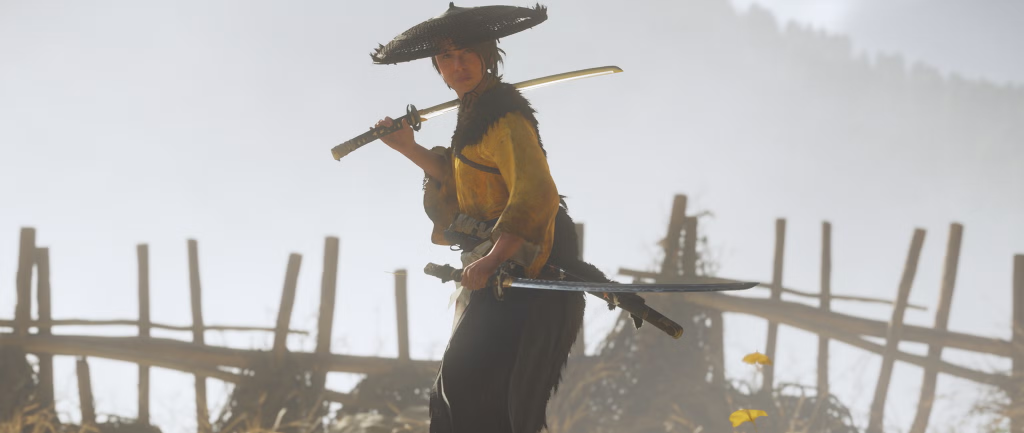
Miike Mode, a flip side to Kurosawa Mode, cranks up the game’s violence and visual style. In addition to tons more blood and mud that spew like geysers, the game’s camera zooms in tight for a more intense and visceral experience. “Our whole idea was that we’d have one [mode] that was all about strong visuals, that would make the combat experience more intimate. He understood our goal. Just hearing his take on what makes an intimate combat experience changed the way [we made things].”
One does not simply dial up the blood levels and punch in the camera without running into problems. For Connell, Miike Mode posed a challenge in that it created blind spots for players. Where players typically see enemies behind or around their avatars, Miike Mode’s tighter point-of-view literally made enemies off camera.
“We have been exploring pushing in the camera for a long time. And it’s hard,” he says. “Ask our combat team: The closer the camera is, the harder it is to see incoming attacks. You want to see those attacks so you can deflect or dodge out of the way. The closer you get, the harder that is. Our entire game is balanced on making sure you can see enough.”
Connell says Miike Mode forced the team to “do a bit of safeguarding” so that it doesn’t feel like the game is cheating players. “Also, because we added so much blood and mud, you go into a cutscene and you might be caked in mud almost too much. We had to sort of knock things down for the cutscenes. It’s all good ideas—there’s just some unintended effects of putting it in.”
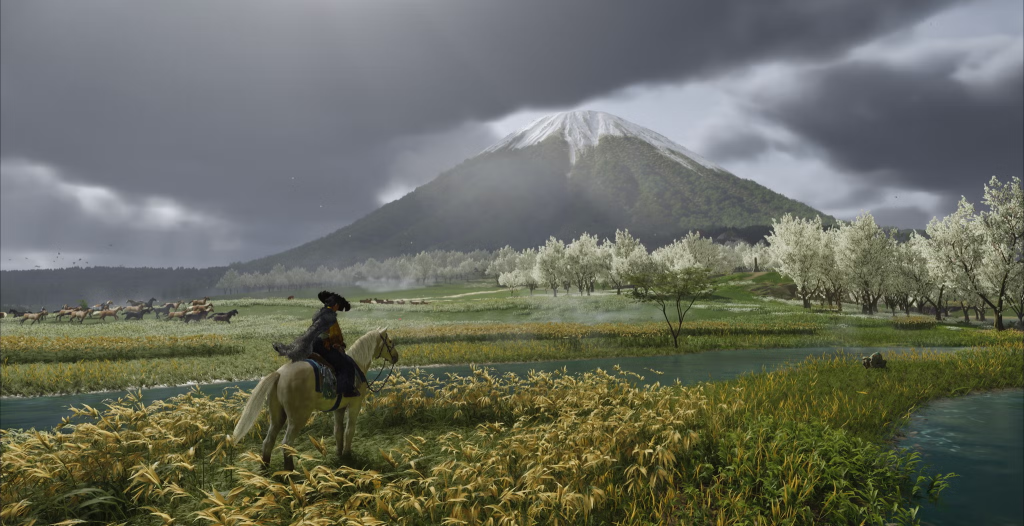
Nothing Sucker Punch is doing with the Ghost series is revolutionary, per se. Rather, it’s a razor-sharp refinement of decades of open-world game design—a meditation in motion on the deep influences world cinema has had on video games as a medium.
There are limits to Sucker Punch’s ambitions. Cinema is the art of creating deliberate images on a flat 2D plane, and the 3D sandbox in which the Ghost games take place cannot be so structured. But the studio is content to colour up to the edges of its boundaries. “It’s incredibly difficult,” Connell admits. “It’s why we don’t really have a cinematographer. It’s so different. But we do care about the cinematic feel.”
He adds, “What we do is break down all the parts of the scene or the frame. What you are looking at, sound and music, the tone of whatever it is you’re experiencing, making sure those things magically fit together. All of those can equal a cinematic feel. Because it’s fully immersive, [the players] have control of the camera, and we believe the more you have control, the better the game is.”
After all, as Connell says, “Otherwise, you would watch a movie.”