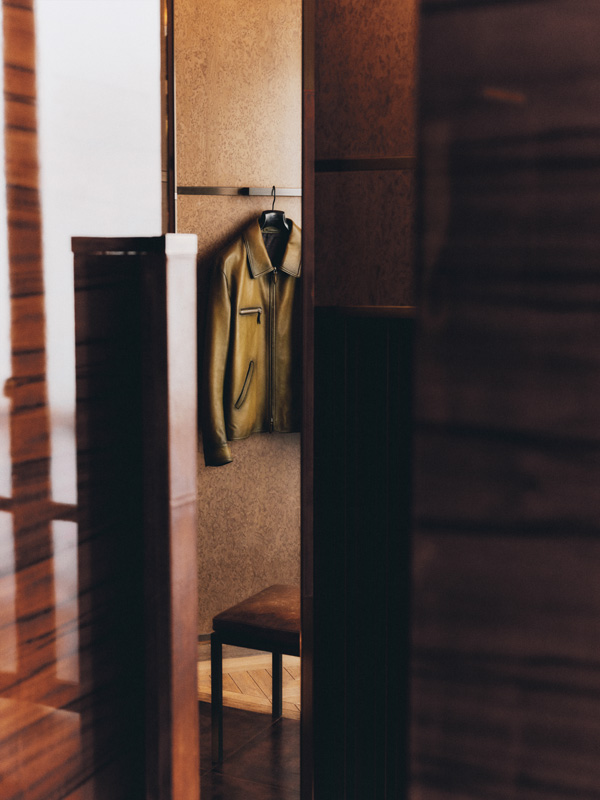
Evolution is the way forward in luxury fashion as it is in life—the best of the best know this and do it steadily. At 130 years in, Berluti has shifted and pivoted multiple times to achieve its current form. What began solely as a shoemaker more than a century ago has grown into a luxury fashion house that places craft and artisanship at its core. Berluti’s original shoemaking expertise has translated to crafting leathers into bags and accessories, while the same level of precision and quality has been adopted for ready-to-wear since Berluti launched it in 2012.
The Berluti universe has certainly expanded, splitting into categories yet unified by the desire for innovation steeped in skilled craftsmanship. And within those categories, stars have burst out as manifestations of Berluti’s design ideals. Their beauty, a result of studied savoir-faire, and appeal signify Berluti’s dedication to combining tradition with a keen sense of the contemporary.
Talbinio Berluti—the grandson of founder Alessandro Berluti—launched the House’s first collection of ready-to-wear shoes in 1959 to resounding success. The collection consisted of popular models of the time that included hunting boots and winter shoes. Never one to rest on laurels, Talbinio was was always searching for the new.
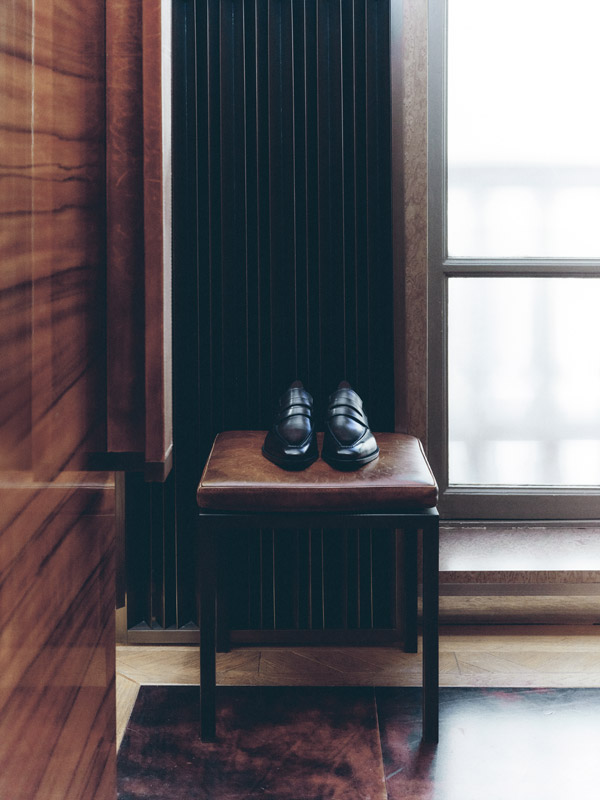
Together with his shoemaker of the time, Jean Bourles (who cut his teeth learning from Roger Vivier), Talbinio travelled to London to discover new techniques and designs. It was there that the duo chanced upon British bespoke shoemaker George Cleverley. In particular, the brand’s loafer, designed with a high strap on the instep, proved to be an ingenious way of levelling up on comfort of wear as well as better support. This inspired Talbinio and Bourles on a project the latter was working on for industrialist Serge Dassault at the time. Dassault wanted a pair of shoes incorporated with the fuselage of one of his aircrafts. The Andy loafer was then born.
At least that’s how one story goes. Because another legendary story by Olga Berluti tells of how Andy Warhol, the king of Pop Art himself, was the one who sketched the design for the loafer in 1963. Olga was said to have scarred the leather for the Andy with barbed wire to highlight the transgressive nature of the shoe—a square-toed loafer with a high vamp.
No matter which version of the story is true, the Andy loafer is a true Berluti signature, one that continues to inspire and re-inspire.
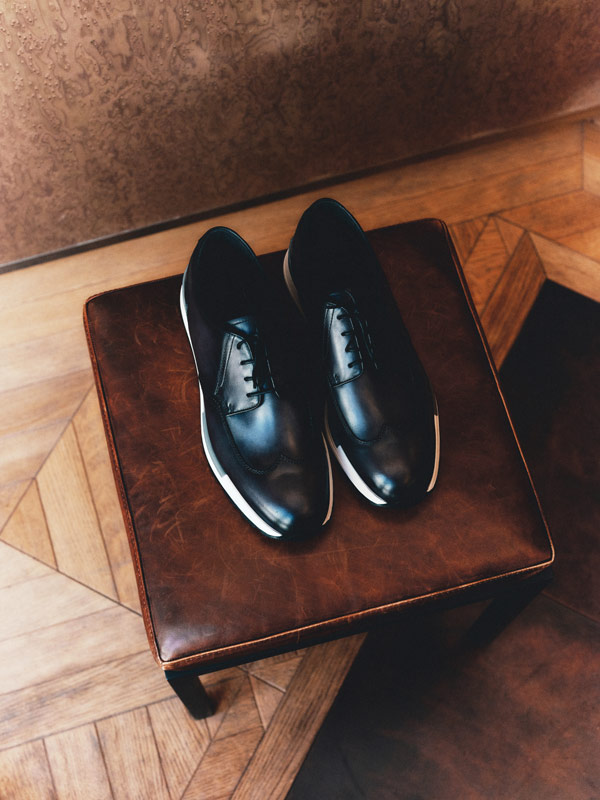
If the Andy loafers were considered subtly irreverent, the Fast Track defies traditional notions. Unveiled in 2016 by then-artistic director Haider Ackermann, the Fast Track is a curious invention that further propelled Berluti’s ethos of crafting hybrid fashion. While the upper of the Fast Track takes on the shape of an Oxford-style rounded-toe that’s sleek and rooted in traditional shoemaking, the shoe is mounted on a sole typical of a running shoe.
There’s no denying that the Fast Track is jarring and striking. The juxtaposition of the upper and the sole were amped up even more with the addition of bold-coloured contrast on the heels of the originals. Newer versions of the Fast Track are more refined, yet still with that rebellious spirit of a formal shoe- sneaker hybrid apparent from almost every angle.
The Fast Track is the most obvious embodiment of Berluti’s fascination with tradition and the contemporary. It’s a star on its own right and while it may not be for everybody, it’s certainly for somebody who values style as well as comfort.
When Berluti acquired Parisian tailoring house Arnys in 2012, it also acquired the Arnys Forestière. Designed by Léon Grimbert, the second-generation heir of Arnys, the Forestière is (once again) a hybrid jacket that blends formal and informal codes inspired by the intersection of workwear and hunting wear. Léon’s son, Jean, revived the Forestière in the late ’80s and reimagined it as a more streamlined jacket. He stripped away any military-inspired elements, added light padding and elbow reinforcements, and fitted in roomier sleeves.
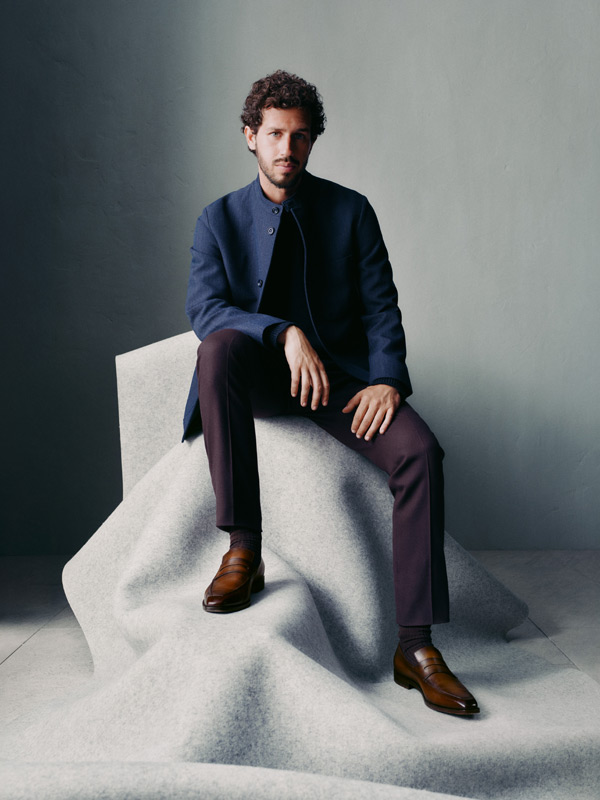
The Forestière received an update post-acquisition. In 2013, a new version was revealed and designed in collaboration with Jean, highlighting the quality of the materials. Buttons are crafted using patinated horn and are reinforced with leather-backing, sleeves are lengthened slightly so that they can be overturned to reveal a hint of contrasting lining, edges are piped with leather especially on the interior, and the jacket’s defining mandarin collar updated with a leather-trimmed buttonhole. And of course, the Forestière’s base ranges from cashmere corduroy to 100 per cent wool flannel to pure cashmere—each a testament to the level of quality Berluti is known for.
“A bag, by definition, is something we set down and carry, unlike shoes which are an extension of the wearer—they present and announce him,” said Olga Berluti. And such is the case of the Deux Jours (Two Days) bag that was designed by Olga, inspired by her husband’s travel needs.
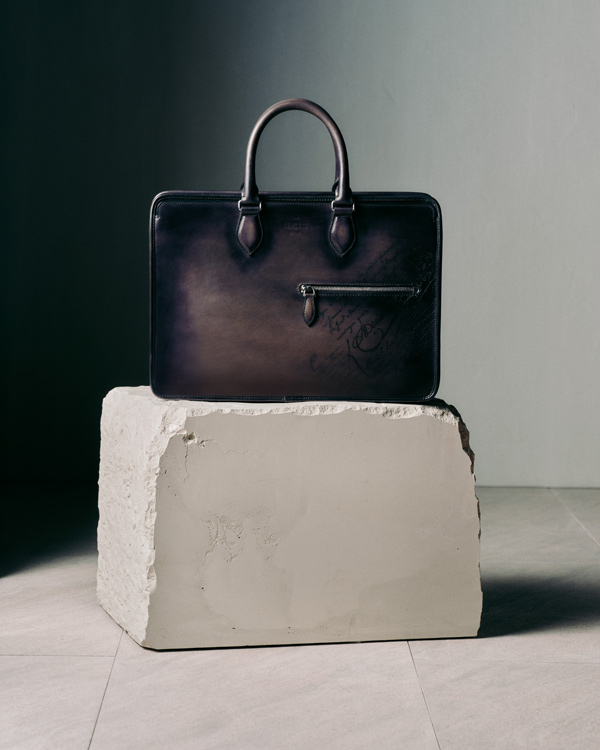
The Deux Jours is meant to be an ideal companion for a well-organised 48-hour getaway. The advent of increased mobility and the automobile meant that a man’s travel bag had to evolve. Designed with intention, the Deux Jours consists of two separate zipped compartments thanks to a double-gusset construction that’s roomy but hardly bulky. The idea is that one compartment is used for documents and the other for a man’s personal belongings. The overall shape is almost too conventional with its rounded corners and briefcase-like appearance, but the addition of an external zipped pocket positioned off-kilter adds a touch of irreverence.
Crafted using 142 individual pieces, the Deux Jours is also made to be comfortable to use. Its tabs are filled with a polymer that feels foam-like to ensure that these touchpoints are soft and luxurious. The handles too are soft to hold and are reinforced with polyester on either side to strengthen the joints.
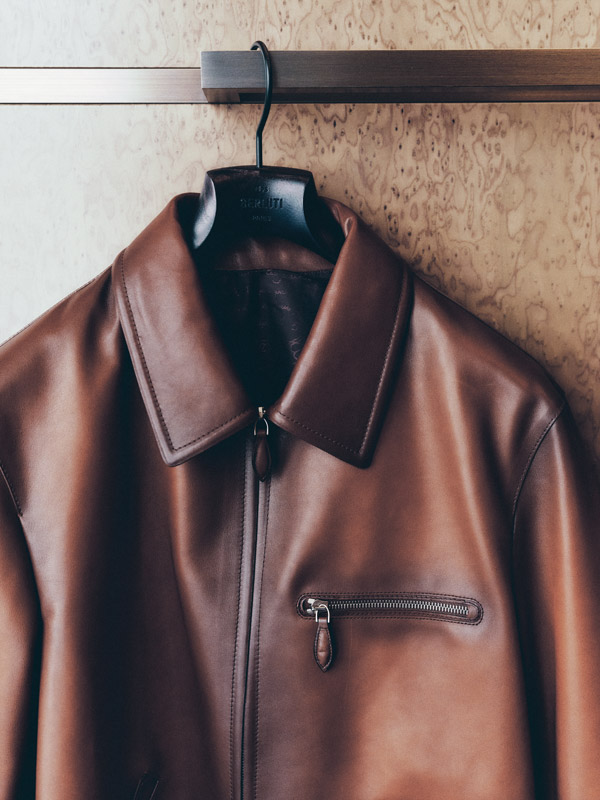
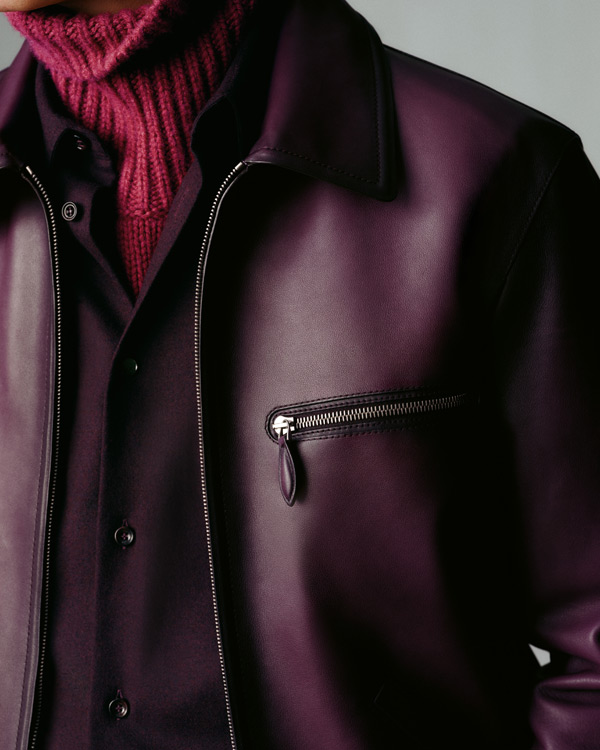
Like second skin, the Un Jour jacket combines the best qualities of leather with the technical know-how of Berluti for a piece that is truly special. Inspired by the bag of the same name, the Un Jour jacket was initially designed by Alessandro Sartori as part of the House’s first ready-to-wear collection, before being interpreted by Haider Ackermann and then Kris Van Assche. It’s the latter’s version that has stood the test of time, imbued with the patina that’s a signature of the House.
The Un Jour jacket, like most of Berluti’s leather creations, begin with the right leather selections and treatments. At the tannery, the leathers need to be given proper attention to ensure that every process is precise so that the resulting pieces are as supple and soft as possible. They are then selected to be matched to be cut into the different panels of the Un Jour jacket. The patina is brushed onto the leather with absolute precision as the leather absorbs colour almost instantly, and then once again, touched up after the jacket is assembled—all to ensure consistency. The result is a jacket that looks like a piece of art and feels featherlight.