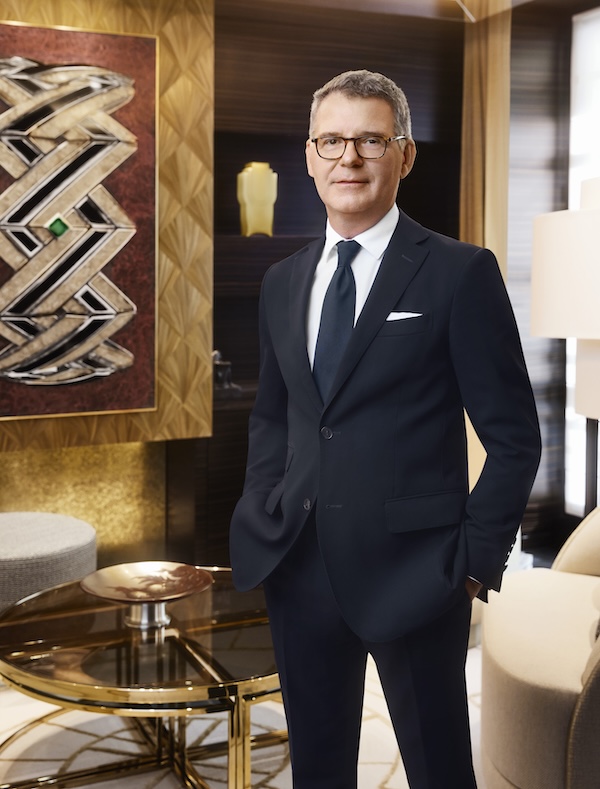
Pierre Rainero has the kind of title that sounds as though it belongs in a Proustian salon: image, style and heritage director at Cartier. But behind the poetry of the label lies a serious mandate—as custodian of the Maison’s mythology. Here is a man who ensures that the Tank model remains as recognisable in 2025 as it was in 1919.
For more than four decades, Rainero has witnessed and shaped the modern evolution of Cartier, including the revival of its iconic watch families such as the Tank and Santos. As the keeper of Cartier’s flame, navigating the tricky intersection between reverence for history and the necessity of relevance. His position requires him to guide the creative teams so that every new watch or jewellery remains unmistakably Cartier, while also ensuring that the Maison’s history isn’t trapped in vitrines but remains a living source of inspiration.
At this year’s Watches and Wonders Geneva, amid the endless carousel of new releases and industry fanfare, we sat with Rainero about their release of a larger Tank LC and the newly designed and limited Tank à Guichet. Candid and speaking with the exuberance of someone who hasn’t fallen out of love of what they are doing, we present Rainero’s thoughts on novelties, Cartier’s house style and everything in-between.
ESQUIRE SINGAPORE: Given Cartier’s extensive heritage, you also want to push the boundaries of what watch designs could be. How do you decide when to revive a classic model piece, and how would it be relevant now?
PIERRE RAINERO: You’ve said it. The key word here is “relevance”. It is our nature to go forward and to create but, of course, not only as a philosophy but also in design. We strive for what we call “internally strong design” and that relies on different aspects.
Originality; it has to be different things. And it has to be relevant, let’s say, towards our own identity, which is a Cartier identity. But at the same time, it needs to be a design that’s not linked to an immediate trend. Even though it is relative, we come up with a design that is interesting and desirable, but also globally strong enough that it transcends time.
Part of the strength of a design is that it should be an open door. This means that the design should have its own capacity to evolve into many different variations. Our founder, Louis Cartier, called it the “mother idea”—a good idea that could lead to many different children or variants.
ESQ: What are some of your designs that are timeless?
PR: The Tank is still in production. So is the Santos. We think that some designs are so strong that they are still relevant today. And some designs can be relevant without being altered. That was the case when we represented the Panthère in 2017. We thought, ok, what should we do with the design? Does it need to be different? Have a different proportion? And the answer was, no. It’s perfect as it is.
So we didn’t change anything, except for the engineering, like updating the movements or making the waterproofness better. We integrated many technical progresses, but in the end, the design is exactly the same.
ESQ: What about the Santos model?
PR: When we launched the model in 2018, we proposed that the Santos has both a bracelet and a strap that you can switch out very quickly. It’s for people who want to wear a watch that reflects the different occasions it’s in. We also redesigned the bezel so that it isn’t a frame around the dial, but it announces by its shape, the presence of a bracelet. It’s a little detail, but that changes the appearance of a watch.
ESQ: Because Cartier has very recognisable aesthetics, do you find its design rules limiting?
PR: That is a very interesting question... I don’t know if there are “rules”. We think of style as a creative language, a living language. You have your permanent elements—the grammar—in that language, which are the founding principles, like the sense of proportion. Then you have the vocabulary, which, in our case, are the aesthetics. For wearable objects, we are looking at the ergonomics, the comfort and the way a piece looks on you when it is worn. The watch [or jewellery] should look easy, meaning that it should not look like it was forced onto your body.
Every Cartier object has a natural position on your body. It does not constrain your movement. On the contrary, it should be in favour of your body movement. It should be naturalistic.
To answer your question, the “rules” are an opportunity. Take a writer, for example. They write in their own language. It doesn’t constrain; rather, it’s a way of expression. It doesn’t prevent them from being creative or writing that novel. [Leonardo Da Vinci] said that “art lives from constraints and dies from freedom”.
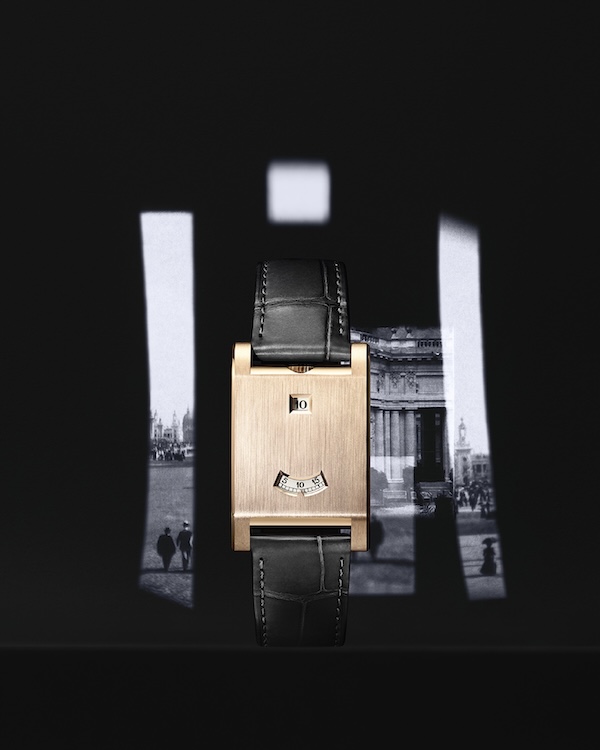
ESQ: Can you talk us through the Tank à Guichets’ dial, especially the new positioning of the windows?
PR: This is very interesting. I don’t know if you saw the windows in our two previous models—a small piece from 1931 and one from 1996. The 1996 model is more or less this piece with sliding minutes, touching the window of the hours. First, we think that separating [the windows] makes reading time easier. The proportion lets it occupy the space in the right way. There’s also a sense of harmony that’s not necessarily linked to symmetry. That’s why we wanted something asymmetrical and also with a certain logic of how you read the time; you read the time with the hours at top-left, and then to the minutes on the bottom-right.
When we saw the first design, we knew it worked. Again, it’s our own sense of what is beautiful.
ESQ: What about the crown?
PR: Louis Cartier wanted the Tank to have the sense of essential shape—a watch with two brancards and a strap, that’s it; there’s nothing simpler than that in creating a wristwatch. Then, in 1928, he made it even simpler, reducing the way you read the time to little windows in a “block of metal”. Following that logic, we decided to hide the crown. Instead of it being at the side at three o’clock, it takes position at 12.
ESQ: You’ve a larger Tank. How can you explain to the layperson that there’s more to just making the Tank dial bigger?
PR: The objective was not to make it bigger; it was to have an automatic movement. So, when you have an automatic movement, you’ll need a bigger watch to contain it. The challenge is to have a thin watch house the automatic movement. This is the second time in the life of a Louis Cartier model that we have an automatic movement.
In 1972, we launched the Collection Louis Cartier. It was a line of different solid gold models with a leather strap. New shapes like the Ellipse and the Gondole. It was proposed that there needed to be a watch with an automatic movement, but at the time, the automatic movement was rather big. The model was called Jumbo, and underneath the dial, you can see what we call a “basin” or “bassinet” in French. [Editor’s note: It looks like a protrusion that can hold the automatic movement.] I remember my friends who take off that watch at the end of the day, and there’s a round indentation on the wrist. We didn’t think it was elegant, and that’s why we were waiting to develop the right automatic movement to be used.
The result is the Calibre 1899 MC. Even though it’s slimmer, we had to increase the dial to fit in the movement. In the world of watchmaking, the Cartier Tank LC isn’t that big, with a 38.1mm diameter and an 8.18mm thickness.
ESQ: You mentioned elegance in the design. Have you been tempted to create something that challenges the conventional idea of what beauty is, just like Crash?
PR: On the contrary, in a way, Crash has a sense of beauty. It’s what we call “the beauty of the accident”. In the world of jewellery, we have encountered many “beauties of accidents”. Take opal, it has so many colours with different repartitions, and we like that, because it’s the basis for incredible creations. In the case of Crash, it’s taking a classic Cartier oval shape and crushing it; to play with it, there’s a sense of irony to it. The buyers who go for Crash share that same sense. The shape is intriguing on its own, but it doesn’t break the code of elegance. On the contrary, it shows an open-mindedness in the people who wear it.
ESQ: You’ve been with Cartier for a very long time. Could you walk us through what it takes to bring back an old design?
PR: It’s a question of feeling. Because there’s no recipe to know exactly what would be a success or not. The only thing that is really thought through is the balance in our range. What we put out should cover different possibilities. We want to have a balanced showcase among differently-shaped watches, different sizes, different metals and things. That’s the constraint.
It’s part of an exchange with my department. We have the content, the knowledge... we can have a discussion with the creative department on a regular basis. We have a creative committee, and very often we share a common vision—what should we do, which model should we give priority to.
ESQ: Is there any part of reviving something from the archives that could be improved upon?
PR: For me, it’s always stimulating because of the challenges. Like the automatic movement in the Tank LC, or the reengineering of the Panthère, it’s interesting to take into account what we want technically and what we want aesthetically. How can we manage the two, between the designers and the manufacture.
What I do appreciate is the commonality between the two. It’s not pitting one department against the other. I appreciate the desire of a manufacture to be stimulated, and there’s a satisfaction on their side to [have their way]. I think it’s very reassuring. There’s a kind of pride, a common spirit, and this, for me, is the most rewarding aspect of my work.
This interview has been edited for length and clarity.