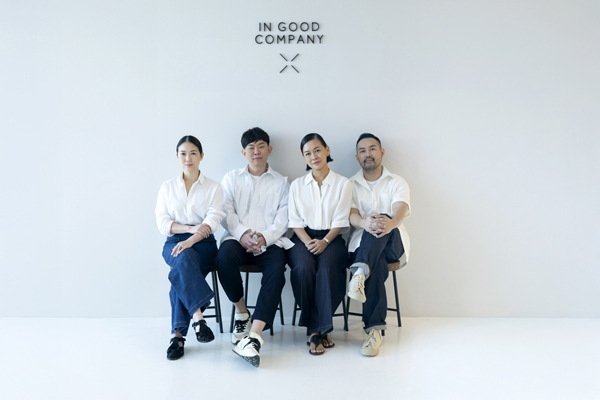
The moment you step into the atelier of In Good Company, you’re greeted with a deafening stillness. It’s quiet, almost too quiet for a fashion atelier. But in that silence sit its four co-founders: Jaclyn Teo, Julene Aw, Kane Tan and Sven Tan. Speaking to them, you understand why the environment is such, even if it is three days before the brand’s first solo runway show.
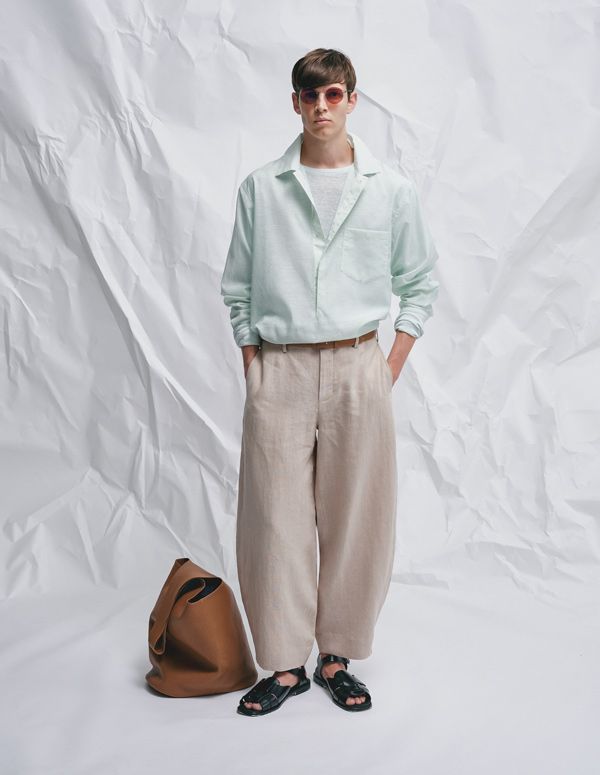
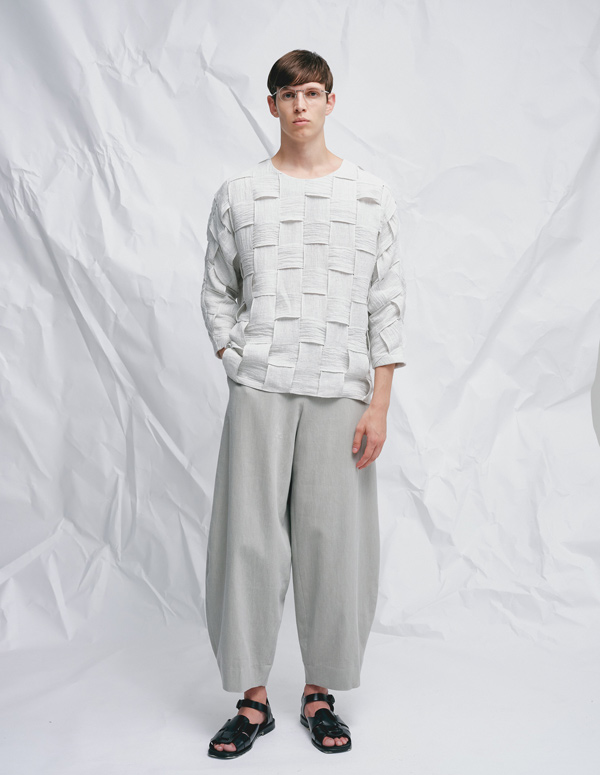
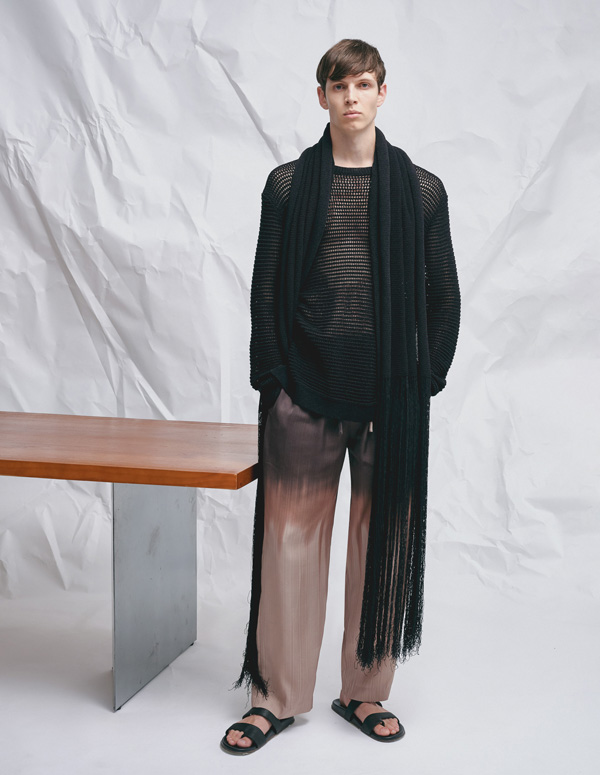
Creative director Sven gives a passionate walkthrough of the 70-piece-strong runway collection, In Between Light & Form, taking time to point out the complexities of the craft behind some of the pieces. Almost in hushed tones, he describes the meticulous process of how a men's woven top had to be crafted in precise ways to result in a sample that's worthy of being shown, despite it looking "rather simple". That's the beauty of IGC; the minimalist, silhouette-driven designs are often deceptively simple but upon inspection, that's hardly the case. The clothes are quiet on the outside, but they brim with stories—much like the co-founders.
ESQUIRE SINGAPORE: IGC launched its first menswear collection in 2016. How has the menswear aesthetic evolved since that very first collection?
SVEN TAN: I think similarly to the womenswear collection, we have kept pretty much the same ethos about designing pieces for the everyday—elevated but still subtly expressive. We play with proportions, fabrics and cuts. But I think now as compared to... when did we launch the menswear collection?
JACLYN TEO: 2016, 2017.
ST: Maybe compared to when we first launched, there are more menswear and womenswear brands that have simplicity and modernity sewn into their DNA. We don't see them as competitors; rather as peers. But then, how do we compete on different levels? I think the way we approach design is, perhaps, on a deeper level. Like with the pieces I just showed you, some demanded a fair amount of craftsmanship and showcase the level of craft for them to look more obviously elevated.
JT: Also, we didn't start menswear intentionally. It came from a personal place because we started with Mini Me (a childrenswear line), stopped it and then started menswear It all began when both Kane and Sven were awarded the Singapore Design Award's Designer of the Year and they didn't have a men's collection from IGC to wear. I think it also comes from a personal aesthetic, like what they would want to wear. Because they've been designing womenswear for the last 20 years. Has it been 20?
ST: Yes.
JT: So going to menswear was initially a little bit of a, I'd say, resistance.
JULENE AW: Laughs.
ST: Because Kane and I were trained in womenswear. And I think menswear at that time was at a very different place. Tailoring was very strong and typically, the production of men's clothes and women's clothes were very different. And from the sampling to the production, we didn't have that. You may be able to design menswear, but what's the point if you can't sample and control? Because a big part of our craft is dependent on our being able to control the sample. We had to approach menswear with a different eye, but still made it obvious that it's menswear and not womenswear. That was a bit of [ambiguity], and we had to toe the line very, very carefully. I think finding a niche in the market for menswear was a journey. Now, we have kind of grown a dedicated following of men who, if they buy into IGC men's, they buy into IGC men's. It's quite heartening to know that.
ESQ: There's this design-centric approach to IGC. What are your constant sources of inspiration?
ST: Predominantly people. We look at art and architecture. But for me, it's always about the people. I think about the wearer a lot. I think about whether something that I make would be relevant today, six months later, 12 months later. I like architecture and art, but I find that in recent years, it's the smaller details that trigger me more than the overall form or something that's very grand. Like how a collar would look when it's flipped, or a sleeve—small details like that. For me, subtlety is more expressive than being over the top.
ESQ: What is the usual starting point of a collection?
ST: Fabric. You can have the perfect cut, the perfect proportion, but if you use the wrong fabric, then you have to resample. You have to restart. Yeah, fabric is a very important starting point for me. I think for Kane, it's slightly different.
KANE TAN: Usually, it starts from the drape on the mannequin. I will use a random fabric to play on the mannequin and then decide which fabric is actually suitable for this.
ESQ: I'm curious to know who comes up with the names of the garments because it's... I mean, there are a lot of names.
ST: Me! [laughs]
ESQ: Is there a system involved, or just like, oh, this looks like, I don't know, a Brian.
JT: Most of the time it's like that, right?
JA: So if you find your name there... [laughs]
ST: Twenty per cent is from Netflix. [laughs] When I named a top Tokyo, it's because I had been watching Money Heist. I watch all kinds of shows—good and rubbish ones. If there are a lot of Japanese shows, it means a Japanese name will come up. Sometimes, it's also people. I think we started from style 001—that was the first style we did. It was a shirt. Now we are at 2,767 styles so that's 2,767 names. There was a dress called Maricon, named after our staff, that was released on the day she got married and it reminded me of her. So when they came in for training, I said, "Maricon dress. And then she's like, is it me?
ESQ: The first IGC physical store at lon Orchard has held up for 10 years now, which is actually a feat given the multiple challenges in the retail landscape. How does this milestone feel?
ST: It is also one of the reasons why we decided to host the runway show. It's to mark the milestone in a meaningful manner for us and our long-term partners. It's definitely not easy to remain, like you mentioned, in a prime location for the past 10 years. What helped manifest this is our consistency, in terms of design, service and quality. It's important that we maintain that standard.
JT: Ion is special because it gave us an opportunity. The space marked the beginning of many collaborations that we've had in the past. Like Plain Vanilla [a café]—as long as we've been in Ion, they've been with us. We grew our roots there, you know, and it's a space that has evolved over time as well. When we first started out with childrenswear, we had a children's play area, and now it's changed.
ESQ: We're in your in-house atelier in Singapore. Why was this important to set up instead of outsourcing to other manufacturers?
ST: It is about control and efficiency; about maintaining the consistency and the standard. For us, it is really, really important to perfect every sample and not have to go through the hassle of communicating it to the factory. It's the most efficient and accurate way because, at the end of the day, the product is the most important thing that we get right. Without the right product, everything else doesn't matter.
ESQ: How many people work at the atelier?
ST: Kane manages the atelier. He works with the sampling team closely on a daily basis. We have one drafter and two sampling machinists, and we have a production merchandiser who liaises with the factory on production.
ESQ: Thats a very lean team.
ST: Very lean. That's why I told everyone they have to give me six months, otherwise we cannot do the show [laughs].
ESQ: When you said lean, I definitely was not expecting a team of four.
ST: But they are very efficient.
ESQ: And have they been working with IGC for a long time?
JA: Yes.
ST: Very long. One of the machinists has been with us-
JT: Since the beginning.
ST: Since the beginning, yeah. She's been with us even from our previous workplace, so we've known her for 20 years. There are two of them who we've known for 20 years.
ESQ: You're right in the midst of preparing for the runway show. What's the approach like?
ST: It's the right time because we have been... a very introverted brand. We are very introverted people [laughs]. We don't talk about ourselves. You can look at our Instagram; we are literally silent.
JT: You can't find us on LinkedIn [laughs].
ST: Can, lah.
JT: But it's not updated.
ST: It's also to celebrate this milestone of our journey and to encapsulate what we have always stood for in terms of the brand and our beliefs. For the runway show, we decided not to make it about ourselves. We're working with local musicians, local production team to shoot the video, local creatives on accessories and bags, and local photographers and videographers.
So it's like a celebration of what we have always believed in, which is community and bringing local creatives together. We hope that it would also kind of give a positive signal that being a creative business in Singapore is not all that dull and gloomy, you know? You can do something good together.
ESQ: How are you feeling about the show now that we're only a couple of days away?
ST: Quite calm, actually.
ESQ: Really?
JT: Oh, he's been very good. He said he would want to finish the collection in July, so that he has one month to prep for the show. So they were actually quite on schedule. I think it's given him a good headspace.
ST: The beginning and the in-between moments are the hardest. Those are the most stressful moments when you are sampling the collection midway, but once you get to a certain stage, you sort of have more clarity, you kind of feel a bit more secure, you know? [laughs] Fewer nightmares.
Then it gets to a point where you fill in the empty spaces to make it all work and be cohesive, before finessing it. But it's completed, that's why now it feels quite calm [laughs].
ESQ: Is there a reason why it's 70 looks?
ST: We initially decided on 60. There's no actual fixed number but we did extra pieces and while we were doing the sequencing, we thought that 70 felt more cohesive. We could have edited it even tighter, but we find that this is the best way for the story to flow.
ESQ: All four of you have worked together for decades now. Obviously, there's a certain established rhythm in working together as a team for so long. Are there still disagreements that happen from time to time? Who usually has the final say when it comes to that?
JA: No one person, really.
ST: I mean, we don't scream and shout at one another...
JA: There are bound to be disagreements, it's part of being individuals.
ST: From day one, we have always maintained a….. I don't know.. boundary? For example, when it comes to merchandising, if Jaclyn decides not to produce this piece, even though it's a very important piece to me, then ok lor, don't produce. You have the final say on that because you are merch, right? But don't stop me from sampling it because I'm in-charge of design [laughs]. For Kane, you don't tell him how to make it because that's his thing. It's respect for our designated fields.
JA: And trust.
ST: I used to work with the sampling team more; now it's much less. I took over the art team and work with our graphic designers, so when it comes to making, I trust Kane to make sure that the best effect is achieved.
JT: We've also worked professionally and a friendship has formed from work. We've poured in many long hours before we started this, so that level of respect and understanding of one another's work ethics and values and all that, has always been there. That kind of formed like the foundation when we started IGC.
When we're faced with decisions, it is unanimous. We have to be comfortable with an idea, otherwise, we cannot go forward with it. And if we're not comfortable, we sleep on it then talk again the next day. We always respect one another's thoughts and perspectives because we bring different ones.
ST: Julene and Jaclyn work with the store team the most, a lot more than Kane and I. Sometimes they will come with feedback that gives us that intel of what's really happening at the store because that's really, really important. Also, sometimes when we have problems, we know who to look for on different matters.
JT: And actually, we're all quite different.
JA: Different personalities.
ESQ: You mentioned getting on-the-ground feedback. How often does that happen?
JA, ST: On a daily basis.
ESQ: Does that also change how you come up with your collections and designs?
ST: Yes and no. Maybe I'm a bit more seasoned now as a designer, so I have my own take. You need to sift out the information and take it on a very neutral basis, but collectively we take in feedback almost on a daily basis. It's very important.
JT: The feedback comes in different forms. There are the qualitative ones that are based on on-the-ground observations, and we also look at data a lot. We always look at the numbers and they tell us whether something works or not. If something works, how can we reiterate it to something that's greater—we'll give it more longevity in different materials and stuff like that. So data is important for us.
ESQ: IGC is rooted in the idea of collaboration. All four of you are collaborating on the brand, and you also highlight other local brands, especially with the current setup at the lon store through pop-ins for local brands. Why is this important for IGC?
JT: It's a good playful take on the brand. For us, of course, we anchor the store with IGC, but we feel like it's good to champion people who we think are creative and are actually making something quite special. We like to showcase that and present them to our audience. It's like a bit of a discovery.
I think that stems from the fact that we came from a background of multi-label luxury, and that element of discovery is something that I think is quite interesting. It's not just discovering our collections, but also other local brands that are interesting from all different design disciplines.
JA: Be it the F&B space, accessories, beauty, etc...
JT: Because consumers are also multifaceted, right? They don't only buy fashion. There's that element of lifestyle. And In Good Company, the name itself is about being in company with likeminded creatives and coming together and sharing that space.
ESQ: All of you can answer this individually. What still keeps you going? At 10 years old, relatively, IGC is still quite new.
JT: It feels like it! [laughs] But we've been in the fashion industry for about 20-odd years now. For me, it's a genuine passion for retail. I don't really like shopping, but there's something about being part of that creative process, even though I'm not a designer.
ST: I think it's also passion for me. I can't see myself doing anything else. The journey of a fashion designer in Singapore is very, very tough. There are way too many hurdles to cross in order to do what you want to do.
I'm always grateful for whatever experience and learning that got me to master this craft at a certain level, and to do what I love.
JA: For me, it's the evolution of the consumer—how they buy—and keeping pace with them. The passion to actually find out what's the next new thing, and understanding consumer behaviour.
KT: I enjoy doing things with my own hands. I like to craft. I usually don't express myself in words; I express myself in the things I do.