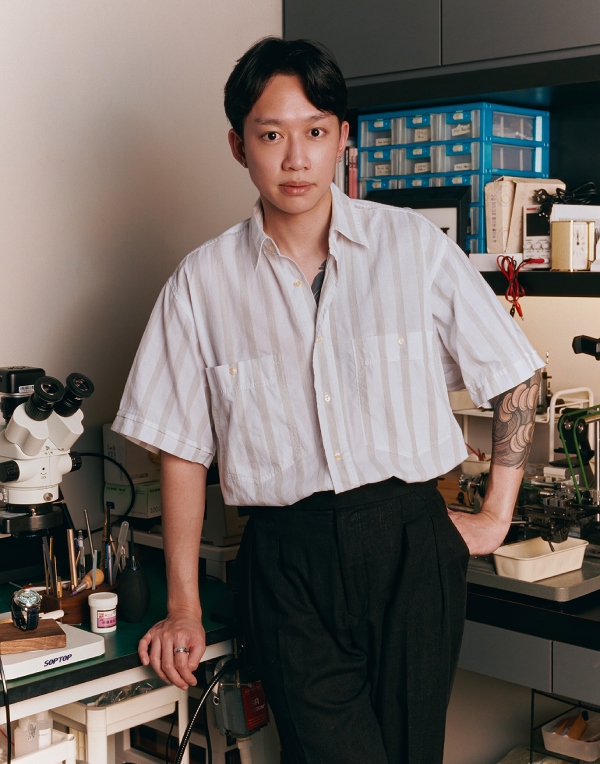
For so long, the artisanal watchmaker has been a myth in Singapore. Sure, there have been the privileged few who studied watchmaking in Geneva, but they usually go on to join established watch brands overseas. The country has also seen its fair share of local micro watch labels—most of which design their watches in-house, while others even craft exquisite hand-finished dials which require painstaking patience. Then there are the rare few who manage to hand-assemble a calibre with the borrowed expertise of trained watchmakers.
But no one in the country has been able to master each horological discipline and channel it into a purely artisanal local brand—until now.
By day, Tristan Ho works as a research assistant in a biomedical laboratory, performing diagnostic tests and peering through microscopes to study cells and tissues. By night, the 28-year-old peers over another kind of microscope—this one for modifying and assembling watch calibres from scratch, gouging designs onto dials, and polishing every plate of a movement, all entirely by hand.
On the second-storey enclave of his family’s terrace house, the NUS alumnus taught himself the fundamentals of watchmaking through YouTube tutorials and mentorship from fellow independent makers across the world. From there, he birthed LOTH—short for “Lab of Tristan Ho”.
It was here, in this little enclave, that we sat down with him to talk about his rather newfound obsession with watches, his struggles with imposter syndrome, and even the type of sounds he fills the silence with while working under the warm glow of his workbench.
ESQUIRE SINGAPORE: What sparked your obsession with watches? Was there a specific moment?
TRISTAN HO: It started three years ago. I was on holiday with my girlfriend, and we walked down these streets selling counterfeit goods. I saw a shop selling fake Rolex watches. Back then, I knew nothing about watches—just Seikos or G-Shocks that my dad passed down to me. But I knew Rolex was expensive; it’s a flex piece.
So, this guy was selling fake Rolexes with ceramic bezels and automatic movements for around 100 plus Singapore dollars. I thought it was a good deal, but my girlfriend said no. I came back empty-wristed but with the itch to buy my first big boy mechanical watch.
I spent days researching the best value-for-money watches. I realised a lot of brands use a SGD400 movement, repackage it, and sell it for SGD3,000. I couldn’t justify that. So I started making my own watches.
At first, I did Seiko mods—buying movements and parts, then building watches. But it wasn’t enough for me. And you know how sometimes, Instagram, when they pick up that you're interested in something, they push it to you. So they started showing me all these very expensive watches, which I couldn’t afford. But seeing the hand-finishing on those movements, it awakened something in me. I wanted that on my wrist.
So I looked up independent watchmakers like Felipe Pikullik. I studied their videos, bought the tools, and tried it myself. That was around two years ago when I first started touching the movement.
ESQ: The intrigue people feel with an item they chase usually fizzles out after a while. How did this interest balloon into what it is now—an obsession?
TH: I think this has always been something deep down that I wanted, but I never knew. In the Singapore education system, you don’t stumble upon something like watchmaking. But as a kid, I loved building things with my hands. My parents always bought me Lego sets, and I enjoyed creating my own combinations.
ESQ: Being a self-taught watchmaker, was it lonely at first?
TH: Early on, a bit.
Actually, not really. I was fortunate to meet my first friend in the watch industry, Wan Yu, a watch photographer who used to work for Sincere [Fine Watches]. She introduced me to people, and then my network grew.
ESQ: Have you ever felt imposter syndrome compared to formally trained watchmakers?
TH: Actually, no. I think I’d only feel that if I were overpricing my watches. But I feel they’re reasonably priced. If anything, I sometimes worry I’ve priced them too low.
ESQ: You spend around 150 hours on each watch, right? And sell them for around 6k?
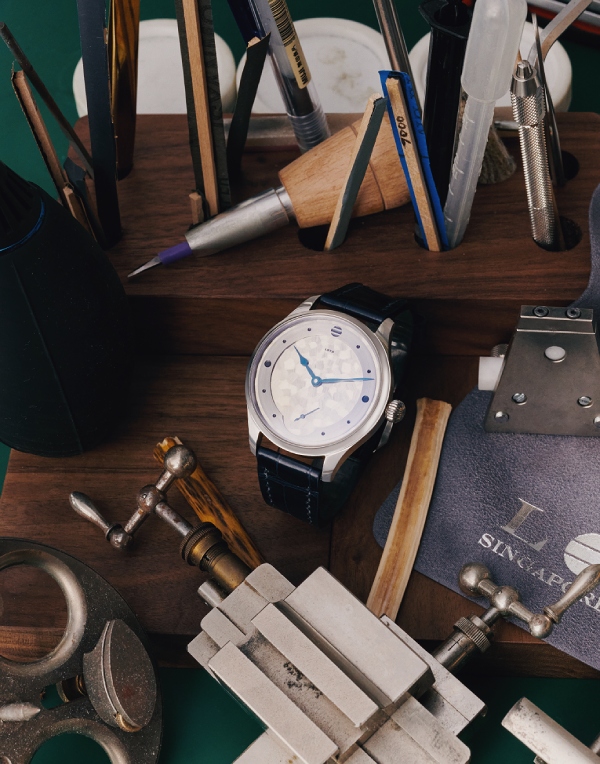
TH: Yeah, 6k. Considering the materials—German silver dial, German silver movement—you won’t find a watch under five figures with that. And with this level of hand-finishing, it’s impossible.
ESQ: Do you hope to one day receive formal watch training?
TH: No. A lot of people ask if I’ll go to Swiss watchmaking school, and I always say no. I want to build something from scratch here in Singapore. Partly because I want my story to inspire other Singaporeans who may not have the resources to study in Switzerland. It’s expensive, and if you take the formal course, you can’t work—you’re a full-time student.
ESQ: Have you developed any unique techniques that a formally trained watchmaker might not use?
TH: Good question. I would say in school, they place a lot of emphasis on technical steps. For me, it’s more experimental. Take the anglage [movement bridge] for example—I make it extra wide. In school, they don’t teach you to have it this wide, but I like the showiness.

ESQ: How much have you invested in your workstation so far?
TH: Because of some bad financial decisions I made, a lot of machines that I bought either cannot be used or are not working anymore. But I’ve spent around SGD30,000 over three years. But disclaimer—you don’t need to spend that much. Most tools are SGD50, some around SGD300 to SGD400. The most expensive is around SGD2,000 to SGD3,000.
I have a few vintage parts which I bought separately, but they don’t fit. So I just keep them for display.
ESQ: Do you listen to music while you work?
TH: Not music, but I listen to video essays on YouTube. It’s damn stupid lah, for example, “fictional character with the most aura.” It’s like white noise to me.
ESQ: Do you have a favourite watch?
TH: My favourite watch is my own watch—LOTH Watch 1, number 0. Usually, the number 0 is the one that the watchmaker keeps for himself. I have a collection of 20-plus watches, but I don’t wear them anymore.
ESQ: I understand you currently hold a full-time job as a research assistant at a biomedical lab. Where do you find the motivation to keep up this double life—working in the day, and making watches at night?
TH: I feel like I’m in a state of limbo—I’m working two jobs, but also not really. Watchmaking is like a way to unwind after work. It’s still a hobby to me; I just happen to make some money from it.
ESQ: What was the hardest moment in your watchmaking journey so far?
TH: The launch. I wanted to be sneaky—I didn’t build up any marketing, just posted a reel and a photo, and thought people would get it. But from the photos, you can’t see the effort that goes into each watch. So I realised I had to educate my customer base.
The first month, I had zero sales. But once I started posting daily—process videos, reels, photos—my followers grew from 500 to 5,200. Now I have steady sales and a waiting list because I’m sold out.
ESQ: Since each watch takes about 150 hours, how long is that in practice?
TH: Around a month per watch. This LOTH Watch 1 series will keep me busy until August next year.
ESQ: What’s been your biggest personal sacrifice?
TH: I would say my time for hobbies and friends. I used to play basketball weekly, now maybe once a month. I stay home more now, but I don’t see it as a sacrifice—it’s more of a switch. I’ve made many new friends in the watch industry.
ESQ: How has founding a watch brand changed you?
TH: It has narrowed my view of the world. Because I’ve connected with customers overseas from the US to Australia and have fellow watchmakers all around the world whom I exchange help with, it makes the world feel smaller.
ESQ: What kind of stories do you want your watches to tell?
TH: The first message is that anything is possible if you have the heart and passion for it. I didn’t attend Swiss watchmaking school, but I still make watches that people can appreciate, even comparable to European heavyweights.
The second message I would like my watch to convey is to represent the rise of independent watchmaking in Singapore. We’re the sixth largest watch market in the world, but we don't really have anyone doing what I do—not really any artisanal, independent watchmakers.
We have a lot of smart and skilled people, and we definitely have people who love watches. I think we have the potential to become the next big thing in Asia.
Photography: Jaya Khidir
Photography Assistant: Amirul Fazaile