From his early days at Noma to his time at Asador Etxebarri, Dave Pynt has always embraced the raw intensity of cooking with fire. It is not just a technique for him but a way of thinking, one that
has carried him across kitchens and continents. In Singapore, that philosophy found a home in Burnt Ends, his one Michelin-starred restaurant that has been redefining barbecue for 12 years.
We met at the restaurant to talk about Chef Pynt's journey so far. Over the course of our conversation, Chef Pynt looked back on the lessons learnt, the challenges faced, and the creative sparks that continue to hone his work. Between stories of fond memories and hard-earned breakthroughs, he offered a glimpse into the vision.
ESQUIRE SINGAPORE: The idea of “hot” and “cold” ovens working in tandem is fascinating. Did that come about through trial and error, or was it part of the plan from the start?
DAVE PYNT: I worked at this place called Asador Etxebarri in Spain, and it’s got a similar set of ovens. I had a bit of experience with them, so I sorta knew what we could potentially achieve. That’s when we decided to build our own [ovens], but there was no blueprint, and we kinda made it up. So, yes, there was a bit of trial and error. This is the fourth set of ovens we’ve built, and every time they’re different.
Hopefully, we’re learning, improving, changing and adapting.
ESQ: Coordinating across two ovens and both sides of the kitchen must get intense. Were there accidents or mishaps?
DP: Thankfully, no accidents. Fire isn’t something I really want to have accidents with, but it can get intense. We have a fire that can literally shoot out because of the pressure difference between the main dining room and the private room. It gets pretty intense, especially on Saturday nights—the fire can get ripping hot and a little bit scary, but also quite exciting.
ESQ: Has your relationship with fire changed as you grew older, as a chef or just as a person?
DP: The thing about cooking with fire is that when you learn how to interact with it, it becomes a lot safer. When you don’t work with it or play with it much, it can be a very dangerous thing. But when you’re around it all the time, you’re kind of like, “I know what’s going to happen.” When the fire comes out, I’m not really worried; I know not much is going to happen, and you kind of understand and learn the parameters.
Learning over the years is something you can apply to everything. If I don’t know anything about it and haven’t worked with it, then I’m going to be scared because I don’t understand it. Whereas if I take the trouble to spend time with something and learn about it, it can remove the fear.
ESQ: You surely don’t throw new chefs straight onto the grill. What do you look for before someone is ready to take that responsibility?
DP: Attitude. It’s one of those things where if someone wants to do something, you can always teach them. But if someone doesn’t want to learn or isn’t interested, you’ve got no hope of teaching them anything. So definitely, attitude and willingness are the biggest factors we look for.
ESQ: People always say it’s about experience, and sure, that helps. But if you don’t have the right attitude, especially in the world of chefs, it gets pretty daunting.

DP: With what we do, because it’s so niche and intense, we can’t really expect people to have the perfectly relevant experience and just step into our world. We want people with good skills and a strong pedigree, who’ve worked in great places, but the final piece is still attitude. If you don’t have that attitude, all that experience and pedigree, and whatever else you want to call it, is worthless.
ESQ: You’ve mentioned kingfish and blue cod going into the cold oven (below 100°C). How does cooking at that low a temperature shift the flavour or texture in ways other methods don’t?
DP: It’s cooked very gently, and in quite a different way. The process actually begins the night before, when the oven is left to hold the residual heat from the bricks, with no live fire inside; that stored warmth creates a soft, steady heat. At the same time, a subtle smoky aroma lingers in the brickwork and insulation, slowly seeping into whatever is being prepared. The result is a delicate transformation of the protein, whether it’s meat or fish. With fish, for instance, it produces a wonderfully tender texture and a refined flavour that could only come from such a gentle method.
ESQ: How long would that take?
DP: Depends on how big the fish is.
ESQ: What’s the longest that you’ve cooked it?
DP: We do some really long cooking there. Let’s say a one and a half kilo blue cod might take 25 to 30 minutes.
ESQ: I’d assume that it would take about two hours to slow-cook a protein.
DP: No, but we might do slower dishes, like a striploin that takes three to four hours; a suckling pig for four to five; or lamb shoulders that can take up to seven. There are all these different things that we can cook in there that take different amounts of time.
ESQ: You mentioned using both sight and touch to judge doneness before even using a probe. Do you remember the first ingredient you really mastered grilling that way?
DP: The biggest challenge was the suckling pig. It’s tricky to teach because it’s small with so many parts, and knowing when it’s done relies on touch, the skin, oven temperature, and experience. We cooked it five nights a week for three years, and eventually, you get the hang of it.
ESQ: This brings me to the topic: how do you know when it’s time to take a dish off the menu for good?
DP: A lot of it isn’t logical. It’s very illogical, and there are two parts to it. One part might be, no reason at all—if it doesn’t interest me any more, then we just get rid of it. The other part is that we always have this battle of, “Can we do this product better another way?” If I think we’ve found a better way to do something, or a better combination, the old one becomes obsolete. We do a bit of internal testing if someone has an idea; we create it, we talk about it, and if we like it, we put it out for the guests. And if the customers really like it, we make the change.
ESQ: I think you wrote about this in Burnt Ends Book, but how do you let your other chefs try out new experiments?
DP: Absolutely, we do a few things. One is encouraging the team to innovate, create, and experiment, but we also have a staff takeover. The team works together to design a menu, and our role is simply to help shape their ideas. Every dish is entirely their own—100 per cent their concept, effort and produce. They put the whole menu together, and it’s the one time I get to eat here. I love those meals because they’re so creative, and I appreciate all the hard work behind them while experiencing the service and atmosphere of Burnt Ends, which is always incredible.

ESQ: Your family shared your love of cooking. What’s one dish a family member made that still sticks in your memory today?
DP: There’d be quite a few. My grandma used to make really good lasagne, and my mum would make an incredible roast lamb with garlic, rosemary and honey. And then my dad was great on the barbecue; maybe not the best cook, but it was the vibe.
ESQ: Would you say growing up in a family that cooked a lot pushed you towards this industry?
DP: Uh… no. I think it was more that our family liked to eat. So cooking was a means to an end, and then there’s a lot of enjoyment you get from cooking for other people because it makes them happy. Also, when you’re actually in that kitchen environment, if you’ve ever played competitive sport, it’s like being in game time. You’ve got to be switched on, paying attention, focused, playing your role, and working as a team, and I really enjoy that as well.
ESQ: It’s your 12th year in Singapore with your brand and restaurant. Do you ever feel the pressure of having to define your place in the food scene here, especially as someone who came in as an outsider?
DP: Not really, but I mean, there are probably always struggles in terms of figuring out your place and other things. I think the great thing about Singapore is that it’s so open-minded and welcoming to other cuisines and cultures. I wouldn’t say integration is easy, but it’s not like you walk into another country and immediately feel like a foreigner. In parts of Europe, that’s really common, and maybe in other parts of the world, like Japan or somewhere, there’s a culture of feeling like you’re not welcome, and that you’re an outsider, whereas in Singapore, I didn’t feel that at all.
ESQ: In your latest book, what sparked the idea to include comic-style pages about your journey? Was that something you always wanted to do?
DP: When I was speaking with PA (Per-Anders Jörgensen) and Lotta [Jörgensen], we discussed how there’s always a section where people want to know who you are and where you’ve come from. I’ve read plenty of cookbooks, biographies and autobiographies, and often that part comes across as really bloody vain. Yet it remains an important element of storytelling and narrative, even if it sometimes slips into feeling self-indulgent, like a sob story. Our perspective, though, was that while we needed to provide that background, we wanted to do it in a way that felt light and engaging—which is how the idea of the comic came about.
ESQ: Do you read comic books? Was that your idea, or did someone pitch it to you?
DP: I think we’d spoken about the backstory and how to do it, and whether there was another way. PA and Lotta have actually done quite a bit of work. They run a magazine called Fool Magazine, and part of that is they often feature manga and comics, and they work with different artists and illustrators to put things together—not necessarily in our way, but just to tell stories and have a bit of fun. With that, it came to their mind, and they were like, “What do you think about this idea?” And I was like, perfect.
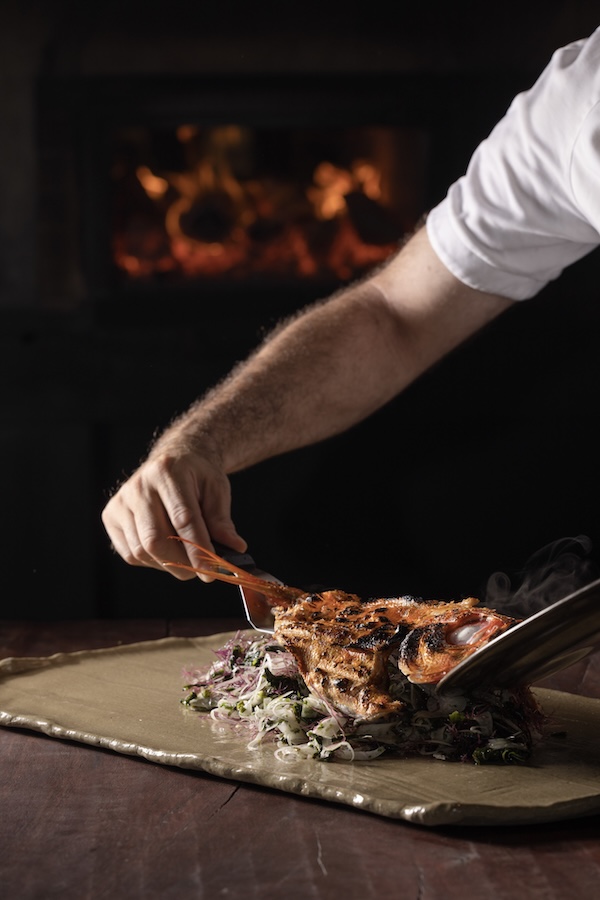
ESQ: You mentioned that you can’t teach grilling, except by doing it again and again. What’s the hardest thing to teach a young chef who wants to rush that process?
DP: We’ve been around long enough to have built strong systems, and depending on where someone is cooking, it comes down to having a mentor who can guide them through the process so they truly learn it. That’s very different from simply understanding it. There are really three stages: first, you learn the process, then you understand it, and finally, you evolve it. It’s a never-ending cycle; even when you think you know, you don’t. There will always be new ways to improve or refine things, even if you haven’t discovered them yet. That’s why keeping an open mind and valuing the learning process is so important.
ESQ: Out of all the recipes in Burnt Ends Book, what is a recipe to introduce to a novice?
DP: The first thing someone should try on a grill is a steak. It’s simple, quick, and just one component. In fact, when my wife and kids returned from the UK, their first requests were Din Tai Fung and Burnt Ends. Since going to Burnt Ends wasn’t an option, I decided to cook a barbecue at home instead. We brought back a beautiful steak from work and grilled a black horse steak, which was perfect on the barbecue. Steak really is one of the best starting points—it’s just on and off the grill, and we’ve even broken it down into a straightforward recipe for people to follow. The other recipe I’d recommend is the leek. It couldn’t be easier: throw a leek into the fire, char it completely, take it off, and cut it up. For beginners, I’d say those two—the steak and the leek—are the best places to start.
ESQ: You mentioned there’s no set recipe, only the “Burnt Ends Theory of Grilling”. How would you sum that theory up in a sentence or two?
DP: Heat, patience, diligence. Maybe a fourth word: magic.
ESQ: Looking back, how did working with chefs like Tetsuya Wakuda or Victor Arguinzoniz help in understanding yourself in the kitchen?
DP: Each chef I worked with brought something unique to what I learnt and understood, and those experiences have shaped me, my work, and the way I approach things.
With Tetsuya Wakuda, I started as a commis chef in what was essentially a three-Michelin-star restaurant in Australia. His ability to combine flavours, his sense of balance, and his remarkable understanding of how to bring elements together left a lasting impression on me.
From there, I moved on to René Redzepi at Noma. Two lessons stood out above all else. First, he put himself in a box by focusing on Scandinavian produce and techniques, making the most of what was available. People often saw that as restrictive, but I found it liberating. By narrowing the scope, he forced creativity and discovered extraordinary ingredients, which in turn built energy and momentum throughout the restaurant. The second was his sheer intensity and infectious energy, which flowed through every corner of the place. I often find myself asking how I can bring that same spirit into my own restaurant.
Then came [Asador] Etxebarri, where Victor Arguinzoniz reigns as the master of wood-fire cooking. From produce to technique and seasonality, his approach made me question how good barbecue could really be. And then you go there, and it hits you—it can be extraordinary. That experience opened my eyes to what wood-fire cooking could achieve in a restaurant setting, something I would never have imagined otherwise.
Finally, I spent time with Fergus Henderson at St. John Bread & Wine. Many people assume they are learning nose-to-tail cooking there, but what Fergus truly teaches is how to make food taste delicious. His philosophy is not about using an ox heart to challenge you, but about using it because he loves eating it and knows it can be delicious. His approach is simple: make food taste good, and you’ve done your job. It is about knowing what you’re doing and ensuring it’s tasty when it reaches the customer.
Being surrounded by these extraordinary chefs, watching their skill, precision, and the repetition required for perfection, has been invaluable. Each of them showed me different ways of thinking and cooking, and together those lessons continue to shape how I work today.
ESQ: What’s your next journey with Burnt Ends?
DP: Our big plan for what’s next is that we’re looking to open a brewery or a brewpub, essentially barbecue and beer; hopefully sometime next year.
This interview was edited for length and clarity.