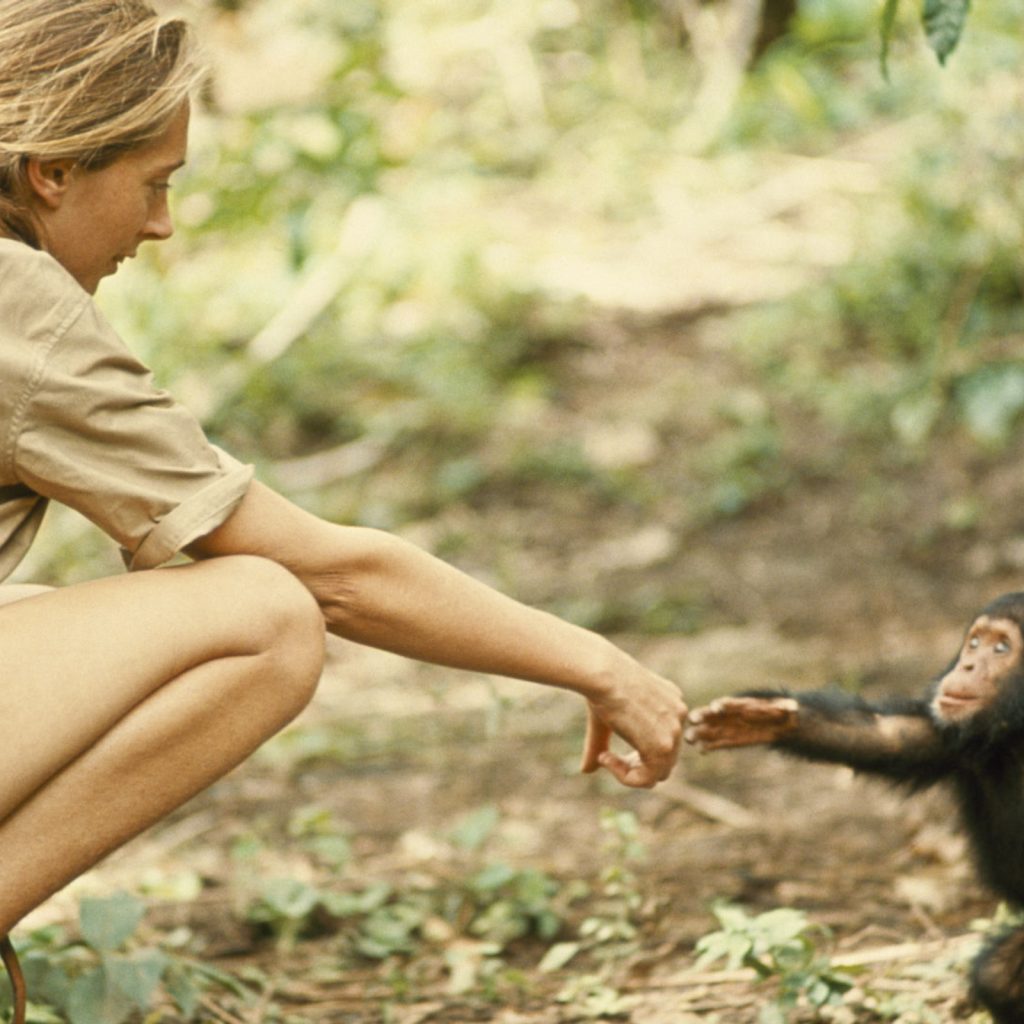
Jane Goodall died yesterday. Ninety-one years old, still on a speaking tour, still carrying that same calm authority she first brought to the Tanzanian forests more than six decades ago. The last thing she ever did was the same thing she’d been doing since 1960: tell us, again and again, that the natural world is worth listening to. And she wasn’t wrong.
She did not set out to become one of the most recognisable scientists of the 20th century. She had no degree when she began her work, no institutional authority to shield her, no claim to the white-coated seriousness that science at the time demanded.
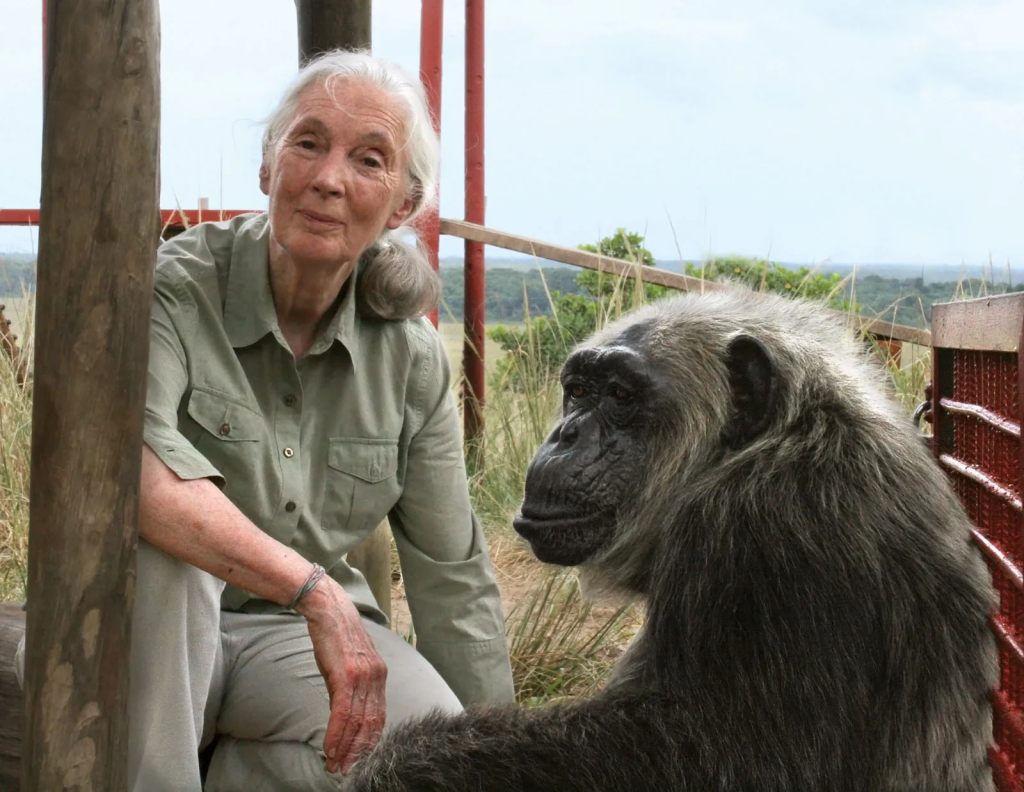
Looking back, her story feels both impossible and inevitable. A young woman in post-war Britain, entranced by Tarzan and Dr Dolittle, follows her curiosity to Africa. By chance she meets Louis Leakey, and soon enough she’s sitting at the edge of Lake Tanganyika, watching chimpanzees. She sees David Greybeard—yes, she named him, against all the rules—strip leaves from a twig and use it to fish termites from the ground. It’s 1960. Until that moment, toolmaking was supposed to be exclusively human. Suddenly, it wasn’t. Leakey, in his wry way, said we must now either redefine “tool,” redefine “man,” or accept chimpanzees as humans.
Her discoveries travelled quickly: the idea that chimps not only made tools but also hunted, grieved, bonded, and waged wars of their own. What startled people was not just that chimpanzees behaved like us, but that in their violence and tenderness, their loyalties and betrayals, they revealed something about what it meant to be human at all. Goodall, with her notebooks and her soft-spoken certainty, had prised open the old boundary between “us” and “them”—and it has never closed since.
The establishment did not quite know what to do with her. Naming animals, attributing emotions to them, describing their family lives with the same intimacy as one might describe a neighbour’s—this was, in the eyes of many of her mostly male peers, unscientific at best, sentimental at worst. But Goodall had proof on her side: the meticulous notes, the hours of footage, the generations of chimpanzees she had watched grow, age, and die. Science bent, reluctantly, to her way of seeing.
And the public—the public adored her. It was not only her work that caught the imagination, but the way she appeared to live inside it. National Geographic put her on the cover, hair pulled back, knees in the dust, chimpanzees at her shoulder. She became a household name, the rare scientist whose reputation rested not only on her findings but also on her presence—the gentle manner, the sunlit conviction, the image of a woman who had made a home in the wild.
By the 1970s, she began to spend more time away from the forest. Not because she’d had enough of it, but because she couldn’t ignore what was happening to it. Deforestation, poaching, the brutal captivity of primates in labs and zoos. In 1977 she founded the Jane Goodall Institute. In 1991 she launched Roots & Shoots. From then on, she barely stopped moving. In 2022, she told The Times she hadn’t slept in the same bed for more than three weeks at a stretch since 1986. The point, she insisted, was not comfort, but continuity—the mission did not pause, so neither did she.
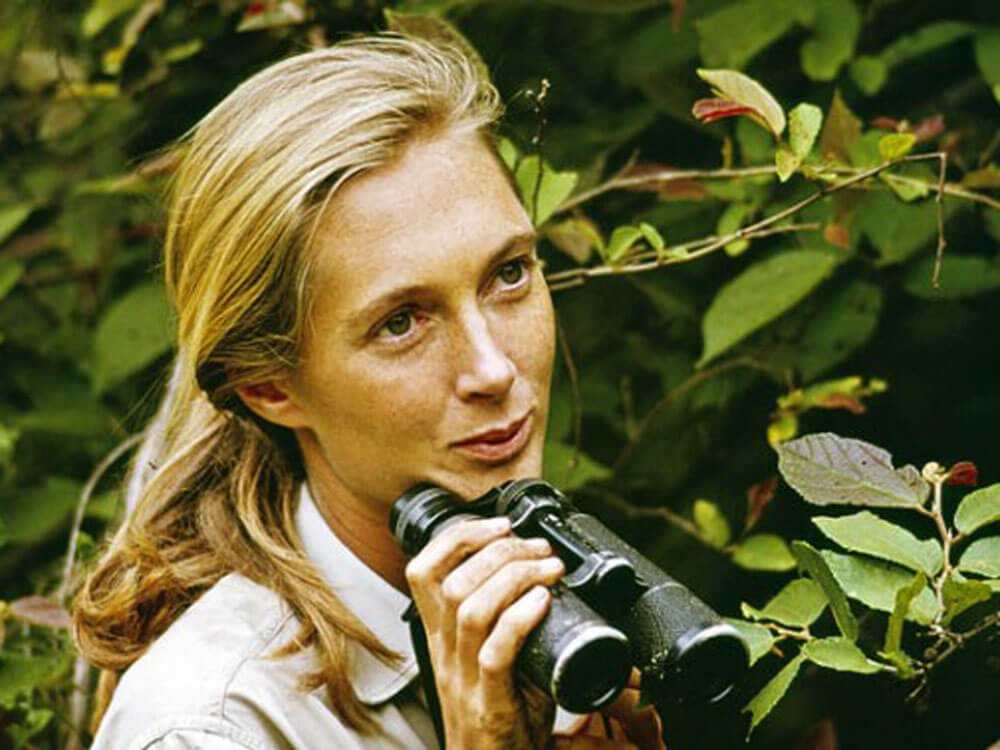
Goodall’s genius was never only that she had discovered tool use among chimpanzees; it was that she understood how to translate those discoveries into stories that moved people—stories that made the fate of a forest in Tanzania feel personal, urgent, unavoidable.
Her cultural footprint was singular. Flo, Fifi, and David Greybeard—chimpanzees she named and described with such intimacy—became public figures in their own right. When Flo died in 1972, The Sunday Times ran an obituary. When Mattel released a Jane Goodall Barbie in 2022, made of recycled plastic, it felt like a natural extension of her iconography. She had, in a way, become the very thing she once marvelled at: a bridge between species, someone who could translate one world into the language of another.
If Goodall’s life has a lesson, it is not only that animals are more like us than we had once allowed, but that empathy, exercised long enough and loudly enough, can become a force. She was not naïve about human destructiveness—she had, after all, documented it among chimpanzees as much as among people—but she believed, stubbornly, in the possibility of choice.
That conviction carried her for six decades. And it doesn’t disappear with her death. The forests are still shrinking. The chimps are still there. The questions about who we are, and how we live, are still open.
Jane Goodall didn’t give us an answer. She gave us a way of looking: one that refused to place humans at the centre of everything. She reminded us, again and again, that animals were not “like us.” They were us.
And now it’s on us to remember.