Christopher Nolan’s The Odyssey is bringing an imaginative new approach to Homer’s 2,800-year-old ancient Greek epic, but other Hollywood filmmakers have also gotten outlandishly creative with the classic journeyman story.
Not every road-trip movie calls back to Odysseus and his ill-fated travels home. Nolan sticks closely to Homer’s narrative, but what exactly makes a narrative an odyssey story? The answer lies mostly in the very definition of the term.
There is no shortage of words for trips, treks, voyages, journeys, and expeditions. But an odyssey is very different. It’s defined by outrageous circumstances, colourful hostile foes, and assorted detours and delays that compound one another until all hope seems lost. If your commute home from work becomes an odyssey, you’ve had a very bad day.
Let’s set an odyssey-test minimum declaring that a film in this tradition needs three things: 1) a hero destined for home, 2) intense side quests and sidekicks, and 3) a cyclops.
With that in mind, Esquire presents this breakdown of three of the greatest odysseys that have ever made their way to the screen.
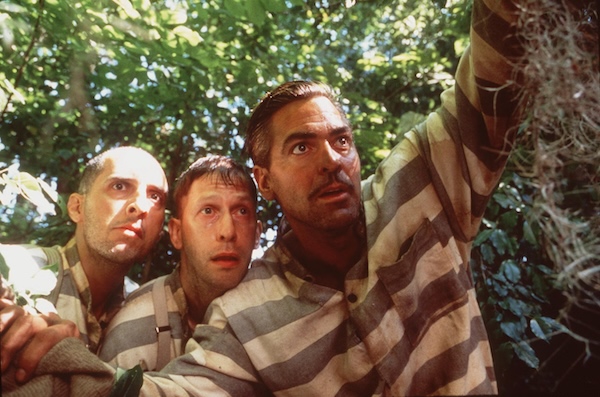
Directors: Joel and Ethan Coen
Homeward-Bound Hero: George Clooney’s Ulysses Everett McGill, a fugitive from a Mississippi chain gang.
Is There a Cyclops? John Goodman plays Big Dan Teague, a con man, Bible huckster, and KKK member who wears an eyepatch in daily life and only needs one hole in his Klan hood.
Ulysses is the Latin version of Odysseus, and Clooney’s Dapper Dan–grooming protagonist faces similar levels of woe as his namesake while he tries his darnedest to get back to his wife Penny, played by Holly Hunter.
Penny, of course, is a play on Homer’s Penelope, Odysseus’s wife back in Ithaca who is under pressure to marry anew given how long he has been gone. Anne Hathaway plays her in Nolan’s film as she fends off an aggressive suitor named Antinous (Robert Pattinson), who is more menacing than most. O Brother’s version of him is Vernon T Waldrip, played by Ray McKinnon as a man who looks like a beanpole but is also surprisingly good at fisticuffmanship.
Ulysses is joined by a crew: fellow prison escapees Delmar (Tim Blake Nelson) and Pete (John Turturro). Vexing them on their path is not only the long arm of the law but also a manic-depressive bank robber, some sweet-singing sirens washing clothes in a stream, and the apparent transformation of Pete into a toad. They cross paths with their own cyclops several times, and Goodman’s antagonist hurls them around just like the monster in Homer’s poem. In another parallel, Odysseus blinds the cyclops with a flame-sharpened branch, but Big Dan goes down at his Klan rally when a burning cross collapses onto his single, hateful, glaring eye.
Joel and Ethan Coen claim they never bothered to actually read a translation of The Odyssey but did scan the pages of a Classic Comics version. It shows how deeply Homer’s tale has permeated culture, since it can be adapted rather faithfully through osmosis. Many people simply know The Odyssey by heart.
Director: Stanley Kubrick
Homeward-Bound Hero: Keir Dullea’s astronaut David Bowman, sent on a clandestine mission toward a monolith orbiting Jupiter that may be a sentinel from an alien species.
Is There a Cyclops? The artificial intelligence program HAL 9000 studies the humans in his care with a single lens, malevolently glowing red.
“It occurred to us that for the Greeks the vast stretches of the sea must have had the same sort of mystery and remoteness that space has for our generation, and that the far-flung islands Homer’s wonderful characters visited were no less remote to them that the planets our spacemen will soon be landing on are to us.”
That was Kubrick speaking to The New Yorker in 1965 during a story meeting with legendary sci-fi scribe Arthur C Clarke as they worked together on the script for their now-legendary deep-space cinematic quest. Their story maintains the Homeric tradition of spanning great distances of time—and then some. It begins in the prehistoric era of Earth as apelike protohumans discover the presence of a mysterious black monolith that spurs an evolutionary leap. After touching it, they realise bones can be used as tools. They set about making more tools by using the ones they have to beat rivals to death and presumably get more bones.
No narrator explicitly connects the dots, but one of the most famous edits in movie history shows us a clobbering bone falling through the air before a startling cut to a drifting space station in the once-futuristic year of 2001. Eons pass in an instant as one object becomes the other.
On the moon, which humans have now colonised in the story (although we wouldn’t reach it until the year after 2001: A Space Odyssey debuted in theatres), another monolith is discovered. When humans reach this one, it emits a signal to the planet Jupiter. Some kind of superior intelligence is watching us, and once we advance until we can leave the surly bonds of Earth, these extraterrestrials want to see if we can go further. Think of the monolith as a kind of Trojan horse, with something unknown and unknowable inside, biding its time.
That sets Dr. Dave Bowman and his crew on a course to our solar system’s largest planet to investigate, although he doesn’t understand the full scope of the mission. He just wants to get there and get home. HAL 9000, the artificial-intelligence program that helps run the mission, has other ideas and goes to war against the deep-space sailors just like Homer’s single-eyed cyclops.
Only Bowman survives, venturing through a reality-bending warp not so different from the Charybdis whirlpool Odysseus navigates around in the Strait of Messina. When he finally reaches whatever is at the end, he pinballs through time, aging rapidly and confronting ideas and questions the human mind has never fathomed. He eventually is released home, just as Calypso ultimately frees Odysseus, but when he arrives back at Earth, he is nowhere near the same. Exactly what the Space Child might be remains forever open to interpretation.
Directors: Jon Hurwitz and Hayden Schlossberg
Homeward-Bound Heroes: Two stoner buddies, Harold (John Cho) and Kumar (Kal Penn), are arrested on a trip to Amsterdam when their bong is mistaken for a bomb.
Is There a Cyclops? They match wits with a strange mutant child who emits a high-pitched whistle but is otherwise benign, as far as cyclopes go.
The original Harold & Kumar Go to White Castle is itself a sort of odyssey story, full of wrong turns, chaotic problems, and deranged and dangerous foes as the title characters try to make it to their favourite burger joint while high as two lost birthday balloons.
The sequel, however, crosses our threshold even further thanks to some specific details. As satire goes, it taps into the theme of how you treat the other, since they only end up inside the notorious offshore American prison for suspected terrorists because of misunderstandings and outright racist pigheadedness.
Then they make a dangerous journey by sea to get away, mix it up with a group of sirens at a brothel (led by madame Beverly D’Angelo), and have a cave-like basement encounter with the one-eyed kid, whose name is Cyrus (get it—Cy?).
The return of Neil Patrick Harris as a drug-crazed, hyper-sexed, sociopathic version of himself and James Adomian’s pothead version of then president George W Bush could be considered godlike figures aiding and abetting the guys on their quest to get Kumar back home to the arms of his girlfriend.
While it doesn’t appear that anyone associated with this movie attempted to connect the ribald drug duo with Homer’s epic poem, other fans have been noticing the similarities for years. But this is far from the only wild interpretation of that classical work.
If you look hard enough (maybe with just one eye) you start seeing The Odyssey everywhere.